

 Français
The gross revenue guide for running your business
Learn how to calculate and analyze your gross revenue. A practical guide to turning this key indicator into a real growth tool.

Gross revenue is simply the total sum of all the sales you’ve made over a given period, whether for goods or services. Think of it as the total amount shown at your register before deducting anything: no product returns, no discounts granted, no taxes. It’s the very first snapshot of your business’s performance.
Why mastering your gross revenue is crucial
Gross revenue, or “top line” as it’s sometimes called, is far more than just a line in a balance sheet. It’s the true pulse of your business. It measures, without detour, your ability to attract customers and close sales. For a sole trader or an SME, keeping an eye on this indicator is the first building block of sound management and controlled growth.
This figure is absolutely fundamental, because it serves as the calculation base for several of your most important obligations. Your social security contributions, and very often your taxes, are calculated directly from your gross revenue. A small tracking error can therefore quickly turn into an unpleasant financial surprise.
A key indicator of your momentum
Tracking your gross revenue trend gives you a clear, immediate view of your business’s health. If it rises steadily, that’s a sign your marketing and sales efforts are paying off. Conversely, if it stagnates or falls, it may be time to revisit your offering, your pricing, or how you communicate with your customers.
The importance of this indicator is even visible at the national scale. Between 2020 and 2021, the total revenue of French companies jumped by 13.2% to reach €4,341.1 billion, a clear sign of the post-pandemic economic rebound.
The cornerstone of your strategic decisions
By precisely analyzing this figure, you can make far more informed decisions for the future. For example, you can identify:
- Your star products or services: Which ones are the real drivers of your revenue?
- The seasonality of your business: Do you see peaks and troughs at certain times of the year?
- The real impact of your promotions: Did that great offer actually boost sales?
To truly make the most of this information, it’s essential to track the right sales performance indicators. By bringing all this data together in a business dashboard, you get a valuable overview to steer your growth with precision.
Put simply, gross revenue isn’t what ends up in your pocket at the end of the month. It’s the total volume of your activity. It’s the starting point of any serious financial analysis.
Navigating gross, net, excl. VAT and incl. VAT revenue without getting it wrong
When running your business, everything is in the detail. A classic mistake, and yet such a common one, is confusing the different types of revenue. This can quickly distort your perception of your business’s real performance and turn your administrative filings into a real headache. To make the right decisions, it’s therefore essential to master every nuance.
Gross revenue is simply the total amount you’ve invoiced over a given period. No deductions, no discounts. It’s the raw, unfiltered indicator of your sales volume.
By contrast, net revenue gives you a more accurate picture of what actually comes into your accounts. You take gross revenue and subtract all discounts, credit notes issued to unhappy customers, or product returns. It’s the revenue your sales actually generate after commercial adjustments.
The fundamental distinction between excl. VAT and incl. VAT
Beyond gross and net, the most important distinction in your day-to-day life as an entrepreneur is the one between revenue excluding VAT (excl. VAT) and revenue including VAT (incl. VAT). Not mastering this difference has a direct impact on your cash flow and your tax obligations. It’s a point you should never overlook.
Revenue excluding VAT corresponds to the fruit of your work. It’s the amount of your sales before adding the well-known Value Added Tax (VAT). This is the figure used to measure your business’s pure performance, because VAT doesn’t belong to you — you merely collect it on behalf of the government.
Revenue including VAT, as its name suggests, includes this VAT. It’s the final amount your customer sees on the invoice and pays you. To fully understand how this tax works, feel free to check out our complete guide on calculating VAT.
This diagram clearly illustrates how gross revenue forms the cornerstone of your business. It’s fed by your sales and your customers, and tracking it is vital for effective management.
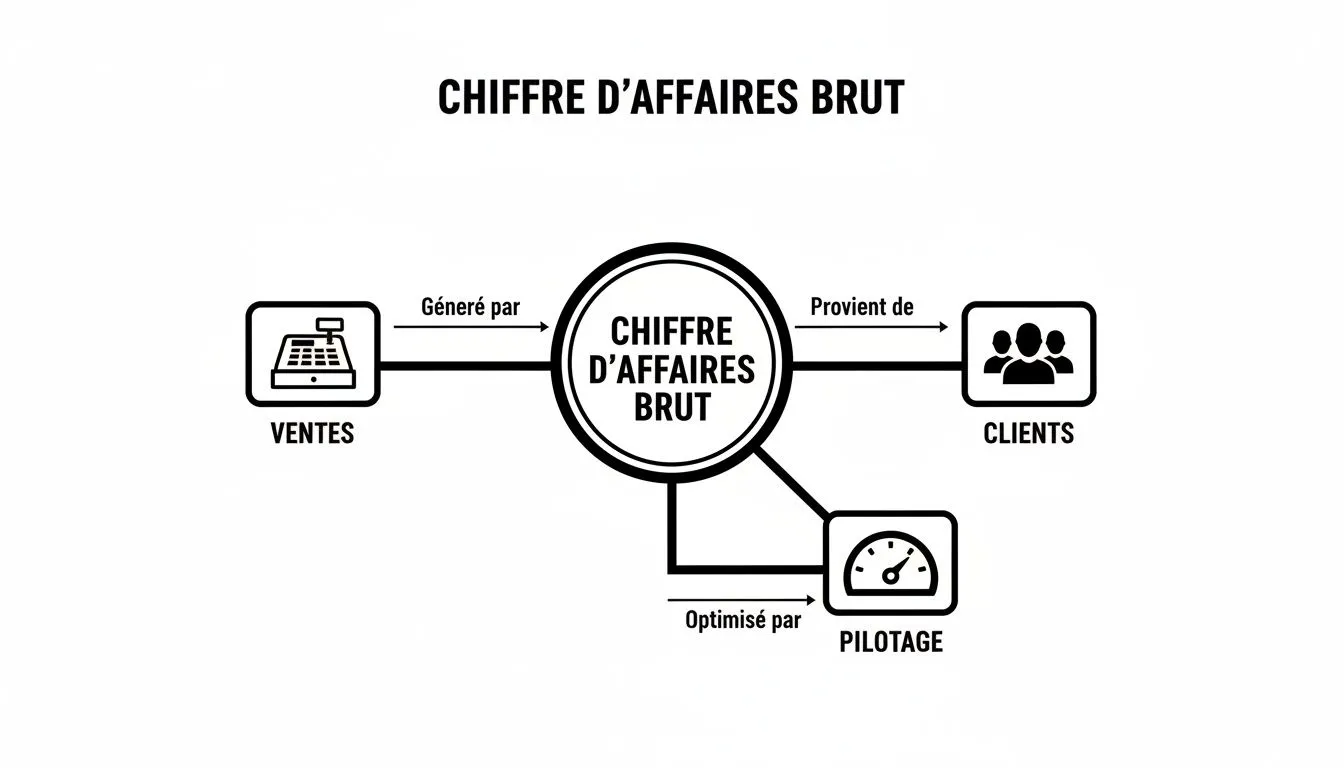
It’s clear that gross revenue is the starting point of any financial analysis, directly tied to your ability to sell and satisfy your customer base.
Let’s take a concrete example to make this crystal clear. Imagine an online seller:
- They sell a product for €120 incl. VAT.
- The applicable VAT rate is 20%, which represents €20.
- Their revenue excl. VAT is therefore €100.
It’s on the basis of these €100 that their performance will be judged. The €20 of VAT will have to be declared and paid over to the tax authorities.
A golden rule: never consider the VAT you collect as earned income. It’s an amount that merely passes through your bank account. The right reflex is to set it aside immediately to ensure healthy, surprise-free cash management.
To help you never hesitate again, here’s a table that sums it all up.
Comparison of revenue indicators
This table summarizes the key differences between gross, net, excl. VAT and incl. VAT revenue for a clear, quick understanding.
| Indicator | Definition | Calculation | Main use |
|---|---|---|---|
| Gross revenue | Total sum of invoiced sales, with no deductions. | Selling price × Quantity sold | Measuring overall business volume; serves as the base for certain contributions. |
| Net revenue | Gross revenue minus discounts, returns and credit notes granted. | Gross revenue - Discounts - Returns | Assessing the actual revenue generated by sales after commercial adjustments. |
| Revenue excl. VAT | Amount of sales before applying VAT. | Revenue incl. VAT / (1 + VAT rate) | Analyzing the company’s real economic performance. |
| Revenue incl. VAT | Total amount paid by the customer, VAT included. | Revenue excl. VAT × (1 + VAT rate) | Customer invoicing, cash flow and payment management. |
With these definitions in mind, you’re better equipped to run your business with precision and avoid common mistakes. Each indicator has its own purpose and tells part of your company’s story.
The simple method for calculating your gross revenue
At first glance, calculating your gross revenue may seem like simple addition. But reality is often more nuanced, especially once you start juggling several offers or products. Rest assured, the logic stays the same, whether you’re an online seller with hundreds of SKUs or a freelancer wearing multiple hats.
The basic gross revenue formula is very simple:
Gross revenue = Unit selling price × Quantity sold
That’s your starting point. This formula applies to each product sold or service invoiced. If you have several revenue streams, simply do this calculation for each one, then add them all together. It’s that simple!
A concrete example to make it clearer
Let’s take the example of a marketing consultant who also sells online courses on the side. To calculate their gross revenue for the month, they simply add up the income from both activities.
-
They invoiced 5 days of services to a client. Their daily rate is €500.
-
Calculation: 5 days × €500 = €2,500
-
They sold 10 seats in their online course, priced at €200 each.
-
Calculation: 10 courses × €200 = €2,000
Their total gross revenue for the month therefore amounts to €2,500 + €2,000 = €4,500. This is the amount they’ll need to use as the base for their filings.
At first, tracking these calculations by hand in a spreadsheet is perfectly manageable. But as your business grows, the risk of error increases. A forgotten invoice or a typo can quickly distort your financial picture and complicate your administrative processes.
Why rigorous tracking is key to your growth
Accurate tracking isn’t just a matter of compliance — it’s a genuine strategic management tool. The economic health of French companies proves it. In 2017, a study revealed that the revenue of non-financial companies had grown by 5.3%, the strongest increase since 2011. SMEs saw their revenue climb by 4.9%, and mid-sized companies (ETI) by 5.5%, a sign of positive momentum driven by sound management. To learn more, you can check the archives on the Banque de France website.
Here’s a quick visual reminder of this formula, simple yet fundamental.

This image makes it clear: even though the basics of the calculation haven’t changed, the tools for doing it certainly have evolved.
This is where automation, with a tool like Bizyness, becomes your best ally. By centralizing your invoices and syncing your sales, the software calculates your gross revenue in real time, without you having to think about it. You gain precision and peace of mind and, above all, free up precious time to focus on what matters: growing your business.
The direct impact of your gross revenue on your taxes and contributions
Your gross revenue isn’t just a number on a dashboard. It’s the foundation on which your entire tax situation and social contributions rest. Understanding how it works is key to running your business without unpleasant surprises.
If you’re a sole trader (micro-entrepreneur), it’s very simple: the amount you declare each month or each quarter to URSSAF is your gross revenue. It’s on this exact sum — and not on your actual profit — that your social contributions are calculated, at a rate depending on the nature of your business.
Thresholds to watch like a hawk
Keeping a close eye on your gross revenue is absolutely vital. It’s what keeps you (or not) within the favorable micro-entrepreneur regime. Exceeding certain caps can lead to significant changes, sometimes welcome, but often complicated if not prepared for. Accurate tracking is therefore the pillar of any solid revenue declaration.
Here are the two thresholds that shape the life of every micro-entrepreneur:
- Micro-entrepreneur regime caps: For 2024, these are €188,700 for goods-selling activities and €77,700 for services. If you exceed them two years in a row, you leave the micro regime and move to the standard tax regime.
- VAT exemption thresholds: Set at €91,900 for sales and €36,800 for services. As soon as you cross this threshold, you must charge VAT to your customers, which considerably increases your administrative workload.
Tracking your gross revenue in real time lets you anticipate these shifts. This way you can prepare your cash flow, adjust your pricing, and adapt your administrative organization instead of being caught off guard.
Take the example of a freelance consultant whose revenue is nearing €77,700. If they don’t prepare for it, they risk a tax reassessment by forgetting to switch to the standard regime. Conversely, with good tracking, they can plan this transition smoothly. They might even decide to slow down their activity slightly toward the end of the year to stay under the threshold, if that’s more strategic for them.
This proactive management turns an administrative constraint into a genuine growth lever. It gives you control to optimize your tax situation and make the best decisions for your business. To see just how crucial tax strategy can be, you can even look beyond our borders and explore different frameworks, such as the tax advantages for companies in Bulgaria. It shows that understanding these mechanisms matters wherever you are.
Common revenue-tracking mistakes and how to prevent them

A simple tracking error in your gross revenue can quickly turn into a real administrative, or even financial, headache. To avoid falling into these traps, the best approach is to know them in advance. It’s the first step to securing the management of your business.
One of the most common pitfalls is simply forgetting certain invoices in the calculation. A small job at the start of the month, a deposit received… every euro counts. Even a minor omission can distort your filing and expose you to painful corrections.
Another classic mistake is mixing up invoiced revenue with revenue actually collected. Yet for the tax authorities, and especially under the micro-entrepreneur regime, it’s the amount actually received in your bank account that counts. Declaring an invoice before it’s paid means risking paying contributions on money you haven’t even received yet.
Anticipating instead of reacting
Lack of anticipation is undoubtedly the costliest mistake. Not monitoring your revenue trend in real time means risking exceeding an important threshold (VAT or the micro-entrepreneur regime) without even realizing it.
And believe me, this happens far more often than you’d think. Entrepreneurial momentum in France is very strong: between 2012 and 2022, more than 8 million businesses were created. In 2021 alone, a record was broken with 995,900 new businesses, or 17% more than in 2020. This rapid growth calls for constant vigilance around these key thresholds. To learn more, feel free to check out the report on 10 years of business creation in France.
The best way to prevent these mistakes is to systematize your tracking. Errors are human, especially when business is booming and you’re deep in the day-to-day grind.
Here are a few habits to adopt to help you stay on track:
- Centralize your documents: Use a single tool to issue and track all your invoices and quotes. No more scattered files.
- Sync your bank account: By linking your business account to accounting software, you can reconcile payments automatically. It’s simple and reliable.
- Set up alerts: Configure notifications to be warned as soon as you approach key thresholds.
In fact, the automation offered by a tool like Bizyness practically eliminates all these risks. By centralizing your data, you get a clear, always up-to-date view of your gross revenue. The result: greater peace of mind and precious time freed up for what really matters — growing your business.
Your questions about gross revenue
Running your business well starts with mastering the basics. And gross revenue is undoubtedly the first indicator most entrepreneurs learn to monitor. To help you see things more clearly, let’s go through the questions that come up most often among entrepreneurs.
Should I declare the revenue I’ve invoiced or the amount I’ve actually collected?
This is a crucial question, especially under the micro-entrepreneur regime. The rule is simple and designed to protect you: you only declare revenue that has actually landed in your account.
Concretely, if you send a €1,000 invoice in March but the client pays you in April, that €1,000 must appear in your April declaration, not before. This is known as cash-basis accounting. The benefit? You never pay social contributions on money you haven’t received yet.
And if I receive a deposit, how does that work?
A deposit is simply a portion of your revenue paid in advance. It follows the same logic: you declare it as soon as you receive it.
Say you land a €2,000 project and ask for a 30% deposit in January. You therefore receive €600 that month. This is the amount you’ll need to declare for your January revenue. The balance, €1,400, will be declared in the month your client pays it.
The rule to remember is simple: every euro that lands in your business bank account counts as gross revenue. It’s the golden rule for always-compliant filings, without the headache.
Does an unpaid invoice count toward my revenue?
Fortunately, no. An invoice that remains unpaid has absolutely no impact on your declared revenue. Why? Because, as we just saw, you only declare what you actually collect.
As long as the money isn’t in your account, that invoice remains a simple receivable. It doesn’t enter into your revenue calculation. This is an essential safeguard for your cash flow, ensuring your taxes and contributions are calculated on your actual income, not on payment promises.
Can revenue ever be negative?
Never. Gross revenue can never be negative. By definition, it’s the sum of your sales. It starts at zero at the beginning of each period and only ever increases with each new inflow of money.
Even if you have to issue a refund to a customer, that outflow doesn’t reduce your revenue. It’s treated as an expense or a credit note, but your total declared revenue for the period doesn’t change.
Navigating between deposits, pending invoices, and collected payments can quickly become a headache. With Bizyness, everything becomes simpler. By syncing your bank account, the tool automatically calculates your revenue in real time. It knows the difference between an invoice sent and a payment received, ensuring your filings are always accurate, with no effort required.
Free yourself from paperwork and focus on what really matters. Discover how to simplify your management at https://www.bizyness.fr.
