

 Français
Mastering gross-to-net conversion: a practical calculation guide
Learn how to convert gross to net prices with precision: a simple formula, real-world examples, and tips to streamline your invoicing.
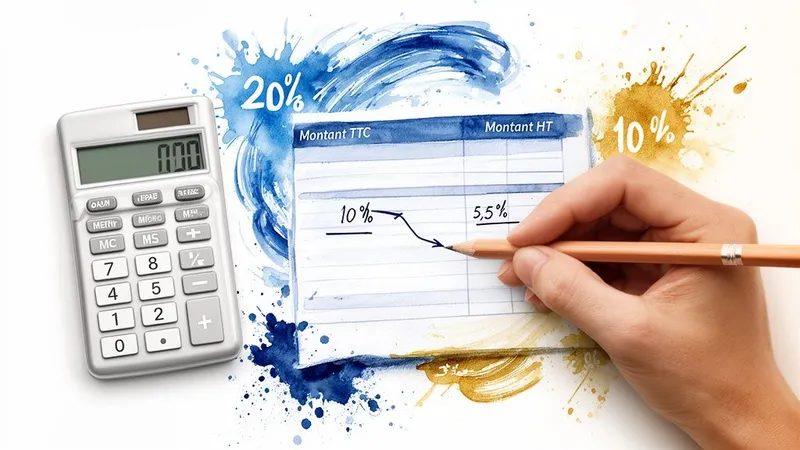
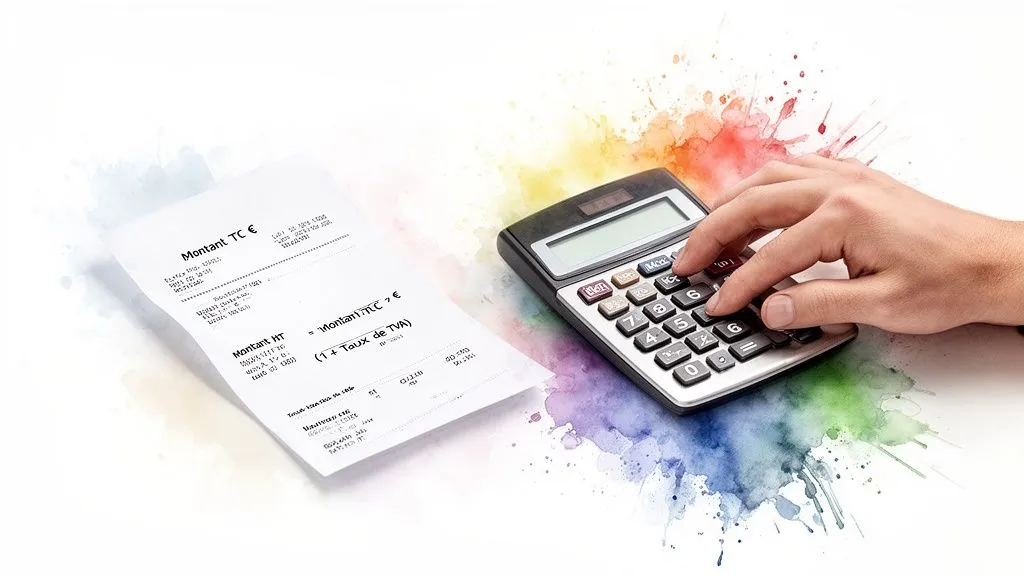
Converting a gross (VAT-included) price into a net (VAT-excluded) amount is one of the most common operations for any business owner. The formula is fairly straightforward: divide the gross amount by (1 + the VAT rate).
For example, if you have a product priced at €120 gross with VAT at 20%, the calculation is simple: €120 / (1 + 0.20), i.e. €120 / 1.20. This gives you a net amount of €100. Simple enough, right? Yet mastering this calculation is absolutely fundamental to the financial health of your business.
The basics of gross-to-net conversion, far more than a simple formula
Understanding how to isolate the net amount goes well beyond basic arithmetic. It’s one of the pillars of running a business. It ensures the accuracy of your accounting, protects your cash flow, and keeps you compliant with the tax authorities. A small rounding error or a misapplied rate can quickly lead to complications.
Why VAT matters so much for your business (and for the state)
Value Added Tax (VAT) isn’t just a number tacked onto the bottom of your invoices. Your business effectively acts as a collector on behalf of the government. Every time you do this gross-to-net calculation, you’re separating what genuinely belongs to you from what you owe back.
This distinction matters for several concrete reasons:
- Clarifying your real income: The net amount is what your business actually earns. The rest is simply passing through your accounts.
- Managing your cash flow accurately: VAT money isn’t yours. It must be set aside for when you need to declare and pay it.
- Ensuring tax compliance: Accurate calculations are the foundation of your VAT returns. They’re your best protection against a tax audit.
The difference between the net and gross amount isn’t an administrative detail; it sits at the heart of how the French state is funded. In 2022, VAT brought in a staggering €202.7 billion, nearly a third of total tax revenue.
That figure is staggering, and it shows why tax authorities are so vigilant on the subject. INSEE’s projections for 2025 even estimate that VAT will account for 35.4% of gross tax revenue. In plain terms, more than one euro in three collected by the state in taxes will come from that small line on your invoices. For further reading, the analysis of VAT revenue composition available on the French Treasury’s website is very informative.
This guide is here to give you solid foundations and help you handle these concepts with ease and confidence day to day.
Putting the formula into practice with everyday examples
The formula is all well and good, but what matters is being able to apply it without a second thought. For a consultant, a craftsperson, or a shopkeeper, converting gross to net should become second nature. The very first reflex to build? Identifying the right VAT rate for what you’re selling.
In France, the pricing puzzle revolves around four main VAT rates: the standard rate at 20%, the intermediate rate at 10%, the reduced rate at 5.5%, and even a super-reduced rate at 2.1%. Naturally, this changes everything. A service you bill at €100 net will cost your client €120 gross at the standard rate, but only €105.50 gross if the reduced rate applies. To dig deeper, the Club Patrimoine website details the VAT rates in effect.
Calculating with the standard 20% rate
This is the most common scenario, the one you’ll encounter for most goods and services.
Take a graphic designer who has just finished a logo and sends an invoice for €600 gross. To work out what they actually keep (the net amount), the calculation is simple:
Net amount = €600 / (1 + 0.20) Net amount = €600 / 1.20 = €500
In practical terms, out of the €600 paid by the client, the designer keeps €500 for their work. The remaining €100 is the VAT they collected and will later have to pay back to the state.
A real-world case with reduced rates
Things get a bit trickier when you’re juggling multiple rates. The best example is the restaurant trade.
Imagine a customer having lunch at your restaurant. Their bill comes to €27.50 gross and includes a dish eaten on-site plus a non-alcoholic drink. The catch is that the two aren’t taxed the same way:
- The meal: subject to the intermediate rate of 10%.
- The non-alcoholic drink (canned): benefits from the reduced rate of 5.5%.
Let’s say the dish costs €22 gross and the drink €5.50 gross. For your accounting, you can’t lump everything together. You need to do two separate calculations.
For the dish:
- Net amount = €22 / 1.10 = €20
And for the drink:
- Net amount = €5.50 / 1.055 = €5.21 (after rounding to the nearest cent)
This little exercise is essential. A simple rate error, even on small amounts, can quickly create significant discrepancies when it’s time to file your VAT return. Knowing how to do these conversions is therefore simply indispensable for running your business with peace of mind.
Handling complex cases: discounts, fees, and rounding
Converting gross to net gets a bit more complicated as soon as you add discounts, shipping fees, or rounding rules. It’s in these very common situations that calculation errors creep in and can end up costing you.
The question that keeps coming up is: in what order should you do the calculations? The golden rule is simple: a discount always applies to the net amount. If all you have is the final gross price, you first need to work out the underlying net amount before you can deduct anything.
The order of operations, the key to getting it right
Let’s take a concrete example. You’re selling a product for €120 gross, with VAT at 20%, and you want to grant a 10% discount. The classic mistake would be to calculate the 10% on the €120, which is incorrect.
Here’s the correct approach:
- Find the original net amount: €120 / 1.20 = €100 net.
- Calculate the discount amount: 10% of €100 = €10.
- Apply the discount: The new net amount is therefore €100 - €10 = €90.
- Recalculate the final gross amount: €90 * 1.20 = €108 gross.
The same logic applies to additional costs, such as shipping fees, which may themselves be subject to a different VAT rate. Each item must be treated individually, always starting from its net base.
Converting gross to net is a logical sequence that must always be followed. It’s a three-step process, well summarized here.
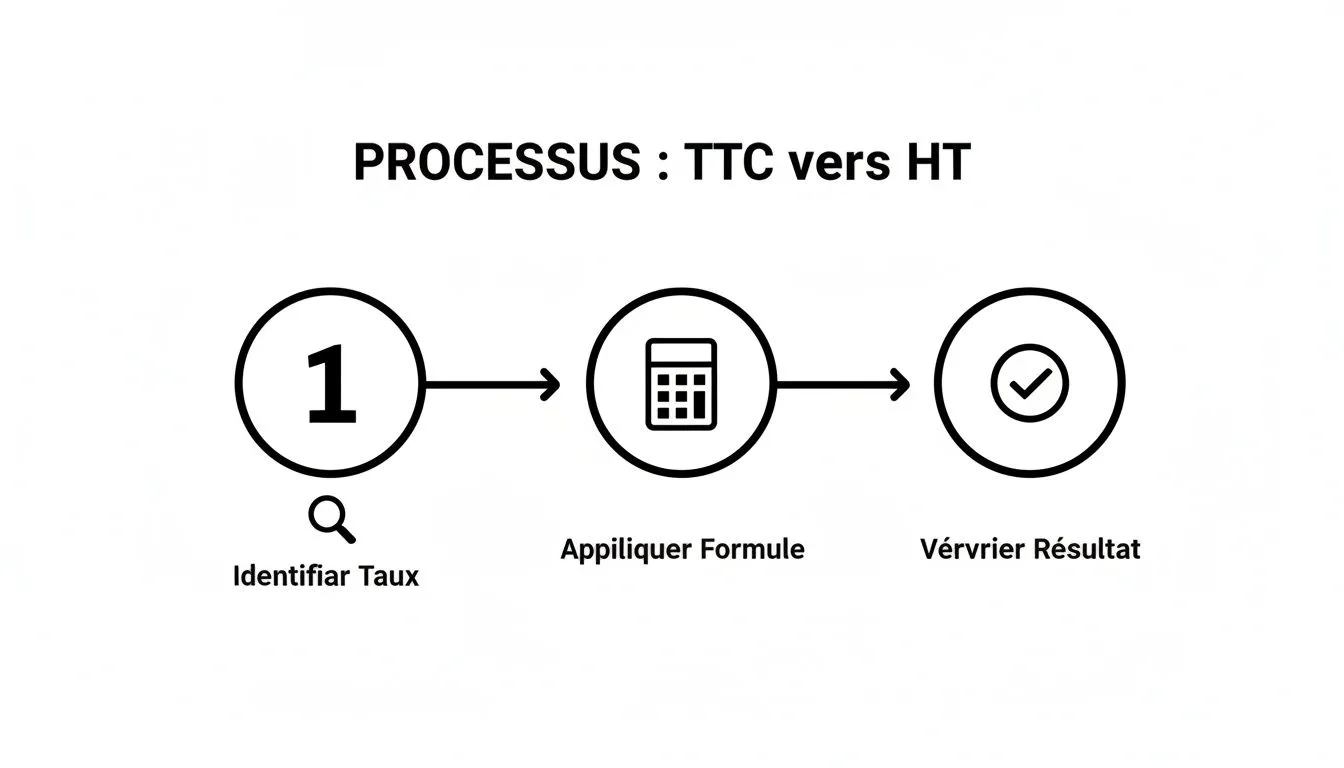
It’s clear that everything starts with identifying the right VAT rate. That’s the essential first step, even before reaching for the calculator.
The rounding puzzle, down to the cent
Another point to watch is rounding. When a net amount has many decimal places, you can quickly end up with discrepancies of one or two cents on the final gross amount. These small differences, multiplied across hundreds of invoices, end up creating real headaches when it’s time to close the books.
To avoid inconsistencies, my advice is to always calculate VAT on the total net amount of the invoice, rather than adding up the VAT for each line. It’s the most reliable method for limiting rounding discrepancies.
Rounding management is a subject in its own right. To make sure all your financial documents stay perfectly consistent, I’d encourage you to take a look at our guide on understanding and simply managing VAT rounding. Mastering these details is truly the key to securing your invoicing and avoiding unpleasant surprises.
The special case of sole traders: when to switch from net to gross pricing
When you launch a micro-business, you typically start out invoicing net of tax. This is thanks to the VAT exemption scheme (franchise en base), a hugely convenient regime that lightens the day-to-day paperwork. But be careful, this simplicity doesn’t last forever. It stops abruptly as soon as your revenue crosses certain thresholds.
Anticipating this transition is crucial for the health of your business. Getting caught off guard means risking penalties and a real administrative headache. Moving to gross-price invoicing is an excellent sign of growth, but it comes with a new set of rules to master.
The VAT exemption thresholds to watch
What triggers the switch from net to gross invoicing is your revenue. For services, the limit is set at €36,800 per year. If you exceed it (with tolerance up to the increased threshold of €39,100), you must start charging VAT from the first day of the month in which the threshold was exceeded.
One thing worth keeping in mind: a reform is planned for 2026. A single threshold of €37,500 should apply to all sole traders. This is a slight boost for service providers, but a real upheaval for retailers.
A key point to understand: as soon as you exceed the threshold, the impact on your prices is immediate. A service you used to bill at €100 net will suddenly need to become €120 gross (at a 20% VAT rate). This can clearly affect your competitiveness if your customers are individuals.
So what do you actually need to do to manage the transition?
The day has arrived? No need to panic, but you do need to act quickly and in the right order to stay compliant.
- Apply for your intra-community VAT number. This is the very first thing to do. Simply contact your local Business Tax Office (SIE) to obtain it. It will become mandatory on all your invoices.
- Update your invoice templates. You’ll need to update them to include this VAT number, as well as the rate applied to each line and the total VAT amount you’re collecting.
- Get ready for your first VAT return. This is the big change: you’ll now need to declare and pay the state the VAT you’ve collected on your sales.
This is an important milestone in the life of your business. To help you through it, we’ve written a complete guide covering everything about sole trader invoicing with VAT and your new obligations.
Automating your calculations for error-free invoicing
Let’s be honest, manual calculations are a source of stress and an open door to errors. A simple digit transposition, a poorly handled rounding, and your entire VAT return can be thrown off. Fortunately, in the digital age, wrestling with a calculator is no longer a necessity. A good invoicing tool eliminates this risk at the root.
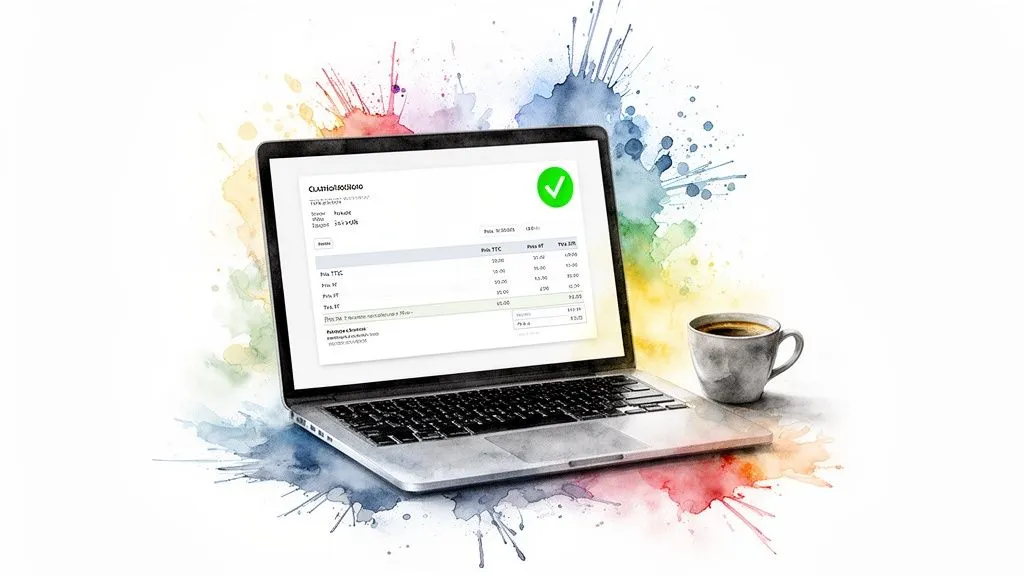
Take a tool like Bizyness, for example. Converting gross to net becomes child’s play. When you’re preparing a quote or an invoice, all you need to do is enter your final selling price (the one the customer pays). The system takes care of everything: it applies the right VAT rate and instantly breaks out the net amount. No more reaching for a calculator or second-guessing yourself.
This automation also handles the finer details, like rounding rules, to guarantee perfect consistency across all your accounting documents. No more headaches.
Gain peace of mind and efficiency
Beyond the calculation itself, the real benefit is regaining total peace of mind. You no longer have to check and double-check your figures. In practical terms, this approach brings you several benefits:
- Rock-solid tax compliance: Your invoices are always flawless and meet legal requirements.
- Significant time savings: That valuable time can be reinvested in your core business, where you create real value.
- A more professional image: Clear, clean, error-free invoices strengthen the trust your customers place in you.
To see a concrete example of this pricing approach, take a look at our pricing structure, which clearly illustrates this net/gross distinction.
Ultimately, adopting a dedicated tool is by far the best strategy for securing your financial management. If the topic interests you and you have a one-off calculation to make, our online net/gross converter can also help you out.
Even with the formula in mind, very practical questions can still come up when converting gross to net. That’s completely normal! Let’s look at the most frequently asked questions to clear up any remaining doubts so you can invoice with peace of mind.
How do I find the net amount with 10% VAT?
This is a classic case, especially if you work in the restaurant trade or carry out certain renovation work. For a VAT rate of 10%, the calculation couldn’t be simpler: just divide your gross price by 1.10.
Let’s take a concrete example: a service cost you €55 gross. The calculation is quick: 55 / 1.10 = 50. Your net amount is therefore €50, which corresponds to €5 of VAT.
I run a micro-business under the VAT exemption scheme, can I deduct VAT?
The answer is no, and this is a crucial point to understand. The VAT exemption scheme works both ways: since you don’t charge VAT to your customers (and therefore don’t collect it on behalf of the state), you also can’t reclaim it on your own business purchases.
It’s only once you move to the standard VAT regime — that is, after exceeding the exemption scheme’s revenue thresholds — that reclaiming VAT becomes possible.
What wording do I need on my invoices if I’m not liable for VAT?
If you benefit from the VAT exemption scheme, a specific legal wording is absolutely mandatory on all your invoices. It’s what informs your customers and the tax authorities that you’re not charging VAT.
The exact wording to use is: “VAT not applicable, Article 293 B of the French General Tax Code”. Omitting it can create complications in the event of an audit, so make it a habit to include it systematically on your invoice templates.
Tired of juggling numbers and worrying about compliance? Bizyness can automate your entire invoicing process, handle VAT effortlessly, and guarantee you’re always compliant. Focus on your core business. Try our invoicing software and see how simple it can be.
