

 Français
How Long to Keep Various Invoices in E-commerce
The complete guide to knowing how long to keep various invoices (customer, supplier). Secure your accounting and avoid penalties.
As an online seller, one question keeps coming back: how long do you actually need to keep invoices? The simple, safe answer is 10 years. This duration covers all your bases, whether from a commercial or a tax standpoint. By keeping everything for a decade, you protect yourself from audits and potential disputes. It’s your best peace-of-mind insurance.
Why keeping your invoices is vital when you sell online
For an online seller, juggling invoices can quickly feel like an administrative chore. It’s tempting to push it aside and focus on order fulfillment or the latest marketing campaign instead. Big mistake. It’s actually a pillar of your business, an essential protection for your company and your cash flow.
Every invoice, whether sent to a customer or received from a supplier, is much more than a piece of paper (or a PDF). It’s proof — proof with major legal and tax value.
Imagine a tax audit landing out of nowhere. How would you justify your biggest expenses, like your Google Ads campaigns or your stock purchases, without the matching invoices? Or think about a dispute with a customer on a marketplace like Amazon, or directly on your Shopify store. Without proof of the transaction, how do you defend yourself? These aren’t disaster scenarios — they’re real, everyday risks for an online seller.
The concrete risks of poor management
Failing to take document retention seriously can cost you dearly. The consequences aren’t just theoretical — they can hit your profitability hard.
- Painful tax reassessments: If you don’t have the invoice to justify an expense, the tax authorities can simply reject it. The result? It’s added back into your profit, and you pay tax on it.
- Loss of VAT deduction: The golden rule is simple: no invoice, no right to deduct VAT. You end up paying a tax you could have recovered. That’s money lost.
- Complications in case of a dispute: Facing a customer acting in bad faith or a supplier failing to honor their commitments, the invoice is often your only solid line of defense.
- Fines for failure to produce documents: Forgetting or losing a document, even with no bad intent, can earn you a fine.
Keeping invoices isn’t just an administrative constraint. Think of it as insurance for your e-commerce business’s financial health. Every euro you spend without being able to justify it is a euro that could cost you far more in the event of an audit.
This guide won’t just list deadlines. The goal is to help you turn this obligation into a real asset for your business.
A strategic advantage for your growth
When your invoices are well organized, you get a clear, precise view of your store’s financial health. That’s what lets you calculate your real margins, analyze your customer acquisition costs, and ultimately make the right decisions to grow your business.
So let’s look together at the exact legal deadlines for each type of document and the possible penalties. But above all, we’ll see how modern tools like Bizyness can automate all of this for you. The goal is simple: free your mind so you can focus on what really matters — selling.
Understanding legal retention periods
Facing the pile of invoices and receipts from your business can quickly feel overwhelming. How long do you need to keep all of it? It’s a legitimate question, but the answer is, fortunately, simpler than it looks. In reality, everything rests on two distinct legal logics, each with its own duration.
It’s often this duality that creates confusion. Yet once you grasp the why behind it, managing your archives becomes much clearer right away. You just need to understand why these two deadlines exist to never get it wrong again.
The double lock of compliance
Imagine your archives as a safe protected by two locks. To open it and calmly get rid of old paperwork, you need both keys.
-
The commercial lock: 10 years. This duration comes from the French Commercial Code. Its purpose? To protect you in the event of a dispute with a customer or supplier. An invoice is proof of a transaction. If a customer disputes a payment years later, or a supplier claims an unpaid debt, this document is what will save you. This long 10-year period ensures you always have the proof needed to defend your rights.
-
The tax lock: 6 years. This one is imposed by the French Tax Procedures Code. The objective is quite different: to let the tax authorities audit your accounting. For 6 years, an inspector can show up and ask you to justify any line in your filings, whether for VAT, corporate income tax, or a deducted expense.
This diagram sums up the situation perfectly and the hierarchy between these two obligations.
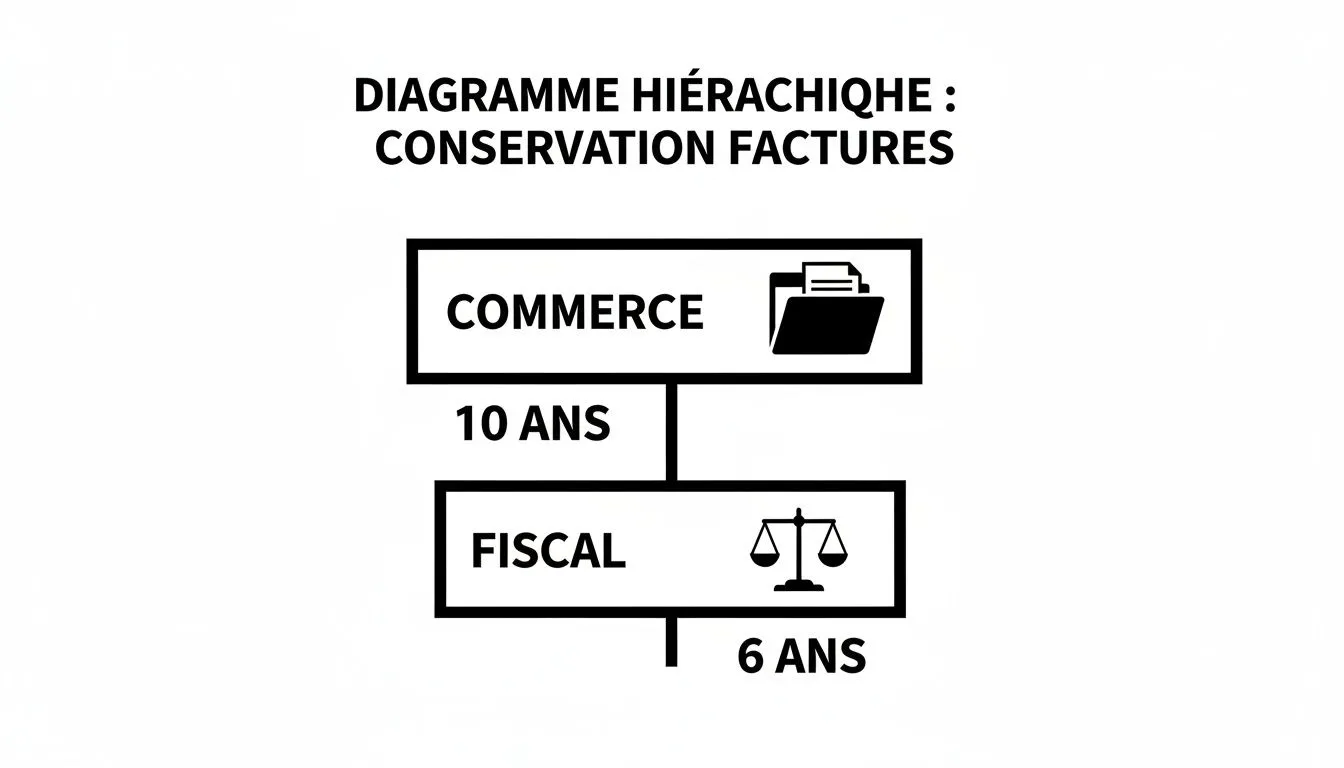
You can clearly see that the 10-year commercial period “absorbs” the 6-year tax period. That’s the key to understanding the right practice to adopt.
The golden rule for total peace of mind
So, do you keep documents for 6 years or 10 years? The answer is clear: you always keep the longer period.
Even though the tax authorities generally cannot go back more than 6 years, a commercial dispute can erupt well after that. By keeping all your documents for 10 years, you’re covered on both fronts. It’s the only way to have true peace of mind.
The precautionary principle is your best ally. Archiving for 6 years leaves a commercial sword of Damocles hanging over your head for 4 more years. Archiving for 10 years eliminates the risk entirely.
This 10-year obligation is, moreover, set in stone by law. Article L123-22 of the French Commercial Code is very clear: businesses must keep their invoices (both customer and supplier) and all supporting accounting documents for 10 years after the close of the fiscal year.
Which documents actually matter for an online seller?
In e-commerce, the term “supporting document” is very broad. It’s not just the invoice you send to your customer — it’s a whole ecosystem of documents that need to be carefully archived.
Here’s a short, non-exhaustive list of paperwork to keep safe for 10 years:
- Customer invoices: Those generated for every sale, whether on your Shopify site or via Amazon.
- Supplier invoices: Stock purchases, of course, but also invoices from your marketing agency, your developer, or your web host.
- Advertising expense receipts: Invoices from Meta (Facebook/Instagram Ads), Google Ads, TikTok Ads, etc.
- Platform fees and commissions: All invoices from marketplaces (Amazon, Cdiscount) or payment processors (Stripe, PayPal).
- Purchase and delivery orders: They serve as proof that the transaction actually took place and was fulfilled.
- Business bank statements: Essential for linking money flows to accounting documents.
Understanding these time periods and the scope of documents to keep is the first step toward sound, risk-free management. To dig deeper, feel free to check out our complete guide on the document retention period. Now that the basics are covered, let’s look at what you actually risk if you don’t follow these rules.
Penalties for failing to meet retention deadlines
Neglecting your invoice retention deadlines isn’t just a minor administrative slip. It’s a direct financial risk that can seriously dent your e-commerce profitability. The consequences aren’t vague threats — they’re concrete, quantifiable penalties that can hurt fast.
Think of this archiving not as a constraint, but as insurance. Without it, your business is exposed to penalties that cost far more than good organization would. Tax audits aren’t an urban legend, and the very first thing an inspector will check is the validity of your supporting documents.
Missing even a single invoice during an audit can trigger a chain reaction, where each missing link turns into a straight loss for your business.
Fines for failure to produce documents
The first, most immediate penalty is the fine for failing to produce accounting documents. If the tax authorities request an invoice and you’re unable to provide it in time, financial penalties apply.
Article 1734 of the French General Tax Code governs this. Even if the oversight is unintentional, the impact on your cash flow is very real. This penalty has a simple purpose: to remind you that keeping all invoices to justify your accounting is an obligation, not an option.
Not being able to produce a supporting document is a bit like reaching a highway toll booth without your ticket. You don’t just pay for the missing stretch — you pay the highest possible rate. The authorities apply a similar logic: without proof, they can assume the scenario that’s least favorable to you.
But this fine is only the tip of the iceberg. The real financial danger lies elsewhere, in the indirect consequences of this failure.
Tax reassessment: the major risk
This is where it really starts to hurt for an online seller. The principle is brutally simple: no invoice, no deductible expense.
Imagine you spent €10,000 on Google Ads campaigns or stock purchases. If you don’t have the matching invoice on hand, the tax authorities are entitled to consider that the expense never happened.
-
Reintegration into taxable profit: The €10,000 expense is “added back” to your result. In practice, your taxable profit artificially increases by that amount. You’ll therefore pay corporate (or income) tax on money you did, in fact, spend.
-
Loss of VAT deduction: At the same time, without a proper invoice, you lose the right to deduct VAT on that expense. On €10,000 excluding tax, that represents a net loss of €2,000 in VAT you can never recover.
This double effect can turn a simple filing mistake into a genuine nightmare for your cash flow.
A risk that’s far from theoretical
These penalties aren’t pure hypotheticals. The statistics prove it: poor document management is a very common cause of reassessment. It’s estimated that nearly 75% of audited French businesses were reassessed for failing to meet invoice retention periods. A Cour des comptes study even puts the average cost of a reassessment linked to these failures at €12,000. To go further, you can check out analyses on the impact of retention periods on the Sage blog.
Investing in a reliable, ideally automated, archiving system is therefore far more cost-effective than the potential price of a single mistake. It’s the assurance of maximizing your deductions and navigating your legal obligations with peace of mind.
How to digitize your invoices legally
For an online seller, the very idea of juggling binders full of paper invoices feels like something out of another era. Going digital is an obvious move for efficiency and security. But be careful — you can’t just do it any old way. For the tax authorities to recognize your documents, digitization has to follow very specific rules.
A simple scan or a hastily-taken smartphone photo has, on its own, no legal value. In the event of an audit, such a document will be seen as a mere copy, and therefore insufficient to justify your expenses or your VAT.
For a digitized invoice to carry the same weight as a paper original, it must achieve “reliable copy” status. This isn’t automatic — you need a digitization process that meets very strict technical criteria.
The three pillars of a reliable copy
For a scanned paper document to become an indisputable digital record, your digitization method must guarantee three essential conditions, defined by Article A102 B-2 of the French Tax Procedures Code.
- Authenticity of origin: You must be able to prove beyond doubt where the document comes from. Who created it? On what date?
- Integrity of content: The digital file must be a perfect clone of the original. No modification, even accidental, should be possible after digitization.
- Legibility: The document must remain perfectly clear, readable, and accessible for the entire legal retention period.
Imagine your digital copy is a valuable object, sealed inside a transparent box. You should be able to see its content perfectly (legibility), know who sealed it and when (authenticity), and be absolutely certain no one has opened or altered it since (integrity).
To reach this level of security, a good scanner isn’t enough. You need specific technical processes.
How do you guarantee the legal value of your scans?
In practice, to create a reliable copy, you need technologies that digitally “lock” the document. The goal is to create a tamper-proof digital fingerprint that attests to its state at a given moment.
The most common methods for achieving this are:
- Qualified timestamping: A certified service applies an exact date and time to your file, proving it existed in that exact form at that precise moment.
- Advanced electronic signature: It links the document to a person or entity and guarantees it hasn’t been altered.
- Electronic seal: A bit like a signature, but for a legal entity (your company), sealing its own documents.
These technologies are the only ones that meet the authorities’ requirements. Without them, the law requires you to keep the paper original alongside your digital copy for 6 years. This defeats much of the purpose of going paperless! To go further, our guide on electronic document management solutions covers these aspects in detail.
That’s why equipping yourself with a specialized tool that handles these processes is essential. It turns a somewhat complex legal constraint into a real asset for your management: saved space, instant access to your archives, and simplified searches.
Your action plan for perfect invoice management
Theory is all well and good. But practice is what really counts. Knowing you need to keep invoices for 10 years is one thing — building a system to actually pull it off without sacrificing your weekends is another. Especially for an online seller juggling Shopify, Meta campaigns, and suppliers. Organization is what wins the war.
Here’s a concrete checklist, designed for you, to build a true administrative fortress that can withstand any audit. See each step as an essential building block for an archiving system that’s not just compliant, but smart.
1. Centralize all your sources
The first, and most common, mistake is letting your supporting documents scatter to the four winds. A Stripe invoice here, an Amazon sales report there, a forgotten expense receipt in a shoebox… It’s the perfect recipe for chaos.
The goal is simple: create a single hub where everything converges. Connect your sales platforms (Shopify, WooCommerce), your payment processors (Stripe, PayPal), your ad networks (Meta, Google), and your bank accounts to one single place. Having this 360° view is the essential starting point for sound management.
2. Adopt digital archiving with evidentiary value
As we saw above, a simple scan dumped into a folder on your computer is no longer enough. To finally free yourself from the constraint of keeping paper originals, your digital archiving system must guarantee two things: the integrity and the authenticity of every document.
Choose a solution that offers archiving with evidentiary value. In practice, this means every digitized invoice is digitally sealed, making it tamper-proof and therefore fully admissible to the tax authorities. It’s the only way to go 100% digital with total peace of mind.
From a purely tax standpoint, French law requires invoices and supporting documents to be kept for 6 years from the date they were issued or the last related accounting operation. This rule is set out in Article L102 B of the French Tax Procedures Code. With DGFiP audits becoming ever more frequent, a documentation gap can quickly add up.
3. Set up a clear naming convention
Finding a specific invoice from three years ago shouldn’t take you more than 30 seconds. There’s no secret to getting there: you need a clear naming convention, applied consistently.
A good naming system might look like this: YYYY-MM-DD_DocumentType_SupplierName_AmountExclVAT.pdf. For example: 2024-10-26_Invoice_GoogleAds_1500EUR.pdf. It’s simple, but it makes your archives instantly readable and easy to sort.
4. Ensure multiple, secure backups
Your archiving system is the heart of your administrative compliance. Have you thought about what would happen in the event of a hard drive failure, a cyberattack, or even a simple human error? A single copy is playing Russian roulette.
The “3-2-1” rule is an excellent practice to adopt: keep 3 copies of your data, on at least 2 different media, including 1 off-site copy (in the cloud, for example). A serious professional solution handles this automatically for you.
5. Automate collection
This is the final step, and arguably the most important: eliminate manual tasks. An automation solution like Bizyness connects to your various sources, fetches every supporting document as soon as it’s created, renames it correctly according to your rules, and archives it in your secure digital vault.
This transforms invoice management. What was a recurring, tedious chore becomes a process that runs quietly in the background. You’re finally free to focus on what really matters: growing your business. For truly complete management, it’s also worth factoring in more specific cases into this automation logic, such as invoicing travel expenses.
How to fully automate the retention of your invoices
Managing invoices and supporting documents is a legal obligation, true. But it shouldn’t become your main job. Manually juggling this constant flow of documents isn’t just a huge time sink — it’s also an open door to errors. Fortunately, it’s now possible to turn this chore into a smooth, fully autonomous process.
The goal is no longer to ask how long to keep various invoices, but rather to make sure that retention happens on its own, in the background, while you focus on what really matters: growing your online store.
The power of direct integration
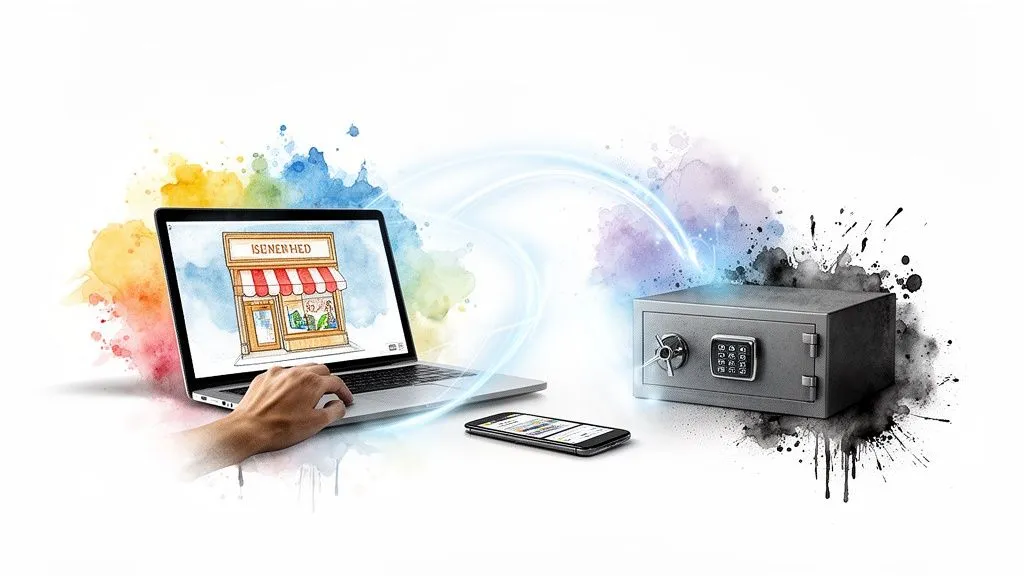
Imagine a system that plugs directly into the heart of your business. It connects to your Shopify store, to marketplaces like Amazon, or to payment processors such as Stripe and PayPal. Every time a sale happens, a compliant invoice, with the correct VAT rate, is created instantly.
Better still, this invoice isn’t just generated and forgotten on your desktop. It’s immediately filed and archived in a secure digital vault — all without you having to lift a finger. That’s what modern financial management tools, designed specifically for e-commerce, offer.
True automation isn’t just about storing files. It’s about creating an ecosystem where every transaction generates, qualifies, and secures its own accounting proof, ready for a potential tax audit.
Much more than simple storage
A genuine automation platform doesn’t just play the role of a digital filing cabinet. It becomes the true financial co-pilot for your business.
- VAT return preparation: The tool analyzes your sales and destination countries to automatically prepare your VAT returns, including sometimes-complex one-stop-shop schemes like OSS and IOSS for international sales.
- FEC (accounting records file) generation: This crucial file, essential in the event of an audit, is produced in a few clicks, perfectly structured to meet the authorities’ requirements.
- Real-time financial visibility: Your dashboards update instantly. You finally get a clear, up-to-date view of your revenue, expenses, and profitability.
This approach radically changes your relationship with accounting. If the topic interests you, our article on how to automate administrative tasks offers concrete ideas.
From reactive bookkeeping to driven management
Financial automation shifts you from a reactive posture — spending your time chasing supporting documents — to proactive management. You no longer wonder whether you’re compliant; you know you are. Compliance is no longer a worry, but a solid foundation to build your growth on.
That’s the real difference: technology handles the administrative rigor, freeing your mind to innovate, sell, and build your brand. You no longer suffer the complexity — you master it, thanks to tools designed for the reality of running an online store.
Your questions, our answers on invoice retention
Even with the best guide in the world, a few gray areas often remain — those small practical questions that keep nagging at you. That’s completely normal. I’ve gathered here the most common questions from online sellers to give clear, straightforward answers.
The goal? To give you concrete solutions so you feel completely comfortable managing your archives.
Does a sole trader also have to keep invoices for 10 years?
Yes, absolutely. This point often comes as a surprise, but the micro-entrepreneur (sole trader) status, while lighter on the accounting side, doesn’t exempt you at all from retention rules.
The legal deadlines are the same for everyone: 10 years under the Commercial Code and 6 years for tax purposes. Every euro spent on a business expense, or earned through a sale, must be justified by an official document. There’s no exception.
What should I do if I’ve lost an important supplier invoice?
Don’t panic — it happens. The first and simplest thing to do is contact your supplier. Ask them for a duplicate of the invoice; it has the same legal value as the original and will solve the problem immediately.
If that’s not possible for any reason, you’ll need to reconstruct proof of the transaction. Gather everything you have: the purchase order, proof of payment (your bank statement or a screenshot of the Stripe transaction), the delivery note, and even the email exchanges related to the purchase. This body of documents will demonstrate your good faith and can justify the expense in the event of an audit.
Losing an invoice isn’t the end of the world, but it should remain an exceptional situation. That’s precisely why digitization and an automatic archiving system are so life-changing. Once a document is recorded digitally, the risk of losing it becomes nearly zero.
Do receipts have the same value as invoices?
As soon as a receipt is used to justify a business expense (a small equipment purchase, a business meal…), it becomes a full-fledged accounting record. You must therefore keep it under the same rules, i.e. 10 years.
One small nuance, though: if you want to recover the VAT on that expense, a simple receipt generally isn’t enough. The tax authorities require a proper invoice that itemizes the VAT. The right reflex? Always ask for an invoice in addition to the receipt. And above all, digitize them right away, since receipt ink has an annoying tendency to fade over time.
How do you prove a digital invoice is the original during an audit?
Great question. A simple PDF saved on your computer has no evidentiary value in the eyes of the law. For a digital invoice to be considered reliable, it must be archived in a way that guarantees two things: its integrity (no one has modified it since creation) and its authenticity (its origin is certain).
In practice, this is achieved through technical solutions such as an advanced electronic signature or an archiving system with evidentiary value. In the event of an audit, it’s not the file itself that you present, but the proof, provided by that system, that the document has remained intact from day one.
What if you switched from manual management to complete peace of mind? With Bizyness, every sale you make on Shopify, Amazon, or Stripe automatically triggers the creation of a compliant invoice, which is then securely archived. Discover how Bizyness can handle your accounting so you can focus on what really matters.
