

 Français
How to Prepare a Balance Sheet Without Getting It Wrong
Discover how to prepare a clear, accurate balance sheet. Our practical guide for small businesses and sole traders simplifies every step of the process.

A balance sheet is a bit like a family portrait of your company’s assets at a specific point in time. Picture a table split into two big columns: on one side, assets (everything your company owns), and on the other, liabilities (everything it owes). The goal? Making sure these two columns balance to the last cent. That balance is what reflects the financial health of your business.
Understanding the balance sheet beyond the legal obligation
Too many business owners still see the balance sheet as a mere administrative chore, a form to fill in once a year to stay compliant. That’s a mistake. Think of it instead as your car’s dashboard: an essential tool for steering your business and making the right decisions at the right time.
This document gives you a clear, precise overview of what you’ve built. It’s not just a list of raw figures; it tells the story of your company, how it finances its assets and manages its debts. Knowing how to read it is a fundamental skill for any manager who wants to stay in control. If you want to go further, our guide on how to read a balance sheet is for you.
Assets and liabilities, the two pillars of your balance sheet
To keep it simple, the structure of a balance sheet is always the same. It rests on a fundamental balancing principle that never changes.
Here’s a table to make things clearer.
The two pillars of your balance sheet
Quickly visualize the fundamental structure of the balance sheet to understand your company’s financial balance.
| Pillar | What it represents for you | Everyday concrete examples |
|---|---|---|
| Assets | Everything your company owns. This is its wealth. | Your computer, inventory of goods, money in the business account… |
| Liabilities | The origin of the funds that financed the assets. These are your resources. | Your initial capital contribution, a bank loan, a supplier invoice to pay… |
In short, the equation is simple: Assets = Liabilities. Every euro of your assets was financed by a euro of your liabilities.
This visual perfectly illustrates the idea: the sum of everything you own must be rigorously equal to the sum of all your financial resources, whether they’re your own or borrowed.
In an economic climate where everything moves fast, the reliability of this document is critical. To give you an idea, the French market saw 588,802 new business registrations in 2024, but also recorded a record 59,352 business failures. These figures show just how crucial it is to have an accurate balance sheet, compliant with the rules of the French General Chart of Accounts (Plan Comptable Général), to navigate with confidence.
A well-built balance sheet isn’t just a formality. It’s your best argument for assessing your financial strength, convincing a banker, and steering your growth with confidence.
Ultimately, every line of this document matters. Take social liabilities, for example, which represent wages and payroll charges to be paid. It’s a key liability item that says a lot about your HR management. To better understand how payroll affects your finances, resources explaining how to read a payslip can be very enlightening.
Gathering documents: the first essential step for an accurate balance sheet
Preparing a balance sheet is a bit like assembling flat-pack furniture. If you dive in without sorting the screws and checking that all the panels are there, you’ll quickly want to pull your hair out. It’s the same with accounting. The first step is to gather and organize all your documents. That’s the foundation that guarantees your balance sheet will be reliable.
Before you even worry about assets or liabilities, your job is to collect all the evidence of your company’s activity over the past financial year. Think of it as an investigation: every invoice, every statement is a piece of evidence.

The key documents to have on hand
To make sure nothing slips through the cracks, be sure to centralize the essential documents that trace your company’s activity.
Here’s your starting checklist:
- All professional bank statements for the year. This is the starting point for reconciling your entries with the reality of your cash flow.
- All of your invoices, whether for sales or purchases. Each one must be complete, dated and numbered. This is the justification for your revenue and your expenses.
- Payslips and social security filings, if you have employees. Essential for accurately calculating your social liabilities.
- Loan agreements and their amortization schedules. These are crucial for distinguishing repaid capital from interest, and therefore for correctly assessing your financial debts.
To make things clearer, it’s vital to know precisely which accounting documents to keep and for how long. Good organization from the start will save you a lot of headaches later, particularly in the event of a tax audit.
A closer look at inventory and fixed assets
If your business involves managing physical goods, two areas deserve particular attention, as they weigh heavily on your assets: inventory and fixed assets.
First, the physical inventory count at the closing date. This is a legal obligation. You need to list and value everything you own: goods, raw materials, finished products. In certain sectors like the restaurant industry, effective inventory management is not only a management asset but also a necessity for providing accurate data for the balance sheet.
Next, the fixed asset register. It lists all durable goods worth more than €500 excl. VAT that your company owns (a computer, a vehicle, furniture…). For each asset, you must track its purchase value, its expected useful life and the resulting annual depreciation.
Depreciation isn’t just a line in a table. It’s the recognition of the loss in value of your assets over time or through wear. This expense, even though it doesn’t correspond to a cash outflow, reduces your taxable income and gives a much more accurate picture of the value of your assets.
Translating documents into accounting entries
Once you have all these documents in hand, it’s time to “translate” them into accounting entries. Every transaction – a purchase, a sale, a salary payment – must be recorded in the corresponding accounting journal: purchases journal, sales journal, bank journal, etc.
The key to an error-free balance sheet? Rigor at this stage. Every entry must strictly follow the double-entry principle: an amount recorded as a debit in one account must have its exact counterpart as a credit in another account.
Let’s take a concrete example: you buy a new computer for €1,200. You wouldn’t just record an expense. The correct entry happens in two steps:
- You debit the fixed assets account (class 2) for €1,200 to record the asset entering your balance sheet.
- You credit the bank account (class 5) for €1,200 to record the cash outflow.
This discipline is what ensures your accounts remain permanently balanced. By recording everything chronologically and meticulously, you’re laying the groundwork for what comes next. Trust me, good preparation is 90% of the work involved in an accurate balance sheet.
Building an accurate trial balance
Once all your entries for the year are neatly filed in their respective journals, you’re left with a mass of raw information. That’s where the trial balance comes in. Think of it as a first major technical inspection for your accounting. It’s the document that will summarize everything and verify that your entries are consistent before you move on to building the balance sheet.
The trial balance is essentially the official record of your bookkeeping. It lists all of your company’s accounts, from customer accounts to capital accounts. For each one, it shows total debit movements, total credit movements, and of course, the final balance. Its job is simple but absolutely fundamental: to ensure that total debits are rigorously equal to total credits.
If it doesn’t balance, that’s a sign an error has crept in somewhere. It could be a duplicated invoice, a debit/credit reversal, or a simple typo. The trial balance forces you to play detective to track down and correct these small anomalies before they distort your entire balance sheet.
From the trial balance to year-end adjustments
Congratulations, your trial balance is balanced! But the marathon isn’t over yet. This document perfectly reflects day-to-day transactions, but it doesn’t yet account for events that haven’t generated an immediate invoice. This is where the famous adjusting entries, also known as “closing entries,” come into play.
These adjustments are essential so that your balance sheet gives an accurate picture of your company’s financial health at the closing date. Their purpose is to allocate expenses and revenue to the correct accounting period, even if the check was sent or the money arrived the following year. This is known as the matching principle.
The purpose of adjustments isn’t to complicate your life. On the contrary, it’s about ensuring your balance sheet reflects the true performance of the past year, not just the raw movements in your bank account.
Let’s take a concrete example: you pay your annual insurance premium of €1,200 in October. A good portion of this premium actually covers the following year. An adjustment is therefore needed to leave only the portion that truly relates to the current period (€300 for October, November and December) in this year’s expenses. Without this, your expenses would be artificially inflated, and your result distorted.
To build this trial balance, you rely on information from the general ledger. If you want to better understand how it all fits together, take a look at our detailed general ledger example. It shows very concretely how each account is structured and populated.
The most common accounting adjustments
Certain adjustments are classics that come up every year for most small businesses. Mastering them ensures an accurate balance sheet that holds up to scrutiny by the tax authorities.
Here are the key operations you should never forget.
- Depreciation of fixed assets: This records the loss in value of your durable assets, such as your computer or company vehicle. It’s a purely accounting expense (no cash outflow) that reduces your taxable income. A benefit not to be overlooked.
- Inventory variation: If you sell goods, you need to assess what’s left in stock at closing. If its value has increased compared to the start of the year, that constitutes revenue. If it has decreased, that’s an expense.
- Provisions for risks and charges: These allow you to anticipate a probable future expense whose exact amount and date are unknown. The typical case? A dispute with a customer that could cost you dearly next year.
To make things clearer, here’s a small table summarizing the impact of these operations.
Common adjustments before finalizing your balance sheet
Understand the impact of the most common accounting adjustments with practical examples for each.
| Type of adjustment | Its role in your accounting | A real-world example |
|---|---|---|
| Depreciation | Spread the cost of an asset over its useful life and reflect its loss in value. | You buy a machine for €10,000, depreciable over 5 years. Each year, you record a depreciation expense of €2,000. |
| Inventory variation | Adjust the result based on the value of unsold goods at the end of the period. | Your stock was worth €5,000 at the start and €7,000 at the end. You record revenue of €2,000 to reflect this increase. |
| Provisions for risks | Anticipate a probable future loss so you don’t discover it the following year. | A struggling customer owes you €3,000. You set aside a provision for part of this amount in case of non-payment. |
| Prepaid expenses | Remove from one period an expense paid this year but relating to the following period. | You pay €1,200 in rent in December for the upcoming first quarter. You neutralize this expense so it doesn’t impact the current result. |
Once all these adjusting entries have been recorded, your trial balance is updated. It’s then called the “adjusted trial balance.” This final document, and this one only, will serve as the solid, reliable foundation for building your balance sheet and income statement.
Formatting and presenting your final balance sheet
You’ve gathered your documents, recorded your entries, and your trial balance is accurate. The bulk of the work is done. It’s now time to assemble the centerpiece: your balance sheet. This is where all these figures finally turn into a clear, readable story about your company’s health.
Let’s be clear: this stage is no longer a calculation phase, but a formatting and presentation phase. Each balance from your trial balance has a specific place, either in assets or in liabilities. There’s no room for improvisation; it’s methodical classification work, a bit like a puzzle where every piece has its own unique spot.
This process clearly shows how the different accounting steps flow logically into one another: you start with raw transactions in the journals, summarize them in the trial balance, then present them in the balance sheet.
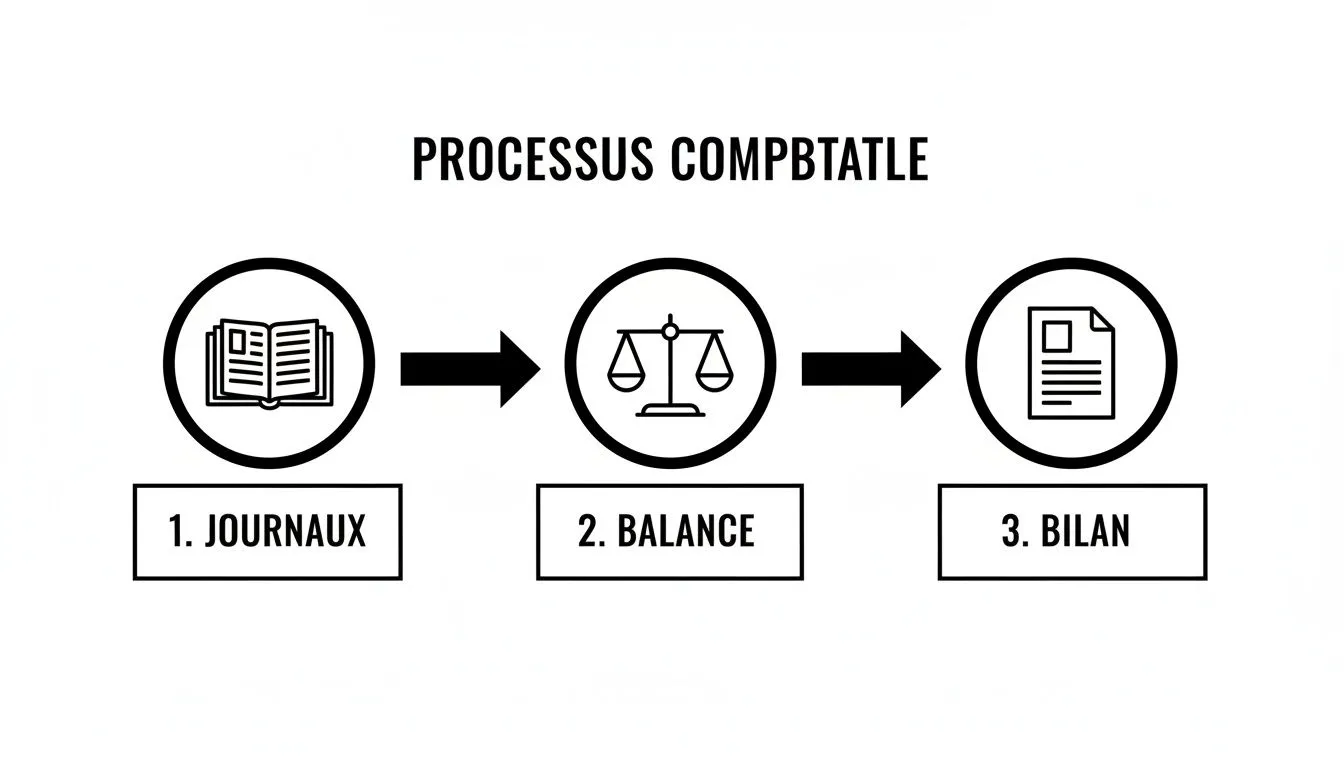
This visual perfectly illustrates that the balance sheet doesn’t appear out of nowhere. It’s the culmination of a rigorous process that guarantees the reliability of the information you present.
Building the assets column
The first column of your balance sheet, assets, is essentially the inventory of everything your company owns. To make it readable, it’s organized in ascending order of liquidity: starting with what’s hardest to convert into cash (like a building) and ending with what’s already cash (your available funds).
You’ll list here:
- Fixed assets: These are all the assets meant to remain durably in the business. Think of your IT equipment, your delivery vehicle or your office furniture. Here you record their net value, meaning their purchase cost minus the depreciation already calculated.
- Current assets: Here you’ll find everything intended to be converted into cash in the short term. This is where you list the value of your inventory, your accounts receivable (invoices awaiting payment), and of course, the money available in your bank accounts and cash register.
For each line item, simply carry over the corresponding final balance from your trial balance. It’s a simple matter of transferring figures, each one finding its place.
Building the liabilities column
Right next to the assets, you build the liabilities column. Its role? To explain where the money came from that financed everything you own. It reflects your financial resources, this time classified by order of maturity (from debts due later to the most urgent ones).
Liabilities break down into two main groups:
- Equity: This is the financial heart of your company, the money that “belongs” to you outright. It includes your initial share capital, reserves accumulated over the years, and above all, the result for the year you’ve just closed (profit or loss).
- Debts: These represent everything your company owes to third parties. This includes financial debts (your bank loans), trade payables (purchase invoices you haven’t yet paid), and social and tax liabilities (social contributions to pay, VAT due, etc.).
The perfect balance between total assets and total liabilities is the ultimate proof that your bookkeeping is accurate. If the two totals don’t match to the last cent, there’s no question about it: you need to go back to the trial balance stage to find the error.
A worked example for clarity
Let’s take the case of “CréaBois,” a small furniture-making business. At the end of year N, its final trial balance shows the following balances:
- Machines: €15,000
- Wood inventory: €4,000
- Accounts receivable: €3,000
- Bank account: €8,000
- Share capital: €10,000
- Result for the year: €5,000
- Bank loan: €9,000
- Accounts payable: €6,000
Here’s how these figures are organized in its simplified balance sheet.
| ASSETS | Amount | LIABILITIES | Amount |
|---|---|---|---|
| Fixed assets | Equity | ||
| Machines | €15,000 | Share capital | €10,000 |
| Current assets | Result for the year | €5,000 | |
| Inventory | €4,000 | Debts | |
| Accounts receivable | €3,000 | Bank loan | €9,000 |
| Cash (bank) | €8,000 | Accounts payable | €6,000 |
| TOTAL ASSETS | €30,000 | TOTAL LIABILITIES | €30,000 |
As you can see, total assets (€30,000) exactly match total liabilities. The balance holds, the balance sheet is correct.
A balance sheet isn’t just a mandatory document, it’s a financial communication tool. A clear, well-presented layout makes it easier to read and analyze, whether for you, your banker or a future investor. Use precise headings and don’t bury the important information.
Beyond the accuracy of the figures, the readability of your balance sheet is essential. Don’t forget the accounting notes (annexe comptable), the document that accompanies the balance sheet and income statement. It’s there to explain the accounting methods you used and to detail certain line items, providing essential insight into a full understanding of your financial situation.
Knowing how to prepare a balance sheet is therefore not just about filling in boxes. It’s the art of summarizing an entire year of activity in a balanced table that speaks to everyone you deal with.
Equipping yourself with the right tools to simplify your bookkeeping
Preparing a balance sheet by hand is a bit like trying to cross a big city without GPS. You can get there, sure, but it’s long, stressful, and you’re quite likely to get lost along the way. Fortunately, there are now much more efficient solutions to guide you and automate a good portion of the work.
By adopting a good management tool, everything changes. Gone are the endless hours spent checking bank statements or sorting through mountains of invoices. A good piece of software does the heavy lifting in the background, making the process not only faster, but also far more reliable.
Saving precious time and avoiding errors
The most immediate benefit of automation is time savings. It’s dramatic. Software like Bizyness can, for example, sync with your business bank accounts, automatically retrieve all transactions and even suggest categories for each one.
This automation significantly reduces the risk of data entry errors, those famous little slip-ups that can create frustrating imbalances and cost you hours tracking them down. Instead of chasing a misplaced decimal point, you can finally focus on analyzing your figures and your company’s health.
A good tool also gives you a clear, up-to-date view of your financial situation. No more waiting until year-end to know where you stand. A well-designed dashboard lets you steer your business day to day and make better decisions.
How to choose the right software?
The market is full of solutions, but not all of them are suited to small businesses. To make the right choice, check that the tool has been specifically designed for the needs of French freelancers and small businesses.
Here are a few essential points to check:
- Bank synchronization: This is the basis of automation. Without it, the benefit is limited.
- Invoice management: The tool should let you create quotes and legally compliant invoices, then easily track payments.
- Accounting export preparation: Make sure it can generate the necessary files (FEC, accounting journals) for you or your accountant.
Expert tip: Good initial setup is key. Really take the time to properly connect your accounts and define your categorization rules. It’s a small time investment upfront that will save you a huge amount of time later on.
This shift toward more powerful tools is a major trend. The accounting profession itself is undergoing a transformation. Did you know that 64% of accounting firms hired in 2024 to prepare for the retirement of 30% of their workforce by 2030? This pressure, combined with the imminent arrival of mandatory e-invoicing, is pushing the entire sector to adopt solutions that automate repetitive tasks. To learn more, you can check the latest updates to the General Chart of Accounts on the website of the French accounting standards authority.
Ultimately, knowing how to prepare a balance sheet today also means knowing how to equip yourself intelligently, turning what used to be a chore into a genuine asset for steering your business.
Frequently asked questions about the balance sheet
Tackling your balance sheet for the first time can be a bit intimidating. It’s an exercise that raises quite a few very concrete questions, and that’s perfectly normal. To help you see things more clearly and clear up any remaining doubts, we’ve gathered the questions that come up most often among business owners, with straightforward answers, no unnecessary jargon.
Can I really do my balance sheet myself?
Legally, the answer is yes, especially if you run a sole proprietorship. Nothing requires you to go through an accountant. If you have solid accounting basics, you’re rigorous, and your business remains simple (few transactions, no complicated inventory, etc.), it’s entirely possible.
But you need to fully grasp what that implies. A small error, such as a miscalculated depreciation or a forgotten provision, can completely distort your result and have tax consequences. An accountant isn’t an expense, it’s a safeguard. They take responsibility for the figures, and their expertise can even save you money through good optimization advice.
At its core, the real question isn’t “can I do it?” but rather “is this the best use of my time?” Sometimes, delegating this task frees you up to focus where you’re irreplaceable: growing your business.
How often do I need to prepare a balance sheet?
The balance sheet is a mandatory annual exercise. It must be drawn up at the close of each financial year, which generally lasts 12 months. Most companies align their financial year with the calendar year (closing on December 31), but that’s not an absolute rule.
That said, nothing stops you from taking stock along the way. Producing interim balance sheets, for example every quarter, is even an excellent management practice.
- For a financing request: Your banker will almost always ask for an up-to-date financial statement to assess your company’s health before lending you money.
- For steering your business: A mid-year balance sheet, in June, gives you a clear view of the trend and lets you adjust course if needed, without waiting until year-end to see the damage.
These interim balance sheets are genuine management tools. They let you make decisions based on facts, not just intuition.
What’s the biggest mistake to avoid?
If there’s one mistake to avoid, it’s this: letting the collection of supporting documents slide. Many business owners rely on their bank statement, but forget that in accounting, every line, every expense, every receipt must be backed up by an invoice, a receipt, a contract.
Without this evidence, your bookkeeping has no value in the eyes of the tax authorities. In the event of a tax audit, any unjustified expense will simply be added back to your taxable profit. And of course, with penalties attached.
The only remedy is discipline. Get into the habit, from day one, of scanning and attaching each receipt to its transaction. A digital tool can help you with this. It’s a small reflex that will save you very big headaches.
Are a balance sheet and a financial balance sheet the same thing?
We often hear both terms and tend to confuse them. Yet, even though they’re based on the same data, their purpose is very different.
| Type of balance sheet | Its main objective | How it’s organized |
|---|---|---|
| Statutory balance sheet | Present the company’s assets in a regulatory format, for the tax authorities. | It follows a highly standardized structure (assets/liabilities) defined by the General Chart of Accounts. It’s the “official” snapshot. |
| Financial balance sheet | Assess the company’s ability to repay its debts (its solvency) and its overall financial health. | It reorganizes the items from the statutory balance sheet. Assets are classified by order of liquidity (from easiest to hardest to convert into cash) and liabilities by order of maturity (from most urgent debts to least urgent). |
Simply put, the statutory balance sheet is a regulatory snapshot, an obligation. The financial balance sheet is an economic analysis tool, often requested by a bank before granting a loan.
What are the three mandatory accounting documents?
The balance sheet never stands alone. It’s the centerpiece of a set of documents known as the “annual accounts.” They’re inseparable and must be produced together at the end of each financial year.
Here’s the winning trio:
- The balance sheet: A snapshot of what the company owns (its assets) and what it owes (its liabilities) at a given point in time.
- The income statement: The movie of the year. It traces all expenses and revenue to explain how the final result (profit or loss) came about.
- The accounting notes: The instruction manual. This document details and explains the figures in the balance sheet and income statement, as well as the accounting methods you applied.
Knowing how to prepare a balance sheet is therefore also understanding how these three documents work together to give a complete, accurate picture of your business.
What if you stopped chasing after your receipts? With Bizyness, automate their collection, track your cash flow in real time and approach your balance sheet preparation with confidence. Discover how Bizyness can truly lighten your administrative workload.
