

 Français
 How to calculate VAT on a VAT-inclusive price without getting it wrong
Learn how to calculate VAT on a VAT-inclusive price with our practical guide. Master the reverse calculation formula and the different applicable rates.

You have a VAT-inclusive price in front of you and need to work out the net amount and the VAT portion? It’s a common situation, whether for an expense report or checking an invoice. The good news is that the calculation is much simpler than it looks.
The magic formula is this: just divide your VAT-inclusive price by (1 + the VAT rate). For example, for the standard rate of 20%, the divisor is simply 1.20. A price of €120 including VAT divided by 1.20 gives us €100 excluding VAT. The difference, €20, is the VAT amount.
The reverse VAT calculation, step by step
When you look at a displayed price, it’s easy to forget that it’s the sum of two elements: the base price of the product or service (the net amount) and the VAT collected for the government. The reverse calculation is a bit like turning back the clock to isolate these two components.
Here’s how to go about it, concretely:
- Identify the applicable VAT rate: Is it the standard rate of 20%? An intermediate or reduced rate? That’s the first crucial piece of information.
- Calculate the divisor coefficient: Add 1 to the VAT rate. For example, for a rate of 5.5% (0.055), the divisor will be 1.055.
- Divide the VAT-inclusive price by this coefficient: The result you get is your net amount (excluding VAT).
- Find the VAT amount: Simply subtract the net amount from the original VAT-inclusive price. And there you go, it’s done!
Let’s take a concrete example with a product sold at €275 including VAT and subject to a VAT rate of 20%. The calculation is: €275 / 1.20 = €229.17 excluding VAT. To find the VAT portion, we take the difference: €275 - €229.17 = €45.83. It’s as simple as that. If you want to dig deeper into the topic, Figaro offers a detailed article on net and gross price formulas (in French).
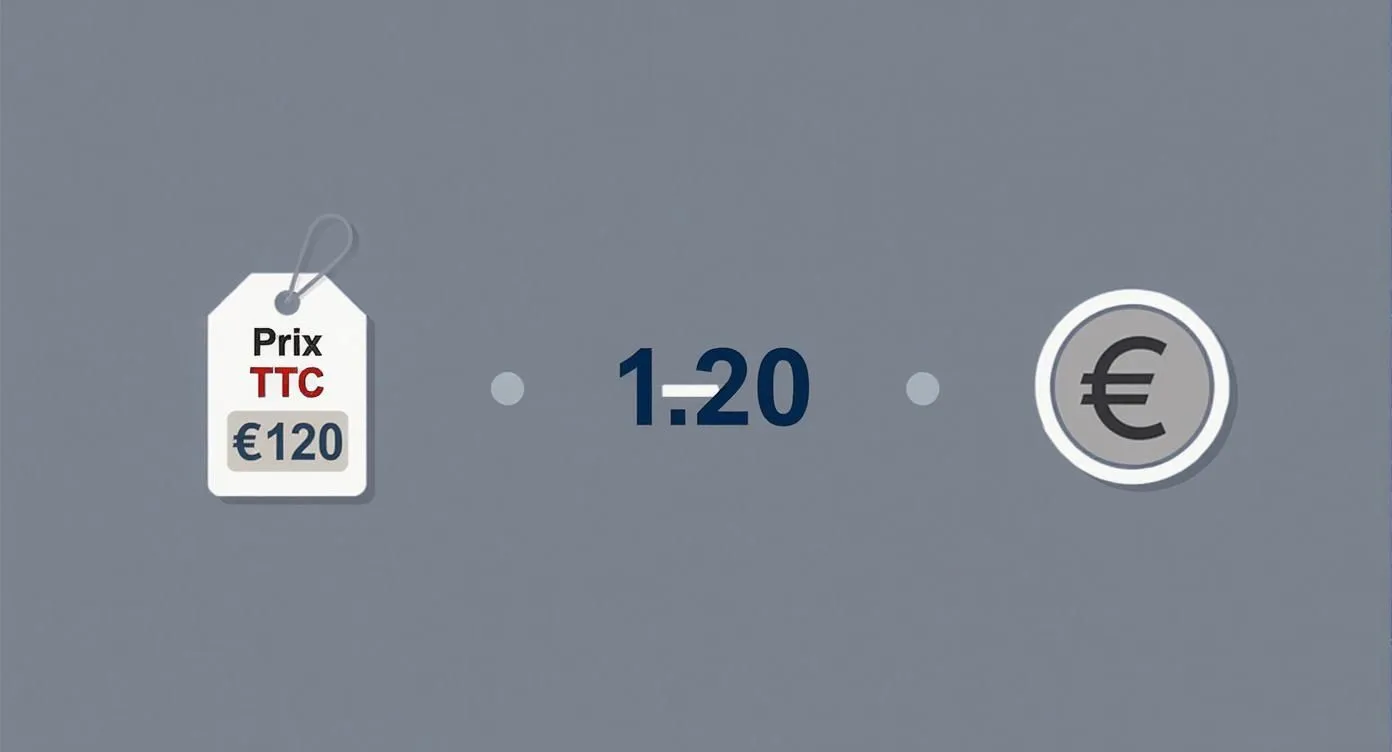
This image perfectly sums up the idea: the final price is divided by the right coefficient to get back to its net base.
The divisor table to keep handy
To make your life easier, there’s no need to redo the coefficient calculation every time. Here’s a handy cheat sheet of divisors to use for the main VAT rates in France.
Divisors for converting VAT-inclusive to net amounts by VAT rate
Use this table to quickly find the net amount (excluding VAT) from a VAT-inclusive price.
| VAT rate | Divisor to apply to the VAT-inclusive price | Example for €120 including VAT |
|---|---|---|
| 20% (Standard) | 1.20 | €120 / 1.20 = €100.00 excl. VAT |
| 10% (Intermediate) | 1.10 | €120 / 1.10 = €109.09 excl. VAT |
| 5.5% (Reduced) | 1.055 | €120 / 1.055 = €113.74 excl. VAT |
| 2.1% (Super-reduced) | 1.021 | €120 / 1.021 = €117.53 excl. VAT |
Keep this table close at hand or memorize the divisors you use most often. It’s a simple trick that turns a sometimes tedious calculation into a straightforward division, guaranteeing accuracy and speed no matter the situation.
Demystifying the logic behind the reverse VAT calculation
The formula to extract VAT from a VAT-inclusive price may seem complicated at first glance. Yet its logic is unshakeable. It all starts with the basic calculation used to go from a net price (excluding VAT) to a VAT-inclusive price. Once you’ve grasped this mechanism, the reverse formula becomes obvious.
Let’s go back to basics. To get a VAT-inclusive price, you simply add the VAT amount to the net price. The formula is therefore: VAT-inclusive price = Net price + (Net price x VAT rate).
For example, for a product at €100 excluding VAT with a VAT rate of 20% (i.e. a rate of 0.20), the calculation gives: €100 + (€100 x 0.20) = €120 including VAT. Simple, right?
How do you isolate the net price?
Let’s take a closer look at this formula. We can simplify it by factoring out the net price, which gives us:
VAT-inclusive price = Net price x (1 + VAT rate)
With our example, that translates to: €120 including VAT = €100 excl. VAT x (1 + 0.20). In other words, €100 x 1.20. This version of the formula highlights an essential point: the VAT-inclusive price is nothing more than the net price multiplied by a coefficient. For a VAT rate of 20%, this coefficient is 1.20.
This is where everything becomes clear. Once you have this relationship in mind, reversing the operation becomes child’s play. All you need is a simple rule of three to find the amount you’re looking for.
To go from VAT-inclusive to net, you therefore need to do the reverse operation: divide the VAT-inclusive price by this same coefficient. The formula is therefore:
Net price = VAT-inclusive price / (1 + VAT rate)
Let’s go back to our product at €120 including VAT. Applying the reverse formula, we get: €120 / 1.20 = €100 excluding VAT. And there you go, we land right back on our starting amount.
This little demonstration proves that the reverse calculation formula is not arbitrary at all. It’s the logical result of a very simple mathematical manipulation. By understanding the “why,” the “how” becomes much easier to remember and apply, whatever VAT rate you come across.
Juggling the different VAT rates in France
Calculating VAT backwards would be simple if there were just one rate. But in France, it’s a bit more nuanced. There are mainly four rates, and each applies to specific goods or services. Knowing which one to use is crucial to keep your invoices and bookkeeping in order.
As an entrepreneur, it’s your responsibility to apply the right rate. Believe me, a small mistake can quickly turn into an unpleasant exchange of letters with the tax authorities. It’s better to take two minutes to properly identify the category of what you’re selling.
Concrete examples for each rate
To make things clearer, let’s see how the formula adapts to situations you experience every day. Each case uses a different rate, which really shows the importance of choosing the right number after the decimal point when calculating VAT from a VAT-inclusive price.
-
The standard rate at 20%: This is the most common one, the one you see everywhere. Are you invoicing a consulting assignment at €1,200 including VAT? To find the net amount, it’s simple: €1,200 / 1.20 = €1,000 excl. VAT. The VAT is therefore €200.
-
The intermediate rate at 10%: Take a restaurant owner who collects a bill of €55 including VAT. To isolate the net base, they divide by 1.10. The calculation: €55 / 1.10 = €50 excl. VAT. They therefore collected €5 in VAT. This is a rate you’ll also often find in renovation work.
-
The reduced rate at 5.5%: A customer does their shopping and pays €21.10 including VAT for basic food products. The calculation will be: €21.10 / 1.055 = €20 excl. VAT. VAT here represents €1.10. This rate also applies to books, for example.
Choosing the right VAT rate isn’t just a technical detail. It directly affects the final price paid by your customer and, of course, the amounts you’ll declare. For more on this, our guide on the different VAT rates in France is here to help.
By the way, these rates aren’t set in stone. You may remember when the standard rate went from 19.6% to 20% on January 1, 2014? That small change forced everyone to update their calculation divisor, going from 1.196 to 1.20. A detail that has a very real impact on day-to-day bookkeeping.
Handling rounding and complex situations
Moving from VAT calculation theory to everyday accounting practice is a bit like moving from a blueprint to actual construction: you always run into surprises. A simple calculation can easily produce a result with three decimal places. Yet on an invoice, you only work with euros and cents. So what do you do?
The rule is quite straightforward: VAT amounts are always rounded to the nearest cent. Concretely, if the third decimal is 5 or more, you round up. If it’s 4 or less, you round down. This is a detail that matters, because rigorously applying this rule is the secret to accurate accounts and smooth VAT returns.

Specific scenarios you should know inside out
Beyond this rounding gymnastics, the world of VAT is full of situations that fall outside the classic framework. They can quickly become a real headache if you’re not prepared.
- VAT exemption scheme: Micro-entrepreneurs (sole traders) are very familiar with this scheme. As long as your revenue stays under certain thresholds, you invoice net of VAT. The mention “VAT not applicable, art. 293 B of the French Tax Code” then becomes your best friend on every invoice.
- Intra-community VAT: Are you providing a service to a business customer based in another EU country? This is where the reverse charge mechanism comes into play. You issue a net invoice, and it’s up to your customer to declare and pay VAT in their own country.
- VAT on the margin: A very specific scheme, often found in the trade of second-hand goods such as vehicles, antiques, or works of art. Here, VAT isn’t calculated on the total selling price, but only on the margin you make, i.e. the difference between your purchase price and your resale price.
These special cases prove that managing VAT is much more than a simple mathematical formula. Knowing how to navigate between these different mechanisms is essential to secure your business and avoid invoicing mistakes that can end up being costly.
Mastering these subtleties, including how to easily manage VAT rounding, will bring you real peace of mind on the tax front and more accurate day-to-day financial management. Each situation has its own set of rules; knowing them means always staying one step ahead.
What if you stopped doing manual calculations?
Knowing how to calculate VAT backwards is a basic skill, for sure. But day to day, insisting on doing it by hand for every receipt or invoice means taking an unnecessary risk and wasting a lot of time. Honestly, who has time for that? This is exactly where modern invoicing software changes the game for good.
Switching to VAT automation isn’t a luxury, it’s a matter of common sense and efficiency. No more stress about calculation errors, poorly handled rounding, or the wrong rate applied to the wrong product. You simply gain peace of mind.
The real benefits of an automated tool
A good piece of software does much more than replace your calculator. It secures the entire process, from creating the quote to filing your VAT return.
Concretely, here’s what changes:
- Accurate invoices, every time. The software knows your products and services and applies the correct VAT rate without you having to think about it. Reliability becomes the norm.
- Time regained. No more need to double- or triple-check everything. You can finally spend that precious time on what really matters: your customers and your growth.
- Peace of mind with the tax authorities. Your VAT returns are ready in a few clicks, based on correct, centralized figures.
Automation turns an administrative, repetitive, error-prone chore into a simple formality. It’s a small investment that pays off handsomely in time saved and penalties avoided.
Don’t forget that VAT is a major source of revenue for the government; it represented nearly €160 billion in 2022. The French system relies on precise coefficients, such as 0.833 for the 20% rate, to make collection more reliable. A tool like Bizyness natively incorporates these rules so you no longer have to worry about them.
To dig deeper into converting from net to VAT-inclusive prices and try it out for yourself, take a look at our net-to-gross VAT converter and explanations.
Your frequently asked questions about VAT calculation
Even with the best explanations, a few very practical questions often remain. Let’s go through the ones that come up most often to clear up the last few points and make your life easier.
How can I quickly find 20% VAT on a VAT-inclusive price?
That’s the big question, the one we all ask ourselves every day! For the standard rate of 20%, there’s a shortcut much faster than the classic formula. Just divide your VAT-inclusive price by 6.
Let’s take a product at €120 including VAT. The calculation is very simple: €120 / 6 = €20. There you go, you directly get the VAT amount. To find the net price, a simple subtraction is enough: €120 - €20 = €100 excl. VAT. It’s a super practical mental-math method for everyday use.
What’s the difference between output VAT and input VAT?
These two terms are really at the heart of how VAT works. It’s essential to distinguish between them clearly.
- Output VAT is the tax you apply on your own sales invoices. It’s the money you collect on behalf of the government.
- Input VAT corresponds to the tax you pay on your business purchases: raw materials, subscriptions, overhead costs… It’s VAT you’re entitled to reclaim.
The amount you’ll owe the tax authorities is simply the difference between the two: VAT payable = Output VAT - Input VAT. If the result is negative, the government owes you money. This is called a VAT credit.
Understanding this distinction is fundamental. As a business, you act as an intermediary: VAT is neutral for you, since only the end consumer actually bears its cost.
Do I need to calculate VAT if I’m a sole trader (micro-entrepreneur)?
It all depends on your situation. If you’re under the VAT exemption scheme (meaning your revenue stays under certain thresholds), you don’t charge VAT. Your invoices must then carry the mandatory mention: “VAT not applicable, art. 293 B of the French Tax Code.”
However, as soon as you exceed these thresholds, you move to the standard scheme and must start applying VAT on your invoices.
Stop wasting time on manual calculations and the risk of errors. Bizyness automates all your VAT management, from creating invoices to preparing your returns. You gain compliance and peace of mind. Discover how to simplify your management today on Bizyness.fr.
