

 Français
The practical guide to calculating VAT rates
Master VAT rate calculations with our guide. Apply the right rates, handle intra-EU VAT, and simplify your tax compliance.

At its core, calculating VAT isn’t rocket science. The basic formula is simple: to get a price including tax (VAT-inclusive), you take the price excluding tax (VAT-exclusive) and multiply it by (1 + the VAT rate). For a standard rate of 20%, you simply multiply the VAT-exclusive price by 1.20.
Diving into how VAT works
VAT (Value Added Tax) is much more than a simple percentage added to an invoice. It’s an indirect consumption tax that makes up a major share of government revenue. But for a business owner, it’s above all a day-to-day matter. Managing it properly is essential to stay compliant and to set fair prices.
In practice, your business acts as an intermediary for the tax authorities. You collect VAT by charging it to your customers (this is output VAT), then you remit it to the State. From that amount, you’re entitled to deduct the VAT you yourself paid on your own business purchases (input VAT). This balancing act ensures that only the value added at each link in the chain is actually taxed.
VAT rates: a percentage for every product
The rate to apply depends directly on what you’re selling. Most of the time you’ll use the standard rate of 20%, but that’s not an absolute rule.
Reduced rates exist, designed to make certain goods and services more accessible or to support specific sectors. For example, there’s an intermediate rate of 10% for restaurant services or renovation work. An even lower rate, 5.5%, applies to essential goods such as food, as well as to energy-efficiency renovation work.
This isn’t a minor detail: VAT accounts for nearly 45% of the State’s net tax revenue, which shows just how significant it is to the economy. For a complete overview, it’s always useful to refer to the details on the different VAT rates provided by official sources.
This table summarizes the rates you’ll encounter most often.
VAT rates currently in force in France
This table presents the main VAT rates currently in force in France and the categories of goods or services to which they apply.
| Rate Type | Percentage | Application examples |
|---|---|---|
| Standard rate | 20% | Majority of goods and services |
| Intermediate rate | 10% | Restaurant services, passenger transport, renovation work |
| Reduced rate | 5.5% | Food products, books, energy-efficiency improvement work |
| Special rate | 2.1% | Medicines reimbursed by social security, press publications |
Knowing these distinctions is key to invoicing correctly and avoiding unpleasant surprises when filing your returns.
The image below perfectly illustrates how you go from the base price to the final price paid by the consumer.
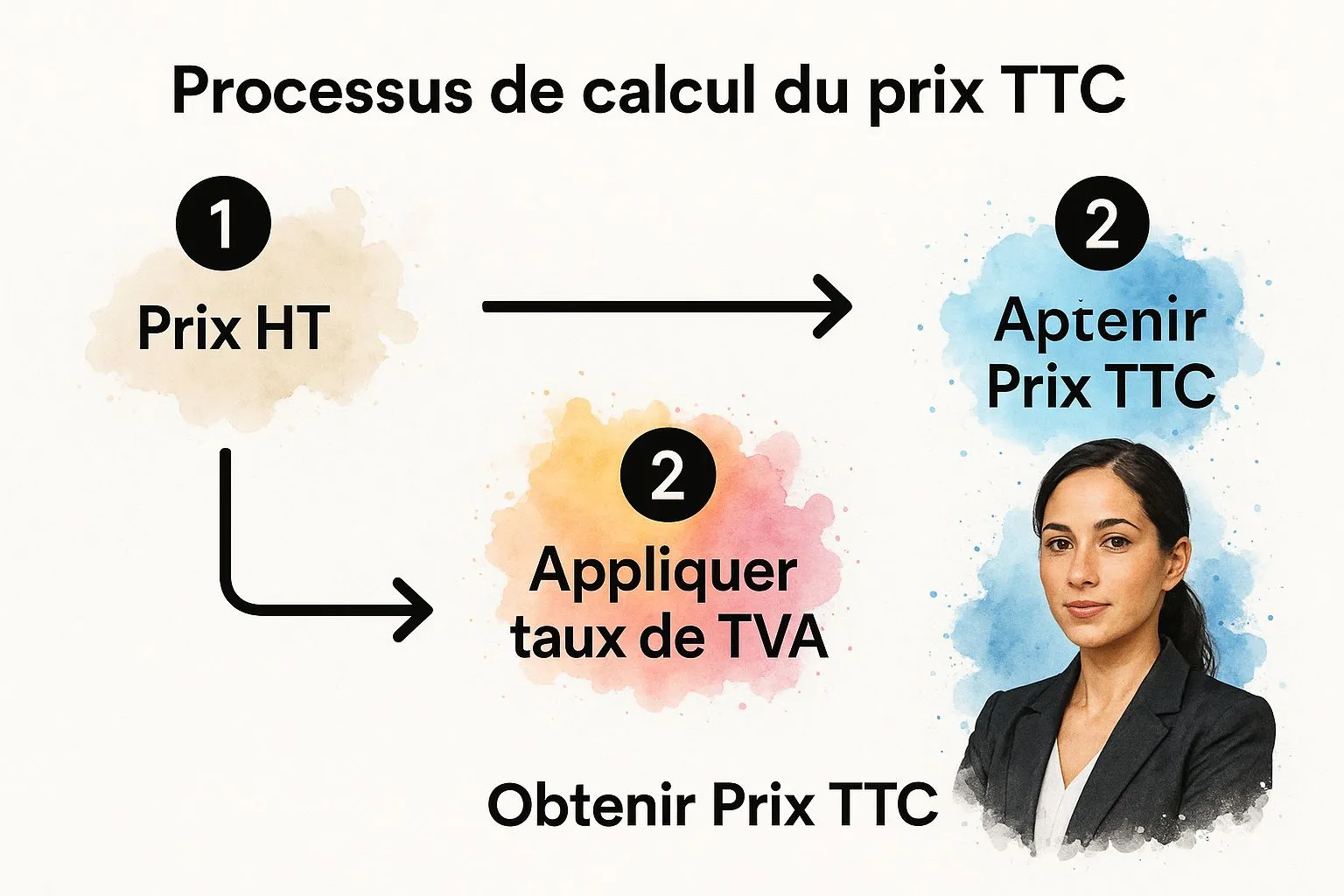
It’s clear that the VAT rate is the central pivot that turns a VAT-exclusive price into a VAT-inclusive price. It’s a simple but crucial step.
The two formulas to know by heart
To never make a mistake, two basic formulas should become second nature. Whether you need to calculate a VAT-inclusive price or isolate the VAT amount, it’s very straightforward.
-
To find the VAT-inclusive price from a VAT-exclusive amount:
VAT-inclusive price = VAT-exclusive price × (1 + VAT rate)Concrete example: A product is sold for €100 excl. VAT. With VAT at 20%, the calculation is:€100 × 1.20 = €120 incl. VAT. -
To extract the VAT from a price already including VAT:
VAT amount = VAT-inclusive price / (1 + VAT rate) × VAT rateAnother way, simpler in my view, is to find the VAT-exclusive price first:VAT-exclusive price = VAT-inclusive price / (1 + VAT rate).Concrete example: A product costs €120 incl. VAT. We find the VAT-exclusive price:€120 / 1.20 = €100. The VAT amount is therefore€120 - €100 = €20.
These calculations are the ABCs of sound financial management. A small mistake can quickly turn into a headache for your tax returns and impact your cash flow. It’s simply a skill you can’t afford to neglect when running a business.
Mastering VAT calculation formulas

Theory is nice, but it’s on the ground that everything plays out. Let’s now move on to the calculations you’ll be doing every day. The idea is to make them so natural that they become second nature. A good way to secure your invoicing and save precious time.
Let’s break down together the two key operations: how to add VAT to a VAT-exclusive price and how to extract it from a VAT-inclusive price. For each method, I’ll give you concrete examples, drawn from situations you’re bound to encounter.
Adding VAT: from excl. VAT to incl. VAT
This is the most common calculation, the one you do every time you prepare a quote or an invoice. The formula is simple and direct.
The formula to remember: VAT-inclusive price = VAT-exclusive price × (1 + VAT rate)
Imagine a freelance graphic designer who invoices the creation of a logo at €500 excl. VAT. For this type of service, the standard VAT rate of 20% applies.
- The calculation is as follows:
€500 × (1 + 0.20) - Which gives us:
€500 × 1.20 = €600 incl. VAT
Your end client will therefore pay €600. Of that amount, you have €100 of VAT that you collect for the State and that you’ll need to remit when filing your return.
My tip for going faster? Learn the multiplier coefficients by heart. It’s very simple: 1.20 for 20%, 1.10 for 10%, and 1.055 for 5.5%. It makes mental calculation much easier and limits errors.
Extracting VAT: from incl. VAT to excl. VAT
This operation, also known as the “reverse” calculation, is your best ally when you start from a final price and need to find the tax portion. This is typically the case when recording expense reports or purchase invoices in your accounting.
The formula to remember: VAT-exclusive price = VAT-inclusive price / (1 + VAT rate)
Let’s take the example of a restaurant owner who lists a daily special at €18 incl. VAT. Restaurant dining on-site is subject to the intermediate rate of 10%. To find its VAT-exclusive base, they’ll do this calculation:
- The operation:
€18 / (1 + 0.10) - The result:
€18 / 1.10 = €16.36 excl. VAT
The amount of VAT collected on this dish is therefore €18 - €16.36, or €1.64.
If you want to explore other practical cases, our comprehensive guide on VAT calculation will give you even more detailed examples.
One last example for the road with the reduced rate. A bookseller sells a book for €21.10 incl. VAT. Books are a special case: they benefit from the 5.5% rate.
- The calculation:
€21.10 / 1.055 = €20 excl. VAT - The VAT amount is therefore
€21.10 - €20, or €1.10.
As you can see, no matter the situation, the formulas remain logical and easy to apply. Mastering them guarantees you’ll avoid costly errors and keep your accounting records clear and accurate.
Choosing the right VAT rate for your business

Applying the wrong VAT rate is a classic mistake that can nonetheless cost you dearly. A simple mix-up between the 10% and 20% rates can trigger a tax reassessment and turn your accounting into a real headache. To avoid falling into this trap, you absolutely need to master which rate corresponds to your sector, your products, and your services.
It’s not always as simple as it looks. The devil is often in the details: the exact nature of the product, whether it’s consumed on-site or taken away, or the specifics of a service can change everything. The first step is therefore to comb through your offering carefully to secure your invoicing from the start.
Identifying the right rate for your sector
The basic principle is quite straightforward: the standard rate of 20% is the general rule for most sales and services. It’s the rate applied by default. But, as is often the case with tax matters, there are numerous exceptions, particularly to support certain economic sectors or make essential goods more accessible.
Here are the different rates you’ll come across most often in your life as an entrepreneur:
- The 10% intermediate rate: Found mainly in restaurant services (for on-site dining), passenger transport, trade shows and exhibitions, or certain improvement work on older housing.
- The 5.5% reduced rate: Applies to products deemed essential. Think food products, books (print and digital), gas and electricity subscriptions, but also energy-efficiency renovation work.
- The 2.1% special rate: Much rarer and reserved for very specific cases, such as medicines reimbursed by social security or the public broadcasting contribution.
It’s interesting to know that these rates haven’t always been the same. VAT was introduced in France in 1968, with a standard rate set at 16.66% and a reduced rate of 6%. After multiple adjustments, a major overhaul took place in 2014, raising the standard rate to 20% and reintroducing the intermediate rate of 10%. For the curious, the detailed history of VAT in France on Wikipedia is a fascinating read.
Concrete examples so you never get it wrong again
Theory is nice, but nothing beats practical cases to really understand. Imagine a restaurant owner selling drinks on-site and pastries to go. The distinction is crucial.
A coffee served at a table will be invoiced with 10% VAT, since it’s a restaurant service. On the other hand, if a customer buys a croissant to take away and eat later, the 5.5% rate applies, since it’s a food product. If that same croissant is served with the coffee in the dining room, it shifts to 10%. It’s really the notion of service that takes precedence here.
For a construction tradesperson, the reasoning is just as subtle. Painting work in a home over two years old can be invoiced at the 10% rate. But if the work concerns attic insulation, it drops to 5.5%, provided of course the technical criteria required for energy-efficiency renovation are met.
Faced with doubt, the best strategy remains caution. Never hesitate to check the information on the tax authority’s website (impots.gouv.fr) or, better still, to seek your accountant’s advice. A good habit to adopt: keep a record of your research so you can justify your choices in the event of a tax audit.
Handling slightly more complex VAT cases

VAT is fairly simple when you stay within the French market. But as soon as your business starts looking beyond our borders, or touching specific industry sectors, things get a bit more complicated. Don’t worry, nothing insurmountable. You just need to know the rules of the game to stay compliant and, above all, not lose money.
These special cases may seem intimidating at first glance, but they’re based on fairly clear logic. Let’s break down together the most common situations: trade with our European neighbors, reselling second-hand goods, or the well-known micro-entrepreneur scheme.
Intra-EU VAT and the reverse charge principle
If you do business with other professionals based in the European Union, you’ll soon hear about VAT reverse charge. It’s a key mechanism, designed to streamline trade between member states.
Concretely, what does that mean? Imagine you buy IT equipment from a supplier in Germany. They’ll issue you an invoice without VAT, i.e. VAT-exclusive. On your end, you won’t have to pay them anything for VAT. However, you’ll need to “reverse charge” this VAT in France.
This simply means calculating the amount of French VAT on your purchase, declaring it as if you had collected it, then deducting it at the same time on the same return. The operation is therefore entirely neutral for your cash flow, but it’s a mandatory administrative exercise.
For everything to go smoothly, one condition is non-negotiable: your business and your trading partner’s business must both hold a valid intra-EU VAT number. This is the very first thing to check before closing the deal.
The same logic applies in the other direction. If you sell a service to a business in Spain, you invoice VAT-exclusive. Be sure to add the mention “VAT exemption - Article 283-2 of the French Tax Code” (or an equivalent wording). It will then be up to your Spanish client to handle the VAT reverse charge in their country, according to their own rules.
Special schemes not to overlook
Beyond Europe, other situations call for a different approach. Margin VAT is a textbook case, particularly if you’re in the business of selling second-hand goods.
This scheme was designed for the sale of second-hand goods, works of art, or collectibles. Its big advantage? VAT isn’t calculated on the total sale price, but only on the profit margin you make. It’s much fairer.
Let’s take a concrete example:
- You find a used car from a private individual for €8,000.
- After a bit of refurbishing, you resell it for €10,000.
- Your gross margin is therefore €2,000. This is the base on which you calculate VAT at 20%, i.e. €333.33 to remit to the State (
2000 / 1.20 * 0.20).
Another very common case is the VAT exemption scheme (franchise en base). This is the default scheme applied to most micro-entrepreneurs (sole traders).
This status simply exempts you from charging and declaring VAT, provided your revenue stays below certain thresholds. For example, €91,900 for goods-sales activities. If this applies to you, your invoices are issued without VAT and must carry the mention “VAT not applicable, art. 293 B of the French Tax Code.”
Monitoring these thresholds is absolutely crucial. As soon as you cross them, you move into the standard VAT regime and become liable for VAT, effective from the first day of the month in which the threshold is exceeded. You therefore need to anticipate this change to adjust your prices, update your invoicing, and prepare your accounting. It’s a key step in the life of a growing business, and it’s one you can plan for.
Forget the calculator: how to automate your VAT calculations and never make a mistake again
Manual VAT calculation is a bit of a nightmare for every entrepreneur. A repetitive, time-consuming task, and above all, a source of errors that can be very costly. A simple rate mix-up or typo, and your entire accounting is thrown off, with the risk of catching the eye of the tax authorities.
Fortunately, we’re no longer stuck juggling Excel spreadsheets. Technology now offers much simpler and more reliable solutions to put an end to this chore.
Modern invoicing and accounting software is exactly there for that. It turns VAT rate calculation into an automatic, near-instant process. The result? You save precious time to focus on what really matters: growing your business.
How does software concretely make your life easier?
The huge advantage of these tools is that they centralize and automate everything related to VAT. No more spreadsheet-and-calculator combo — you get a single, smart system that handles everything.
Concretely, here’s what good software should offer you:
- VAT rate configuration: You should be able to set up the different rates that apply to you in a few clicks (20%, 10%, 5.5%, etc.). Once that’s done, they’re ready to use.
- Automatic application on your invoices: When you create a quote or an invoice, you simply choose the product or service sold. The software applies the correct VAT rate on its own, without you having to think about it.
- Handling multiple rates on a single invoice: Selling items with different VAT rates? No problem. The tool should be able to handle this complexity on a single invoice and calculate an accurate total.
- Automatic legal updates: The best software, like Bizyness, monitors regulatory changes for you. If rates or tax rules change, they’re updated so you always stay compliant.
This chart perfectly illustrates the evolution of VAT rates in France over time. It highlights why it’s so important to use a tool that’s always up to date.
It’s clear that rates have changed a lot. Using an automated system prevents you from mistakenly applying percentages that are no longer current.
Choosing the right tool for your business
The market is full of solutions, but they’re not all equal and, above all, not necessarily suited to your situation. To make the right choice, start by assessing your actual needs. A freelancer doesn’t have the same constraints as an SME with several employees.
For independent workers, for example, it’s crucial to master the specific rules of VAT for sole traders and to make sure the chosen tool handles this status properly.
The goal isn’t to find the most sophisticated tool, but the one that will save you the most time while securing your accounting. Automating VAT calculation is no longer a luxury, it’s a necessity for running your business with peace of mind and professionalism.
Ultimately, investing in good invoicing software is a bit like investing in your peace of mind. You drastically limit the risk of errors, free up considerable time, and ensure your VAT returns, generated in a few clicks, are always spot on.
Your frequently asked questions about VAT calculation
Even with the best explanations, VAT calculation often brings its share of very concrete questions. Let’s dive into entrepreneurs’ most common questions to demystify it all.
How do I correct a VAT error on an invoice already sent?
Above all, don’t be tempted to modify an invoice that’s already been issued and sent. This is a practice to avoid. The one and only method recognized by the tax authorities is issuing a corrective invoice, more commonly known as a credit note.
This new document must necessarily reference the original invoice. It cancels and replaces it, showing the correct amounts and the correct VAT calculation. This is key to maintaining clear accounting and flawless traceability.
Can I really reclaim VAT on all my expenses?
The short answer is no. For VAT to be deductible, the expense must be incurred in the strict and direct interest of the business. This covers purchases of raw materials, professional IT equipment, your accountant’s fees, or subcontracting costs, for example.
Be careful, certain expenses are always excluded from the right to deduction, even if they seem related to your business. Think in particular of:
- Housing costs for executives or employees.
- The purchase or rental of most passenger vehicles.
- Certain expenses considered as extravagant (hunting, fishing, luxury residences…).
Always take the time to check the nature of the expense before including the VAT in your return. Any doubt? It’s best to ask your accountant for advice.
Good advice: keep an eye on your revenue to anticipate crossing the VAT exemption threshold. It’s the best way to steer your growth calmly and avoid sometimes painful adjustments.
What happens if I exceed the VAT exemption threshold?
The moment you cross the increased VAT exemption threshold, you move into the standard VAT regime. The effect is immediate: you become liable for VAT from the 1st day of the month in which the threshold is exceeded.
Concretely, you must immediately start applying VAT on your invoices. For those on the micro-entrepreneur scheme, this is a pivotal moment. Learning about tax optimization for sole traders then becomes essential to best manage this transition. Anticipation is your best asset for avoiding unpleasant surprises.
Stop wasting precious time on complex calculations. Bizyness automates your invoicing and VAT returns so you can focus on what really matters: your business. Try Bizyness for free.
