

 Français
How to Create a Deposit Invoice: A Quick and Effective Guide
Learn how to create a compliant deposit invoice for your online business. A clear guide to the mandatory information and VAT rules.
Knowing how to create a deposit invoice isn’t just a matter of paperwork. It’s an accounting document that lets you request partial payment before delivering a product or completing a service. In practice, this first payment secures the order, commits your customer, and above all gives your cash flow some breathing room.
Why the deposit invoice is vital for your cash flow
More than a simple formality, the deposit invoice is a genuine strategic weapon for your e-commerce business’s financial health. It turns a verbal promise or a signed quote into a real financial commitment, which considerably reduces the risk of an unpaid invoice.

We all know late payments are the nightmare of many entrepreneurs. That’s where the deposit invoice comes in. By requesting an upfront payment, often between 20 and 50% of the total amount, you secure part of the funds before you even start working or producing. This is significant protection when you consider that the average payment delay in France is 49.7 days, well beyond the legal 30 days.
Concrete cases where a deposit isn’t optional
Take an example. A customer orders a custom-made product from your Shopify store. This item requires specific materials and production time. If you don’t ask for a deposit, you’re advancing costs and work time with no payment guarantee at all. The deposit covers these initial costs and confirms that your buyer is serious.
The exact same logic applies to services. Launching the build of a website for a client? The deposit lets you fund the first stages of development without dipping into your reserves.
A deposit isn’t just a cash advance. It’s a signal of mutual trust that lays healthy foundations for the business relationship and protects your activity.
Mastering this document is therefore a triple win: it builds trust, keeps you compliant with tax rules, and protects your business. To dig deeper, feel free to discover more cash flow management tips.
Quote, deposit, invoice: never mix them up again
It’s crucial to clearly distinguish between these documents to avoid management errors. Each has its own role, timing, and legal implications within the sales cycle.
To make things clearer, here’s a short table summarizing the essentials.
Comparison of key commercial documents
This table clarifies the differences, obligations, and timing of each document for error-free financial management.
| Document | Main purpose | Legal obligation | Impact on VAT |
|---|---|---|---|
| Quote | Propose a detailed commercial offer. | Becomes contractual once signed by the customer. | None. VAT is not due. |
| Deposit invoice | Request payment of part of the order. | Mandatory as soon as an advance payment is received. | VAT becomes due upon collection. |
| Standard invoice | Confirm the sale of a good or service. | Mandatory for any commercial transaction. | VAT is due on delivery (goods) or on payment (services). |
Understanding these nuances is the foundation of flawless invoicing and healthy cash flow. Think of the deposit invoice as the first financial link in the chain: the one that secures everything else.
The mandatory information for a rock-solid deposit invoice
A deposit invoice isn’t just a slip of paper recording a first payment. It’s a fully-fledged accounting document, with very precise rules of the game. If you miss a required mention, your invoice can be invalidated by the tax authorities — and that’s the start of trouble, for you and for your client alike.

Think of it as the foundation of your transaction. If it’s shaky, the whole structure risks collapsing. So, to avoid that, let’s go through the list of essential information that will make it rock solid.
The basics: information found on every invoice
Whether you’re selling a service paid via Stripe or a product on a marketplace, your deposit invoice must first include the standard information found on any invoice. It’s the base — the essentials for identifying who is selling what to whom.
Forgetting one of these elements is a bit like handing over a check without a signature: it’s worthless.
Here’s the checklist of must-haves:
- Your full details: Your name, your registered office address, your SIREN number, and your legal structure (SAS, sole trader/micro-entrepreneur, etc.).
- The customer’s details: Their name and address, or their company name and registered office if it’s a business.
- The issue date: Simply the day you create the invoice.
- The sale details: A clear, precise description of the service or product involved. No jargon — get straight to the point.
- Everything about VAT: Your intra-community VAT number, the rate applied, and the total tax amount. If you’re VAT-exempt (as many micro-entrepreneurs are), don’t forget the magic phrase: “VAT not applicable, art. 293 B of the French Tax Code.”
These elements are the bare minimum for any invoicing. To go further, take a look at our full guide on mandatory invoice information.
The special “deposit” touch
Now that the basics are in place, you need to add the details that turn an ordinary invoice into a genuine deposit invoice. These are the specifics that give it its full meaning and legal value. Miss one, and you open the door to confusion in your bookkeeping.
In invoicing, clarity is king. Each deposit-specific mention serves one purpose: connecting this partial payment to the overall sale and guaranteeing flawless accounting tracking through to final settlement.
Here are the three crucial points you must never skip:
- An unambiguous title: Clearly state “Deposit invoice.” Not “first invoice” or “partial invoice.” Be precise.
- A unique invoice number: This invoice must follow the numbering sequence of all your other invoices. If your last invoice was F2024-052, this one will be F2024-053. It’s a rule of chronology and continuity that cannot be broken.
- Reference to the original document: Always link back to the quote or purchase order accepted by your customer. For example: “30% deposit on quote No. DV2024-031.”
Thinking ahead to avoid misunderstandings
A good deposit invoice is also one that paves the way for what comes next. It’s a matter of professionalism for you and clarity for your customer.
Take the example of a freelancer collecting a deposit via PayPal. By specifying the payment terms and mentioning the future balance invoice, they reassure their client. The client knows exactly where things stand and what they’ll still owe. No unpleasant surprises.
For this, two small mentions can make a big difference:
- The due date: Clearly state the deadline for paying this deposit.
- A mention of the final invoice: Not mandatory, but excellent practice to specify that this deposit will be deducted from the final invoice. It shows you’re organized and makes life easier for everyone.
How do you calculate VAT on your deposits? The method explained
Dealing with VAT on deposits can sometimes feel daunting, especially since an important change in legislation. But rest assured, once you have the right method, everything becomes much clearer. The key principle to remember is simple: VAT is now due as soon as you collect the deposit, whether you’re selling goods or a service.
This point is essential. Since January 1, 2023, the law is clear: for any advance payment, a VAT-registered business must issue a deposit invoice. In practice, this means you must collect and declare VAT at the time of collection, no longer upon delivery of the product or completion of the service. The old distinction between goods and services is gone!
For example, if you sell on PrestaShop and a customer pays you a 30% deposit on an order of €10,000 excl. VAT, you must immediately create an invoice for €3,000 excl. VAT and collect the corresponding €600 of VAT. This €600 must appear on your next VAT return. This new rule standardizes practices but requires greater rigor in your bookkeeping.
Practical case: calculating for a sale of goods in France
Let’s take a very concrete scenario. You sell a custom-made piece of furniture for €500 excl. VAT on your WooCommerce store. The standard VAT rate in France is 20%. To start production, you request a 40% deposit.
Here’s how to break down the calculation, step by step:
- First, the total including VAT: €500 excl. VAT + (€500 x 20%) = €600 incl. VAT.
- Then, the deposit including VAT the customer must pay: €600 incl. VAT x 40% = €240 incl. VAT.
- We isolate the excl.-VAT portion of this deposit: €240 incl. VAT / 1.20 = €200 excl. VAT.
- And finally, the VAT on the deposit: €240 incl. VAT - €200 excl. VAT = €40 of VAT.
Your deposit invoice must therefore clearly show: €200 excl. VAT, €40 of VAT, and a total of €240 incl. VAT. This €40 of VAT is now collected and must be remitted to the state on your next VAT return, even though the furniture is still in your workshop.
The mistake to avoid is calculating the deposit percentage on the amount excluding tax. You should always start from the total including VAT of the order to determine what the customer must pay, then “extract” the excl.-VAT base and the VAT from that amount.
This logic applies to all VAT rates. For a book (5.5% VAT), you’d simply divide the deposit amount including VAT by 1.055 to find the excl.-VAT base. If you want to dig deeper, our full guide on calculating VAT has you covered.
The case of an international service sale via OSS
Things get a bit more complex when selling to individuals in other European Union countries. Fortunately, the VAT one-stop shop (OSS) is there to simplify life.
Imagine a freelancer selling an online coaching session to a client living in Belgium. The full service is invoiced at €1,000 excl. VAT.
Here, the rule is simple: you apply the VAT rate of the customer’s country. In Belgium, the standard rate is 21%. You request a 50% deposit to reserve the slot.
The calculation stays the same, but with the Belgian VAT rate:
- Total including VAT for the service: €1,000 + (€1,000 x 21%) = €1,210 incl. VAT.
- Deposit amount including VAT: €1,210 x 50% = €605 incl. VAT.
- Excl.-VAT portion of this deposit: €605 / 1.21 = €500 excl. VAT.
- VAT to declare on the deposit: €605 - €500 = €105 of VAT.
This €105 of VAT must be declared via the OSS portal. The portal then handles remitting it to the Belgian tax authorities. Without this system, you’d have to register for VAT in Belgium — a far heavier administrative process.
Accounting entries and the reflex toward automation
Behind every deposit invoice lie precise accounting entries. When you receive the payment, you must credit the account 4191 “Customers - advances and deposits received on orders” and debit your bank account (account 512). The VAT collected is also recorded.
Managing all of this by hand, especially with a high volume of sales or international transactions, is a recipe for errors.
This is exactly where tools like Bizyness change the game for an online seller. By connecting directly to your platforms (Shopify, Stripe, etc.), the software handles everything, without you having to think about it:
- It automatically detects the partial payment.
- It applies the correct VAT rate, whether French or European via OSS.
- It generates a fully compliant deposit invoice.
- It prepares the corresponding accounting entries.
Automation guarantees you eliminate the risk of human error and stay compliant with tax authorities effortlessly. A time saving and peace of mind that are priceless.
Let’s move from theory to practice. Knowing how to calculate is one thing, but knowing how to actually create your invoices is even better. To fully understand how to create a deposit invoice without making mistakes, nothing beats a concrete example.
Imagine a creator selling personalized items on her Etsy shop. A customer orders a custom piece for €500 excl. VAT. To start production and buy raw materials, she requests a 40% deposit. The applicable VAT rate is 20%.
The process is fairly simple and follows a three-step logic: quote, deposit, then balance.
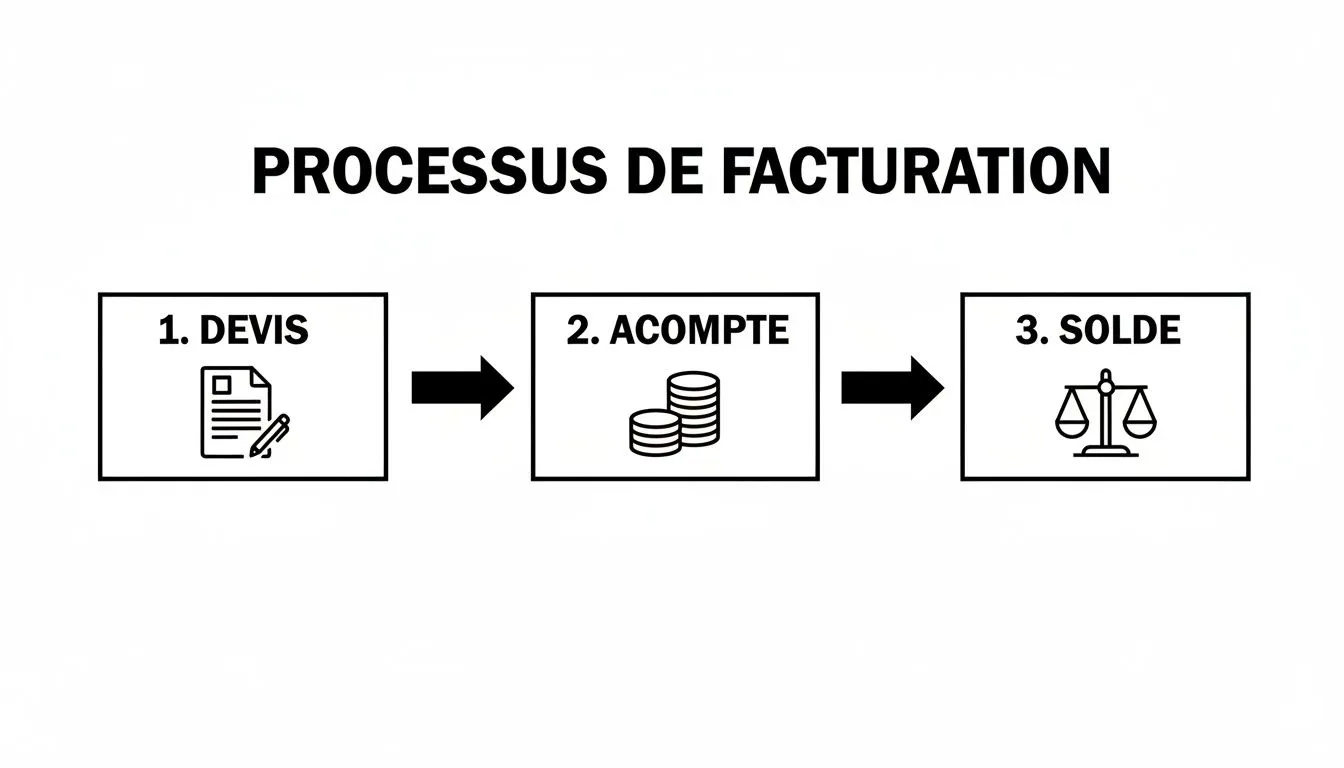
This diagram clearly shows that the deposit invoice isn’t a standalone document. It’s the central link that bridges the initial agreement (the quote) and the final payment.
Building the deposit invoice, step by step
Let’s return to our example. The total order is €500 excl. VAT, which comes to €600 incl. VAT (€500 + 20% VAT). The deposit is 40%, so the calculation is simple: €600 incl. VAT x 40% = €240 incl. VAT.
Here’s what our creator absolutely must include on this first document:
- A clear title: “Deposit invoice” must be visible at a glance.
- A unique numbering: The invoice follows the usual sequence (e.g., FA-2024-078).
- Reference to the quote: It must state something like “40% deposit on quote No. DEV-2024-055.”
- Deposit amount excl. VAT: €200
- VAT (20%): €40
- Total due: €240 incl. VAT
The crucial point here is transparency. Your customer must clearly see that their payment of €240 breaks down into €200 of base amount and €40 of VAT. This is not only a legal obligation, but also a genuine mark of professionalism.
Of course, don’t forget to include all the standard mandatory information (your details, the date, your SIREN number, etc.). Once these elements are in place, the invoice is ready to send.
Issuing the final balance invoice
Once the product is finished and ready to ship, it’s time to close out the transaction with the final invoice, often called the balance invoice. This is where the deposit already paid takes on its full meaning. This document must summarize the entire transaction and clearly indicate what remains to be paid.
The most common mistake? Forgetting to deduct the deposit already received. It might seem trivial, but it creates immediate confusion for the customer and a real headache for your bookkeeping.
Here’s how our Etsy creator should structure her balance invoice:
-
First, summarize the total order:
- Custom product: €500 excl. VAT
- VAT (20%): €100
- Subtotal: €600 incl. VAT
-
Then, deduct the deposit paid:
- Deposit paid (invoice No. FA-2024-078): -€240 incl. VAT
-
Finally, show the balance due:
- Net amount due: €360 incl. VAT
To keep it simple and effective, you can reuse this structure on your own invoices:
- Line 1: Total order | €600.00 incl. VAT
- Line 2: Your deposit paid on [payment date] | -€240.00 incl. VAT
- Line 3: Remaining balance | €360.00 incl. VAT
To make things even clearer, here’s a short summary table.
Numerical example of deposit invoicing
A concrete example to visualize the VAT calculation and the final amount on the deposit invoice and the balance invoice.
| Item | Deposit invoice (30%) | Balance invoice (70%) | Total order |
|---|---|---|---|
| Amount excl. VAT | €150.00 | €350.00 | €500.00 |
| VAT (20%) | €30.00 | €70.00 | €100.00 |
| Amount incl. VAT | €180.00 | €420.00 | €600.00 |
This table perfectly illustrates the split of the excl.-VAT amounts and the VAT between the two invoices, ensuring accurate and transparent bookkeeping.
Automation for flawless management
Managing this link between deposit and balance by hand is doable when you have few orders. But as soon as volume increases, the risk of error rises sharply. A single missed deduction, and it’s the start of trouble: an unhappy customer, accounting to correct…
This is exactly where invoicing software like Bizyness changes the game. It makes the process smooth and nearly automatic:
- Deposit creation: You create your quote, and with one click, the software generates the deposit invoice with the correct percentage.
- Payment tracking: As soon as you mark the deposit as paid, the system records it.
- Balance generation: When it’s time to invoice the rest, the software prepares the balance invoice and automatically deducts the amount already received.
This automation is a guarantee: every step is respected, the calculations are accurate, and the reference to the deposit is never forgotten. For an online seller, that’s a huge time saving and one less source of stress.
Automate your deposit management with invoicing software
Managing deposits by hand is a bit like sorting mail by hand in the age of email: it works, but it’s terribly slow and errors can creep in anywhere. At first, it’s manageable. But as soon as your business takes off, what was a simple formality turns into a real headache. Tracking who paid, how much, when to follow up for the balance… This is exactly where automation changes everything.
Imagine no longer having to worry about these details. That’s exactly what well-designed invoicing software offers, especially when built for online sellers.
The ideal workflow for an online seller
Let’s take a concrete, real-world example. You sell personalized products on Shopify and collect payments via Stripe. A customer orders a custom item and pays you a 30% deposit. Without a dedicated tool, you’d have to create the deposit invoice manually, check the calculations, send it by email, then set yourself a reminder somewhere so you don’t forget to invoice the balance. Multiply that by ten, fifty, a hundred orders…
With a tool like Bizyness, this whole process becomes nearly invisible. The software connects to Stripe and detects the partial payment. Right away, it generates a fully compliant deposit invoice, with the correct mentions and VAT calculated down to the cent, before sending it to the customer. Everything is recorded, tracked, and ready for what comes next.
This much smoother approach relies on a few key actions:
- Automatic detection of the order and the partial payment.
- Application of the correct VAT rate, including for international sales thanks to built-in one-stop-shop management (OSS/IOSS).
- Creation and sending of a valid deposit invoice, without you lifting a finger.
- Preparation of the corresponding accounting entry, ready to be sent to your accountant.
Later, when the customer pays the balance, the platform automatically generates the final invoice, correctly deducting the deposit already paid. It’s simple, reliable, and remarkably efficient. If you’re looking to optimize your processes, our guide on online invoicing can give you more ideas.
Save time and get ready for e-invoicing
Time savings are the most obvious benefit of automation, without a doubt. But its impact goes well beyond simple productivity. Above all, it’s about securing your tax compliance, an issue that’s becoming absolutely central with the reforms on the horizon.
Automation is no longer a luxury — it’s a strategic necessity. It turns a heavy administrative burden into a genuine competitive advantage, freeing up your time for what really matters: growing your business.
The major e-invoicing reform, which is fast approaching, will make compliance for every invoice — including deposit invoices — non-negotiable. The state’s systems will simply be able to block a document that doesn’t follow the rules to the letter. Automation not only helps avoid these blockages but also saves up to 80% of the time you currently spend on invoicing. To learn more, you can read this analysis on the impact of the reform.
A tool like Bizyness was designed specifically for this transition. By integrating directly with your sales tools, it ensures every deposit invoice issued is valid, that international VAT is handled without a headache, and that your accounting exports are flawless.
A clear, real-time financial view
Beyond compliance, automation offers you something invaluable: a clear, up-to-date view of your financial health. Goodbye complex Excel spreadsheets and rough estimates. Every deposit is tracked, every upcoming balance is clearly identified.
You know in real time how much cash is secured and what revenue you’re about to collect. This visibility is crucial for making the right decisions, whether managing your stock, investing in marketing, or planning your growth. Automating deposit invoicing is therefore not just a simple optimization. It’s the first building block of calmer, smarter financial management for your business.
Deposit invoicing in e-commerce: the questions that keep coming up
Even with the best guide in the world, some gray areas often remain — especially when it comes to deposit invoicing in the very specific context of e-commerce. Let’s go through the questions I get asked most often to help you see things clearly.
Does a signed quote plus a deposit count as a contract?
The answer is a resounding yes. It’s actually one of the most solid commitments there is in business. When your customer signs a quote and pays you a deposit, you hold a firm legal commitment from both sides.
Think of it this way: the customer commits to paying the full amount, and you commit to delivering the product or performing the service. This is why the deposit invoice is so crucial. It sets this first payment in stone and lays the first building block of your accounting trail. It’s material proof of the agreement.
Do I really need to issue an invoice for every deposit?
Absolutely, no exceptions. The golden rule in accounting is traceability. Every incoming flow of money must correspond to a document. Every deposit you receive is a partial payment and therefore needs its own invoice.
Imagine you sell a custom product with payment in three installments before delivery. You’ll receive a first deposit, then two more payments. You’ll therefore need to issue three separate deposit invoices, one for each payment.
Only on the final invoice — the balance invoice — do you settle up: total order amount, minus the total of the three deposits already received. It’s clear for you, for your customer, and above all for the tax authorities.
What happens if a customer cancels their order after paying the deposit?
The right reflex is to turn to your Terms and Conditions of Sale. That’s where you’ve defined the rules of the game. If you haven’t yet, it’s time to! Generally, it all depends on who hits the “stop” button.
- The customer cancels? In principle, the deposit is considered compensation for the work already started or the costs already incurred. You keep it.
- You cancel? In this case, the rule is simple: you must refund the full amount received.
A crucial point in the event of a refund: you absolutely must issue a credit note. It’s the only way to officially cancel the original deposit invoice in your accounting and, most importantly, to reclaim the VAT you’d already declared and paid. No credit note, no VAT refund.
Deposit or down payment (arrhes) — what’s the real difference?
It’s a legal subtlety, but with very real consequences. Not mixing them up can save you a lot of headaches.
A deposit (acompte) is an ironclad commitment. Once paid, neither you nor the customer can back out without risking legal action for breach of contract. The sale is considered final.
Down payments (arrhes) are more flexible. They offer an exit door. If the customer changes their mind, they lose the amount paid, and that’s the end of it. If you’re the one who backs out, the law requires you to refund double the amount of the down payment. Watch out: by default, the law considers a payment from an individual to be a down payment (arrhes), unless the contract explicitly states the word “deposit” (acompte) in black and white. Precise wording is therefore your best ally.
What if you stopped worrying about all these questions? With a tool like Bizyness, managing deposits, balance invoices and credit notes becomes child’s play. Everything is automated so you can focus on your core business.
Discover how Bizyness can transform your e-commerce management.
