

 Français
How to Edit an Invoice Without Risk: an Expert Guide
Find out how to edit an invoice legally and without mistakes. Expert tips, pitfalls to avoid, and safe alternatives for your bookkeeping.

Why editing an invoice is an obstacle course

Editing an invoice, believe me, is rarely a walk in the park. It’s tempting to think a small change here or there is insignificant. Don’t be fooled! I’ve personally seen business owners land in genuinely complicated situations for editing an invoice, even over trivial details. You have to understand that an invoice isn’t just a piece of paper: it’s a legal commitment, and the tax authorities don’t take that lightly.
Picture a stage play. Once the curtain falls, you can’t go back on stage and rewrite the script. Well, an invoice is a bit like the script of your transaction. As soon as it’s issued and recorded, it becomes an official accounting record. Touching it is like trying to rewrite history.
Tax authorities keep a close eye on these edits, because they can hide attempts at fraud or income concealment. Imagine a company editing its invoices to artificially lower its revenue… and pay less tax. That’s exactly the kind of practice the authorities want to prevent. By the way, to make sure you’re compliant, take a look at our guide on mandatory invoice details.
So how do you know if you’re allowed to edit an invoice? The answer is complex and depends on several factors. For example, a typo in the client’s address is easier to fix than a change to the total amount. The time elapsed between issuing the invoice and editing it also plays a crucial role. The more time passes, the more suspicious the edit becomes. We’ll break all this down in the rest of this article, so you can edit your invoices with peace of mind, when the situation genuinely allows it.
The unwritten rules the tax authorities never forgive
In accounting, there are rules, and then there are… the rules. See what I mean? Those little implicit things, never really explained, but that can get you in trouble if you ignore them. Take the principle of immutability of accounting entries, for instance. I’ve personally seen business owners, acting in good faith, get reprimanded for editing an invoice a few months after it was issued. They simply didn’t know. And yet… editing an invoice isn’t like fixing a typo in an email.
You need to clearly distinguish between a draft invoice and a posted invoice. You can edit a draft as much as you like. A posted invoice, on the other hand, is an official document. Once validated and sent, it’s part of your accounting records and affects your revenue. Touching it is potentially playing with fire, especially from a tax standpoint. As a reminder: electronic invoicing is becoming standard practice in France and will be mandatory for all businesses from September 1, 2026. More information here!
Timing also plays an important role. Fixing a small typo on an invoice issued the day before? Generally not a problem. Editing an invoice several months old, especially to change the amount or the VAT? That starts to look suspicious. Imagine editing a substantial invoice right before a tax audit… the authorities could see it as an attempt at concealment, and believe me, that’s never good.
Finally, even seemingly harmless edits can be perceived as accounting manipulation. Changing an invoice number to make another one disappear, for example. Tax authorities pay very close attention to the chronological sequence of invoices. The slightest gap, the slightest inconsistency, and trouble begins. In short, think carefully before editing an invoice and favor alternatives, such as credit notes or corrective invoices, whenever possible. We’ll see how to do that in the next sections.
My proven method for editing invoices without ending up in court

After fifteen years of juggling invoices, I’ve refined a method that lets me edit an existing invoice without breaking into a cold sweat when a letter from the tax office arrives. First and foremost, ask yourself the essential question: is editing the invoice really necessary? A credit note or a corrective invoice can sometimes solve the problem more simply and, above all, more safely. A quick reminder for sole traders: invoicing has its own set of rules. Take a look at this article on invoicing for sole traders if you’re unsure.
If you genuinely have no choice but to edit the original invoice, here are the six steps I follow every time to stay on the safe side:
-
I assess the impact: A comma error isn’t the same as a VAT error! You need to gauge the severity of the mistake and its consequences. I remember a client who had billed €10,000 instead of €1,000… the impact was, let’s say, quite significant!
-
I check the deadlines: Am I still within the legal timeframe? Some edits are simply impossible after a certain period. Knowing these deadlines is essential to avoid penalties.
-
I put together a complete file: Before even opening Bizyness, I gather every document that justifies the edit. Emails, purchase orders, anything that can prove my good faith. A solid file is your best ally in the event of an audit.
-
I make the edit in Bizyness: I document every action in Bizyness: the date, the time, the nature of the edit and, above all, the reason. Transparency is your friend.
-
I update my systems: I make sure the edit is properly reflected across all my accounting tools. Inconsistencies in your data can draw the attention of the tax authorities.
-
I keep a record of everything: I carefully keep every version of the invoice (the original, the edited one), the supporting documents, and the edit history in Bizyness. In the event of a dispute with a client, these documents will save you.
By applying this method rigorously, I’ve spared my clients (and myself!) plenty of headaches. In the rest of this article, we’ll look together at concrete examples and the warning signs that should make you give up on editing an invoice.
Electronic invoicing: when technology complicates everything

We were promised miracles with electronic invoicing, and it’s true that for many things it has made life simpler. But let’s talk about editing invoices… Ouch! On some platforms, once an invoice has entered the system, it’s set in stone. I’ve personally witnessed business owners breaking into a cold sweat after sending an invoice with a simple VAT error… with no way to correct it!
The adoption of electronic invoicing in France is happening gradually. In 2022, only 31% of businesses used structured electronic invoices (UBL or Factur-X format), the type of invoice that allows automated processing. More information on these figures here. With mandatory rollout on the way, editing invoices is becoming a critical issue. Better to prepare and choose the right tools now. By the way, take a look at our guide on online invoicing, it could come in handy.
And then there are formats like Factur-X, which complicate things even further. Editing the PDF is no longer enough. You also need to update the XML metadata, that invisible information software uses to process the invoice. If the PDF and the XML don’t match, the system may reject your invoice.
Anticipating the problems linked to editing an invoice
Every electronic invoicing platform has its own rules, and some are far more flexible than others. The most important thing is to anticipate these limitations from the start, at the invoice creation stage. Check every piece of information carefully before validating, because correcting it afterward can become a real obstacle course, or even impossible.
Imagine: you edit an invoice in Bizyness, with no error message. Months later, during year-end closing, that edit creates an unexplained discrepancy. What a headache! You really need to understand how your platform works and document every edit precisely. Traceability is your best friend in this kind of situation. In the next section, we’ll look at alternatives to direct editing, solutions that are often simpler and less risky.
The smart alternatives that avoid all the trouble
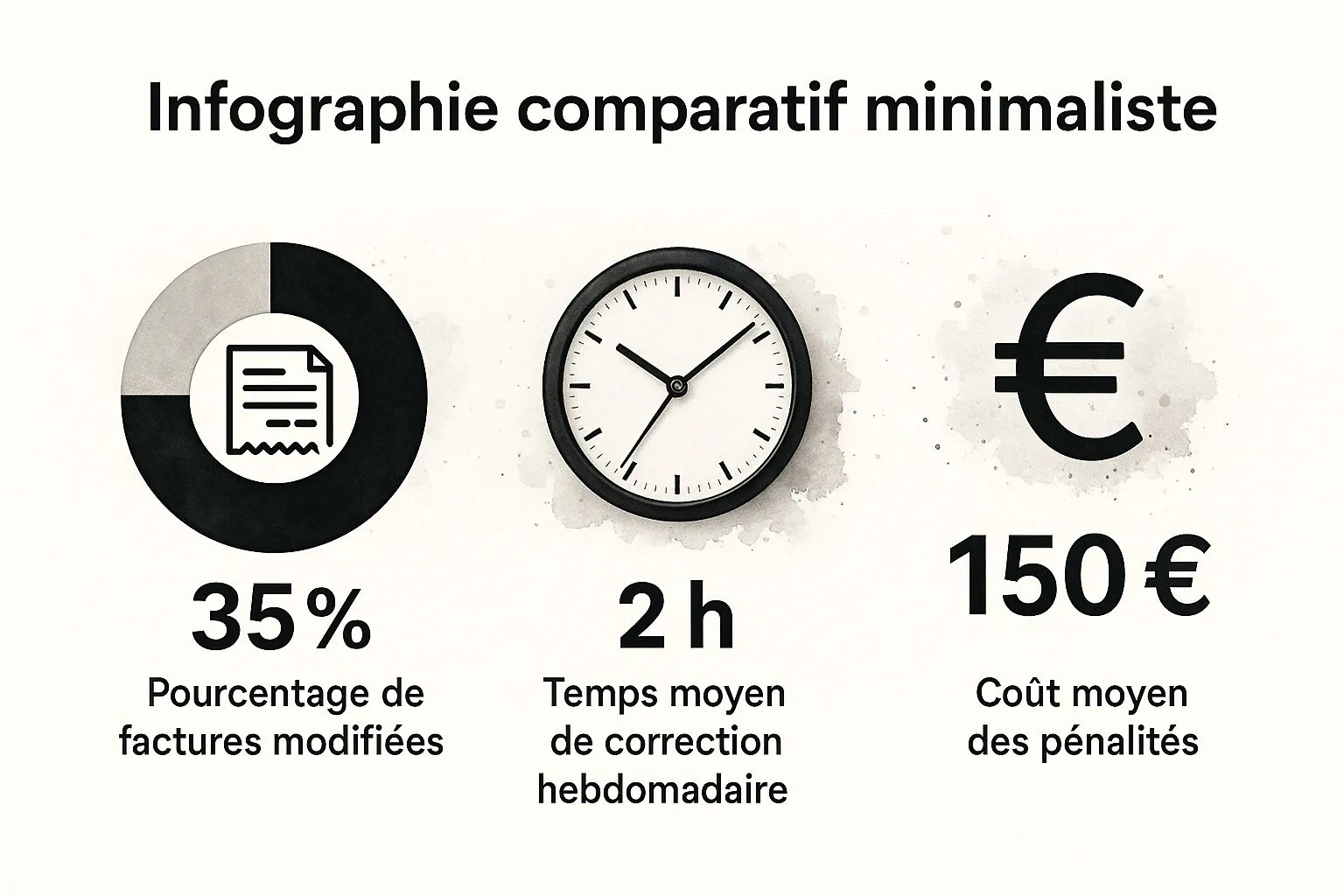
The infographic above shows a few key figures on invoice edits: the percentage of invoices edited, the time spent each week correcting them, the cost of penalties… It’s clear that editing an invoice directly can be costly, in both time and money, and can disrupt the whole organization.
Sometimes, the best way to “edit an invoice” is precisely not to edit it! With experience, I’ve learned that there are much simpler and less risky solutions. Take the credit note, for example. A classic, but often misused. There are several types of credit notes: a full credit note completely cancels the original invoice, a partial credit note corrects just one amount, and a credit-invoice allows you to bill for an additional service not initially planned.
For certain situations, the corrective invoice is a real secret weapon. Ideal for correcting a VAT error or a missing legal notice. And if the error is caught quickly, cancel-and-reissue is often the cleanest solution: you cancel the original invoice and simply issue a new one.
Choosing the right solution: a few tips
Choosing the right method is a bit like choosing the right tool. Several factors come into play. The nature of the error, obviously: a typo isn’t handled the same way as an amount error. The time elapsed since the invoice was issued is also crucial. The more time passes, the fewer options you have.
Your client relationship also plays a role. Explaining a credit note to a loyal client is easier than to a new prospect. Finally, the impact on your cash flow and your track record with the tax authorities can influence your choice. A simple edit can sometimes draw attention if your file is already somewhat sensitive.
Here’s a summary table to help you see things more clearly:
Comparison of solutions for correcting an invoice
A practical guide to choosing between a credit note, a corrective invoice, and cancel-and-reissue depending on your situation
| Solution | Advantages | Drawbacks | When to use it |
|---|---|---|---|
| Full credit note | Complete, simple cancellation | Impact on accounting | Invoice entirely incorrect |
| Partial credit note | Correction of a specific amount | Requires a clear justification | Error on one line of the invoice |
| Credit-invoice | Billing for additional services | Can complicate client follow-up | Service not initially planned |
| Corrective invoice | Correction of specific errors (VAT, legal notices) | More complex to set up than a credit note | Error affecting legal obligations |
| Cancel-and-reissue | The “cleanest” solution | Only possible if the error is caught quickly | Error detected before sending to the client or right after |
In short, mastering these alternatives will save you time and money and spare you plenty of headaches. Used well, these solutions are true allies for managing your invoicing with peace of mind.
The mistakes that turn a small problem into a disaster
Let me tell you a few slightly scary anecdotes, to help you avoid some cold sweats in the future. Imagine: a client, thinking she could edit an invoice that was six months old, quietly changes an amount from €1,200 to €1,000. The result? A tax reassessment of €15,000 on suspicion of revenue concealment. Ouch.
Another real case: a business owner who had the unfortunate habit of editing his invoices to “round off” figures. Except he ended up creating a €50,000 gap in his invoice numbering. A detail that jumped out at tax inspectors. The thing about invoice chronology is that editing an old invoice without respecting the order is an open door to an in-depth audit.
The importance of chronology and dates
Editing an invoice after the accounting period has closed is a bit like trying to change the past. And believe me, tax authorities are not fans of that kind of practice. Conversely, I’ve seen much more complicated situations resolve easily thanks to impeccable management of dates and invoice numbers in Bizyness.
Even with the best intentions in the world, editing an invoice can quickly turn into a nightmare if you don’t follow the rules. For example, repeated edits to the same invoice can make you look suspicious in the eyes of the tax authorities’ algorithms. They’re designed to spot anomalies, and this kind of behavior is a red flag.
Traceability: your best ally
A lack of traceability can turn a simple mistake into suspicion of fraud. If you can’t clearly justify an edit, the tax authorities may misinterpret the situation. My advice? Document everything in Bizyness, keep your supporting documents carefully, and be transparent about your actions. It can spare you a lot of trouble.
These examples, drawn from my own experience, show just how crucial it is to manage your invoices rigorously. Before editing anything, weigh the pros and cons carefully, and always favor safety.
Your roadmap for acting safely
Editing an invoice may seem like a simple task, but believe me, it’s a minefield! After several years of experience, I’ve learned just how essential a methodical approach is. Before touching anything, I always ask myself three fundamental questions: does this error really justify an edit? Am I still within the legal boundaries? And above all, do I have solid proof to justify this change to the tax authorities?
A quick look at this screenshot from the service-public.fr website reminds us of the mandatory details on an invoice. Issue date, invoice number, description of services… every piece of information matters. One simple mistake, and you’re guaranteed a headache!
To assess the risk, I use a small personal checklist. I look at the severity of the error (a typo isn’t the same as a wrong amount!), the age of the invoice (the older it is, the riskier it gets), my tax history (let’s be honest, some profiles are watched more closely than others…), and even the time of year! A friendly tip: avoid editing invoices during tax audit campaigns.
Documentation and internal procedures
If you need to edit an invoice, there’s one golden rule: supporting documents. Carefully keep every exchange with your client (emails, quotes, purchase orders) that proves the edit is legitimate. Put solid internal procedures in place to avoid mistakes from the outset. A team well trained in using Bizyness and best practices is key!
Tools and communication
Fortunately, technology is here to make life easier. There are digital tools that let you track edits, ensure perfect traceability, and generate flawless reports. And above all, don’t forget your accountant! Explain the situation clearly, show them the steps you’ve taken. Transparent communication avoids unpleasant surprises. By following this advice, editing an invoice will become a simple formality, without stress or complications.
Simplify your accounting and tax management with Bizyness. Discover all of Bizyness’s features now!
