

 Français
 How to grow your business: practical strategies
Discover how to grow your business with proven strategies that deliver real results for your growth.

Understanding the French entrepreneurial ecosystem

Growing a business in France requires a thorough understanding of its entrepreneurial ecosystem. Dynamic and constantly evolving, this environment offers opportunities for business founders, but also challenges to overcome. It is therefore essential to clearly identify growth levers and anticipate potential obstacles to ensure the longevity of your project.
Identifying promising sectors and opportunities
To thrive, a business must be able to spot fast-growing sectors. Areas such as information technology, renewable energy, and healthcare show steady growth and attractive prospects. At the same time, it is equally important to recognize the right moment to launch a product or service. For example, a company offering remote-work solutions was able to capitalize on the widespread shift to remote working in recent years.
The keys to success for French businesses
Businesses that succeed in France often share common traits. Innovation, adaptability, and resilience are essential qualities in a competitive environment. In addition, a strong digital presence and an effective communication strategy have become essential to reach customers. Finally, mastering the French regulatory and tax environment, often underestimated, is a decisive success factor.
Pitfalls to avoid and indicators for taking action
Running a business means minimizing common mistakes. A lack of planning, poor financial management, or limited market knowledge can jeopardize a company’s development. It is crucial to understand business creation trends. In January 2025, business creations in France remained stable after a 2.0% decline in December 2024. Traditional business creations rose by 0.4% after a 7.6% drop, while micro-entrepreneur registrations fell slightly by 0.3% after a 1.3% increase the previous month. Year-on-year, up to January 2025, the total number of business creations rose by 4.0%. See the detailed statistics from INSEE. It is therefore essential to analyze market signals and adjust your strategy accordingly. Rising demand for your products or services, the arrival of new competitors, or changing regulations are all indicators that call for a response.
Company culture and networking: important assets
Company culture plays a major role in a business’s growth. A stimulating, collaborative environment fosters innovation and performance. Moreover, networking is essential for creating opportunities and accessing valuable resources. Attending professional events, joining associations, or connecting with other entrepreneurs can be highly beneficial for growing your business in France. Understanding the French entrepreneurial ecosystem therefore means grasping a complex set of interconnected elements and knowing how to leverage them for success.
Building solid foundations for growth

Growing a business is not just about increasing revenue. It’s about building robust foundations capable of supporting sustainable, lasting growth. Customer acquisition and financial matters are often prioritized, at the expense of fundamental elements that prove decisive in the long run. This section explores these essential, sometimes overlooked, pillars of truly healthy growth.
Defining a clear and ambitious vision
Vision is the starting point of every thriving business. It provides direction, sets a course, and guides every strategic decision. This vision must be ambitious, inspiring, and shared by the entire team. It acts as a guide, helping you navigate difficult periods and stay focused on long-term goals. How can you envision coherent, lasting growth without a clear vision?
Setting up scalable processes
Optimized, scalable internal processes are essential to support growth. Take the example of a car factory: if the assembly line isn’t designed to handle increased production, the company won’t be able to meet demand. The same applies to any growing business: automating repetitive tasks, simplifying procedures, and implementing effective information systems are essential. These actions improve efficiency, reduce costs, and free up time to focus on higher-value activities.
Creating an attractive company culture
Company culture is at the heart of your organization. It shapes the work environment, influences team motivation, and attracts talent. A strong culture, built on shared values, fosters collaboration, innovation, and engagement. Attracting and retaining top talent is a major asset for growing your business, particularly in a highly competitive context. For French entrepreneurs, it’s important to understand the local ecosystem and available resources, which is why it’s worth registering with Pôle emploi.
Assessing resources and identifying competitive advantages
Before embarking on an ambitious growth phase, it’s essential to carry out a full audit of your resources: human, financial, material, and intangible. This assessment helps identify the company’s strengths and weaknesses and determine its growth levers. At the same time, it’s crucial to identify your true competitive advantages: what sets you apart from the competition? What is your added value? Knowing your strengths allows for effective market positioning and the development of a winning growth strategy. In 2024, the number of new businesses created in France reached a record of more than 1.07 million, reflecting strong entrepreneurial momentum. In February 2025, 94,999 businesses were created, a 4% decrease compared to February 2024. More detailed statistics here. This competitive context reinforces the importance of standing out on solid foundations. Building solid foundations is therefore a strategic investment in your company’s future. These pillars support sustainable growth and let you face market challenges with confidence.
Mastering customer acquisition to accelerate growth
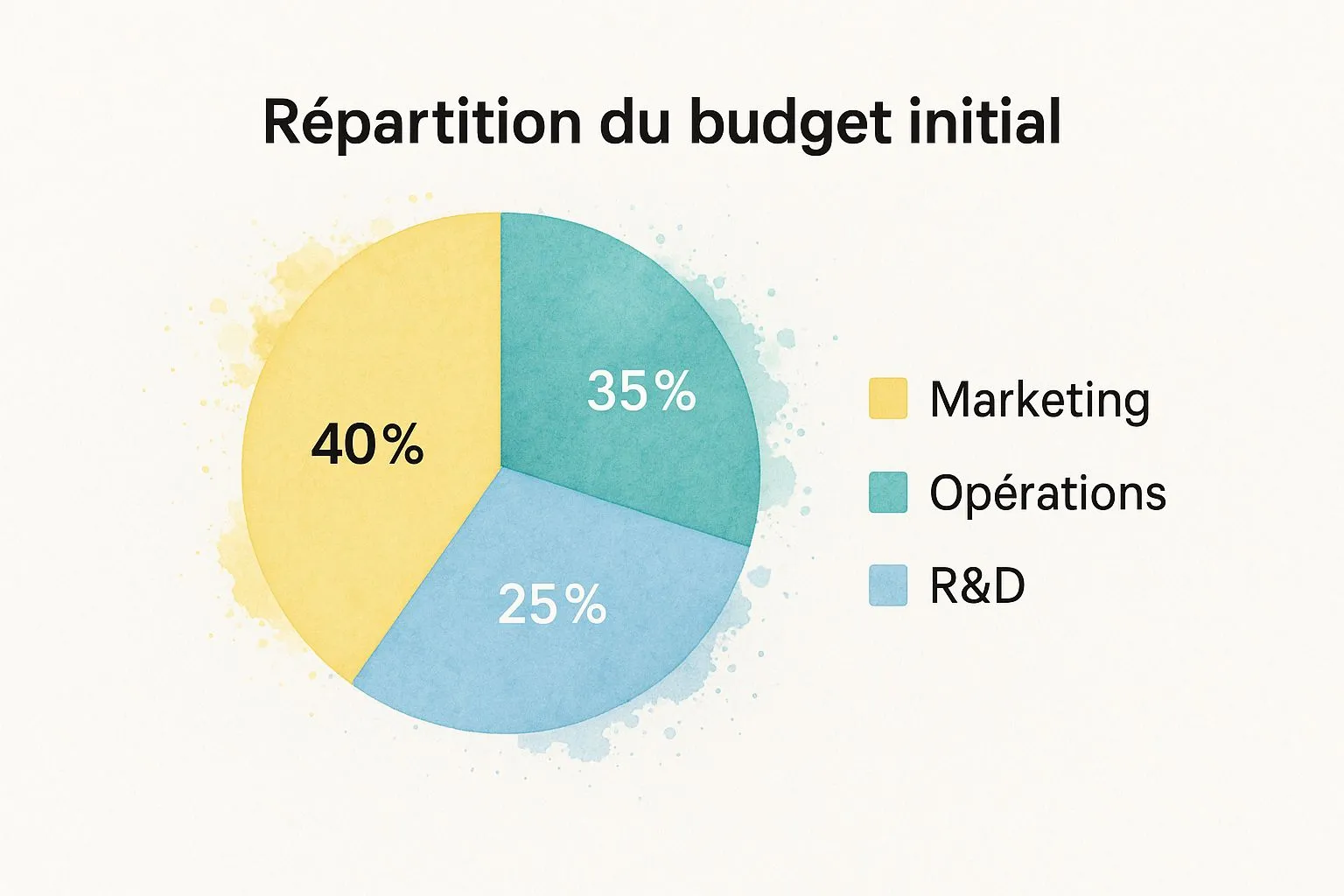
The infographic above shows an ideal budget breakdown for growing a business: 40% for marketing, 35% for operations, and 25% for research and development (R&D). This breakdown highlights the importance of marketing for customer acquisition, while maintaining a balance with operational aspects and innovation. Customer acquisition is the engine of growth, but it’s essential to choose the right strategies. The goal isn’t quantity, but quality and precise targeting.
Personalized prospecting: the key to lasting relationships
In an environment saturated with information, personalized prospecting is essential. It involves targeting specific prospects with messages tailored to their needs and interests. Much like an angler choosing the most effective bait to attract the fish they’re after. Personalized prospecting significantly increases the conversion rate. For effective growth, it’s therefore crucial to identify your ideal customer and offer them tangible added value.
To illustrate the importance of a personalized approach and the various acquisition channels available, here is a comparison table:
Comparison of customer acquisition channels
Comparative analysis of different customer acquisition channels by cost, effectiveness, and return-on-investment timeframe
| Acquisition channel | Average cost | Conversion rate | ROI timeframe | Ease of implementation |
|---|---|---|---|---|
| Social media (targeted advertising) | Moderate | Variable depending on platform and targeting | Short to medium term | Easy |
| Search engine optimization (SEO) | Low to medium | High in the long term | Medium to long term | Complex |
| Influencer marketing | Variable depending on the influencer | High potential, but hard to measure | Short to medium term | Moderate |
| Email marketing | Low | Moderate | Short term | Easy |
| Partnerships | Variable | Hard to measure | Medium term | Moderate |
This table highlights the strengths and weaknesses of each channel. The optimal choice depends on your industry, your budget, and your goals.
High-performing digital marketing: attracting and engaging your audience
Digital marketing is an essential lever for growth. It allows you to reach a wide audience at a lower cost and precisely measure the effectiveness of your actions. Social media, search engine optimization (SEO), and online advertising campaigns are powerful tools. An effective digital strategy requires in-depth market analysis and constant adaptation to new trends. The rise of video marketing, for example, offers opportunities to stand out. You might be interested in this article: How to find customers.
Strategic partnerships: strength in numbers
Strategic partnerships can be decisive. Collaborating with complementary businesses provides access to new markets, pools resources, and builds credibility. An electric bike manufacturer, for example, might partner with a chain of sporting goods stores. Identifying the right partners and building lasting relationships is crucial.
The conversion funnel: a key concept
The conversion funnel represents the customer journey, from first contact to final purchase. It breaks down into several stages: awareness, interest, desire, and action. Each stage requires specific marketing actions. Educational content can spark interest, while customer testimonials can strengthen purchase intent.
Building loyalty to create ambassadors
Acquiring new customers comes at a cost. Retaining existing customers and turning them into ambassadors is therefore essential. A satisfied customer recommends your products, generating new opportunities. Loyalty programs, quality customer service, and personalized communication all contribute to retention. Growing a business is an ongoing challenge that requires mastering customer acquisition, adaptability, and a long-term vision.
Optimizing your operations to support expansion

To successfully expand, having optimized operations is essential. Picture a race car: engine power alone isn’t enough to win. You also need high-performance tires, precise steering, and a solid chassis. In the same way, growing a business relies on smooth, efficient operations. This section explores concrete optimizations to support ambitious expansion.
Intelligently automating repetitive processes
Automating repetitive tasks is a powerful lever for improving efficiency. Take the example of invoicing software like Bizyness. It automates invoice creation and sending, freeing up time for higher-value activities.
This time savings translates not only into lower costs, but also fewer human errors. Freed from tedious tasks, your teams can focus on more strategic missions for the company’s growth.
Managing the supply chain effectively
Faced with growing demand linked to expansion, an efficient supply chain is essential. You need to optimize inventory, manage supplier relationships, and ensure flawless logistics.
A delivery delay or stockout can affect customer satisfaction and slow your growth. Picture a restaurant running out of key ingredients: delays and unhappy customers are inevitable.
Continuously improving productivity
Improving productivity is an iterative process. It involves identifying bottlenecks, defining relevant key performance indicators (KPIs), and continuously optimizing processes.
Analyzing production times, for example, can reveal areas for improvement and enable efficiency gains. Using data for informed decision-making is also a major asset for optimizing operations and supporting growth.
Identifying and eliminating bottlenecks
Bottlenecks are weak points in your operations that limit your growth. They can occur at different levels: production, logistics, customer service, and so on.
Identifying and eliminating them is crucial to optimizing your operations and supporting your expansion. A bottleneck is like a pinched garden hose: water struggles to get through. It limits the flow of your operations and slows your growth.
Using data to make informed decisions
Today, data is a valuable resource for growing a business. Analyzing sales data, marketing performance, and production indicators helps identify growth levers and optimize operations.
Data analysis tools allow you to track performance in real time and adapt your strategy based on results. Data enables informed, fact-based decisions and helps anticipate operational challenges.
It allows you to build scalable systems, capable of supporting fast, sustainable growth. Optimizing your operations is therefore essential for successfully growing your business. Solid, scalable systems will let you manage growth and achieve your goals.
Financing your growth intelligently
Growing a thriving business requires careful financial planning. Choosing the right funding sources is essential to laying solid foundations and ensuring sustainable growth. This guide explores the various options available, helping you navigate the complex world of business financing and select the solutions best suited to your needs.
Financing options: a strategic choice
Finding the right financing is crucial to growing your business. There are many options, each with its own advantages and disadvantages. Here is an overview of the main sources:
- Bank loans: Traditional bank loans remain a common option. A solid business plan and collateral are generally required.
- Private investors (business angels, investment funds): These investors bring not only funds but also valuable expertise and networks. They look for businesses with strong growth potential.
- Crowdfunding: Crowdfunding allows you to raise money from a large audience through dedicated platforms. It’s an interesting option for innovative or high social-impact projects.
- Public grants and subsidies: Various public bodies offer financial support to businesses, often in the form of non-repayable grants. It’s essential to research the programs available.
To help you compare these different options, we’ve prepared a summary table:
Financing sources for business growth
Comparison of the main funding sources by characteristics, typical amounts, and eligibility conditions
| Type of financing | Average amount | Time to obtain | Main conditions | Advantages |
|---|---|---|---|---|
| Bank loan | Variable | 2 weeks to 3 months | Collateral, solid business plan | Accessible financing, potentially low interest rates |
| Private investors | Variable, often higher than bank loans | 3 to 6 months | High growth potential, experienced team | Investor expertise and network, strategic support |
| Crowdfunding | Variable, depends on the project and platform | Campaign duration (4 to 8 weeks) | Attractive project, effective communication, engaged community | Increased visibility, market validation, pre-sales |
| Public grants | Variable, depends on the program | 3 to 12 months | Specific eligibility criteria (innovation, job creation…) | Non-repayable financing, support for innovation |
This table offers an overview of the possibilities. Feel free to research each option in more depth.
Building a solid financing file
A well-prepared file is essential to convince lenders. It must be clear, concise, and present your project convincingly. Here are the key elements:
- Detailed business plan: Describe your strategy, target market, financial projections, and team. Use figures to support your arguments.
- Compelling presentation: An attractive visual presentation is essential to capture investors’ attention. Pay attention to layout and content.
- Realistic financial forecasts: Credible financial projections, based on solid assumptions, are essential to demonstrate your project’s viability.
Negotiating and managing your growth
Once financing is secured, negotiating terms is an important step. Whether it’s a loan or an investment, you need to optimize the contract terms. Repayment period, interest rate, and equity stake are all factors to consider.
Managing growth is just as crucial. Anticipate your needs in terms of human resources, premises, and equipment. Rigorous cash flow management is essential to ensure your company’s longevity.
Attracting investors: practical tips
To convince investors, highlight your project’s growth and profitability potential. Present your competitive advantages, the quality of your team, and your long-term vision. Investors look for ambitious projects and passionate teams.
Financing your growth is a complex process that requires a well-defined strategy. By following this advice, you’ll maximize your chances of success and give your business the means to achieve its ambitions.
Growing your team without losing your culture
Growing your business inevitably means growing your team. This growth inevitably changes interactions and dynamics within the company. Recruiting, training, and retaining talent then becomes a crucial challenge, especially in a context of rapid growth. How can you preserve your company’s essence and values while expanding it?
Identifying key skills for your expansion
It’s essential to identify the skills you’ll need to support your growth. For example, if you’re targeting international markets, language skills and knowledge of target markets will be essential. This precise targeting will let you optimize your recruitment and training efforts and build a team capable of meeting the challenges of expansion.
Attracting profiles that share your values
Recruiting the right people isn’t just about technical skills. Alignment with your company’s values and culture is just as important. Imagine a family-spirited, collaborative company hiring an authoritarian manager: friction would be inevitable. Bringing in people who share your values makes their integration easier and preserves your company’s spirit. You might be interested in: Tax optimization for sole traders.
Creating a motivating work environment
A stimulating, fulfilling environment is essential to motivate and retain your teams. Offer growth opportunities, encourage initiative, and foster internal communication. A valued employee with opportunities for advancement will be more engaged and productive. A positive environment strengthens the sense of belonging and preserves company culture, even during rapid growth.
Delegating effectively without losing control
As your team grows, delegation becomes essential. Learn to hand off responsibilities while maintaining appropriate oversight. Clearly define objectives, deadlines, and resources. Delegation frees up time for strategic tasks and develops autonomy and leadership within the team.
Developing leadership at every level
Leadership shouldn’t be confined to management. Encourage its development at every level of your company. Offer management training, opportunities to take on responsibility, and set up mentoring. Developing leadership fosters initiative and autonomy, essential for supporting growth. Shared leadership helps manage transitions better and preserve company culture despite the arrival of new team members.
Preserving company culture during growth
Your company culture is a major asset. Communicate regularly about your values, organize internal events, and encourage interaction between longtime and new employees. Nurturing your culture creates a sense of belonging and ensures the longevity of your company’s original spirit despite its growth. Growing a business is a human adventure. By taking care of your teams and nurturing your culture, you build the foundations for sustainable, harmonious growth.
Measuring, adjusting, and accelerating your growth
Growing a thriving business requires constant monitoring, regular adjustments, and close attention to performance indicators, much like flying a plane. This section explains how to evaluate the effectiveness of your actions, identify the most profitable growth levers, and adapt your strategy in real time to grow your business.
Key performance indicators (KPIs)
For effective management, it’s essential to rely on key performance indicators (KPIs). These measures, specific to your industry, quantify your progress and highlight areas for improvement. Take the example of an online store: conversion rate, average order value, and bounce rate are crucial KPIs. They provide insight into the effectiveness of your website and marketing efforts.
The dashboard is another essential tool. It centralizes important data and provides an overview of performance, much like an airplane cockpit. Your dashboard should allow for quick visualization of important KPIs and identification of trends.
Building an effective dashboard
An effective dashboard is clear, concise, and relevant. The goal isn’t to accumulate data, but to select the information that’s truly useful for decision-making. Focus on the KPIs that reflect your strategic goals.
If your goal is to increase revenue, closely monitor the number of customers, average order value, and conversion rate. To improve customer satisfaction, measure retention rate, positive reviews, and customer service response time.
Here are a few examples of indicators to include:
- Revenue: its trend across different periods (month, quarter, year).
- Customer acquisition cost (CAC): expenses incurred to acquire a new customer.
- Customer lifetime value (CLV): average spending by a customer throughout their relationship with the company.
- Churn rate: percentage of customers lost over a given period.
Using data to identify opportunities
Collecting data isn’t enough; it must be analyzed to extract relevant conclusions. Data analysis tools help identify trends, correlations, and anomalies. A sudden drop in web traffic, for example, may signal a technical problem or a search algorithm change.
Data analysis also helps identify profitable growth levers. If a social media advertising campaign generates a high return on investment, it may be worth increasing the budget allocated to that channel.
Anticipating and responding to market changes
Measuring and analyzing performance helps anticipate difficulties and respond quickly. A drop in conversion rate may indicate a website usability problem or a lack of clarity in your offer.
Data analysis also helps you seize opportunities. Rising demand for a specific product may encourage the development of a new range or the introduction of targeted promotional offers.
Sustaining your company’s growth
Growing a business is a marathon, not a sprint. It’s crucial to put processes and tools in place to track performance over the long term. Regularly analyzing KPIs and adapting your strategy help maintain a sustainable growth trajectory.
In conclusion, measurement, analysis, and constant adaptation are the keys to successful growth. Like a pilot, you need to monitor the instruments, adjust course, and anticipate turbulence to reach your destination. Bizyness, a simplified management tool for small businesses and sole traders in France, supports you by automating your invoices, VAT, and financial transactions. Focus on what matters: growing your business. Simplify your management with Bizyness.
