

 Français
 How to Improve Cash Flow as a Sole Trader
Discover how to improve your cash flow with concrete strategies. A practical guide to securing your sole trader business finances.

For a sole trader, improving cash flow often comes down to one simple thing: making money come in faster and go out more slowly. In practice, that means optimizing your invoicing to reduce payment delays, tracking unnecessary expenses, and anticipating upcoming financial needs. This is what lets you pay your bills with peace of mind and invest in the future.
Your cash flow, much more than just a number

Cash flow is the real pulse of your independent business. It’s the oxygen that lets you not only hold on, but also grow. When it’s healthy, it gives you the freedom to steer your business instead of just enduring it.
Yet many entrepreneurs put it aside, often for lack of time or because the economic reality is tense. This isn’t just a feeling: a recent survey found that 34% of small and medium businesses consider their cash flow situation difficult. A figure that clearly shows the pressure weighing on small structures. You can find all the details in the findings of the survey conducted by Bpifrance and Rexecode.
Getting a handle on your business flows
Cash flow is simply the difference between what comes in and what goes out of your account over a given period.
- Inflows (receipts): these are payments from your clients, expense reimbursements, etc.
- Outflows (disbursements): here we’re talking about your social contributions, your taxes, equipment purchases, or your professional subscriptions.
A positive cash flow means you’re bringing in more money than you’re spending. That’s the number one goal of healthy management.
Working capital requirement, the friend too often ignored
Another key concept is working capital requirement (WCR). Don’t run away, the term sounds more intimidating than it actually is! It simply refers to the time gap between when you pay your own bills and when your clients pay you.
Let’s take a concrete example: a freelance graphic designer buys a software license (immediate outflow) for a project that won’t be paid until 60 days later. WCR is the money they have to “advance” in order to work during those two months.
By mastering these two concepts, you turn an administrative chore into a real strategic lever. You become able to anticipate hard times, but above all to seize opportunities, like investing in new equipment on sale without endangering your financial balance.
Speeding up your incoming payments without upsetting your clients
Waiting for invoices to be paid is often the independent worker’s worst enemy and a real poison for cash flow. The good news is that there are very concrete levers to reduce these delays, without turning into an aggressive creditor. In reality, everything is decided well before you even send the invoice.
It’s about changing your posture: instead of passively waiting for the money to arrive, you put active management in place to secure and speed up every payment. This is a shift that can literally transform your day-to-day cash flow.
Clear invoices for fast payments
The first thing to do, and the simplest, is to take care of your invoices. A clear invoice, one that leaves no room for doubt, is an invoice that gets paid faster. It must be flawless, both in substance and in form.
Think of your invoice as an instruction manual for paying you. The simpler and more precise it is, the faster you’ll get paid.
- Mandatory legal information: Invoice number, date, your contact details and the client’s, your business registration number, and the well-known “VAT not applicable” mention if you’re under the VAT exemption scheme. A single mistake can hold up the process at your client’s end.
- Payment terms: Never leave this field blank or vague. State clearly “Payment on receipt” or “Payment within 30 days.” Most importantly, this condition should be agreed upon as early as the quote signing. No surprises!
- Service details: Be precise. A vague label like “Services rendered” is an open door to delays. Your client’s accounting department will have to call to find out what it’s about, and your invoice will end up at the bottom of the pile.
The deposit, your best insurance against unpaid invoices
Asking for a deposit isn’t a sign of distrust, it’s a sound and increasingly standard business practice. For long or high-value projects, it’s even essential. It’s the best way to secure a minimum of cash flow and make sure of your client’s real commitment.
Don’t feel awkward about asking for a 30% deposit when the quote is signed. This covers your initial costs and reduces the risk on the remaining balance accordingly. For projects spread over several months, consider staged invoicing: 30% at the start, 40% at a key milestone, and 30% on delivery. Your working capital requirement will thank you.
To get paid faster, make life easier for your clients
The easier it is to pay you, the faster you’ll get paid. It’s as simple as that. The idea is to remove every possible friction at the moment of payment.
Offering online payment directly on your invoices is a real turning point. Solutions like Stripe or PayPal let your clients pay by card in just a few clicks, without having to log into their bank to make a transfer. Invoicing tools like Bizyness can even automate adding these payment links to every invoice. It’s smooth for you, and super simple for your client.
On average, invoices offering an online payment option are settled twice as fast. That’s a significant gain in time and peace of mind.
Setting up a respectful but firm follow-up process
Even with all these precautions, payment delays do happen. What matters is having an action plan so you don’t let the situation drag on and, above all, so you don’t have to figure it out under pressure.
- The friendly little reminder (D+1 after the due date): A simple, courteous email is more than enough. “Hi [First name], unless I’m mistaken, it looks like invoice #XXXX, due yesterday, hasn’t been paid yet. Could you take a look?”
- The firmer follow-up (D+15): Step it up a notch, with a phone call if possible, followed by an email. “I’m following up regarding invoice #XXXX, still unpaid. Are you facing any particular difficulty with the payment?”
- The formal notice (D+30): This is the last warning before moving to collections. Sending a registered letter with acknowledgment of receipt is necessary here. Explicitly mention the legal late-payment penalties.
This gradual approach has the double advantage of preserving your client relationship while showing that you manage your business seriously. It’s an essential balance to strike.
Turning your working capital requirement into an advantage
Working capital requirement (WCR) may sound like a term reserved for accountants, but it’s a very concrete reality for any independent worker. Simply think of it as the gap between when you pay your own bills (suppliers, software, raw materials) and when your clients finally pay you. If you have to pay your rent and groceries before receiving your paycheck, you intuitively understand the problem. That’s exactly what WCR represents for your business.
The goal, then, is to reduce this gap to the strict minimum. A high WCR forces you to constantly “advance” money to keep your business running, which puts enormous pressure on your cash. By mastering it, you don’t just relieve financial stress; you turn a constraint into a real asset, freeing up cash to invest or simply to have more peace of mind in the face of the unexpected.
Negotiating payment terms with your suppliers
One of the most direct ways to act on your WCR is to try to align your outgoing payments with your incoming ones. It’s fairly simple: if you systematically pay your suppliers within 30 days while your clients pay you on average within 60 days, you create a permanent 30-day cash gap that you have to finance yourself. The key lies in negotiation.
Dare to discuss payment terms, especially with your regular suppliers. Explain to them that an extended payment period, for example 45 or 60 days end of month, would let you secure your business relationship over the long term and guarantee regularity in your orders.
Too many entrepreneurs don’t dare to negotiate. Yet a supplier will often prefer to grant a delay to a good client rather than risk losing them. Trust and transparency are your best arguments.
This image illustrates well how synchronizing payments works as a regulator for your cash flow.
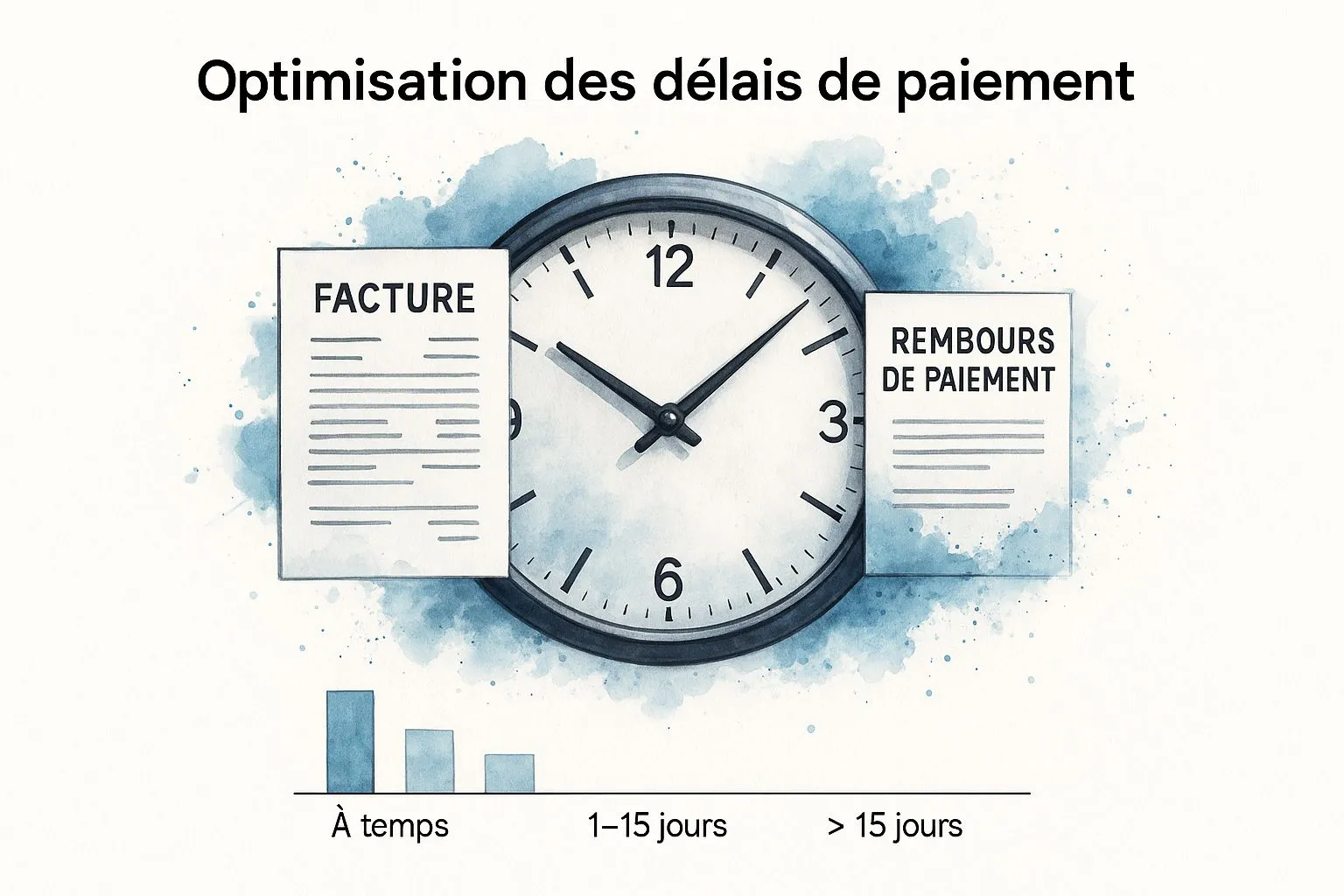
Picturing invoices and payments as the gears of a clock, you realize that every day gained on a payment has an immediate impact on the cash you have available.
Optimizing your inventory management
If you sell physical products, whether you’re an e-commerce seller or a craftsperson, your inventory is at the heart of your WCR. Every product sitting on a shelf is money asleep. The goal obviously isn’t to reach zero stock, but to manage it in a much more agile way.
Adopting a “just-in-time” approach can literally change the game. The principle is to only order your raw materials or finished products once you receive a firm order from a client.
Here are a few concrete ways to get there:
- Analyze your sales: Identify your star products, the ones that sell fast, and the ones gathering dust. Concentrate your stock on the former and consider only ordering the latter on demand.
- Define a minimal safety stock: For your best-sellers, keep just enough stock to hold you over until your supplier delivers, but no more.
- Consider dropshipping for certain items: For less in-demand or very expensive products, dropshipping is an excellent option. Your supplier ships directly to the client, which saves you from having to finance the stock.
For example, a jewelry maker could keep the most popular beads and chains in stock, but only order rarer semi-precious stones after a client has confirmed a specific order. This fine-tuned management instantly frees up cash that would otherwise be tied up on a shelf. It’s a direct action to improve your cash flow without hurting your ability to sell.
This table sums up the three main levers for reducing your working capital requirement and their direct impact on your cash flow.
Your levers for optimizing WCR
| Lever | Main goal | Concrete example |
|---|---|---|
| Accounts receivable | Get paid faster | Ask for a 30% deposit at order |
| Accounts payable | Pay more slowly | Negotiate a 60-day payment term instead of 30 |
| Inventory management | Reduce dormant stock | Order expensive products only on client demand |
By playing on these three fronts, you actively regain control of your WCR. Every small optimization helps strengthen your business’s financial health.
Spending smarter to strengthen your cash flow
Cutting costs doesn’t necessarily mean slowing down your growth. Quite the opposite. It’s mainly about learning to spend more intelligently so that every euro invested really works for you. To improve your cash flow, you inevitably need to dive into an honest and rigorous audit of your business expenses.
This exercise is a bit like running a fine-tooth comb through all your outgoing money, from the most obvious to the most discreet. The goal is simple: understand where your money is going and decide whether each expense is justified, can be optimized, or is simply superfluous.
Tracking down unnecessary expenses and renegotiating contracts
Start with the simplest thing: hunting down dormant subscriptions. You know, that online tool you signed up for “just to see” and that you no longer use? Or that trade magazine piling up in a corner of the office? These are small water leaks that, added together, can create quite a flood in your accounts by year end.
Next, tackle your recurring contracts. Never assume they’re set in stone. Never.
- Professional insurance: Your needs have probably changed since you signed up. Take the time to use an online comparison tool. You might discover you’re over-insured or that a competitor offers much better coverage for less.
- Phone and internet plans: This market moves constantly. A simple call to your provider to renegotiate, subtly slipping competitors’ offers into the conversation, can translate into surprising savings.
- Bank fees: Go through your bank statements. Look for fees that seem excessive or services you’re being charged for but never use. Online banks, for example, often have offers much better suited and more competitive for sole traders.
Every contract you manage to renegotiate is a fixed cost reduced for good. It’s an effort you make once, but that has a direct and positive impact on your cash flow, month after month.
Identifying hidden costs and optimizing purchases
Beyond the obvious expenses, there are all these “hidden” costs that can hurt your profitability without you really noticing. This can be late-payment penalties on your social contributions (which are actually avoidable) or supply purchases made in a rush, and therefore at full price.
For your purchases, a little strategy can make all the difference. Need equipment? Plan ahead and schedule your purchases to take advantage of sales or promotions. If you work with other freelancers, why not consider pooling certain orders to access bulk pricing?
Also think about free alternatives. Before reaching for your card for paid software, explore freemium versions. Many tools offer very complete free plans, often more than enough for the needs of a sole trader just starting out.
Every euro saved isn’t just a saving. It’s a euro that directly boosts your cash flow, strengthens your ability to handle the unexpected, and finances your growth. These good practices are, moreover, the ideal complement to smart tax management. To dig deeper into the topic, check out our guide on tax optimization for sole traders.
Steer your cash flow with the right tools
Navigating blind is the best way to head straight into a financial iceberg. For an independent worker, proactively steering your cash flow isn’t an option, it’s a necessity. Everything hinges on the tools you use to move from a rear-view mirror perspective (“Where did my money go this month?”) to a predictive one (“How much will I have in 3 months to invest?”).
Getting started: a spreadsheet cash flow plan
The simplest and most accessible starting point? The good old spreadsheet, whether Excel or Google Sheets. Don’t underestimate it: it’s a fantastic first step to visualize your financial flows and start feeling the pulse of your business.
The exercise is fairly simple, but its results are powerful:
- List all your expected receipts, month by month (client payments, potential reimbursements, etc.).
- Do the same for all your upcoming disbursements (your social contributions, taxes, subscriptions, equipment purchases…).
- Calculate the balance at the end of each month.
This simple projection gives you a first map of your financial future. You’ll immediately see the months where the balance risks dipping into the red, giving you precious time to react before you’re caught off guard.
Anticipating a lean period, even just a few weeks, completely changes the game. It gives you the room to postpone a non-priority purchase or to more firmly follow up on late-paying clients.
This kind of anticipation has become even more vital today. Access to external financing is getting harder. According to the Banque de France, annual growth in business lending was only 1.2% in February, a clear sign of the impact of rising rates.
Level up with management software
The spreadsheet is a great ally for getting started, but it quickly hits its limits. The risk of data entry errors is real, manual updates are time-consuming and, let’s be honest, reliability can leave something to be desired. For truly calm and effective management, the next step is clear: adopt management software designed for independent workers.
That’s where tools like Bizyness come in. They’re specifically designed for sole traders and automate a large part of this tedious tracking. Syncing with your bank account, for example, makes tracking your money in and out instantly reliable. No more forgetting anything!
Here’s what a clear and effective dashboard can look like on Bizyness.

All the key information is centralized. At a glance, you know where you stand.
The real gain from this automation is the time and mental energy you get back. Instead of spending hours compiling numbers, you focus on what matters: analysis and decision-making. What’s more, these platforms often include features that have a direct impact on your cash flow, such as professional invoicing with built-in payment links. This approach is, in fact, the foundation of good unpaid invoice management, a topic we cover in depth in our guide on collecting outstanding client invoices.
In just a few clicks, you generate reliable forecasts and take back control of your financial future.
Your frequently asked questions about cash flow management
Even with the best strategies in the world, day-to-day cash flow management inevitably raises its share of questions. That’s completely normal. To help you see things more clearly and make the right decisions, here are the answers to the questions that come up most often among sole traders.
What’s the first indicator to watch?
If you only had to track one number, it would be this one: your available cash balance. This is the very real money sitting in your professional bank account at this exact moment.
Be careful not to confuse it with revenue or profit. It’s the immediate liquidity you have to pay your expenses, your suppliers, and of course, your social contributions. Taking a quick look once a week is an excellent habit to never be caught off guard and to make sure you can meet your deadlines.
Should you accept short-term financing?
Short-term cash credit can look like a providential lifeline when the end of the month gets tight. Yet it should be seen for what it really is: a bandage, a temporary fix, and definitely not a long-term strategy.
Use it sparingly, almost surgically, to get through a clearly identified rough patch. For example, to offset a very large client’s late payment. The essential thing is to tackle the root of the problem in parallel (payment terms too long, expenses too heavy…) so you don’t become dependent on borrowing.
The economic context inevitably weighs into the equation. A recent survey shows a slight improvement: 32% of businesses consider their cash flow difficult, down 2 points from before. Even though access to credit has eased slightly, the prevailing uncertainty remains a major obstacle for small structures. To better understand this context, you can read the full analysis by Bpifrance and Rexecode.
How often should you update your forecast?
As a sole trader, consistency is your best ally. A monthly update to your cash flow forecast is an excellent cruising pace. It gives you the chance to adjust course based on the invoices you actually collected and the expenses of the past month.
That said, stay flexible. If your business is picking up sharply, with new contracts and rapidly changing expenses, don’t hesitate to switch to an update every two weeks, or even weekly. Your management tool needs to match the reality of your business. Also remember to plan ahead for major tax deadlines, such as your VAT return, which have a direct impact. If this topic feels unclear, our article on VAT for sole traders is here to help.
How to react to a large unpaid invoice?
A significant unpaid invoice can quickly upset the fragile balance of your cash flow. The worst reaction is to do nothing. You need to act, fast, and with method.
- Direct contact: From the very first day of the delay, pick up the phone. A simple oversight happens easily, and a call is often much more effective than yet another email that will get lost in the pile.
- Formalization: If the call hasn’t yielded results after a few days, move to writing. A first follow-up by email, followed by a formal notice letter sent by registered mail with acknowledgment of receipt to make your point.
- Escalation: If the dialogue has broken down, don’t wait months. Quickly consider stronger solutions, such as calling on a collection agency or launching a payment order procedure.
And while you’re dealing with this, immediately reassess your own expenses. Anything that isn’t urgent should be postponed to preserve every euro of liquidity.
By applying these few tips and equipping yourself with the right tools, you can truly transform your cash flow management. From a source of stress, it will become a powerful lever to secure and grow your business. To go further and automate a good part of this tracking, discover how Bizyness simplifies daily life for sole traders by centralizing invoicing, payment tracking, and cash flow management.
