

 Français
How to reduce income tax as a sole trader?
Reducing your income tax as a sole trader is possible, under certain conditions. Discover the tips for lowering your income tax while staying fully within the law.

By choosing the sole trader (micro-entrepreneur) status, you opt for a simplified tax and social security framework. It’s important to fully understand how your legal status works, so you can make the most of it and select the best options to optimize the income tax you owe. In this guide, we explain how to reduce your income tax, while of course staying within the law.
The tax system for sole traders
The sole trader regime is a simplified regime under which you are subject to personal income tax (IR) rather than corporate tax (IS), even though you run a business. You benefit from special conditions, namely the micro-fiscal regime for income tax and the micro-social regime for social contributions.
Eligibility for this status is determined by revenue thresholds, which must not exceed the following amounts:
- €77,700 for services falling under the BIC (industrial and commercial profits) or BNC (non-commercial profits) categories;
- €188,700 for the sale of goods, merchandise, supplies, or food to take away or eat on site, or for accommodation services, including classified tourist furnished rentals, except for the rental of furnished residential premises, for which the threshold is €77,700;
- for mixed activities (sales and services), total revenue must not exceed €188,700, including a maximum of €77,700 for services.
Thanks to this micro-fiscal regime, you benefit from lighter tax and accounting obligations. As a sole trader, you declare your income on your income tax return (form no. 2042-C-PRO, an appendix to form no. 2042) together with the other income of your tax household.
Whatever your activity, you declare the gross revenue excluding tax. It is up to the tax authorities to deduct the flat-rate allowance that is automatically applied. As a result, your taxable base is subject to the progressive income tax scale, just as it is for employees or retirees.
Social contributions proportional to your revenue
The sole trader regime is inherently favorable for reducing income tax, because your social contributions are calculated proportionally to the revenue you generate, unlike traditional companies that bear fixed costs. Moreover, you pay the amounts due each month or each quarter, which avoids having to provide a large sum when the deadline is annual.
Social contribution rates in 2023
Since October 1, 2022, the social contribution rates are as follows:
- 12.3% for the purchase and resale of goods (BIC);
- 21.2% for commercial or craft services (BIC);
- 21.1% for other services and self-employed professionals affiliated with the general retirement scheme (BNC);
- 21.2% for self-employed professionals affiliated with Cipav.
These rates are reduced if you are eligible for ACRE (business creator/takeover support). You benefit from the following rates for the first 12 months of your activity:
- 6.2% for the purchase and resale of goods (BIC);
- 10.6% for commercial or craft services (BIC);
- 10.6% for other services and self-employed professionals affiliated with the general retirement scheme (BNC);
- 12.1% for self-employed professionals affiliated with Cipav.
The sole trader flat-rate allowance
The flat-rate allowance reserved for sole traders naturally helps reduce income tax, since it is a fixed amount automatically applied to your revenue, whatever your activity. It amounts to:
- 34% for BNC service activities;
- 50% for BIC service activities;
- 71% of revenue for sales activities.
This allowance may seem very generous, but there’s a reason for it: a sole trader cannot deduct any expenses, unlike in a traditional company. You must cover all your own costs — company vehicle, purchase of supplies or raw materials, rent, subscriptions, and so on. The flat-rate allowance is therefore designed to compensate for this inability to deduct your actual expenses.
Reducing income tax by passing costs on to your client
Since your expenses aren’t deductible, they eat into your margin. Nothing stops you from asking your client, transparently and legally, to cover part of these costs.
If you’re a craftsman, for example, and need to buy raw materials for a construction or repair job, your client can pay for them directly. You won’t make any margin on them, but you’ll be paid for your labor. The amount spent on that purchase won’t then count toward your revenue. As a result:
- You won’t pay contributions on the purchase of raw materials;
- You delay reaching the maximum sole trader threshold too quickly;
- You will reduce your income tax, because you don’t declare that amount.
On this last point, not only is your income declaration legally lower, but you also improve your chances of staying in the lowest possible tax bracket, as shown in the table below.
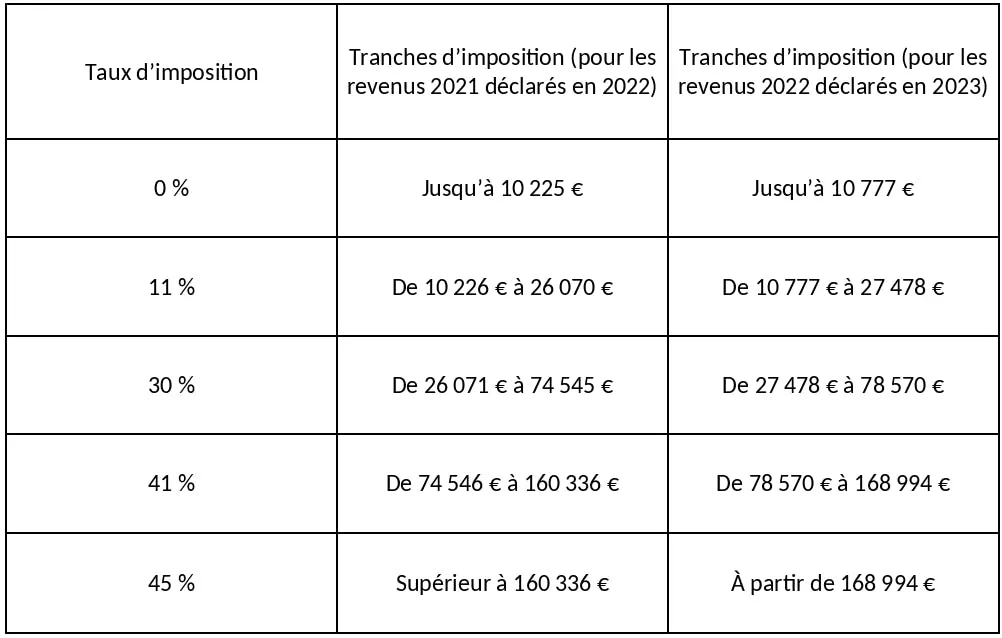
Having your client pay for raw materials directly is also beneficial for them, since they know for certain that you’re not taking a margin on their materials. On the other hand, if they’re billed directly, you still handle selecting the products and getting them to the job site, so nothing changes for them in practice.
You can adapt this method to other situations too. For example, you could pass on the cost of renting a tool or piece of equipment needed for a job.
The final flat-rate tax payment (versement fiscal libératoire) to reduce income tax
To reduce income tax, sole traders can opt for a scheme called the final flat-rate tax payment (versement fiscal libératoire).
N.B. Be careful, this isn’t beneficial for everyone. Before deciding whether or not to opt for the final flat-rate tax payment, you should draw up a forecast of your business and run the numbers to determine the most advantageous solution for you.
You must also respect the deadlines set by the tax authorities. The option for the final flat-rate tax payment must be exercised by September 30 of the year preceding the one to which it applies, or by the last day of the third month following the creation of the business.
The final flat-rate tax payment lets you pay a percentage of your revenue at the same time as your social contributions, monthly or quarterly. You no longer benefit from the allowance or the progressive income tax scale, but when it comes to your annual income tax return, you have no amount related to your sole trader income to declare. It can therefore be a way to reduce your income tax.
Conditions for the final flat-rate tax payment
The final flat-rate tax payment is calculated by applying a rate to your revenue excluding tax, which varies depending on the nature of the activity. The rates are as follows:
- 1% for the sale of goods, merchandise, supplies, and food to take away or eat on site, or for the provision of accommodation, except for furnished rentals;
- 1.7% for service activities;
- 2.2% for taxpayers under the BNC regime.
Filing your tax return if you opted for the final flat-rate tax payment
The amount of your revenue must be entered on the supplementary income tax return no. 2042-C PRO, in the box under the “Micro-entrepreneur having opted for the final flat-rate tax payment on income” section, corresponding to the nature of your activity.
