

 Français
How to write a professional, clear quote example
Learn how to write a quote example that turns prospects into customers. Practical guide with tips, legal mentions and tricks to convince.

Building a solid quote isn’t just about listing your services and calculating a price. Think of it as your very first professional business card: a document that must be clear, complete and, above all, legally sound. It’s the foundation of trust with your client, and once signed, it binds both parties.
The foundations of a quote that inspires confidence

A well-crafted quote is much more than a simple price proposal. It’s the cornerstone of your future client relationship. From the very first contact, it reflects your professionalism and transparency.
Far from being a mere formality, this document becomes a genuine contract as soon as it’s accepted. It protects both you and your client. In France, certain information is absolutely essential for a quote to be valid.
Clearly identify who is who
The first thing to do, and this is the basics, is to state without any ambiguity who is offering the deal and to whom it’s addressed. It may seem obvious, but a simple omission can invalidate your quote.
So make sure you’ve included:
- All your business information: your name, your registered office address, your SIRET number and, if applicable, the mention “EI” or “Entrepreneur Individuel” (sole trader).
- Your client’s precise details: their full name or company name, along with their address. This is essential so it’s clear exactly who you’re addressing.
A document that’s vague on these points can not only create confusion, but also weaken its legal value if a dispute arises.
Don’t confuse a quote with an invoice — it’s key to good management
To avoid accounting headaches, it’s crucial to clearly distinguish between a quote and an invoice. The quote is a proposal before the job, while the invoice is a request for payment once the work is finished.
If you’d like to dig deeper into this distinction and understand its importance, I recommend reading our full guide that explains in detail what a quote is.
Did you know? A quote signed by your client with the mention “Bon pour accord” or “Bon pour travaux” (approved for work) carries the same value as a contract. It’s a firm commitment: you must carry out the services, and the client must pay you the agreed amount.
Don’t forget to give each quote a unique number and to state its issue date. This is a legal requirement, but it’s also an excellent way to keep your files organized.
Finally, remember to set a validity period for your offer (usually between 1 and 3 months). This is a strategic detail that protects you if the cost of your raw materials rises, and it encourages your client to make up their mind without delay. Every mention counts when building a solid, professional relationship.
How to structure a quote so it makes people want to sign
A quote that complies with the law is the baseline. But a quote that persuades your prospect to become a client, that’s the real goal. How you structure your offer is just as decisive as the legal mentions. It’s what turns a simple price list into a value proposition that hits the mark.
The goal is simple: your client should understand at a glance what you bring them and why they should choose you over anyone else. To achieve this, banish vague descriptions. Every product, every service, deserves its own clear, detailed line. Clarity is your best persuasion tool.
The power of a well-detailed quote
The secret to a convincing offer is precision. Rather than presenting one big catch-all “package”, take the time to break down your work. This is an approach that reassures and shows your seriousness.
Each line of your quote should be a mini identity card for the service:
- A precise description, that speaks to the benefits for the client.
- The quantity: whether it’s hours of work, square meters, days or units.
- The unit price excluding tax (before VAT).
- The applicable VAT rate (20%, 10%, 5.5% or 0% if you’re not liable).
- The total amount excluding tax for that specific line.
This method has a dual benefit. On one hand, it lets the client follow your logic and understand where every euro goes. On the other, it builds a climate of trust. Transparency is the first step toward a signature.
A detailed quote is proof of your expertise. It shows you took the time to thoroughly analyze the request. It’s a mark of professionalism that instantly sets you apart from competitors who send off proposals in a rush.
This approach is particularly essential in sectors like construction. Did you know that 96% of the 381,000 construction companies in France are small structures with fewer than 10 employees? For these tradespeople, breaking down costs (materials on one side, labor on the other) isn’t optional — it’s a necessity to justify their rates in a highly competitive market. For those interested in the figures, you can check out these construction industry statistics.
Don’t sell tasks, sell solutions
The way you word your services can change absolutely everything. Don’t just list technical actions; translate them into real, concrete benefits for your client. Your quote should tell a story: the story of the solution you bring to their problem.
Let’s take an example to make this clearer:
- To avoid (too technical): “Tile installation”
- To prefer (more persuasive): “Supply and installation of full-body porcelain stoneware tiles for greater impact resistance and easier day-to-day maintenance.”
The second version doesn’t just describe the action. It explains why it’s the right choice for the client. You’re no longer selling a service, but peace of mind, durability and simplicity. It’s far more powerful.
Finally, the presentation of totals must be flawless. Clearly display the total excluding tax, the breakdown of each VAT amount by rate, and finally, the total including all taxes. This financial transparency is the finishing touch that reassures the client and encourages them to approve your proposal.
To help you apply these tips, feel free to draw inspiration from our ready-to-use quote template. It will guide you in creating documents that are both professional and truly persuasive.
Include your terms of sale to protect yourself

Once your client has signed the quote, it changes nature: it becomes a genuine contract. That’s why it’s absolutely crucial to attach your terms and conditions of sale. They set the rules of the game and cover you in case something goes wrong.
Don’t see this as a mere administrative formality. Your terms of sale are actually the legal framework that will secure your entire relationship with the client. By anticipating potential questions and problems, you spare yourself plenty of headaches.
Well-written, clear and precise clauses make all the difference. Let’s look together at what you must never forget.
Set the payment terms
This is perhaps the most sensitive point, the one with a direct impact on your company’s financial health. Good management starts with clear payment rules, established in writing from the outset.
You must clearly state how and when you expect to be paid. To do so, be sure to detail:
- The deposit: specify the percentage of the total amount to be paid before you even start. Generally, between 20% and 40% is requested. This deposit secures your mutual commitment and lets you cover your initial expenses without dipping into your cash flow.
- The installments: for projects spread over time, it’s wise to plan intermediate payments tied to reaching certain milestones. This is an excellent way to maintain steady cash flow.
- Late payment penalties: don’t be afraid to mention the consequences of a delayed payment. The law is on your side and allows you to apply penalties, as well as a flat-rate compensation for collection costs.
Defining these terms upfront removes any gray areas and drastically reduces the risk of unpaid invoices, a real scourge, especially when you’re self-employed.
Define timelines and warranties
Meeting deadlines is a pillar of client satisfaction. Your quote should therefore show a realistic estimate of the time needed to carry out the service or deliver the product.
Be as precise as possible. Give a start date and an estimated end date. This transparency is the best way to manage your client’s expectations and avoid frustrating misunderstandings for everyone.
Also remember to mention the warranties that apply to your work. If you’re in construction, for example, mentioning the perfect completion warranty or the ten-year warranty isn’t just a legal obligation. It’s a powerful sales argument that greatly reassures the client about the quality and durability of your work.
The vital reflex: A quote isn’t forever. Never forget to state a validity period for your offer, typically 1 to 3 months. This small clause protects you against price increases (of materials, for example) and encourages your prospect to make a decision.
By setting these rules from the start, you demonstrate your seriousness and professionalism. A successful quote example always includes solid terms of sale. This is what turns a simple commercial proposal into a sound, balanced contractual basis, the key to a smooth and lasting client relationship.
A tradesperson’s quote example, examined in detail
Theory is all well and good, but nothing beats a good practical example. To truly master the art of the quote, the best approach is to break down a real one. Let’s take the example of a painting contractor and see together how each element fits together to form a document that’s clear, professional and trustworthy.
To start, keep this simple pattern in mind. It’s the common thread of any well-constructed quote, from the client header to the final calculation.
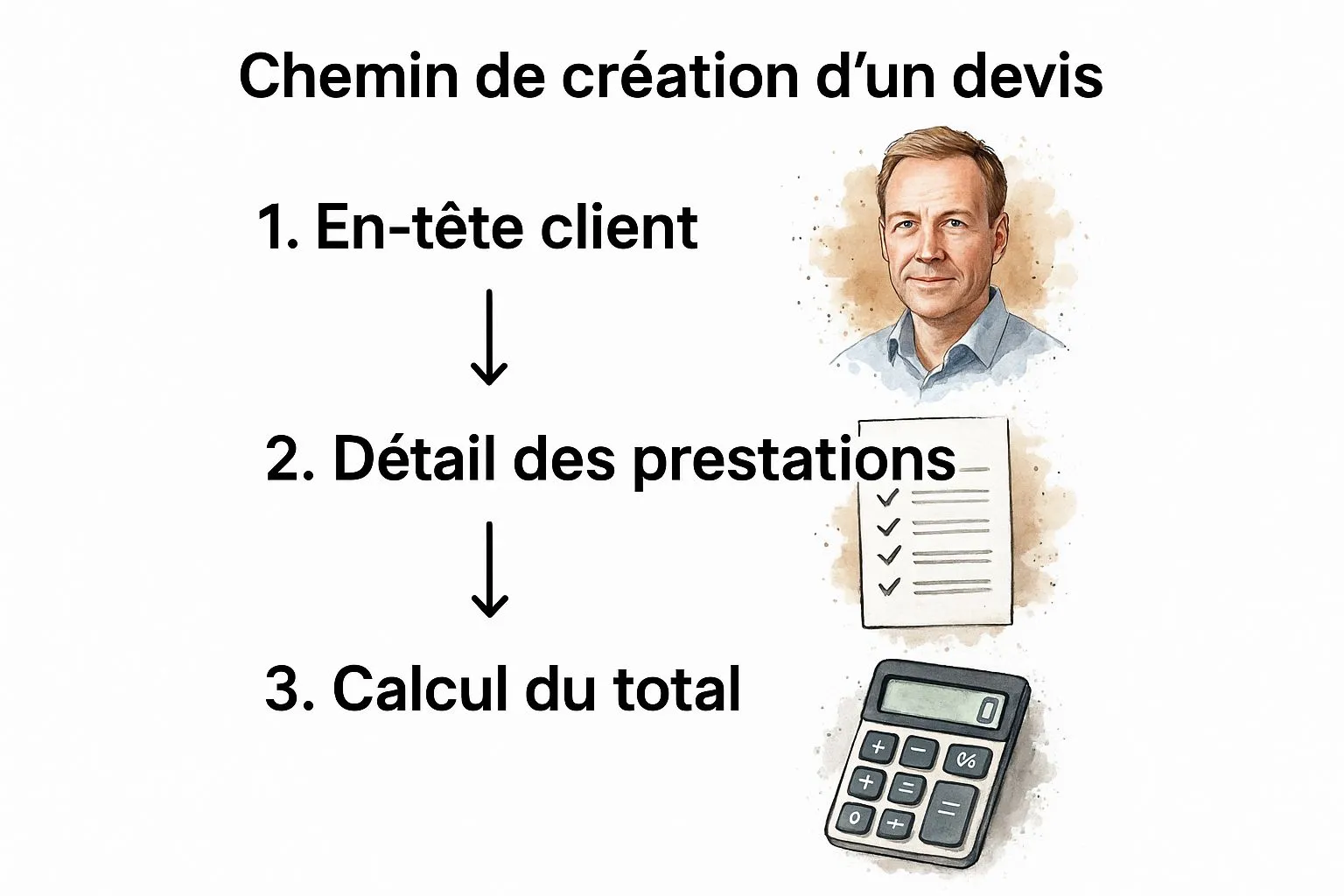
This logic is the backbone of your proposal. It takes your client by the hand and explains your offer in a structured, transparent way.
The header: who’s talking to whom?
Every good quote starts here. As you can see in the example below, both parties are clearly identified: you (the tradesperson, with your name, SIRET, address) and your client. This is the basics, the non-negotiable element for the document to have legal value.
You’ll also immediately spot the unique quote number and the date. Essential for keeping track and ensuring proper follow-up.
This visual perfectly shows how a well-crafted quote should look.
As you can see, the distinction between sections is clear: identification at the top, the body of the quote in the middle, and the footer with the totals. This clarity is essential. Your client should be able to understand your offer in a single glance.
The service breakdown: the key to trust
This is where your professionalism comes into play. Forget vague lines like “Painting work”. A reassuring quote is a detailed quote. Each step of the project becomes a separate line, with its own pricing.
- Wall preparation: washing, minor repairs, protection of floors and furniture (quantity in m², unit price).
- Paint supply: type of paint (matte, satin), brand and color (offered as a package or per liter).
- Application: applying a primer coat and two finishing coats (quantity in m², unit price).
- Site cleanup: waste removal and final cleaning (usually a flat rate).
This breakdown doesn’t just justify your price; it proves to the client that you took the time to carefully and precisely analyze their request. To better understand the logical next step, our article on the differences between a quote and an invoice will shed light on the transition to payment.
In today’s context, setting a fair price is a real balancing act. Factoring in cost inflation is no longer optional, it’s a necessity to protect your margin.
Indeed, surging prices force us to stay vigilant. The index of prices for maintenance and improvement work (IPEA) has jumped 17.6% since 2021. A significant increase, driven by the cost of materials and energy. To stay profitable, one piece of advice: consider including a price revision clause in your terms.
The footer: the numbers and the rules of the game
Finally, the footer must be crystal clear. Display without any ambiguity the total excluding tax, the breakdown of the different VAT rates if you’re subject to them, and of course, the total including all taxes the client will pay.
Above all, don’t forget to add the validity period of your offer and your payment terms (deposit, balance, deadlines). This is what turns a simple commercial proposal into a genuine contractual framework once your client has signed it.
As this example shows, with a bit of method, creating a professional quote is truly within everyone’s reach.
Choosing the right tools to create your quotes

Writing a quote can quickly become an administrative chore. It’s time-consuming and, let’s be honest, fairly repetitive. When you’re churning out commercial proposals one after another, the method you choose has a huge impact on your productivity and on the image your clients have of you. The days of spending hours filling in each line by hand are, thankfully, behind us.
The first idea that often comes to mind is using Word or Excel. We know them, we have them on hand. It’s flexible, you can create a template to your liking and master it fairly quickly.
But be careful, this artisanal approach has its limits. A small typo in an Excel formula, a price you forget to update, and the whole calculation is off. You could end up with a shrunken margin without even noticing. Managing the logical sequence of quote numbers becomes a real headache, and tracking status (sent, accepted, declined) relies on your memory or a filing system that can quickly turn into a mess.
The efficiency of dedicated invoicing software
Faced with these pitfalls, dedicated invoicing software, like Bizyness, completely changes the game. It doesn’t just generate a document; it secures and automates the entire sales chain.
Just imagine…
- A library of clients and services within reach of a click. No more retyping everything each time. You pick from your catalog, and the description, price and VAT fill in automatically.
- Guaranteed error-free calculations. The software does the math and applies the correct VAT rates for you. Your totals are always accurate, without the headache.
- Real-time tracking of your quotes. At a glance, you see where your offers stand and know exactly who to follow up with, and when.
Moving from a spreadsheet to invoicing software isn’t just about saving time. It’s a real leap forward in professionalizing the management of your business. You drastically reduce the risk of errors, improve your cash flow with rigorous tracking, and project a far more serious and organized image.
The real power of these platforms lies in their ability to link the steps together. The game-changing feature is converting a quote into an invoice with a single click. Client signs? Perfect. All the information is instantly transferred to a new invoice, ready to go. This workflow eliminates double entry and the risk of inconsistencies between your documents.
Ultimately, the choice of your tool will depend on your volume of activity. But investing in a solution designed for this frees your mind to focus on what really matters: your core business and your clients’ satisfaction.
Frequently asked questions about creating quotes
Even with the best templates in front of you, questions always come up when creating a quote. That’s perfectly normal. Sales management brings its share of tricky situations where you might hesitate on the right course of action.
This FAQ is here for that. I’ve gathered the most common questions among entrepreneurs and freelancers to help you see things more clearly and avoid small mistakes that can sometimes prove costly.
Does a signed quote have the same value as a contract?
The answer is a resounding yes. Once your client has signed the quote, adding the date and the handwritten mention “Bon pour accord” or “Bon pour travaux”, the document changes status. It becomes a contract that legally binds you.
Specifically, this signature commits both parties. On your side, you’re obligated to carry out the service as described, at the price and under the conditions set. On their side, the client commits to paying you the agreed amount. This is why a quote must be crystal clear before it’s signed.
Can I charge for creating a quote?
In principle, a quote is free. This is the norm for most services. However, the law allows you to charge for it if producing it requires substantial work.
Imagine you need to travel, conduct an in-depth study, or carry out a complex assessment that takes several hours. In that case, it’s entirely legitimate to charge for that expert time. The only condition, and it’s non-negotiable, is to inform your client beforehand and get their clear agreement on the amount. Transparency is key.
Pro tip: If you charge for a quote and the client ultimately entrusts you with the job, remember to deduct the cost of that quote from your final invoice. It’s a much-appreciated commercial gesture that strengthens the trust relationship.
How should I react if a client wants to start without signing the quote?
My answer will be direct: never start. Never. The signed quote is your only protection, your safety net. Without a signature, there’s no formal agreement, either on the scope of the job or on the price. You have no legal cover.
If a disagreement arises or the client refuses to pay, you’ll be left defenseless, without any contractual document to assert your rights. Explain calmly but firmly that this signature is an essential guarantee for them as much as for you. Besides, a client who’s reluctant to sign is often a warning sign not to be taken lightly.
Can a quote be modified after it’s signed?
Once signed, the quote is set in stone. You can no longer change it on your own. Any modification, whether an adjustment or an additional service requested by the client, must go through an amendment.
This amendment is an additional document that supplements or modifies the original contract. It must precisely describe the new tasks, their cost, and any impact on deadlines. And to be valid, it must of course be dated and signed by both parties, exactly like the original quote.
Managing your quotes and invoices shouldn’t be a chore. With Bizyness, you can create compliant, professional documents in just a few clicks, track their status in real time and turn an accepted quote into an invoice instantly. Free yourself from paperwork to focus on your core business. Try our tool now at https://www.bizyness.fr.
