

 Français
The complete guide to intra-community VAT calculation
Intra-community VAT calculation: master the calculation and reverse charge, B2B/B2C rules and filings for professionals.
Intra-community VAT can seem complex. Yet the basic principle is fairly simple. For sales between professionals (B2B), you invoice net of tax. This is the well-known reverse charge mechanism at work. For sales to individuals (B2C), you apply the VAT rate of the customer’s country. The cornerstone of the whole system? Your VAT number. It’s what opens the door to the European market and ensures your transactions are compliant.
The fundamentals of intra-community VAT you need to know
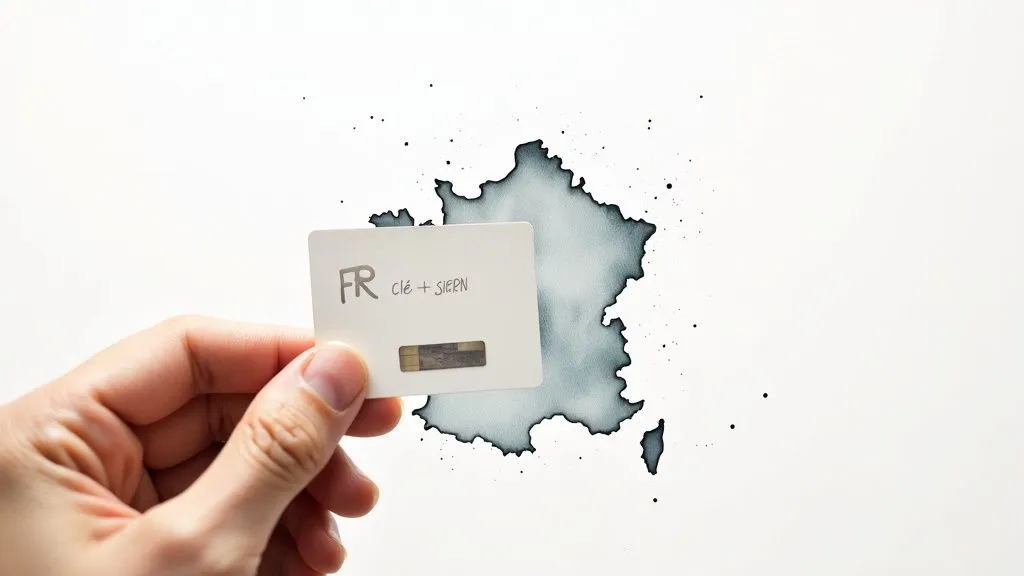
To master VAT calculation on your European transactions, you first need to understand the critical importance of the intra-community VAT number. It’s not just another number on your invoices; it’s what activates the whole trading framework within the European Union.
In practice, when you do business with another company in the EU, the first thing to do is check that both of your VAT numbers are valid. This mutual validation is what gives you the green light to invoice net of tax and lets your customer handle VAT on their end through the reverse charge. Without this identifier, forget the simplified regime.
What is your VAT number actually for?
This number is proof that you are indeed a VAT-liable business, recognized throughout the Union. It identifies you uniquely and officially within the single market.
Its structure is the same everywhere in Europe to avoid any confusion. In France, it is always made up as follows:
- The country code: FR.
- A computer key: 2 digits.
- Your SIREN number: 9 digits.
Let’s take an example: if your company’s SIREN number is 552081317, your intra-community VAT number might look like FR 03 552081317. As the government portal reminds us, every French business liable for VAT must have one for its European operations. To dig deeper, you can check the definitions on the Annuaire des Entreprises.
Why checking this number is a crucial step
Before closing a sale, always take the time to check the validity of your customer’s VAT number. The VIES (VAT Information Exchange System) online service, provided by the European Commission, is made for exactly this. It’s fast and free.
Never skip this check. If you invoice net of tax to a customer whose number is invalid, the tax authorities could come after you. They can reclassify the sale and charge you French VAT, as if you had sold in France.
It’s a simple habit that secures your transactions and protects you from a painful tax reassessment. By adopting this good practice, you ensure that the reverse charge applies legitimately. It’s an essential foundation before moving on to calculations, for which a net-to-gross converter can actually help you make quick estimates.
Navigating between B2B and B2C rules
The distinction between a sale to a professional (B2B) and to an individual (B2C) is absolutely crucial for intra-community VAT calculation. This is often where things go wrong and costly mistakes appear, because the regimes are radically different. Knowing how to switch between these two logics is the first building block for securing your European trade.
In practice, a B2B transaction with a German partner and an online sale to a Spanish customer don’t follow the same tax rules at all. Overlooking this difference exposes you to non-compliant invoices and, eventually, complications with the tax authorities.
The simplicity of B2B thanks to the reverse charge
For trade between VAT-liable professionals within the European Union, the keyword is the reverse charge. This mechanism was designed to simplify the process as much as possible for the seller.
In practice, if you sell a product or a service to a business in Italy, here’s what to do:
- Check the validity of their intra-community VAT number (this is a non-negotiable step!).
- Issue an invoice net of tax.
- Add the mention “Reverse charge by the recipient” clearly on your invoice.
Your Italian customer, in turn, handles everything. They will declare and pay Italian VAT directly to their own tax authority. For them, the operation is generally neutral: they collect the VAT and then immediately deduct it on their own return. It’s simply a bookkeeping entry with no impact on their cash flow, a mechanism designed to smooth intra-European trade.
The B2C challenge and the OSS one-stop-shop solution
Things get a bit trickier for sales to individuals. Here, the basic rule is simple to understand but more complex to apply: the VAT due is that of your customer’s country of residence, not France’s.
Before 2021, this was a real headache. Online sellers had to track revenue thresholds specific to each country. As soon as a threshold was crossed, you had to register for VAT locally and file returns there. An administrative nightmare, especially for small businesses.
Fortunately, the VAT One-Stop Shop (OSS) changed everything. Since July 1, 2021, this scheme lets you centralize everything through a single portal, the French tax authority’s.
Thanks to the OSS, you keep invoicing VAT at the rate of your customer’s country, but you declare and pay the total amount in one go in France. The French tax authority then takes care of redistributing the amounts to the relevant member states. No more multiple registrations!
To better understand the rates applicable in each country, our detailed article on VAT rate calculation will give you all the keys.
This administrative simplification is a real breath of fresh air for entrepreneurs selling online across Europe, making the single market much more accessible.
For clarity, here is a table summarizing the fundamental differences between the two regimes.
Comparison of B2B vs B2C intra-community VAT rules
| Criterion | B2B transactions (Goods & Services) | B2C transactions (Goods & Services) |
|---|---|---|
| Invoicing | Invoice issued net of tax. | Invoice issued VAT included. |
| Applicable VAT | No VAT charged by the seller. | VAT of the individual customer’s country. |
| VAT collection | The professional customer self-assesses (reverse charges) VAT in their country. | The seller collects VAT at the customer’s local rate. |
| Invoice mention | ”Reverse charge by the recipient” is mandatory. | No specific mention, standard VAT-included invoice. |
| Filing obligation | Statistical Survey on Trade in Goods (EMEBI) or Services (DES). | Filing via the One-Stop Shop (OSS). |
This table highlights the reversed logic between the two systems: in B2B, VAT responsibility shifts to the customer, whereas in B2C, it stays entirely on the seller’s side, who simply needs to use the right tools to manage it efficiently.
Putting the VAT reverse charge mechanism into practice
The VAT reverse charge can seem daunting at first, but it’s mostly an accounting exercise. Once you’ve grasped the logic, it becomes second nature and secures all your purchases of goods and services from your European suppliers. The idea is simple: on a transaction initially invoiced net of tax, you are the one who collects VAT in France on behalf of the state.
In reality, this process is completely neutral for your cash flow. You declare the VAT as if you had charged it, but at the same time, you deduct it on the same return. The financial impact? Zero. It’s a huge simplification for B2B trade within the European Union.
The journey of an intra-community purchase
To make this clearer, let’s take a practical case. Imagine your company, based in France, buys a service from an Irish company — say, a software subscription — for an amount of €1,000 net of tax.
- The invoice arrives: You receive an invoice for €1,000. It is indeed issued net of tax and must include your intra-community VAT number as well as your supplier’s.
- Calculating French VAT: It’s up to you to “self-assess” the VAT. To do this, apply the French VAT rate in force for this type of service, i.e. 20%. The calculation is simple: €1,000 x 20% = €200.
- The CA3 return: This is where the bookkeeping trick makes sense. You will enter these €200 in two separate places on your monthly or quarterly return.
This infographic will help you visualize the VAT flow in European trade, clearly showing the difference between the B2B path (via the reverse charge) and the B2C path (managed through the OSS one-stop shop).
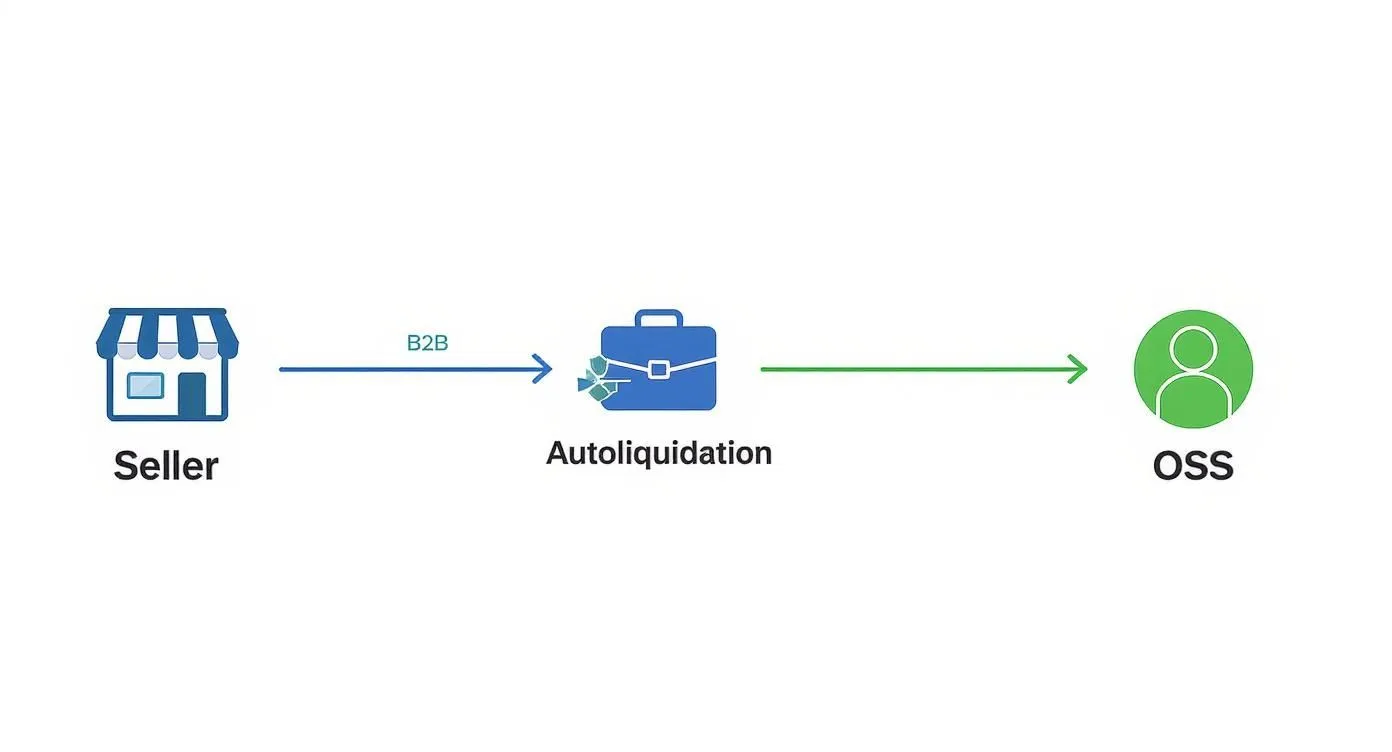
This diagram clearly shows that, in a B2B context, VAT management shifts from the seller to the buyer. A way of smoothing transactions for the supplier.
The concrete impact on your VAT return
The crucial point is to correctly fill out your VAT return (the famous CA3 form) so that the operation is neutral.
Let’s go back to our example with the €200 of VAT to self-assess:
- You first enter it in the “VAT collected” section. This is the VAT you theoretically owe the state.
- Then, you carry over the exact same amount, €200, to the “Deductible VAT” section. This is the VAT you recover on this business purchase.
The result is a wash: +€200 - €200 = €0. The reverse charge has no impact on the final amount of VAT to be paid or refunded. It’s purely a filing formality.
On the accounting side, this VAT calculation is always based on the French rate in force. In practice, it’s recorded as a debit to account 445662 (deductible intra-community VAT) and a credit to account 445200 (intra-community VAT due). If you want to dig into the accounting aspects of intra-community VAT, the LegalPlace website is a good resource.
Once you’ve mastered this mechanism, you can make purchases anywhere in the EU with peace of mind. My advice: check that your accounting software is properly configured to automatically handle this double entry. It will save you a lot of headaches.
How to handle your filing obligations without pulling your hair out
Calculating VAT is good. Filing it correctly is even better. It’s actually crucial. One small mistake, one omission, and you open the door to questions from the tax authorities. Let’s see together how to stay on track, without stress.
Intra-community VAT calculation and filing are really two sides of the same coin. It’s not enough to juggle the right rates or issue a perfect invoice. Everything you’ve done then needs to show up clearly in the right returns, transparently for the tax authorities.
Demystifying the goods trade declaration (EMEBI)
Since January 2022, you may have heard of EMEBI (Monthly Survey on Intra-EU Trade in Goods). It’s simply the new name for the former Declaration of Trade in Goods (DEB). But it’s not just a name change; the underlying logic has evolved to properly separate the tax component from the statistical component.
In practice, you’re concerned by EMEBI if you:
- Ship goods to other European Union countries.
- Receive (referred to as “introduction” or “acquisition”) goods from another member state.
Watch out for thresholds. For purchases (introductions), the trigger is set at €460,000 per year. For sales (shipments), however, it’s from the very first euro! This is an obligation not to be taken lightly.
E-commerce and the OSS one-stop shop: your best ally
If you’re an online seller selling to individuals (B2C) across Europe, the OSS one-stop shop (One-Stop Shop) will change your life. No more headache of having to register for VAT in every country where you exceeded a certain revenue threshold.
The OSS centralizes everything. You declare and pay the VAT for all your European customers in one go, every quarter, directly through the French tax portal. The French administration then takes care of distributing the right share to its European counterparts.
This system is a huge administrative simplification, but be careful: it doesn’t remove the need for rigor. You still need to precisely track your sales by country and apply the correct local VAT rates. It’s simpler to file, not necessarily simpler to calculate day to day.
The intra-community VAT regime, introduced in 1993, was designed to harmonize tax rules within the EU. Today, your standard French VAT return (the CA3) has specific lines for intra-community acquisitions, ensuring perfect traceability. A practical tip: set up your accounting software with dedicated sub-accounts for these operations. It will save you precious time when filing. To dig deeper, you can find out more about intra-community VAT on Glossaire International.
The classic mistakes that cost you
Finally, here’s a small roundup of pitfalls to avoid so your filings go smoothly:
- Forgetting the DES: For services, there’s the European Services Declaration (DES). It’s mandatory for any service provided to a professional customer in the EU, from the very first euro invoiced. Don’t neglect it.
- Getting the date wrong: Deadlines are sacred (generally around the 10th business day of the following month). A delay, even by a single day, can trigger penalties. Set alerts in your calendar!
- Neglecting the mentions on the invoice: Forgetting the “Reverse charge” mention on a B2B invoice can simply invalidate the VAT exemption. It’s a small sentence, but with big consequences.
Keeping these few points in mind, what might seem like an administrative chore quickly turns into a smooth, secure routine.
How to build rock-solid intra-community invoices
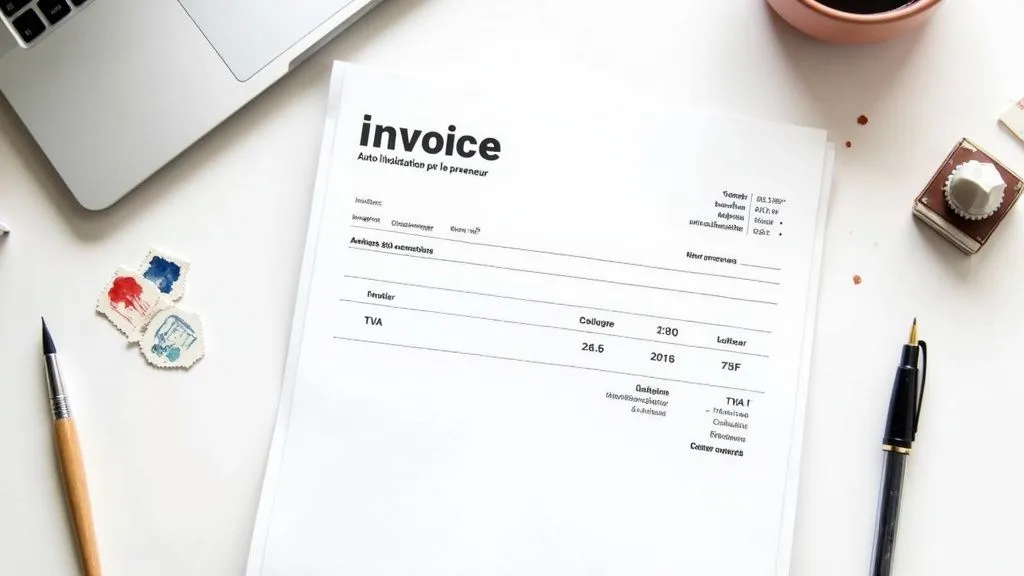
You might think a poorly drafted invoice is just a minor administrative oversight. Big mistake. It’s actually a wide-open door to a potential tax reassessment. To sleep easy, it’s crucial to master the mandatory mentions and understand their role in intra-community VAT calculation.
Let’s move from theory to practice. The validity of your invoices rests on very precise details that justify applying the special intra-community regime. Every element counts, from identifying both companies to justifying the absence of French VAT.
The mentions that bulletproof your B2B invoices
When you sell a good or service to another professional based in the EU, the rule is simple: your invoice must be issued net of tax. But for this exemption to be accepted by the tax authorities, certain information is simply non-negotiable.
Here’s the essential checklist for every invoice:
- Your full details and your SIREN number.
- Your customer’s details, with their address in their EU country.
- Your intra-community VAT number and, above all, your customer’s. This is the key that proves you’re dealing with an identified VAT-liable party.
- The legal mention that justifies the VAT exemption.
The magic sentence, the one you must never forget, is: “Reverse charge by the recipient” (or “Autoliquidation par le preneur” in French). This simple mention officially transfers VAT responsibility to your customer, who will have to handle it in their own country. Its absence can render your invoice non-compliant and expose you to a painful VAT reassessment.
Concrete example: a French SME selling in Germany
Imagine your SME sells machine tools to a company in Berlin for an amount of €10,000. Your invoice must of course show the VAT numbers of both companies. The total amount due will be €10,000 net of tax.
At the bottom of the invoice, just below the total, you’ll need to clearly add the mention “Reverse charge by the recipient.” This is what allows the German company to simultaneously declare and deduct VAT at 19% (the German rate), an operation entirely neutral for its cash flow.
In the other direction: a micro-entrepreneur buying in Ireland
The reverse charge mechanism also works when you’re the buyer. Let’s say you’re a micro-entrepreneur in France (with a VAT number) and you buy a software license from an Irish company for €500. You’ll receive an invoice without VAT.
This invoice will show your VAT number and the mention “Reverse charge.” It will then be up to you to self-assess French VAT of €100 (20% of €500) on your CA3 return. As we’ve seen, you’ll both declare it as collected and deduct it as deductible. The operation is a wash. To go further, our complete guide on invoicing with VAT is a goldmine of information.
By applying these habits to your business, you’ll create documents that are not only legally compliant but that also make your trade with European partners easier.
Your questions about intra-community VAT
Let’s now turn to the questions that come up most often in the field. Here are clear, direct answers to clear up any remaining doubts, based on situations you’re bound to encounter.
What should I do if my European B2B customer doesn’t have a VAT number?
This is a more common scenario than you might think. If your professional customer within the EU doesn’t provide you with a valid intra-community VAT number, the golden rule is caution. In this case, it’s impossible to apply the reverse charge principle.
You have no choice: you must treat this transaction as if you were selling to an individual (B2C). In practice, this means invoicing VAT included, applying the VAT rate in force in your customer’s country. This is precisely the kind of situation the OSS one-stop shop was created for, as it will let you declare this foreign VAT.
Does a sole trader charge VAT to a European customer?
It all depends on your VAT regime. Things are quite different depending on your situation.
- Are you under the VAT exemption scheme (franchise en base)? Simple: you always invoice net of tax, whether your customer is in France or elsewhere in the EU. Don’t forget the mandatory mention: “VAT not applicable, art. 293 B of the French Tax Code.”
- Are you liable for VAT? You apply the standard rules. For a professional customer (B2B), you invoice net of tax and mention the reverse charge. For an individual (B2C), you invoice VAT included, applying the VAT of their country.
An important point often forgotten: even under the exemption scheme, a sole trader must request an intra-community VAT number if they purchase services within the EU for more than €10,000 per year.
How does it work for online services and digital products?
Selling dematerialized services such as software, online courses, or e-books to individuals in the EU has its own rules. It’s simple: the VAT to apply is always that of the country where your customer lives. And watch out, this rule applies from the very first euro collected.
There’s no tolerance threshold here. Using the OSS (One-Stop Shop) is therefore non-negotiable from your very first B2C sale of this type. It’s the tool that lets you easily declare and pay all the VAT collected across different countries. For your professional customers, however, you stay with the standard reverse charge approach.
I only made a single shipment of goods, do I really need to file a declaration?
Yes, without the slightest hesitation. As soon as you ship goods to a company located in another EU country (a B2B flow, therefore), you must fill out a trade-in-goods declaration (now part of the EMEBI statistical survey). This obligation starts from the very first euro.
Unlike purchases (intra-community acquisitions), which benefit from a trigger threshold of €460,000, there is absolutely no threshold for sales. Every shipment of goods to a European professional must be declared, regardless of whether the invoice is €50 or €50,000.
Juggling all these rules can quickly become a headache. That’s exactly why Bizyness was designed: so you don’t have to worry about it. Our tool generates fully compliant invoices, applies the right VAT regime for every situation, and prepares the groundwork for your filings. You focus on growing your business, we take care of the paperwork. Discover how Bizyness can simplify your life today.
