

 Français
Invoice due date definition: the guide to mastering your invoicing
Understand the invoice due date definition to optimize your cash flow. A complete guide to legal deadlines, penalties and invoicing best practices.

When we talk about the due date on an invoice, we simply mean the deadline by which your customer must pay you. Think of it as the metronome that sets the pace for your e-commerce business’s financial health. It’s the finish line that keeps your cash flow smooth and predictable.
The vital importance of the due date for your e-commerce business
Far more than just a date on a piece of paper, the due date is a genuine strategic lever for any online entrepreneur, whether you sell on Shopify, Amazon, or collect payments directly via Stripe. It provides a framework for your incoming cash and turns a sale into a receivable with a precise deadline.
Loose management of this date can quickly create a devastating domino effect. A late payment means money that isn’t coming in. And this lack of liquidity can bring things to a halt:
- Your ability to restock right before a major sales push or the holiday season.
- The budget you allocate to your marketing campaigns to bring in new customers.
- Your momentum to innovate and launch new products that make a difference.
In France, the law is very clear on this point. The due date is the deadline before which an invoice must be settled, or penalties apply. Article L441-10 of the French Commercial Code sets the default payment term at 30 days after receipt of goods or completion of the service.
Setting a due date is therefore anything but a mere formality. It’s an essential management practice that protects your cash flow and secures the growth of your business.
Understanding this concept well, along with the payment terms that go with it, lays the foundation for confidently steering your e-commerce business. Your invoicing then becomes a performance tool, rather than a source of stress.
Decoding the different legal payment terms
Finding your way through legal payment terms can quickly become a headache. Yet it’s an essential step to protect your cash flow and work with peace of mind. In France, the law is quite strict on this subject for good reason: to prevent late payments, a real scourge that can put any business in difficulty, including an e-commerce business.
Specifically, if you haven’t arranged anything particular with your business customer, the rule is simple: the payment term defaults to 30 calendar days. This countdown starts when your customer receives the goods or at the end of your service delivery. This is the legal baseline that applies if your invoices or terms and conditions of sale don’t specify otherwise.
Of course, it’s entirely possible to agree on different terms. But be careful: for this to be valid, the agreement must be spelled out in writing in your Terms and Conditions of Sale (T&Cs) and clearly stated on every invoice. Let’s look at the two most common options.
Negotiated terms
The Commercial Code allows you to agree on longer terms, provided they don’t create a blatant imbalance to your disadvantage. Here are the two ceilings you’ll come across most often:
- 60 calendar days: This is the most straightforward option. The countdown starts on the day you issue the invoice. Simple and clean.
- 45 days end of month: This one is a bit more technical, but very widespread. The calculation also starts from the invoice date, but payment must occur by the end of the month in which those 45 days end.
Let’s take a concrete example
You send an invoice on May 5 with the note “45 days end of month”. The 45th day falls on June 19. Your customer doesn’t have to pay you on the 19th, but rather before June 30, the last day of the due month.
The diagram below summarizes the journey of an invoice, from creation to payment, showing where this famous due date fits in.
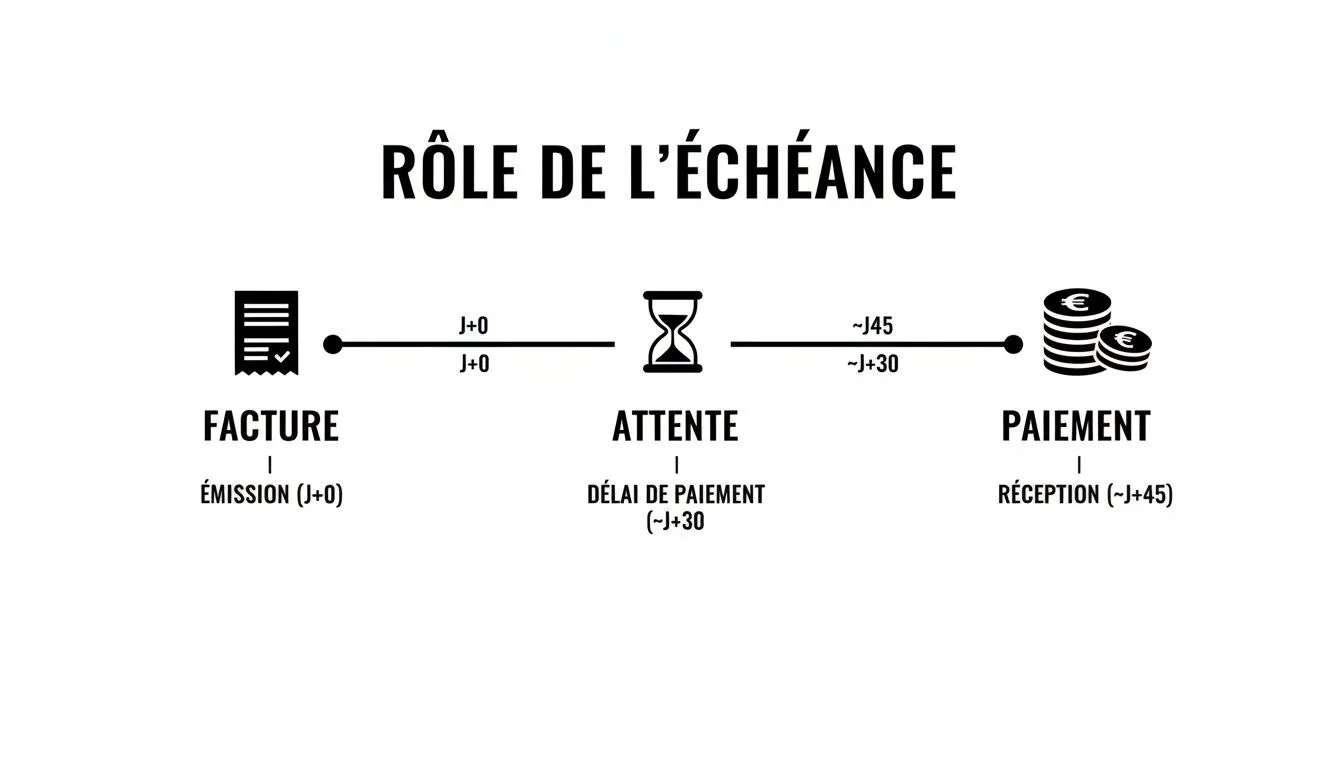
It’s clear that the due date isn’t just a date on a piece of paper. It’s the culmination of an entire process that has a direct impact on the money coming into your business.
Mastering these options is therefore crucial. If you want to dig deeper into the topic, our complete guide on invoice payment terms is an excellent resource. By setting the right terms, you better anticipate your cash inflows and build healthy, transparent relationships with your customers.
Measuring the impact of late payments on your cash flow
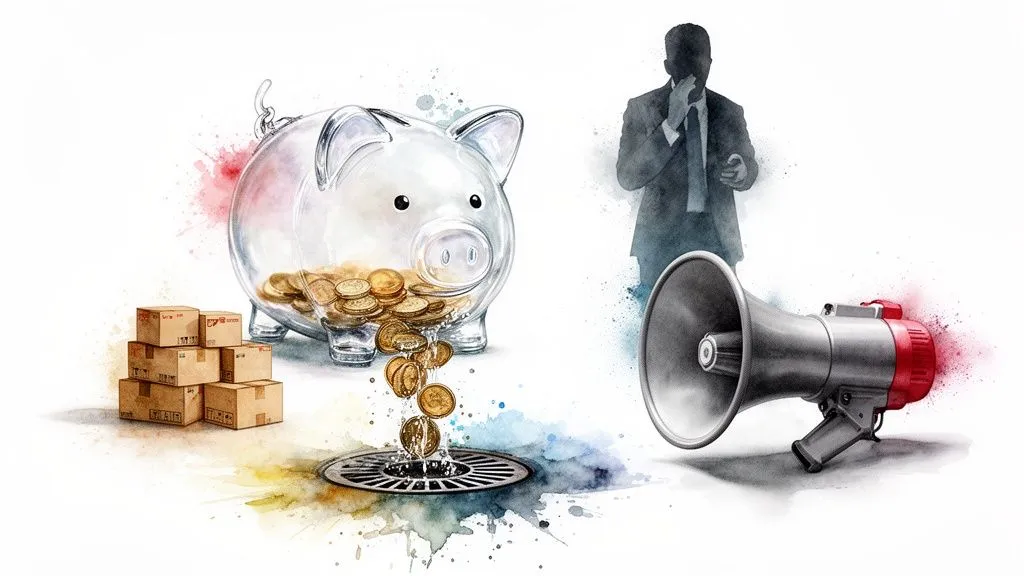
A late payment isn’t just a pending line in your accounting software. Think of it instead as a small leak in your business’s tank. At first it’s barely visible, but every drop that falls slows you down and risks leaving you stranded at the worst possible moment. For an online seller, the effect is immediate and very real.
As soon as an invoice goes past its due date, your working capital requirement (WCR) shoots up. Put simply: you’ve already paid for stock, ads and shipping, but the money from the sale still isn’t in your account. So it’s up to you to fill that gap by dipping into your own cash reserves.
The hidden cost of customer credit you never chose to give
Every unpaid invoice turns you, against your will, into a banker for your customer. You’re giving them free, involuntary credit — a “gift” that weighs heavily on your finances and curbs your growth potential.
Every euro tied up in a pending invoice is a euro you can’t reinvest. It’s an enormous opportunity cost that concretely slows your growth and weakens your business.
Think about everything you could achieve with that cash if it were available:
- Order more stock to anticipate a sales spike or the holiday season, and avoid stockouts that drive customers away.
- Boost your ad budget on Instagram or TikTok to attract new customers right before a major sales push.
- Invest in better packaging or express shipping to impress your customers and bring them back.
This forced credit puts enormous pressure on your day-to-day management. It forces you to constantly juggle your cash, delay paying your own suppliers, or, worse still, put vital projects on hold. Defining a clear due date and following up on it closely isn’t just an administrative detail — it’s an essential safeguard to secure your cash flow and finance your growth.
Unpaid invoices: how do you activate late payment penalties?
Your friendly reminders are going unanswered? Your patience has limits? Rest assured, the law is on your side when dealing with a bad-paying customer. Activating late payment penalties isn’t a favor you’re requesting, but a right that applies automatically from the very first day of delay, right after your invoice’s due date.
This protection, provided for by the Commercial Code, entitles you to two types of compensation. It’s an excellent way to deter late payments and demonstrate how serious your management is. The only condition to be eligible? These penalties must be clearly stated in your Terms and Conditions of Sale (T&Cs) and reiterated on every invoice.
How do you calculate and apply the penalties?
The calculation is actually quite simple. The penalty rate is based on the European Central Bank’s (ECB) key interest rate, to which 10 points are added. The law thus allows you to apply late-payment interest of up to three times the legal interest rate.
But that’s not all. On top of this interest, you’re entitled to claim a flat-rate compensation of €40 for collection costs. This amount is owed for each overdue invoice, and you don’t even need to justify the costs incurred.
Let’s take a concrete example:
Imagine an invoice for €1,500 including tax that has been unpaid for 45 days. Using a penalty rate of 15% per year (a common figure), here’s the calculation:
Penalties = (€1,500 x 15%) x (45 days / 365 days) = €27.74
The total amount you can claim is therefore €27.74 + €40 = €67.74.
These legal tools are a genuine lifeline for your cash flow. Their effectiveness is well proven: in 2022 alone, 1.5 million businesses used them to recover €4.2 billion in unpaid invoices. An essential lever to stay on course. If you’d like to explore the topic further, feel free to check out detailed guides on due dates and invoicing.
To make your life easier, tools like Bizyness automatically add all the legally required notices to your invoices. This way, you can be sure you’re always compliant and ready to act if the situation calls for it.
Automating due date management to protect your cash flow

Tracking due dates manually is a bit like playing with fire. You’re exposed to oversights, data-entry errors and, inevitably, late payments. Every minute spent chasing an invoice is time you’re not spending growing your e-commerce business.
Fortunately, there’s a solution to turn this chore into a genuine advantage: automation.
Think of it as an autopilot for your finances. It eliminates human risk and ensures rock-solid rigor in tracking payments. For an online seller, it guarantees healthier, more predictable cash flow, without spending your days on it.
How does it actually work?
Tools like Bizyness integrate directly with your sales ecosystem (Shopify, WooCommerce, Stripe, etc.). They intelligently manage the entire invoice lifecycle, from calculating the due date to following up on unpaid invoices.
The goal of automation isn’t to replace your judgment, but to free up your time. By delegating repetitive tasks, you can finally focus on strategy, marketing or customer service.
Here’s what a dedicated platform can do for you:
- Calculate due dates with zero errors: No more guesswork. Every invoice displays a precise deadline, in line with the terms you’ve chosen.
- Generate fully compliant invoices: All mandatory notices, including late payment penalties, are added automatically. You can relax.
- Schedule personalized reminders: Reminders are sent before, during and after the due date to maximize your chances of being paid on time.
- Give you a real-time overview: A clear dashboard shows you exactly where you stand, invoice by invoice.
By switching to automated invoicing, you secure your cash flow, improve your customer relationships with clear, professional communications, and build solid financial foundations.
To go further, take a look at our guide on the benefits of online invoicing. You’ll see how a small change can transform your day-to-day management. It’s a minor investment for an enormous gain in peace of mind and efficiency.
Your questions about the due date, answered
To wrap up, let’s go through the questions that come up most often among entrepreneurs. Here are a few clear, direct answers to clear up any remaining doubts and bulletproof your management.
Can I really choose whatever due date I want?
In reality, no. French law is quite strict on payment terms between businesses. If you haven’t agreed on anything specific with your customer, the default rule is payment within 30 days after delivery of the goods or completion of the service.
Of course, you can negotiate longer terms, but there are limits you can’t cross:
- Either 60 calendar days maximum after the invoice issue date.
- Or 45 days end of month, again counted from the invoice date.
For these extended terms to be applicable, they must appear in your Terms and Conditions of Sale (T&Cs) and be restated on every invoice. This is non-negotiable. For individual customers (B2C), on the other hand, the standard is payment in cash, meaning immediate payment.
What about customers abroad?
With international customers, clarity is your best weapon. Your payment terms must be crystal clear to avoid any misunderstanding, whether cultural or legal in nature.
When selling internationally, tight management isn’t optional, it’s a necessity. The slightest imprecision can turn into significant payment delays and make collection far more complex, with a direct impact on your cash flow.
Fortunately, invoicing tools like Bizyness make life much easier. They let you standardize your communications and payment tracking, regardless of currency or country. They even handle the complexity of VAT for you via the OSS/IOSS one-stop shops.
What if a customer refuses to pay the late payment penalties?
If a customer disputes the penalties, stay professional and follow a well-defined procedure. The first thing to do is check that your invoices and T&Cs clearly state all the required legal information: the applicable penalty rate and the flat-rate compensation of €40. This is your legal foundation.
Next, start a conversation to understand why they’re disputing it. Often, a simple exchange is enough. If no amicable solution is found and you’re certain you’re in the right, the next step is to send a formal notice by registered letter. A well-built file, with impeccable invoices and written exchanges, will be your best ally in making your case.
Don’t leave your cash flow at the mercy of late payments any longer. With Bizyness, you can automate the tracking of your due dates, generate fully compliant invoices and follow up with customers without even thinking about it. Discover how to take back control of your financial management by visiting Bizyness.
