

 Français
Invoice number: the complete guide to compliant invoicing
The invoice number guide: master the rules, avoid mistakes, and discover how to automate your invoicing to stay compliant.
The invoice number is far more than just a string of digits on a document. Think of it as the unique identity card of every transaction you make. It’s a mandatory reference, made up of numbers and sometimes letters, that must strictly follow a chronological and continuous sequence. It’s a bit like the license plate of your sales: every invoice must have its own, no exceptions.
Understanding the essential role of the invoice number
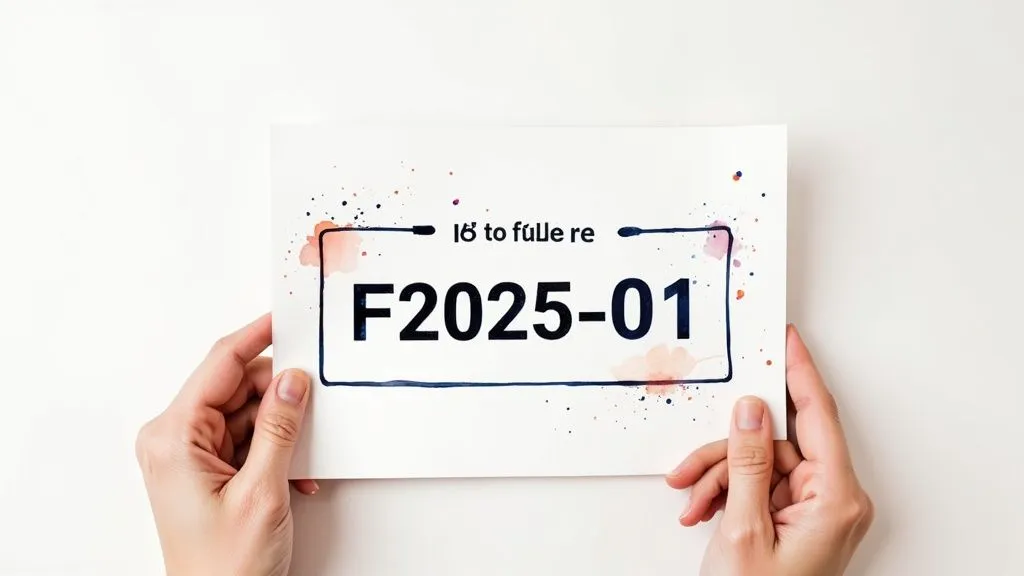
Far from being a mere administrative formality, this number is the cornerstone of your accounting and your best ally when it comes to legal compliance. It forges an unbreakable link between a sale, your cash flow, your VAT returns and your annual balance sheet. Without rigorous numbering, your financial management would be like a puzzle missing pieces: you’d never get a clear overview.
This rule isn’t there to make your life harder. It answers very specific obligations under the French General Tax Code. A correct numbering sequence ensures flawless traceability of all your operations, which is absolutely crucial in the event of a tax audit. Every invoice number proves the existence of a transaction and prevents any risk of concealed revenue.
Why rigorous numbering is non-negotiable
A small mistake, a simple oversight, or a gap in your numbering series can quickly turn into a much bigger problem. To the tax authorities, these anomalies can be interpreted as an attempt at fraud, even when the error was made in good faith. And the penalties are not to be taken lightly: they range from fines to potentially heavy tax reassessments.
In France, issuing a non-compliant invoice or failing to invoice at all can lead to a tax fine equal to 50% of the transaction amount. For repeated errors on mandatory information, the fine is €15 per missing item, capped at a quarter of the invoice amount.
Taking the time to properly understand numbering logic turns a legal constraint into a genuine asset for your business. A well-designed system gives you:
- Perfect traceability: you can find any invoice in the blink of an eye, whether to answer a client or to prepare your balance sheet.
- Simplified financial management: payment tracking, reminders and an overall view of your revenue become far smoother.
- Legal security: peace of mind, knowing you’re compliant. This protects you from penalties and potential disputes.
Getting ahead of e-invoicing
With the major e-invoicing reform rolling out progressively from September 2026, the invoice number is set to become even more central. It will be one of the key pieces of information automatically transmitted to the tax authorities via dedicated platforms. Flawless numbering will therefore be the sine qua non condition for everything to run smoothly.
Put simply, the invoice number isn’t just a technical detail. It’s the backbone of your invoicing, a sign of professionalism for your clients, and proof of your transparency toward the tax authorities. Building a business on solid foundations starts right here.
The legal framework for invoice numbering: what you need to know
When we talk about invoicing, we usually think about the amount, the client, the service provided… But there’s one detail that carries huge weight in the eyes of the tax authorities: the invoice number. Far from being a simple filing code, it’s a key element of your compliance.
The rules of the game are set by the French General Tax Code, and they’re fairly simple, yet uncompromising. They rest on two fundamental principles.
First, every invoice must have its own unique number. Think of it as its fingerprint. Reusing a number is strictly forbidden, whether for a different client or even the following year. This is what guarantees that two transactions can never be confused.
Second, your invoice numbers must follow a continuous and chronological sequence. Think of it like a chain: if one link is missing, the chain is broken. A gap in your numbering (jumping from invoice 2024-052 to 2024-054, for example) is a genuine red flag for the authorities. It can suggest that an invoice was “forgotten” or concealed.
The principles to follow for flawless numbering
To put all this into practice, you simply need to apply a rigorous logic. Your invoice numbering must follow a clear sequence that leaves no room for chance or interpretation.
The law is very clear on this point. Article 242 nonies A of Annex II to the French General Tax Code specifies that invoices “must be numbered with a unique number based on a chronological and continuous sequence.” This simple rule is in fact a pillar of the fight against VAT fraud, as it ensures perfect traceability of all operations.
Following these rules isn’t just a box to tick for the authorities; it’s also a sign of professionalism and good management. And beyond the number itself, don’t forget to check that all the other mandatory pieces of information are present. To make sure you’re not missing anything, take a look at our complete guide on mandatory information on an invoice.
To make things clearer, here’s a table summarizing the golden rules and legal obligations for issuing an invoice number.
Invoice numbering principles and obligations
| Key Principle | Description of the Obligation | Risk of non-compliance |
|---|---|---|
| Uniqueness | Every invoice must carry a number that has never been used before and never will be again. | Accounting confusion, suspicion of duplicates or fake invoices. |
| Continuity | Numbers must follow one another without any gap or interruption in the sequence (e.g., 1, 2, 3, 4…). | Alerts the tax authorities, raises suspicion of concealed revenue. |
| Chronology | The sequence of numbers must match the chronological order in which invoices were issued. | Inconsistencies during an audit, undermines the reliability of your accounting. |
These three pillars are inseparable in guaranteeing compliant numbering and avoiding unpleasant surprises.
Does a numbering error really cost that much?
A small numbering error, even made without any bad intent, can have much more serious consequences than you might think.
In the event of a tax audit, a shaky invoicing sequence or duplicate numbers can quickly cost you dearly. The fine can go up to €15 per missing or incorrect item on an invoice, capped at a quarter of the total invoice amount.
And that’s not all. If the tax authorities suspect these errors are hiding an attempt at fraud, the penalties can be much heavier, potentially leading to a full tax reassessment. Rigor is therefore not optional.
This vigilance will become all the more crucial with the arrival of mandatory e-invoicing. This reform, which will progressively affect 4.5 million businesses in France starting September 2026, will automate the transmission of invoicing data to the state. A non-compliant invoice number will be enough to block the entire process.
Yet many businesses aren’t ready yet. A recent study found that only 1% of companies with more than 10 employees have fully prepared for this transition.
So it’s really time to build the right habits. By adopting flawless numbering practices now, you secure your business today and prepare calmly for tomorrow.
Choosing the right method to number your invoices
Choosing the structure of your invoice number may seem trivial, but it’s a decision that directly affects the clarity and efficiency of your accounting management. The law doesn’t impose a single method, only one golden rule: a logical sequence, without interruption. The challenge is to find the system that best fits your business and makes your life easier.
Think of your numbering system as a personal library. If the books are well organized from the start by genre or author, finding information is child’s play. Otherwise, it’s guaranteed chaos, wasted time and a source of stress every time you search.
Let’s go through the most common approaches to help you build a numbering logic that’s both compliant and remarkably efficient.
Simple sequential numbering: the straightforward option
This is the most straightforward method, perfect for getting started. If you’re launching your business or handle a fairly low volume of invoices, it’s ideal. The principle is childishly simple: each new invoice takes the next number (+1).
For extra clarity, you can add a prefix to instantly identify the document as an invoice.
- Concrete examples:
001,002,003… or with a prefix,F-001,F-002,F-003…
The small detail that changes everything: leading zeros (001 rather than 1). They ensure your invoice lists stay perfectly aligned, even once you go past ten, then a hundred. It’s a meaningful gain in readability.
Pros:
- Extremely simple: no headaches, the next number is obvious.
- Guaranteed compliance: as long as there’s no “gap,” this method follows the rules to the letter.
Cons:
- Lack of information: the number alone tells you nothing about the year or the context of the invoice.
- Less intuitive archiving: to find invoices from a specific year, you always have to check the dates.
Numbering with a time-based prefix: the most popular approach
This is by far the most widespread and cleverest approach, as it naturally organizes your accounting in chronological order. It involves including the year, and sometimes even the month, in the invoice number.
The idea is to adopt a format like YEAR-NUMBER or YEAR-MONTH-NUMBER. The big advantage is that at the start of each new year (or month), the counter resets to 1. This is perfectly allowed, because the prefix makes each number unique (2024-001 is clearly distinct from 2025-001).
- Examples by year:
2024-001,2024-002… then on January 1st, you restart with2025-001. - Examples by month:
2024-09-001,2024-09-002… then the following month, you move to2024-10-001.
This method turns your invoice number into a genuine filing tool. At a glance, you know which period a transaction belongs to. This greatly simplifies preparing your VAT returns or your annual balance sheet.
This small dose of time-based context is a valuable ally for keeping a clear view of your business over time.
Numbering with distinct series: for more complex businesses
Does your business handle several types of services, run multiple shops, or serve very different types of clients (individuals and professionals, for example)? In that case, creating clearly distinct numbering series can be very worthwhile.
The principle is to assign a unique prefix to each category, followed by its own number sequence.
Examples of prefixes by activity:
- For services:
SERV-2024-001 - For product sales:
PROD-2024-001 - For a specific online shop:
ECOMM-A-2024-001
Pros:
- Fine-grained analysis of your business: you can easily track the performance of each business line.
- Top-notch organization: very useful if different teams manage different types of invoicing.
Cons:
- More complex to manage: you have to juggle several sequences in parallel without mixing them up.
- Higher risk of error: the risk of using the wrong prefix or the wrong counter is real if the process isn’t automated.
The infographic below shows you how to react in the event of an anomaly in your sequence, an essential point regardless of the method you choose.
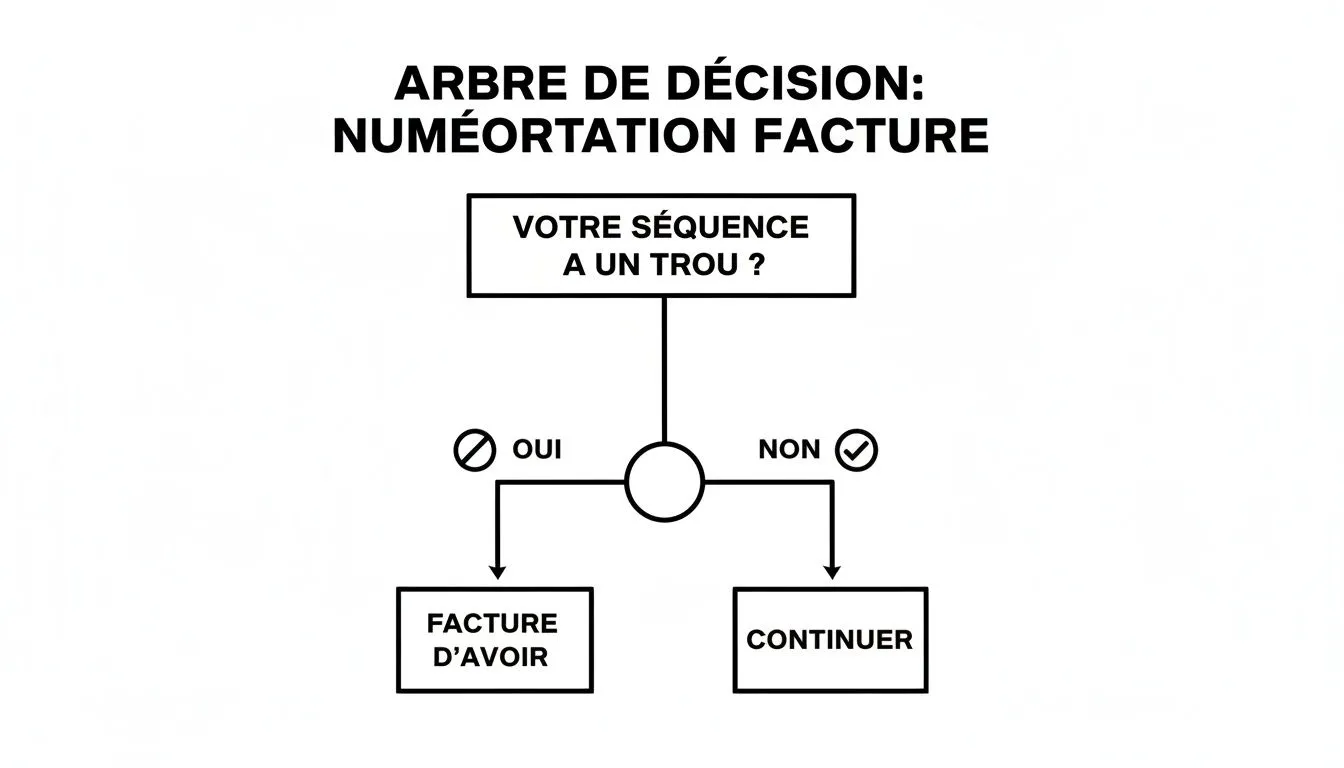
This decision tree highlights a golden rule: you never “fix” a gap by deleting a document. You issue a credit note to properly cancel the transaction, while preserving the continuity of the sequence.
Ultimately, the choice is yours. Simple numbering is perfect for getting started, but the time-based prefix approach provides a much stronger foundation to support your business’s growth. And if your business diversifies, distinct series will become a strategic asset.
Handling invoicing errors without breaking the law
A mistake happens so easily: a wrong amount, a poorly described service, a simple typo… It’s entirely human. But when the error slips into an invoice that’s already been sent, the first instinct is to delete it and redo it. Careful — that’s a serious offense under French law.
A validated invoice, bearing its own invoice number, simply cannot disappear into thin air. Every number must exist in your accounting to guarantee that the sequence remains continuous. Deleting an invoice would create a “gap” that the tax authorities could interpret as an attempt to conceal revenue.
To correct the situation legally, there’s only one method: cancel the erroneous invoice with another official document. This is where the credit note comes in, acting as the mirror image of your original invoice.
The credit note, your essential correction tool
Let’s say you issued invoice F2024-085 for an amount of €500. If it contains an error, you need to create a new document, a credit note, to neutralize this invoice from an accounting standpoint.
This credit note must include all the mandatory information of a standard invoice, but it has two crucial specifics:
- A clear reference: it must be identified as a “Credit Note” and mention the number of the original invoice it cancels (for example: “Credit note referring to invoice F2024-085”).
- A negative amount: the credit note amount will be -€500 to cancel out the original accounting entry.
Issuing a credit note isn’t a mere formality. It’s an accounting act that preserves the integrity and traceability of your invoicing. It proves that you corrected an error transparently, without ever breaking the numbering chain.
Once the credit note has been issued and sent to the client, you can finally create a new, correct invoice. It will carry a new number that logically follows your sequence (for example F2024-086). To fully understand every step, our guide on amending an invoice that’s already been issued explains it all in detail.
Numbering your credit notes with the same rigor
Just like your invoices, your credit notes must have their own numbering system. This too must be unique, continuous and chronological. The simplest and clearest approach is to create a clearly distinct series so you never confuse them with your sales invoices.
Here are a few formats that work very well:
- “CREDIT” prefix:
CREDIT-2024-001,CREDIT-2024-002, etc. - “CN” prefix:
CN-2024-001,CN-2024-002, etc.
This distinction is truly essential for the clarity of your accounting. At a glance, you can tell sales transactions apart from corrections or cancellations.
Rigor in handling errors and payments is crucial, especially in a sometimes tense economic context. The 2025 barometer on payment terms in France shows a worrying situation, where delays weigh heavily on businesses’ cash flow. The healthcare sector, for example, shows an average payment time of 72 days, a situation made worse by administrative red tape.
Handling invoicing errors properly is therefore not just a matter of compliance. Above all, it’s a mark of professionalism that protects your company’s financial health.
Secure your accounting by automating your numbering
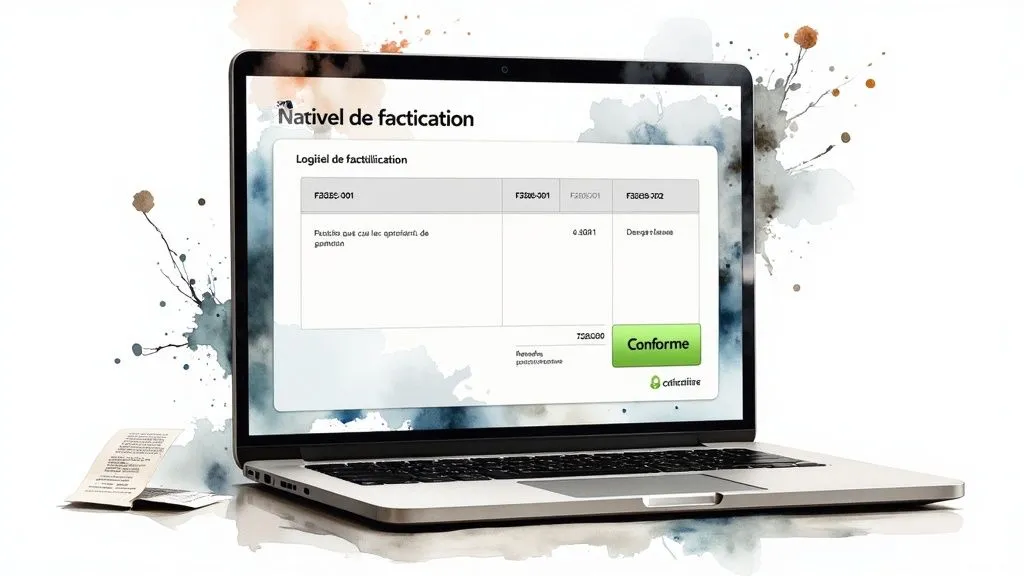
At first, managing your invoices in an Excel spreadsheet seems like an easy solution. It’s simple, it’s free, and it gets the job done. But this artisanal method is a genuine open door to trouble. One small typo, an unfortunate copy-paste, and suddenly there’s a gap in your sequence or a duplicate number. These errors, even when well-intentioned, can quickly catch the eye of the tax authorities and cast doubt over your entire accounting.
Switching to invoicing software isn’t a luxury, then — it’s a strategic decision to bulletproof your management. Think of it as an infallible guardian for your finances. It never sleeps, never makes mistakes. It ensures every invoice number is generated automatically, without you having to think about it. You get a perfect, continuous and chronological sequence, freeing you from a heavy mental burden.
No more human errors, hello rock-solid compliance
Automation is your best ally against human error. Good invoicing software acts as a safety net, protecting you from the small oversights that end up costing dearly during an audit.
In concrete terms, here’s what an automated system guarantees you:
- Zero duplicates: the software knows the last number used and creates the next one, plain and simple. It’s impossible to generate the same reference twice.
- Perfect sequence: no more “gaps” in your numbering. Every new invoice finds its place, creating an accounting chain with no missing links.
- Flawless formatting: you choose your structure once and for all (for example,
2024-09-XXX), and the system applies it to the letter on every document. - Crystal-clear credit note management: an invoice needs correcting? The software generates a credit note with its own sequence, while linking it to the original invoice. Traceability is total.
In short, you move from “gut-feeling” management to surgical precision. It’s the peace of mind of knowing with certainty that every document sent is fully compliant. If you’re a sole trader, very effective solutions exist. Take a look at our guide on invoicing software for sole traders to find the one that suits you.
Get ahead of the curve on e-invoicing
Automation is no longer just an option — it’s becoming a necessity with the major e-invoicing reform on the horizon. Starting September 2026, all French businesses will need to be able to receive invoices in electronic format, and progressively, to issue them as well.
Careful — we’re not talking about simple PDFs here. These new invoices will be files with structured data, designed to be read automatically by computers, including those of the tax authorities. The invoice number will of course be one of the key elements of these exchanges.
Modern, compliant invoicing software, like Bizyness, prepares you for this transition starting today. It ensures your documents comply not only with current numbering rules, but also with future exchange formats like Factur-X.
Getting equipped now means approaching this shift smoothly rather than having to change everything under pressure later. According to the France Num 2025 Barometer, while 69% of small and medium businesses have invoicing software, only 20% already issue their invoices in a structured format ready for tomorrow. There’s still a long way to go for many, and you can dig deeper into the topic by checking out the study results on the government website.
Ultimately, automating the management of your invoice numbers is a smart investment. You save precious time, secure your legal standing, and prepare your business for the future. It’s a decisive step toward more professional, more reliable management, firmly focused on what’s ahead.
The questions everyone asks about invoice numbers
Even when you’re very rigorous, certain practical situations can quickly become a headache. We’ve gathered the most frequently asked questions here to give you clear, concrete answers and help you handle these particular cases without stress and by the book.
Can I restart my numbering at 1 every year?
Yes, no problem at all! It’s even a very common and rather clever practice. Restarting your numbering at the beginning of a new fiscal year is entirely permitted. There’s just one golden rule to follow: every invoice number must remain absolutely unique.
The solution is simple: just add a prefix that changes every year. For example, using the current year.
- Your last invoice of 2024 could be
FA2024-150. - The very first one of 2025 would then become
FA2025-001.
The FA2025- prefix guarantees that this number is completely different from FA2024-001. This method is very popular because it greatly simplifies filing and analyzing your revenue from one year to the next, while remaining perfectly compliant.
Help, I accidentally skipped a number!
It happens, especially when you manage your invoicing by hand. You go from invoice F-056 to F-058, and suddenly F-057 has fallen through the cracks. The right reflex is to never try to “fill the gap.” Creating an invoice after the fact with the missing number would amount to breaking the chronology, and that’s a mistake in the eyes of the tax authorities.
The right approach? Document the incident. Take the time to write a short internal note, which you’ll keep carefully with your accounting records, simply explaining that number F-057 was skipped by mistake and was never issued. This document will be your safety net in the event of a tax audit. It will prove your good faith and the transparency of your management. The key is to continue your sequence from the last number issued, as if nothing had happened.
Do the quote number and the invoice number need to follow each other?
No, there’s no legal obligation on that front. A quote and an invoice are two clearly distinct documents, each with its own life and its own numbering sequence.
A quote is a commercial offer. An invoice is an accounting document that records a sale. Each document must have its own logical numbering sequence, without interruption and in chronological order.
That said, to make things easier to track, it’s an excellent idea to mention the quote number on the corresponding invoice. A short line like “Following your quote no. DV2024-042” is enough to make the connection clear. It’s clearer for you, and for your client.
What should I do if I have several different business activities?
If your business wears several hats — for example, part services and part product sales — you can, and it’s even recommended, create a separate number series for each activity. Just use a distinct prefix to keep things organized. For example: SERV-2024-001 for services and SALES-2024-001 for products.
This approach will give you a much clearer view of the performance of each business line. It’s fully permitted by the tax authorities, as long as each series, on its own, follows the rules of continuity and chronology.
Managing all these rules by hand can quickly become a source of errors and stress. A tool like Bizyness automates this entire process for you. It guarantees numbering that’s always perfect and compliant, even if your business is complex. Discover how to simplify your invoicing today at bizyness.fr.
