

 Français
E-commerce invoice numbering made simple for 2026
Master invoice numbering for your e-commerce business. Our complete guide to the rules, formats, and automation for total compliance.
You hear a lot about the invoice number. But what actually is it? Simply put, it’s a unique identifier you assign to every invoice you issue. In France, it’s an unavoidable legal requirement, crucial for your bookkeeping and tax compliance. Think of it as the ID card for each transaction: it makes it unique, traceable, and much harder to dispute.
Why the invoice number is the backbone of your e-commerce business

If every sale is a brick building your business, the invoice number is the mortar holding them together. It’s what gives the whole structure its solidity and consistency. Far from being mere paperwork, this identifier vouches for your credibility with the tax authorities and forms the foundation of sound management.
With the explosion of online commerce, rigorous numbering has become vital. The French e-commerce sector shattered records with revenue of €196.4 billion in 2025 and a volume of 3.2 billion transactions. That’s more than 100 orders processed every second. For an online seller, this explosive growth comes with a flood of invoices, where the smallest mistake can be costly.
The impact of well-managed numbering
Loose management of your invoice numbers exposes you to very real risks: fines for non-compliance, suspicion of fraud during a tax audit… the list goes on. Conversely, by mastering this process, you turn a legal constraint into a genuine business asset.
The benefits are immediate:
- Stronger credibility: A logical sequence of numbers with no gaps or duplicates is the best proof of your reliability, whether for the tax authorities or your business partners.
- Simplified management: Finding an order, handling a customer return, or analyzing your sales performance becomes effortless with consistent numbering.
- Easier accounting: Your accountant will thank you. Well-numbered invoices let them work faster, which reduces their fees and the risk of errors. Good numbering is also the basis for complying with the rules on retaining accounting records.
An invoice number isn’t just a figure on a document. It’s formal proof that a transaction took place, at a specific time and in a logical order. It’s your first line of defense against administrative chaos.
This guide was designed to help you turn this obligation into a strength, whether you sell on Shopify, Amazon, or via Stripe. Together, we’ll look at how to move away from manual management full of risks toward an automated, reliable system that safeguards your growth. For a broader overview of the topic, feel free to check out this guide to mastering the invoice number.
The rules set by the tax authorities
Let’s be clear: invoice numbering is anything but an administrative detail. For the tax authorities, it’s simply the backbone of your bookkeeping. Precise rules exist to guarantee the traceability of every transaction and, of course, to fight fraud.
Picture your invoice series as a chain. Each invoice number is a link. If a link is missing or duplicated, the chain is broken. That’s exactly the kind of break the tax authorities want to avoid at all costs, which is why they impose three fundamental principles.
Understanding and applying these rules isn’t optional — it’s the basis of sound management. The slightest deviation, even unintentional, can be seen as negligence and undermine your entire set of accounts during an audit.
The uniqueness principle: one number, one invoice
Every invoice you issue must have its own unique, permanent number. It is strictly forbidden to reuse a number, whether for a canceled invoice, a different customer, or any other reason. Once a number has been assigned, it’s set in stone.
This golden rule ensures there’s no possible ambiguity. It guarantees that a sale isn’t counted twice and that no fake invoice can slip into your books.
Think of the invoice number as a fingerprint: it identifies one single operation. Giving the same number to two invoices creates “administrative twins” — an anomaly that immediately raises red flags with the tax authorities.
Sequence continuity: no gaps allowed
Your invoice numbers must follow one another without any skips. If your last invoice was numbered INV-2026-0150, the next one must be INV-2026-0151. Not 0152.
This logical sequence proves that no invoice was “forgotten” or deleted along the way — a real guarantee of transparency. Even if you make a mistake and need to cancel an invoice, it must keep its number. Deleting it would create an unexplained gap in your sequence.
And if a bug or a slip-up creates a “gap”?
- Above all, don’t fill it by creating a fake invoice to plug the hole.
- Document the incident. Write a simple, clear note explaining the cause of the break (e.g., “Software malfunction on DD/MM/YYYY, invoice number XXXX could not be generated”).
- Keep this note carefully with your other accounting records.
This simple step proves your good faith and justifies the anomaly should any questions arise.
Respecting chronological order
Finally, the number sequence must strictly follow the chronological order in which invoices are issued. You can’t have a June 15 invoice with a lower number than the June 14 one. It makes sense: the numbers advance along with the calendar.
With the explosion of e-commerce, manually following these three rules has become a real headache. The French market is expected to cross €200 billion in 2026, with annual growth of 10 to 12%. For many entrepreneurs, the sheer transaction volume makes manual management simply too risky. You can also check the key e-commerce figures on Ecommerce Nation to better visualize this trend.
This is where an automation solution like Bizyness becomes more than a convenience — it becomes a necessity for ensuring perfect compliance without losing sleep over it.
Choosing an invoice number format suited to your business
We tend to see invoice numbering as a mere administrative constraint. Yet it’s much more than that. A good numbering system is above all a powerful tool for gaining clarity in your management and even for analyzing your business performance.
There’s no magic formula or single format that works for everyone. The best system is the one that fits the reality of your business. Let’s review the most common options so you can find the one that suits you best.
The simple chronological format
This is the starting point for many entrepreneurs: an endless sequence of numbers. Simple, straightforward, and fully compliant with the law.
- Example: 0001, 0002, 0003… then 1548, 1549, and so on.
- Advantage: It’s incredibly easy to set up and follow. If you’re just starting out and your sales volume is still modest, it’s often the most pragmatic solution.
- Drawback: This format lacks context. Your invoice #1548 tells you nothing about the year it was issued or its source. When it comes to analysis, you risk wasting time.
The format with an annual prefix
This is arguably the most widespread format, and for good reason: it naturally organizes your bookkeeping by fiscal year. The principle is simple: you add the current year as a prefix and reset the counter to 0001 every January 1st.
Concrete example: Your last invoice of 2025 is
2025-1789. Logically, the very first one of 2026 will be2026-0001. Each invoice’s uniqueness is guaranteed by the year prefix, and the sequence remains continuous within each fiscal year.
This method greatly simplifies archiving and searches. At a glance, you (and your accountant) know which fiscal year an invoice belongs to. A real time-saver day to day.
The multi-prefix format for multichannel selling
If you’re an online seller juggling several sales platforms, things get a bit more complex. Using a prefix per sales channel can greatly clarify your management, provided you do it correctly to stay compliant.
Imagine you sell on your own Shopify site and on a marketplace like Amazon. You could structure your numbers like this:
SHOPI-2026-0001,SHOPI-2026-0003…AMZ-2026-0002,AMZ-2026-0004…
Here’s the crucial point to watch: you must never have a separate number sequence for each channel. The tax authorities require a single, unified chronological sequence for your entire business. The trick, then, is to use one series of numbers that increments across all your sales, simply changing the prefix to identify the source.
This is exactly what tools like Bizyness do automatically. They ensure your numbering stays compliant, even with sales coming in from everywhere, without you having to think about it.
Managing invoice numbering under the pressure of e-commerce
In e-commerce, not everything boils down to a simple sale. A customer returns an item, you request a deposit, you sell on Amazon in addition to your own site… Each of these situations, however common, complicates the management of your invoice number.
If you’re not careful, these edge cases can quickly throw a numbering sequence into chaos — one that needs to be flawless in the eyes of the tax authorities.
What to do in the case of a product return or a deposit?
Let’s imagine a very common scenario: a customer returns their order. Your first instinct might be to delete the invoice. Don’t! The law strictly forbids it, as it would create a “gap” in your accounts.
Best practice is to issue a credit note. This document cancels the original sale from an accounting standpoint and, of course, it must have its own number.
There are two possible approaches for numbering your credit notes:
- A single sequence for everything: Your credit note simply picks up where your invoices left off. For example, invoice
INV-2024-0115is canceled by credit noteCN-2024-0116, then the next sale becomes invoiceINV-2024-0117. It’s simple, but it can make tracking your invoices a bit less clear. - Separate sequences: You keep one series for invoices (
INV-2024-...) and create another one dedicated to credit notes (CN-2024-...). Many prefer this method for its clarity, as long as each series remains continuous and uninterrupted.
Deposit invoices follow the same logic: they must fit seamlessly into your main sequence, as they carry real accounting value.
On the other hand, a pro forma invoice is a commercial document, not an accounting one. It’s therefore not subject to these numbering rules. Just be aware that as soon as your customer accepts it and it turns into a final invoice, that invoice must receive an official, unique, sequential number. If you’re struggling to tell them apart, our guide on the differences between invoices and quotes is here to help.
Multichannel sales, marketplaces, and international selling
The real headache often starts when you sell across several channels at once: your Shopify store, a marketplace like Amazon, or even direct sales.
The temptation would be to create separate numbering per sales channel. That’s a mistake to avoid at all costs. The tax authorities are very clear on this point: your business must have only one single, centralized invoicing sequence. All your sales, no matter their origin, must follow one another with no gaps or duplicates.
This also applies to international sales, even when managing VAT through the one-stop shops (OSS/IOSS). Every transaction, whether your customer is in France, Germany, or Belgium, must receive a unique invoice number from your central sequence.
This decision tree can help you see more clearly which format to adopt for your situation.
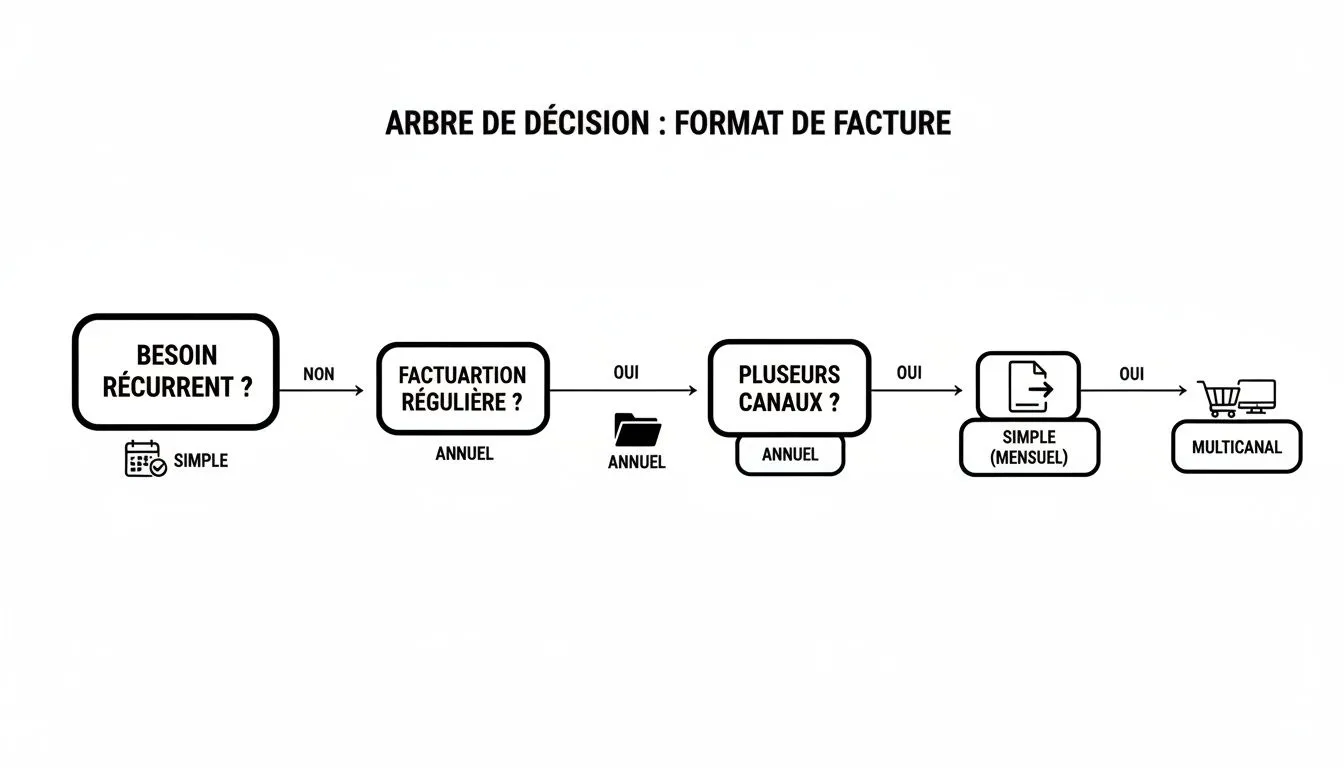
The more your business grows and diversifies (multiple stores, sales outside France), the more centralized numbering with clear prefixes becomes not just good practice, but a necessity.
Trying to manage all this manually is a recipe for errors. Invoicing software like Bizyness is built exactly for this: it automates the assignment of the right number for every document (invoice, credit note, deposit) and centralizes all your sales to guarantee a consistently flawless sequence. Which means total peace of mind.
Automating your invoice numbering to end the stress
Managing your invoice numbers by hand is a bit like playing with fire. At first, with just a few invoices a month, a simple Excel spreadsheet seems enough. But as your business takes off, this method becomes a real ticking time bomb. A data-entry error, a duplicate, a simple oversight — and your entire sequence goes off the rails, which never fails to draw attention during a tax audit.
Let’s be honest: the risk of human error grows sharply with sales volume. A copy-paste done a bit too quickly, a moment of inattention, and there’s a gap in your books. To rule out this risk for good, there’s no secret: you need to hand this task over to a reliable system.
This is where a dedicated tool like Bizyness changes the game. It handles 100% of the numbering automatically. Think of it as a flawless co-pilot for your invoicing, making sure every document is perfectly identified, without ever creating a duplicate or a break in the sequence.
Centralizing for clarity
The real power of automation lies in its ability to centralize everything. An invoicing tool connects to all your sales channels (Shopify, WooCommerce, Amazon…) and payment channels (Stripe, etc.) to create a single, unified numbering logic.
Concretely, here’s what happens behind the scenes:
- Every order is detected instantly, whether it comes from your own site or a marketplace.
- A compliant invoice is created on the spot, with all the mandatory legal notices.
- A unique, sequential invoice number is assigned, respecting your business’s chronological order.
This system guarantees a perfect, continuous numbering chain, even when you’re juggling simultaneous sales across multiple platforms.
Managing invoicing manually is like trying to count cars one by one on the highway at rush hour. Automation is like installing toll gates that log every passage, without errors and without even thinking about it.
Freeing up time for what really matters
Beyond the peace of mind it brings with the tax authorities, automating your invoicing is a genuine growth lever. The time you no longer spend checking number sequences is time you can reinvest where it has the most impact. If you want to dig deeper into the topic, our guide on online invoicing is packed with tips.
Imagine being able to fully focus on your products, your marketing, or customer service. Automation turns an administrative chore into an invisible, efficient process. It gives you sound management that supports your growth instead of holding it back.
Frequently asked questions about invoice numbers
Theory is all well and good, but the day-to-day life of an online seller always raises very concrete questions. Let’s go through the most common ones to give you clear answers and help you manage your invoicing with complete peace of mind.
Can you reset the counter to 1 every year?
Yes, absolutely. It’s even an excellent practice for keeping your bookkeeping and archives clear. The trick, to keep it fully legal, is to use a prefix that identifies the year.
For example, if your last invoice of 2025 is INV-2025-1450, your very first invoice of January 1, 2026 can be INV-2026-0001. The 2026- prefix ensures each number remains unique across your entire business, while giving you a clear, continuous sequence for each fiscal year. Good invoicing software, like Bizyness, even handles this year-end transition automatically.
What should I do if I have a gap in my numbering?
Don’t panic, it happens. Above all, don’t give in to the temptation to “fill the gap” by creating a fake invoice or shifting the following numbers. That would be a very bad idea, as it would break the chronology and draw even more attention during an audit.
The only right response is transparency. Simply document the incident. Write a short, dated note explaining what happened (for example: “Tool malfunction on DD/MM/YYYY, invoice number XXXX was not generated”). Keep this document carefully with your accounting archives. This note is proof of your good faith and shows that you identified and addressed the anomaly.
Should I have one number series for Shopify and another for Amazon?
This is a classic mistake, but the answer is no. The tax authorities expect a single, unified series of numbers for your entire business, no matter how many stores or marketplaces you use. Running parallel numbering sequences isn’t just non-compliant — it’s also a real headache for your bookkeeping.
The right approach is to centralize everything into a single sequence. If you want to identify the source of each sale, you can play with prefixes:
SHOPI-2026-0101AMZ-2026-0102SHOPI-2026-0103
This is precisely where an automation platform becomes essential. It pulls in orders from all your sales channels and assigns them a unique, sequential invoice number, without you having to lift a finger.
Does the invoice number have to match the order number?
No, and it’s best to avoid linking them. Think of it this way: the order number is a commercial identifier specific to your store (Shopify, Amazon, etc.). The invoice number, on the other hand, is an accounting document governed by strict legal rules.
The problem is that order numbers are never perfectly continuous. Between abandoned carts, test orders, and cancellations, there are inevitably “gaps.” Applying that logic to your invoices would be illegal. It’s therefore essential to keep them separate and let your invoicing system manage its own clean, uninterrupted sequence.
Put an end to the numbering headache and secure your tax compliance without even thinking about it. With Bizyness, every sale is automatically turned into a perfectly numbered invoice, no matter your sales channel. Discover how Bizyness can secure and automate your accounting today.
