

 Français
 A simple, compliant invoice template for entrepreneurs
Download a free invoice template (Word/Excel) and follow our guide to master mandatory details, VAT and numbering.
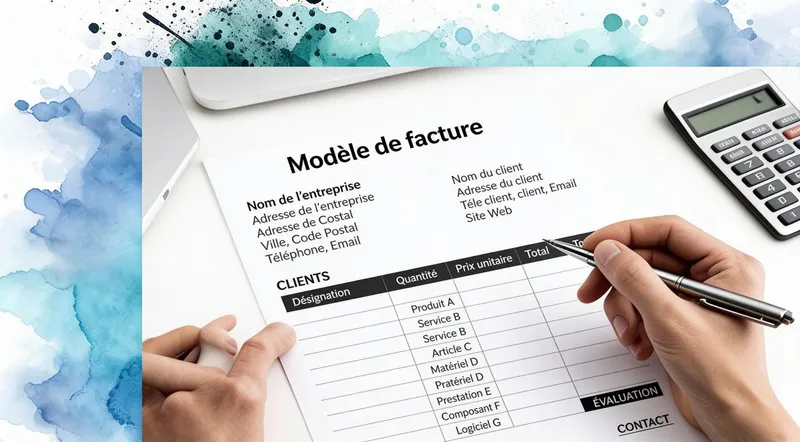
Starting out as an entrepreneur is a bit like assembling a puzzle. You have the idea, the product, the energy… but there are also all these administrative pieces to put in place. And the invoice is one of the most important. It’s tempting to cobble together a template in Word or Excel, and that’s a great starting point to save time and make sure you don’t forget anything essential. It’s the first step toward giving your exchanges a professional framework and sleeping soundly on the compliance front.
Why a good invoice template changes everything
Let’s be clear: an invoice isn’t just a piece of paper to claim money. It’s a reflection of how serious you are. A clean, well-organized document without a single typo sends a strong message to your client. It shows them they’re dealing with a professional who’s on top of things, from the service itself to the paperwork. It’s often the very last interaction you have with them after a sale, so you might as well leave an excellent impression.
But beyond the image it projects, an invoice is above all a fundamental accounting and legal document. It’s irrefutable proof of a business transaction, the document your bookkeeping and VAT returns rely on. The smallest mistake — a stray SIREN number, a slightly off tax calculation — can quickly turn into a headache with the tax authorities.
What makes an invoice effective
For an invoice to truly work, it needs to rest on two solid pillars.
The first is clarity. Your client shouldn’t have to play detective. They should understand immediately what they’re paying, why, and how. Every service, every product must be described unambiguously. It’s simple: a clear invoice is an invoice paid faster.
The second pillar is legal compliance. An invoice is a document governed by law. There are mandatory details that must appear on it, and these can vary slightly depending on whether you’re a sole trader or a company, for example. Starting from a reliable template saves you hours of research and, above all, protects you against omissions that can be costly.
Did you know? The tax authorities can apply a €15 fine for each missing or inaccurate detail on an invoice. Multiply that by the number of documents issued during the year, and the bill can quickly add up.
The foundations to lay before you even start invoicing
Before jumping into your first invoice template, take a moment to check that the basics of your business are properly in place. Having clear administrative processes and a solid understanding of your tax obligations is key to peaceful management. In fact, invoicing is just one step in the journey; for a full overview, this guide to launching your halal online business covers all the groundwork in detail. The better prepared you are, the simpler day-to-day operations become.
That’s exactly the goal of this tutorial: to walk you through it step by step. We’ll break down every essential element of an invoice together, show you concrete examples, and explain how to adapt it to your situation. By the end, you’ll be fully equipped to create flawless invoices on your own. You’ll have a ready-to-use template in hand along with all the tips to avoid common mistakes.
For an invoice to be valid, it must be perfectly clear, both for your client and for the tax authorities. Every piece of information has its purpose and, far from being a mere constraint, it’s a mark of professionalism. Think of it as your transaction’s ID card: every detail matters.
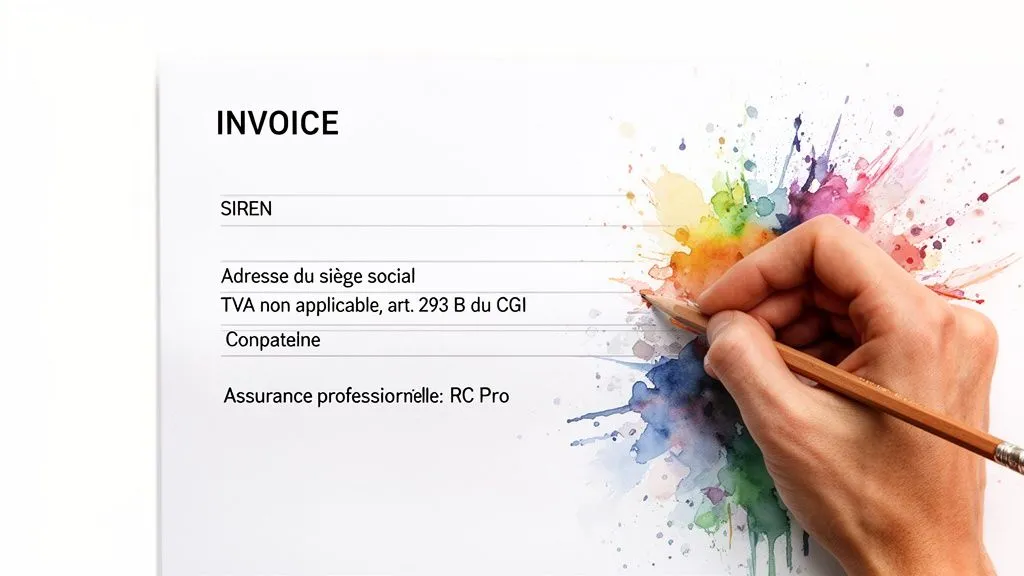
The basis of everything is identifying yourself without any ambiguity. Your invoice must display your first and last name if you operate as a sole trader, or the full legal name of your company. Right next to it, your registered office address is essential, as is your SIREN number, the unique identifier of your business.
Next comes identifying your client. You need to state their name, or company name for a professional client, along with their billing address. This is crucial not only for the document’s validity, but also to protect you in case of follow-up or a dispute.
Details that adapt to your status
Careful: not all businesses are on equal footing. The information that needs to appear can vary slightly depending on your legal structure or tax regime. That’s why it’s so important to adapt your invoice template to your own situation.
Here are the most common cases you’ll come across:
- If you’re a micro-entrepreneur (sole trader): Under the VAT exemption scheme, one mention is non-negotiable: “VAT not applicable, art. 293 B of the French Tax Code”. Forgetting it risks sowing doubt in your client’s mind and drawing unnecessary attention from the tax authorities.
- For craftsmen and regulated professions: Displaying your professional insurance details is often mandatory. This is the case for ten-year liability insurance in construction, for example. It’s an excellent way to reassure your client and show that you’re fully in order.
- For companies (SASU, EURL, SARL, etc.): Never forget to indicate your company’s legal form, its share capital amount, and the RCS number followed by the name of the city where your registry is located.
A simple omission may seem trivial, but it has the potential to call into question the validity of the entire invoice. Really take the time to check that all the information specific to your status is present. To dig deeper into the topic, we have a complete guide detailing all the mandatory details on an invoice.
To get a concrete idea, feel free to take a look at this company’s legal notices, which illustrate well the type of information to gather.
The breakdown of services or products
Now we get to the heart of the invoice: a clear description of what you sold. For each line, be as precise as possible about the nature of the service or product. Too much detail is better than a vague description that could cause confusion.
For each line of service or product, you must show:
- The quantity: whether that’s hours, days worked, or number of items.
- The unit price excluding tax (net of VAT): this is the basis of your calculation.
- The applicable VAT rate: only if you’re subject to VAT, of course.
- The total net amount for the line.
This structure makes the invoice easy to read and the final calculation crystal clear for everyone.
Adapt your invoice template to your business
Let’s be clear: there’s no such thing as a universal invoice template. A consultant who bills their time will never have the same needs as an online seller juggling stock and shipments. That’s why personalizing your invoices is a crucial step. It’s not just about making things look nice — it’s about making the document perfectly readable for your client and true to the reality of your work.
This adaptation mainly plays out at the level of line item detail, the heart of your invoice. A precise description is your best safeguard against misunderstandings and, very often, an excellent way to get paid faster.
For service providers
If you sell expertise — whether consulting, design, or writing — clarity is your best friend. Whether you bill by the hour, by the day, or on a flat-fee basis, every service must be explained without ambiguity.
When billing by time spent, the devil is in the details. Make sure to break down tasks and the corresponding number of hours. For example:
- SEO Consulting - Technical audit | Quantity: 8 hours | Unit price (net of VAT): €90
- Content writing - Blog article (1,200 words) | Quantity: 3 hours | Unit price (net of VAT): €75
For a flat fee, the trick is to break it down into major stages or concrete deliverables. This helps justify the total amount and shows the client where they stand in the project.
- Website creation - Flat fee Stage 1: Mockups and design | Quantity: 1 | Unit price (net of VAT): €1,500
My expert tip: Never underestimate the power of a short description. Just below the main line, add a sentence that gives context, like “Keyword research and competitive analysis.” For the client, this changes everything and adds value to your work.
For sellers of physical products
When you sell physical goods, your invoice should mirror well-oiled logistics. Here, precision on quantities, references, and additional costs is non-negotiable.
Your invoice template must include clearly separate columns for:
- The product reference (the famous SKU) to avoid any identification error.
- The quantity ordered.
- The unit price excluding tax.
- The total net amount for each line.
And above all, don’t forget the dedicated line for shipping costs. Specifying the delivery method is a plus that demonstrates your transparency about the final cost the client actually pays.
The special case of digital activities
Selling dematerialized products — e-books, online courses, software — brings its own set of specifics. “Delivery” is instant and intangible, but the invoice must remain just as rigorous.
Be ultra-precise in your description. “Lifetime access to the online course ‘Become a Photography Pro’” is infinitely clearer than a vague “Course purchase.” This is also an area where VAT management can quickly become a headache, particularly if you sell to individuals within the European Union, since it’s often the rate of the client’s country that applies.
Surprisingly, despite the explosion of e-commerce, there is still a lack of precise data on invoicing practices specific to this sector in France. If you’d like to revisit the fundamentals, you’ll find additional information on Bizyness.fr to help you build a solid foundation.
By fine-tuning these few points, your invoice will stop being a mere administrative paper. It will become a genuine communication tool that strengthens trust and clarity in your relationship with your clients.
Numbering and VAT: the two technical pillars of your invoices
Let’s now tackle two aspects that can quickly become a headache: invoice numbering and VAT management. It often feels complex, but once you’ve grasped the logic, everything becomes simpler. Mastering these ensures airtight bookkeeping and helps you avoid trouble with the tax authorities.
For numbering, there’s one golden rule: every invoice must have a unique number. This number must follow a chronological, continuous sequence, without a single gap. If the tax authorities spot a break in your series, it immediately raises a red flag.
Setting up a bulletproof numbering system
The simplest way to never go wrong is to use a prefix based on the year. This lets you reset the counter to zero each year (or each month) while keeping a perfectly logical and traceable sequence.
Here are a few formats that have proven their worth:
- YEAR-XXXX:
2024-0001,2024-0002… By far the most common, and the easiest to follow. - YEAR-MONTH-XXX:
2024-01-001,2024-01-002, then you move to2024-02-001the following month. This is an excellent option if you handle a large volume of invoices.
The right instinct to have: Once sent, an invoice must never be deleted, even if you notice a mistake. The only legally proper way to correct it is to issue a credit note to cancel the original. To learn everything about this essential point, our complete guide on the rules of invoice numbering is here for you.
Managing VAT like a pro
Value Added Tax (VAT) is the other big topic for businesses subject to it. If, like many micro-entrepreneurs starting out, you benefit from the VAT exemption scheme, it’s simple: you must state it in black and white. The magic wording is: “VAT not applicable, art. 293 B of the French Tax Code”.
For everyone else, things need to be clearly detailed. Your invoice must show:
- The total amount excluding tax (net of VAT).
- The VAT rate(s) applying to each product or service line.
- The total amount of VAT collected.
- And of course, the total amount including all taxes (gross, VAT included), i.e. the sum your client owes you.
This little diagram will help you visualize how to organize your invoice, whether you sell products or services.
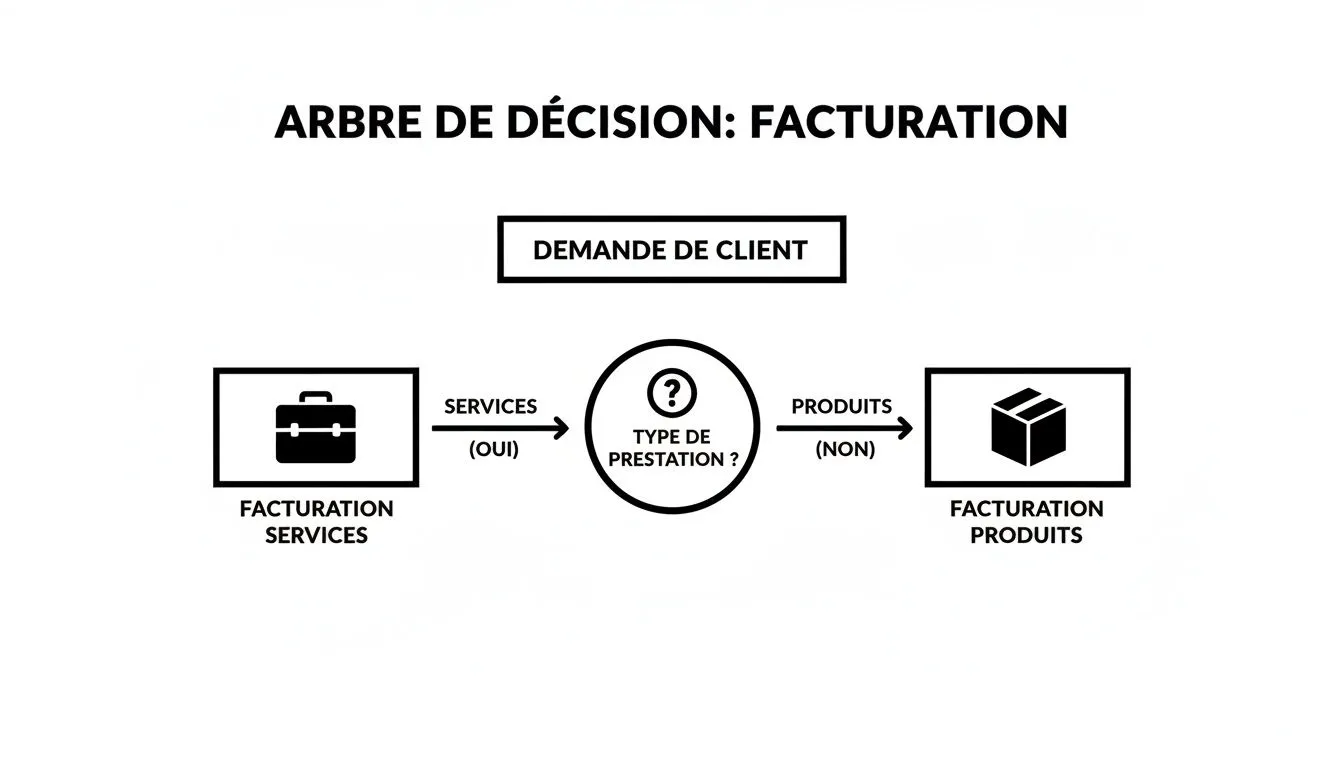
The distinction between a sale of goods and a provision of services is crucial, particularly for applying the correct VAT rate and ensuring the description of the transaction is accurate.
A well-designed invoice isn’t just a legal obligation — it’s also a mark of professionalism. It makes life easier for your client when it comes to payment and, believe me, it will greatly simplify things for you at tax return time.
Save time with an invoicing tool
At the start, everyone launches with an invoice template in Word or Excel. It’s simple, it’s free, and it does the job. But let’s be honest: your time is far too valuable to spend copying and pasting lines and checking calculations. What was once a quick fix quickly becomes a real burden.
Manual invoicing opens the door to small mistakes that can quickly become annoying, or even costly: a typo in an invoice number, incorrectly calculated VAT, a forgotten mandatory detail… Every document demands maximum concentration, time you could instead spend on your clients or growing your business.
When the DIY approach hits its limits
Managing your invoices by hand is a bit like navigating by sight. At first, everything’s fine. But as clients and projects pile up, the mental load grows heavier. Did I actually send that invoice? Has my client paid? What was the last number I used?
Beyond wasting a huge amount of time, this method carries real risks.
- The risk of errors is constant: a simple digit swap in the numbering, and your entire bookkeeping loses its compliance.
- It’s a real drain on time: add up the time spent creating, checking, sending, and then chasing up each invoice… you’re quickly talking several hours every month.
- No visibility into your business: it’s impossible to get a clear view of your cash flow, track pending payments, and anticipate incoming money.
This is where a specialized invoicing tool like Bizyness radically changes the game.
Here, for example, is what a dashboard designed to simplify your life looks like.
At a glance, you have all the key information to run your business, without having to compile dozens of files.
Automation, a real lever for your business
Think of switching to invoicing software not as an expense, but as a direct investment in your productivity. Imagine being able to generate recurring invoices for your subscription clients with a single click. Think of the peace of mind that comes from knowing your numbering is 100% reliable and legally compliant, without having to think about it.
A tool like Bizyness frees you from tasks that add zero value:
- Creating an invoice becomes a matter of seconds, since your info, your clients’ info, and your products are already saved.
- Track payments in real time: you know instantly who has paid and who you need to chase.
- Set up automatic payment reminders: no more chasing late payments manually — the system does it for you, politely but firmly.
- Guarantee your legal compliance: the software is continuously updated to stay aligned with the latest legal requirements.
By adopting a dedicated tool, you’re not just saving time. You’re gaining peace of mind, professionalism, and visibility into your cash flow. It’s the key to freeing your mind and refocusing on what truly matters: taking great care of your clients and growing your business.
Switching to modern management is a logical step in the life of any entrepreneur looking to get organized. To see concretely how these tools can change your day-to-day, take a look at our complete guide on the benefits of online invoicing. It’s choosing efficiency and security.
The questions everyone asks about invoicing
Even with a complete guide and a good template in hand, some gray areas often remain. That’s completely normal, especially at the start. To help you see things more clearly, I’ve gathered here the questions that come up again and again from entrepreneurs, with direct, practical answers.
Oops, I made a mistake on an invoice I’ve already sent. What do I do?
Whatever you do, don’t edit it! Once sent, an invoice is set in stone. It is strictly forbidden to modify or delete it from your books. That’s a golden rule.
The only clean, legal solution is to issue what’s called a credit note. This is a document that cancels the erroneous invoice, either entirely or just for the incorrect part. Be sure to include the number of the original invoice on it. The good news is that serious invoicing software, like Bizyness, handles this almost automatically, keeping you compliant without any hassle.
How long do I need to keep all these documents?
The answer is simple and non-negotiable: 10 years. That’s the legal retention period for all your invoices, whether they’re the ones you send to your clients or the ones your suppliers send you.
Whether you’re team “physical binder” or team “fully digital,” what matters is being able to produce a legible document of certain origin throughout that entire decade. Online archiving still offers a lot of comfort, letting you find an old invoice in three clicks rather than digging through a damp basement.
My client isn’t paying me, what are my options?
Faced with an unpaid invoice, take a deep breath and start gently. The first step is always a friendly reminder. A quick email or phone call is often enough to fix a simple oversight.
If radio silence persists, it’s time to step things up: the formal notice (“mise en demeure”). This is a letter sent by registered mail with acknowledgment of receipt, which sets a formal framework and is a mandatory prerequisite before considering legal action. A good invoicing tool will help you keep an eye on deadlines and can even automatically send the first reminders, sparing you this rather thankless task.
A word of advice from experience: never let unpaid invoices linger. The longer time passes, the harder it becomes to recover your money. Acting quickly and in a structured way is key to protecting your cash flow.
Is invoicing software really mandatory?
Not for everyone, no. But be careful: the anti-VAT-fraud law is very clear — if you use point-of-sale, accounting, or management software, it must be certified to guarantee data integrity. Using a recognized tool is therefore the best way to sleep soundly.
Beyond the obligation, think of it as a smart investment. Good software saves you a huge amount of time, secures your invoice numbering (goodbye gaps in the sequence!), and drastically limits the risk of a small mistake that could cost you dearly later on.
Ready to make your invoicing simpler and finally compliant, effortlessly? Discover how Bizyness can automate all this management so you can refocus on what truly matters: your craft. Create your first invoices for free.
