

 Français
Invoices and quotes for e-commerce that your customers will understand
Optimize your invoice and quote management. Our guide covers legal obligations, VAT (OSS/IOSS) and automation for online sellers.

For an online seller, invoices and quotes aren’t just administrative paperwork. They are the pillars of your business relationship. The quote is a promise that lays the foundation of trust, while the invoice finalizes the transaction, confirming the agreement and triggering payment.
Why is good invoice and quote management so important?
Think of every sale on your store as a dialogue. The quote is the first exchange: it clarifies your offer, the price, the terms. It’s your commitment in writing. The invoice, on the other hand, closes that conversation. It’s the official document that confirms the sale, reassures the customer, and serves as your accounting and legal proof.
For a web entrepreneur, juggling these documents isn’t a chore. It’s the foundation of your credibility and the guarantee of your tax peace of mind. Solid management turns a legal obligation into a genuine business asset.

A pillar of customer trust
A transparent quote and a polished invoice are the first reflections of your professionalism. When a customer receives a clear document, free of errors and easy to read, they immediately feel confident. It shows that you’re a pro, that you know your business, and that you respect them.
A flawless financial document is a form of customer service. It avoids misunderstandings, limits back-and-forth with support, and makes the whole purchasing experience more pleasant.
In e-commerce, where human contact is almost nonexistent, this rigor is essential. Your invoice becomes a key touchpoint, a mark of your seriousness.
The engine of your cash flow and your compliance
Beyond image, tight management of invoices and quotes is simply vital for your store’s financial health.
- Faster payments: A clear invoice, sent at the right time, gets paid faster. A customer who knows exactly what they’re paying for has no reason to drag their feet.
- Guaranteed tax compliance: Navigating between different VAT rates, especially internationally with the OSS/IOSS one-stop shops, can quickly become a headache. Compliant invoices protect you from a tax reassessment.
- Visibility into your finances: Accurate tracking gives you an overview of your revenue, collections and performance. It’s essential for making the right decisions.
Understanding and mastering these documents well is the foundation of any healthy business relationship. You can also learn more about the importance of quotes to start off on the right foot. Ultimately, optimizing this process is simply investing in the sustainable growth of your business.
Decoding mandatory information and legal rules
Diving into the legal obligations of invoices and quotes can quickly feel overwhelming. Yet it’s an essential step to secure your transactions and protect your business. Think of this section as your compliance checklist, designed so that every document you issue is absolutely flawless.
Don’t worry — we’ll break down together, without legal jargon, all the information that must appear on your documents. A small mistake, even a simple oversight, can be costly in the event of a tax audit.
The essential information on your quotes
A well-crafted quote isn’t just a price proposal. It’s the first building block of your business relationship, a real commitment in the making. To be valid, it must contain precise information that lays healthy foundations and avoids unpleasant surprises for your customer.
Here are the key elements to never forget:
- Your business identification: Your name (or company name), your registered address, your SIREN/SIRET number and, where applicable, your registration number with the RCS or RM. This is your professional ID card.
- Customer details: The name and address of your customer, to clearly identify who the offer is for.
- Issue date and validity period: The date the quote was created, but above all, the period during which your offer remains valid (usually 30 days). After that period, you’re no longer bound by it.
- Itemized breakdown: Each product or service must be listed with its quantity, unit price excluding tax (net of VAT) and the applicable VAT rate. Transparency is key.
- Total amounts: The total excluding tax and the total including tax must appear without any ambiguity.
To dig deeper into the topic, feel free to check out our full guide on mandatory information on a quote, which details each point.
Mandatory information specific to the invoice
If the quote is a promise, the invoice is the concrete proof of the sale. It naturally carries over elements from the quote but adds crucial information that gives it its full legal and accounting value. Missing even one of these details can render your invoice invalid in the eyes of the tax authorities.
An invoice is not just a simple summary. It’s the official document that seals the transaction and binds your liability as well as your customer’s. Its accuracy is therefore anything but optional.
In addition to the information already on the quote, an invoice must absolutely include:
- A unique invoice number: Numbering must be sequential, with no gaps and no duplicates. This is one of the first things tax authorities check.
- The invoice issue date: Simply the day you create the document.
- The date of sale or service delivery: This corresponds to the day the products were delivered or the service completed.
- The intra-community VAT number: Essential for you and for your VAT-registered business customer, especially if you trade within the European Union.
- Payment terms: The payment due date, applicable late-payment penalties, and the flat-rate compensation amount for collection costs (€40).
This rigor becomes even more critical with the upcoming rollout of e-invoicing. This reform will change the game for all VAT-registered businesses. Starting September 1, 2026, all businesses will need to be able to receive electronic invoices. The obligation to issue them will be phased in through 2027. In fact, a study showed that 71% of businesses that have already made the switch have seen their payment terms shorten.
The table below summarizes the key differences to make things clearer.
Comparison of key requirements for a quote and an invoice
This table highlights the information required for each document, underlining the common elements and the specifics of the invoice (such as the invoice number or the payment date).
| Requirement | Mandatory on the Quote | Mandatory on the Invoice | Important note for e-commerce |
|---|---|---|---|
| Business identification (SIREN, etc.) | ✔️ | ✔️ | Essential for trust and compliance. |
| Customer details | ✔️ | ✔️ | Essential for delivery and communication. |
| Issue date | ✔️ | ✔️ | Marks the start of the offer’s validity period. |
| Itemized description (Product/Service, Quantity, Unit price excl. VAT) | ✔️ | ✔️ | Transparency is key to avoiding disputes. |
| Total amounts (excl. and incl. tax) | ✔️ | ✔️ | Must be clear and unambiguous. |
| Applicable VAT rate | ✔️ | ✔️ | May vary depending on the customer’s country (OSS/IOSS). |
| Offer validity period | ✔️ | ❌ | Crucial for the quote, not applicable to the invoice. |
| Document number | Recommended | ✔️ (unique and sequential) | A non-compliant invoice number is a serious error. |
| Sale / delivery date | ❌ | ✔️ | Proves when the transaction took place. |
| Payment terms and due date | ❌ | ✔️ | Specifies payment terms and penalties. |
In short, the invoice is an enriched, finalized version of the quote, with far stricter accounting and legal obligations.
Managing international VAT for e-commerce
Selling across Europe from your online store? VAT management can quickly become a real headache. Fortunately, the OSS (One-Stop Shop) and IOSS (Import One-Stop Shop) one-stop shops simplify things, but they impose a strict rule: you must apply the VAT rate of your individual customer’s country of residence.
In practice, your invoices need to be smart. A sale to a customer in Germany? The invoice must show 19% VAT. An order for Spain? You’ll need to apply 21%. Trying to handle this manually is a near-certain source of errors. An automated invoicing system then becomes not a luxury but a necessity to stay compliant, avoid penalties and simplify your one-stop-shop filings.
From order to bookkeeping: how to orchestrate the perfect flow?
The journey of an e-commerce transaction doesn’t stop at the click of the “Buy” button. Far from it. Behind that simple gesture lies an entire chain of financial and administrative operations. If that chain is poorly oiled, it can quickly turn your management into a real headache.
To truly grasp what’s at stake, you need to visualize every step. From the customer’s initial order to its final entry in your books, everything must flow smoothly. Think of it as a well-rehearsed choreography: the order comes in, the invoice is created, the payment is collected, and every piece of information finds its place for flawless bookkeeping.
Scenario 1: The dream of integrated automation
Let’s set the scene. A customer in Germany places an order on your Shopify store and pays via Stripe. In an ideal world, a management tool like Bizyness takes the wheel and orchestrates everything behind the scenes.
Here’s what happens, without you having to lift a finger:
- Instant trigger: The order on Shopify automatically triggers the creation of an invoice. No delay, no oversight.
- Tax intelligence in action: The system sees that the customer is in Germany. It instantly applies the correct German VAT rate, 19%, based on the OSS one-stop-shop rules. No need to check it yourself.
- Payment synchronization: The payment received on Stripe is immediately linked to that invoice. Its status automatically switches to “Paid.”
- Bookkeeping done for you: The sale, the VAT to be reported, and even the commission taken by Stripe are already pre-recorded in the right accounts. Your accountant just needs to validate it.
In this scenario, everything is smooth, instant and error-free. Your tax compliance is assured, and the time you save is enormous. Every piece of the puzzle fits together perfectly, creating a reliable system you can count on as you grow.
Scenario 2: The nightmare of manual processing
Now let’s rewind and imagine the same scene, but handled the old-fashioned way, with spreadsheets and a good dose of copy-paste. The picture is immediately less rosy.
First, you have to export your Shopify orders to an Excel file. Then you open another spreadsheet to cobble together an invoice, hunting down the correct German VAT rate on Google. And you cross your fingers not to get it wrong.
Manual management isn’t just slow, it’s dangerous. Every copy-paste is a doorway to error. Every missed reconciliation is a hole in your cash flow that can cost you dearly by year-end.
This patchwork system is a never-ending source of problems:
- Costly VAT errors: Applying the wrong rate is one of the most common mistakes — and one of the most scrutinized in a tax audit.
- Shaky reconciliations: Forgetting to mark an invoice as paid, or poorly linking a Stripe payment to its Shopify order, creates black holes in your financial tracking.
- Massive time loss: All those hours spent every month juggling between your different platforms are hours you’re not spending growing your business.
Why a single source of truth changes everything
The fundamental difference between these two worlds is the centralization of information. A well-integrated system bridges your sales platforms (like Shopify or Amazon) and your payment solutions (like Stripe or PayPal) to create a single source of truth.
In practice, this means that all the data for a given transaction — the order, the customer, the payment, the invoice — is gathered and synchronized in one place. No more discrepancies between what Shopify says and what Stripe shows.
Thanks to this synchronized flow, managing your invoices and quotes stops being a stressful, reactive chore. It simply becomes a logical, automatic consequence of every sale. It’s the foundation of healthy financial management, able to keep pace with your growth without friction. By eliminating manual work, you’re not just securing your compliance — you’re freeing your mind to focus on what matters most: selling more, and selling better.
How to create professional, compliant document templates
Of course, your invoices and quotes need to tick every legal box. But beyond that, they are silent ambassadors for your brand. A well-crafted document doesn’t just comply with the law; it builds customer confidence, makes their life easier, and ultimately helps you get paid faster. It’s an often-underrated part of the purchasing experience.
So let’s move from “strictly necessary” to “genuinely effective.” The idea is to turn a simple administrative paper into a communication tool that strengthens your brand image with every transaction.
The diagram below shows exactly the optimized workflow we’re aiming for, from the customer’s order to the accounting entry.
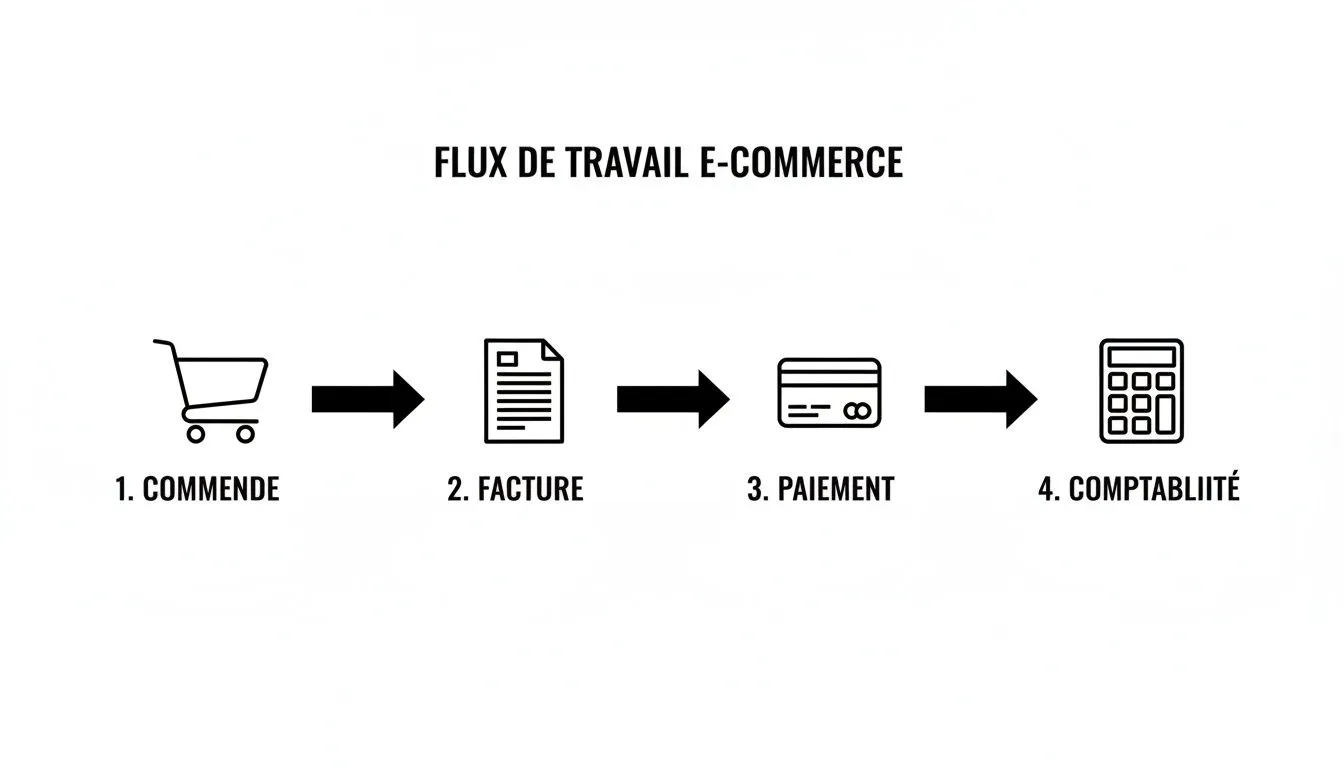
You can clearly see how each step logically follows the next. This is what reduces friction and ensures healthy, even automated, financial management.
The keys to design that hits the mark
A good document template shouldn’t look like a Christmas tree. It should breathe, be easy to read, and guide the customer’s eye straight to the information that matters. Think about the ergonomics of your invoice the way you would for your website.
- Your logo, front and center: Top left or centered, it’s the first thing the customer should see. They immediately know where the document comes from.
- A clear visual hierarchy: Play with font sizes. Headings, subtotals and body text shouldn’t all be on the same level. The total amount due should jump out.
- Color, but not too much: Use your brand colors, but sparingly. Use them to highlight an important piece of information or for headers, without ever sacrificing readability.
- Room to breathe: Don’t cram everything together. A spacious layout instantly looks more professional and far less intimidating.
By following these few rules, you create a document your customer will want to deal with right away, simply because it’s pleasant to look at and easy to understand.
Worked example: a B2C sale in Europe (OSS)
Let’s set the scene. You’re selling to a customer in Italy. For your invoice to be both clear and compliant, it needs to reflect the specifics of an intra-community sale.
The perfect invoice template:
- A clear header: Your logo, your full contact details and your intra-community VAT number. Opposite, the Italian customer’s details.
- The essential information: Unique invoice number, order date and invoice issue date.
- Product breakdown: One line per product, with a clear description, quantity and unit price excluding tax.
- VAT breakdown (the crucial point): This is where it all comes together. Show the subtotal excluding tax, then add a clearly visible line: “VAT at 22% (Italy rate).” The tax amount is calculated and added to arrive at a perfectly transparent total including tax.
- A useful footer: Even if the invoice is paid, restate your terms. It’s also the ideal place to add a short thank-you note and a link to your terms and conditions of sale.
A customer who immediately sees that their own country’s VAT has been correctly applied is a reassured customer. This transparency is non-negotiable for cross-border sales; it proves you know the European rules of the game.
The B2B quote: first impressions are everything
For a custom B2B order, the quote is your best salesperson. It needs to be detailed, flexible and, above all, inspire absolute confidence. If you’re looking for concrete examples, feel free to check out this quote template, which covers various scenarios.
Here are a few tips for a quote that converts:
- Break down every line: Don’t settle for a vague “Service provided.” Break products or tasks down so your price is fully justified.
- Offer options: Add optional complementary products or services. It shows you’ve anticipated the customer’s needs and can easily increase the order value.
- Be precise about timelines: Give a clear estimate of delivery or completion times. No one likes vagueness.
- Spell out the rules: The validity period of your offer and the deposit terms must be stated in black and white, without any ambiguity.
A well-built quote is much more than a simple price proposal. It’s the start of a business relationship and the first tangible proof of your professionalism.
How automation can grow your business
Spending hours juggling spreadsheets, copy-pasting order details and checking every VAT rate by hand… that’s a massive drag for any ambitious online seller. That’s precious time you’re not spending on your marketing, your products or your customer service. Far from being a luxury reserved for big companies, automation is actually the engine that lets you take back control and focus your energy where it truly matters: growth.
Think of automation as your best employee. It never sleeps, never makes mistakes, and works for you 24/7, ready to react the instant a sale is completed. Its mission is simple but vital: turn every transaction into a flawless financial and accounting flow, without you having to lift a finger.
This approach changes everything about managing your invoices and quotes. You stop being at the mercy of admin work — you drive it.
Triggers and actions: the mechanics of efficiency
At the heart of automation lies a simple cause-and-effect principle: an event (the trigger) sets off a series of actions you’ve defined in advance. In e-commerce, these triggers are simply the key moments in the purchase journey.
The system is designed to react instantly to these signals:
- Trigger 1: New order on Shopify. A customer completes their purchase. Within a second, a fully compliant invoice is created, with the correct details, the correct products and, above all, the correct VAT rate applied based on the delivery country.
- Trigger 2: Successful payment via Stripe. The money lands in your account. The action is twofold: the invoice automatically switches to “Paid” status, and an accounting entry is prepared to record this revenue.
- Trigger 3: Order shipped from Amazon. The order status changes. The system can then send the final invoice to the customer, ensuring perfectly synchronized communication, with zero effort.
This mechanism puts an end to the delays, oversights and human errors that are inevitable when doing everything by hand. Each step logically follows the previous one, creating a reliable, frictionless workflow.
The concrete benefits for your growth
Setting up an automated invoicing system isn’t just about convenience. It’s a genuine strategic choice with direct, measurable impacts on your store’s performance.
The first, most obvious benefit is a massive time saving. The hours spent creating invoices, sending them and chasing payments are suddenly freed up. You can finally focus on what really matters: finding new products, refining your marketing, or taking care of your customers. To go further, you can also discover how to automate administrative tasks and unlock even more potential.
The second, equally important benefit, is a drastic reduction in the risk of errors. A VAT mistake, a missed invoice or a poor bank reconciliation can be very costly — whether in wasted time, customer disputes or, worse, a tax reassessment. Automation ensures every invoice is spot-on, with the correct VAT rate applied to every sale, whether it’s in France or on the other side of the world.
By entrusting the compliance of your invoices and quotes to a smart system, you’re not just saving time. You’re buying invaluable peace of mind, knowing your management is protected from costly errors.
Real-time visibility into your cash flow
Finally, one of the most important benefits is having a clear view of your finances. When every sale is instantly translated into accounting data, you get an always-up-to-date dashboard of your cash flow. You know in real time what’s been invoiced, what’s been collected, and what’s still pending.
This clarity is essential for making the right decisions, anticipating your stock needs and steering your business with precision. In France, late payments are a real scourge for cash flow. The average delay can reach 58 days in manufacturing and even 72 days in healthcare. For an online seller, even a much shorter delay can paralyze restocking. Automated tracking flags anomalies in real time, smooths out the sales cycle, and significantly reduces this risk.
Ultimately, automating your invoicing isn’t just an optimization. It’s a solid foundation that secures your present and actively prepares your future, giving you the means to grow faster and with greater peace of mind.
Frequently asked questions about e-commerce invoicing
Even with a well-oiled system, managing quotes and invoices in e-commerce always raises its share of questions. That’s normal. A doubt about a legal requirement, hesitation over best practice… and it can slow down your entire day-to-day management.
Let’s go through the most common questions together to provide clear, directly applicable answers. The goal: to let you move forward with confidence.
Do you really need to create an invoice for every sale to an individual?
In theory, French law states that for a distance sale to an individual, an invoice is only mandatory if the customer requests it. But be careful — stopping at that rule is a very narrow view and, frankly, quite risky for an online seller.
In practice, the reality is much more complex:
- EU sales: As soon as you ship an order to a customer in another EU country, the invoice becomes essential. It’s the proof that you’re correctly applying that country’s VAT via the OSS one-stop shop.
- Traceability and disputes: Without an invoice, how do you prove the details of a transaction in the event of a dispute, a refund request, or worse, a tax audit? It’s your only official supporting document.
- Brand image: Systematically sending an invoice is a mark of seriousness. It reassures the customer and strengthens your store’s credibility.
The best practice, and by far the safest, is to generate an invoice for every sale, without exception. With a good automation tool, this becomes invisible and requires no effort on your part.
This rigor is your best insurance for perfect traceability and rock-solid compliance.
How do you handle invoice numbering when selling on multiple sites?
This is a critical point and a mistake we see far too often among multi-channel sellers. The rule is simple and non-negotiable: your invoice numbering must follow a single, chronological sequence with no gaps.
Trying to cobble together different prefixes for Shopify, another for Amazon, and yet another for your direct sales is a very bad idea. It’s an open door to errors, duplicates and gaps in the sequence — exactly the kind of anomaly that raises an immediate red flag during a tax audit.
The only truly reliable solution is to go through a centralized invoicing system.
- It pulls in all your orders, regardless of their source.
- It assigns them a unique invoice number, drawn from one single sequence.
- Whether the sale comes from your own site or a marketplace, it simply takes its place in line, without causing disorder.
With this approach, compliance becomes a given, and you finally get a clear, unified view of your business.
What is the value of a quote once it’s been signed?
Never take a quote lightly. The moment your customer dates it, signs it, and adds a clear statement such as “Approved” or “Read and approved,” the document changes status: it acquires the same legal value as a contract.
In practice, this means it binds you both, with no turning back:
- On your side (seller): You have a legal obligation to deliver the products or services described, strictly complying with the agreed terms and price.
- On your customer’s side (buyer): They have a legal obligation to pay you the agreed amount in exchange for what you provide.
This is precisely why a quote must be absolutely clear. Every line, every condition, every price must be unambiguous. In the event of a disagreement, it will be the key piece of evidence to prove what you both agreed to.
How do you charge VAT on a sale outside the European Union?
When you sell and ship a product to a customer located outside the EU (in the United States, Switzerland, the United Kingdom…), the transaction is treated by the authorities as an export.
The general rule for these sales is that they are exempt from French VAT. Your invoice must therefore show a total amount excluding tax only.
To keep everything in order, you need to add a legal statement justifying this exemption. The most commonly used one is:
“VAT exemption - Article 262 I of the French Tax Code”
This short statement tells the tax authorities why you didn’t collect tax. But be careful — it’s not enough to just write it. You must be able to prove that the parcel actually left EU territory. So keep all your export documentation safe (customs declarations, proof of shipping…). It’s essential in the event of an audit.
Managing invoices and quotes can seem like a burden, but with the right tools, it becomes simple and secure. Bizyness is built for exactly that: centralizing and automating your entire financial cycle, from order to bookkeeping, so you can focus on what really matters — your growth. Discover how to transform your management at https://www.bizyness.fr.
