

 Français
The Guide to Invoicing a Private Individual Without Making a Mistake
Learn how to invoice a private individual while staying compliant with the law. Our guide covers mandatory information, VAT, and the tools for compliant invoices.
Invoicing a private individual isn’t just about sending a piece of paper to get paid. It’s a genuine legal act that protects your work and, above all, builds a relationship of trust. A well-crafted B2C invoice is your best protection in case of a dispute and the foundation of sound, professional management.
Why invoicing private customers properly is essential for your business
Issuing an invoice to an individual customer can seem superfluous, especially for small jobs or quick sales. Yet this document is far more than a formality: it’s the foundation of your business relationship. It sets the agreement in writing, detailing precisely what you provided and at what price. It’s tangible proof of your service.
The dynamic is very different from a sale to another professional (B2B). Here, your customer isn’t expected to know the ins and outs of accounting. They need a clear document that’s easy to understand and free of any ambiguity. Clarity is king.
Protecting your business and your customer, a dual challenge
A properly drafted invoice is a real shield. If a customer is slow to pay, it’s the key document that will let you launch a debt collection procedure. Without an invoice, good luck proving the debt exists… it’s often an uphill battle.
But protection works both ways, and it’s a selling point! For your customer, the invoice is essential to assert their rights, such as a warranty on a product or after-sales service. Think of a tradesperson renovating a bathroom: the detailed invoice is the only official proof for the customer that the work was done by a professional. It’s an essential document if they resell their home or in the event of water damage.
Invoicing a private individual isn’t just a legal obligation in certain cases — it’s above all a professional reflex. It demonstrates your seriousness, reassures your customer, and greatly simplifies your own accounting management.
A legal obligation in many cases
It’s often wrongly assumed that invoices are only mandatory between professionals. While they are indeed systematic in B2B, the law also requires them in very specific situations involving individuals, precisely to protect them. Ignoring these rules exposes you to penalties, and it’s best to avoid that.
So, when is it mandatory? This table summarizes the cases where the law requires issuing an invoice for a transaction with a non-professional customer.
When must you issue an invoice to a private individual?
| Transaction situation | Invoicing obligation | Specific condition to meet |
|---|---|---|
| Any service provided | Mandatory if the amount exceeds €25 including tax | The invoice must be issued as soon as the service is completed. |
| Distance selling (e-commerce) | Always mandatory | The invoice must be provided at the latest at the time the goods are delivered. |
| Building and construction work | Always mandatory, regardless of amount | This covers construction, renovation, cleaning, maintenance, etc. |
| Explicit customer request | Mandatory, regardless of amount | You can never refuse to provide an invoice if the customer requests one. |
Knowing these rules of the game from the start saves you a lot of hassle. See invoicing not as a constraint, but as an asset for the longevity of your business. It’s the first building block of a solid customer relationship, based on clarity and mutual trust.
The essential information for a fully compliant invoice
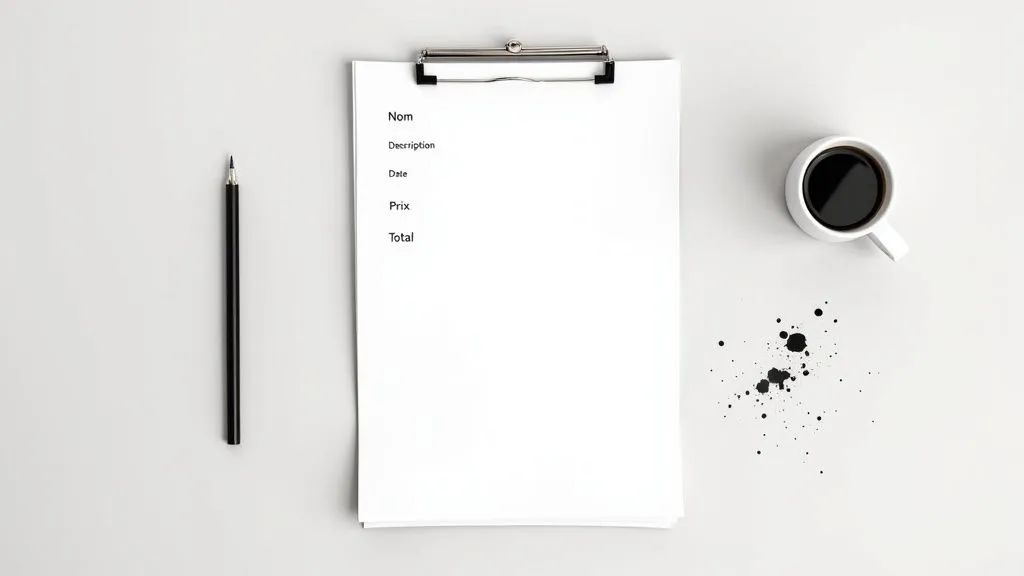
An invoice isn’t just a piece of paper to ask for money. It’s a legal document that carries your liability. The smallest omission can make it invalid in the eyes of the tax authorities or complicate matters in a dispute with a customer. So let’s go through, point by point, what turns a simple summary into a rock-solid invoice.
Each mandatory item serves a purpose: ensuring the traceability of the transaction, clearly identifying who is who, and defining without any ambiguity what was sold. Missing one of these rules exposes you to a fine that can reach up to €75,000 for an individual. That’s food for thought.
Clearly identifying seller and buyer
The basics of the basics. For an invoice to be valid, you need to know who the two parties involved are. This is non-negotiable and must be spelled out in writing.
For you (the professional):
- Your full name (or company name if you operate as a company).
- The address of your registered office.
- Your SIREN number (or SIRET), which is your business ID card.
- The mention of your status (for example, “Micro-entrepreneur” or “Sole trader”).
For your customer (the individual):
- Their full name.
- Their home address.
This dual identification is crucial. It officially links the transaction to the right people and avoids any possible confusion.
Numbering and date: the pillars of your tracking
These two elements are at the heart of your bookkeeping. They must be flawless to guarantee an unbroken chronology of your transactions.
The issue date is simple: it marks the start of the receivable. It’s from this day that payment terms begin to run.
The invoice number, on the other hand, is even more critical. It must be unique and follow a chronological, continuous sequence, without any gaps. For example: INV-2024-001, INV-2024-002, etc. A break in this logical sequence is a red flag for the tax authorities, who may see it as an attempt at concealment.
Never underestimate the importance of flawless numbering. Invoicing software like Bizyness handles it automatically for you. It saves you from human errors that can be very costly during an audit.
Detailing the service: transparency above all
This is the part where you concretely explain what your customer is paying for. A lack of precision here opens the door to misunderstandings, or even disputes.
For each product or service, you must absolutely indicate:
- The precise description: Be specific. Don’t write “Painting work,” but rather “Wall preparation and application of two coats of satin paint, color XYZ, over a 25 m² surface.”
- The quantity: The number of hours, square meters, units sold, etc.
- The unit price excluding tax: The cost for a single unit.
- The total amount excluding tax for the line.
This breakdown is essential. It allows your customer to understand exactly what they’re paying for, justifies the final amount, and, along the way, strengthens your credibility.
Skilled trades are a great example of the importance of this rigor. In 2024, France saw a record 278,700 new skilled trade businesses, an 11% increase in one year. For all these new entrepreneurs, knowing how to issue clear invoices to private customers is a mark of professionalism. And knowing that 69% of these businesses are still operating after three years, it’s clear that mastering invoicing from the start is a key factor for lasting.
Amounts and specific mentions not to forget
Once everything is detailed, the invoice must conclude with totals and the legal mentions that apply to your situation. This naturally includes the total amount due, the payment due date, and any conditions if you offer a discount.
Depending on your business, other mentions may be mandatory. For example, a building tradesperson must indicate the details of their ten-year liability insurance (garantie décennale). This is crucial information that reassures the customer. Similarly, if you’re a micro-entrepreneur under the VAT exemption scheme, the mention “VAT not applicable, art. 293 B of the French Tax Code” is essential to justify the absence of tax.
For a truly complete overview, feel free to check out our guide on mandatory invoice information, which breaks down every scenario.
How to apply the right VAT rate for a private customer
The question of VAT can quickly seem daunting, but it’s an absolutely essential step to invoice a private individual by the book. The good news? For many independents, especially when starting out, the system is actually very simple. For everyone else, you just need to know a few key principles to navigate without stress.
The starting point is often the VAT exemption scheme (franchise en base). This is the typical case for micro-entrepreneurs who stay below certain revenue thresholds. If you’re in this situation, you simply don’t have to worry about VAT.
In practice, this means you invoice your services or products “excluding tax.” The price you quote to your private customer is therefore the final price they’ll pay, full stop. It’s a real advantage for staying competitive when starting out.
The VAT exemption scheme case
If you fall under this scheme, a very specific mention must appear on all your invoices. Without it, your document isn’t compliant and could be rejected.
The phrase to write is: “VAT not applicable, art. 293 B of the French Tax Code.”
This little sentence is more important than it looks. It signals to the tax authorities, and to your customer, that you’re legally invoicing without VAT. Forgetting it is a classic mistake that, in the event of an audit, can cast doubt on the seriousness of your bookkeeping.
Choosing the right VAT rate when you’re subject to it
When your business grows and you cross those famous thresholds, things change: you become liable for VAT. Your role is then to collect this tax on behalf of the government by adding it to your invoices, before remitting it. This is where you need to choose the right rate.
In France, there are mainly three VAT rates in play, each corresponding to well-defined types of goods or services.
- The standard rate at 20%: This is the default rate, the one you’ll encounter most often. It applies to the majority of sales and services. A coaching session, building a website, or selling a garment will all be subject to 20% VAT.
- The intermediate rate at 10%: Mainly found in improvement and renovation work on homes over two years old, in the restaurant industry, or in passenger transport.
- The reduced rate at 5.5%: This rate applies to products considered essential, such as food, books (print and digital), or energy renovation work (installing insulated windows, for example).
Identifying the right rate isn’t a mere formality — it’s a legal obligation. Applying the wrong rate can expose you to a tax reassessment. Always take the time to properly qualify your service to invoice correctly.
To help you visualize all this, here’s a table summarizing the different scenarios with concrete examples.
Which VAT rate should you choose for your invoices to a private individual?
A comparative overview of VAT rates in France with concrete examples of goods and services to help you see things more clearly.
| Applicable VAT rate | Percentage | Concrete examples of goods or services |
|---|---|---|
| Standard rate | 20% | Sale of furniture, consulting session, repair of an electronic device, sports class. |
| Intermediate rate | 10% | Renovation of a bathroom in an older home, meal served in a restaurant, hairdressing service. |
| Reduced rate | 5.5% | Sale of a book, installation of a heat pump, sale of basic food products. |
| VAT exemption | 0% | Any service if you’re a micro-entrepreneur below the thresholds (with the mandatory mention). |
Understanding these nuances well is the basis for sound, compliant invoicing. If you want to dig deeper into the topic, our guide on calculating the VAT rate gives you all the keys to mastering the different rules.
Also note that certain sectors have their own specifics. For example, if you’re in the training field, it may be worth consulting dedicated resources to master VAT for a training organization.
Ultimately, once you’ve grasped the basic rules, managing VAT becomes almost second nature. Whether it’s adding the exemption mention or selecting the right rate, rigor is your best ally for securing your business.
Properly framing the sale: the essential role of the quote and the deposit
Even before thinking about the final invoice, everything often starts with a key document: the quote. Don’t see it as a mere commercial formality. It’s the true cornerstone of your relationship with your private customer. Once it’s signed, this document protects both of you by clearly setting out the rules of the game in writing.
An accepted quote, bearing the famous mention “approved” (bon pour accord), has real legal value. It sets the scope of your work, any materials involved, the timeline and, of course, the price. If a problem or disagreement arises later, it will be your best ally for recalling what was originally agreed.
Moreover, in many trades, particularly in skilled crafts, the quote is simply a legal requirement. And that’s a good thing! This rigor is fundamental for a sector that carries significant weight in France, with more than 3.2 million skilled trade businesses shaping our economy.
The deposit invoice, a reflex to secure your cash flow
The quote is signed? Great. Now let’s talk cash flow. Asking for a deposit isn’t a sign of distrust — it’s a sound practice and proof of professionalism. It’s a first payment, made before or during the job, which has a dual benefit: it helps you cover your initial costs (buying raw materials, for example) and it commits your customer in a concrete way.
Note that for every deposit you collect, you’re required to issue a deposit invoice. This isn’t a simple note. It must contain the same mandatory information as a standard invoice and clearly reference the original quote.
- Link to the quote: Always remember to indicate the number and date of the corresponding quote.
- Clear description: A label like “Deposit for service X per quote no. Y” is perfect.
- Amount and VAT: The deposit is calculated on the total amount including tax. If you’re liable for VAT, it must appear distinctly.
A deposit is a strong signal that both parties are committed to the project. Asking for 30% has become standard practice in many sectors — don’t hesitate to adopt it.
This diagram illustrates the journey an entrepreneur takes with VAT, from the exemption scheme through to the different rates.
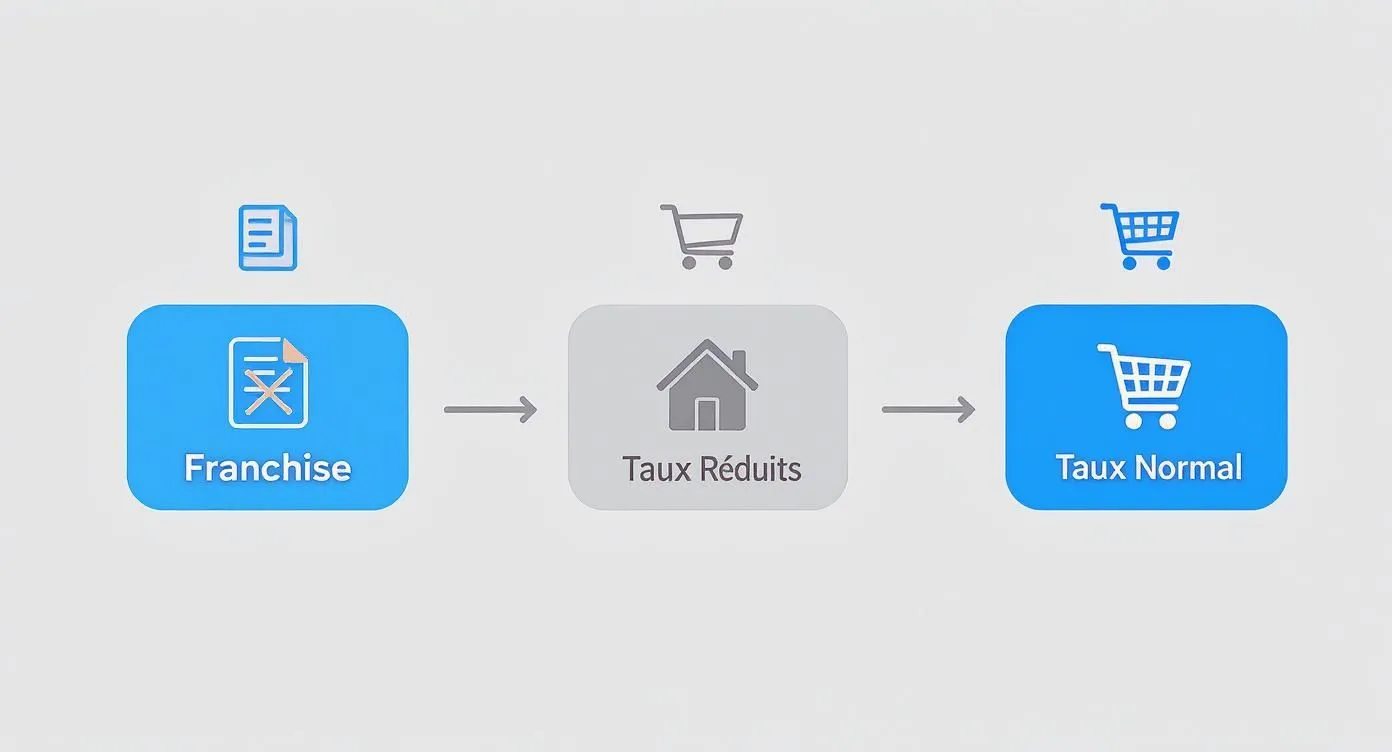
Understanding this progression is crucial, whether for a deposit invoice or the final invoice.
Closing the loop with the balance invoice
Your job is finished, congratulations! It’s time to request payment of the remaining amount. That’s the role of the balance invoice. This final document must not only summarize the entire service, but also, and this is essential, very clearly deduct the deposit you’ve already received.
Transparency is your best friend here. The customer should understand at a glance how the amount they still owe is calculated.
A concrete example for your balance invoice:
Imagine a service invoiced at €1,200 including tax (€1,000 excluding tax + €200 VAT), with a 30% deposit already paid.
- Total amount of the service, including tax: €1,200.00
- Deposit paid on [date] (invoice no. Z): - €360.00
- Net amount due (balance): €840.00
It’s simple, clear, and avoids unnecessary questions. If you want to dig into how to structure these different documents, take a look at our full article on managing quotes and invoices.
Mastering this quote-deposit duo well is a fundamental skill for any entrepreneur who invoices private customers. It’s the best way to prevent misunderstandings and drastically reduce the risk of unpaid invoices.
Modern tools to make your life (and your invoicing) easier
Let’s be honest: managing your invoicing by hand on a spreadsheet, or worse, with a paper invoice pad, is a huge waste of time and an open door to errors. Between the risk of forgetting a mandatory mention, messing up the numbering, or spending hours chasing customers, this administrative side of things can quickly become a nightmare.
Fortunately, there are much smarter solutions to turn this chore into a simple, almost automatic process. Adopting online invoicing software is undoubtedly the best move for any entrepreneur who wants to invoice a private individual calmly and efficiently.
Save time and sleep easy
A specialized tool like Bizyness is designed to relieve you of all the stress related to legal compliance. Instead of scrutinizing every invoice, you use preconfigured templates that already include all the necessary fields. You enter your customer’s details, your service lines, and in just a few clicks, your invoice is ready and guaranteed compliant.
One of the biggest reliefs is automatic numbering management. No more worrying about creating a duplicate or a “gap” in the sequence, a small mistake that can quickly catch the tax authorities’ attention. The system generates a unique, chronological number for every document, without you having to think about it. Your bookkeeping stays flawless.
This automation has become crucial, especially in highly dynamic regions like Île-de-France, which alone accounts for 10% of France’s national skilled-trades sector. Digitalization is a deep-rooted trend there, and against this backdrop, more than 67% of sole proprietorships in service-based crafts have opted for micro-entrepreneur status. For them, a simple, compliant tool is simply essential. If the topic interests you, you can check out this full analysis of skilled trades in Île-de-France.
A good software solution gives you a clear, centralized view of your business, as shown in this Bizyness interface.
Everything is gathered in one place, making it easy to track issued invoices and their status at a glance.
Track your payments closely for better cash flow
Knowing who has paid you and who’s dragging their feet is the crux of your business’s financial health. A good invoicing tool gives you a real-time dashboard to track the status of each invoice: sent, viewed, paid, overdue…
No more manually checking off your bank statements! Most modern solutions sync with your business account to automatically reconcile incoming payments and mark invoices as settled.
This visibility lets you be responsive. You can set up automatic, personalized reminders for unpaid invoices. It’s a huge time saver that also speeds up payments without straining the relationship with your customer.
Get ahead with electronic invoicing
The digitalization of invoicing is no longer just an option — it’s an inevitable evolution. The reform on mandatory electronic invoicing (e-invoicing) is being rolled out progressively in France. Eventually, it will apply to all businesses, including those invoicing private individuals (B2C).
Even if the deadline still feels far off, using a compatible tool now prepares you for this transition smoothly. By familiarizing yourself with the formats and submission portals, you’ll avoid a last-minute scramble.
A few tips for sending your invoices (and getting paid faster)
How you send your invoices has a direct impact on how quickly you get paid. Here are a few best practices:
- Email is the baseline: It’s the fastest and simplest method. Use a clear, direct subject line, like: “Invoice No. [Number] for [Project Name].”
- PDF, your best friend: Always attach a clean PDF that’s readable on all devices (computer, tablet, smartphone).
- Offer a customer portal: Some software, like Bizyness, offers a secure space where your customers can find all their invoices. It’s a real plus that strengthens your professional image.
- Include a payment link: Make life easier for your customer! A simple button to pay by card or bank transfer can make all the difference. The fewer steps involved, the faster you get paid.
In short, modern invoicing software isn’t a gadget. It’s a genuine strategic partner that secures your revenue, professionalizes your image and, above all, frees up your time so you can focus on what you do best: your craft.
Frequently asked questions about invoicing private customers
Invoicing private customers can seem simple, but it often raises a whole host of questions. It’s easy to feel a bit lost in the rules. No worries, I’m here to clear things up with concrete answers, drawn from real-world experience.
Am I really required to issue an invoice to a private individual?
The short answer? No, not every time. But between us, it’s a very good habit to get into. The law is fairly specific and requires an invoice in certain cases to protect the consumer.
In practice, you have no choice if:
- Your customer asks you for one, regardless of the amount. It’s their right.
- The service you provided exceeds €25 including tax.
- You sell online or remotely (e-commerce, for example).
- You carry out building or construction work, even for a very small amount.
Even when the law doesn’t require it, think of the invoice as your best ally. It’s formal proof of the transaction, a shield in case of dispute, and it strengthens your credibility. For your customer, it’s also essential to claim a warranty. In short, everyone wins.
Help, my customer isn’t paying me! What do I do?
Ah, the anxiety of an unpaid invoice… It’s a stressful situation, but you need to stay methodical. The very first thing to do is a friendly reminder. A phone call or a friendly email can be enough. People forget sometimes, it happens.
If that doesn’t work, it’s time to move up a level. Send a formal notice letter (mise en demeure) by registered mail with acknowledgment of receipt. It’s not just a reminder — it’s a legally significant document that shows you mean business.
A golden piece of advice: a perfectly drafted invoice is your best weapon in the event of non-payment. Without it, any procedure to recover your money becomes a real uphill battle.
Still no payment? You can then launch a judicial debt collection procedure. For small amounts (under €5,000), there’s a simplified procedure via a court bailiff (commissaire de justice, formerly known as an huissier) that’s quite effective.
I made a mistake on an invoice I already sent — how do I fix it?
This is the golden rule in accounting: an issued invoice can NEVER be modified or deleted. It’s set in stone. The chronological order of your invoices is sacred.
So how do you fix a mistake? The one and only legal solution is to create a new document: a corrective invoice, better known as a credit note.
For this credit note to be valid, it must absolutely:
- Clearly reference the original invoice (its number, its date).
- Explain what is being corrected.
- Carry a number that follows the logic of your usual numbering sequence.
If you overcharged, the credit note will have a negative amount. If, on the other hand, something was missing, you’ll need to create a new, additional invoice. This is exactly the kind of situation where invoicing software like Bizyness saves the day, generating compliant credit notes in just a few clicks.
Can a private individual invoice me without being a business?
The answer is clear: no. To issue a proper invoice in France, you need professional status, and therefore a SIRET number. This number is what proves your business legally exists.
Issuing invoices regularly without being registered is considered undeclared work. And that’s illegal, with heavy penalties.
For a one-off sale between two people who aren’t professionals, you can use a “sales certificate” or a “fee note.” But be careful, these documents have no accounting or tax value. The buyer, for example, won’t be able to reclaim the VAT with it.
As soon as you have an activity that earns you money, even as a side income, you need a structure. Micro-entrepreneur status is perfect for getting started and invoicing private customers fully legally. It’s simple and quick to set up.
Don’t let administrative paperwork slow you down any longer. With Bizyness, create professional invoices, track your payments, and stay in control of your cash flow without the hassle. Discover how Bizyness can simplify your daily life starting today.
