

 Français
 Invoicing as a private individual: legal framework and simple solutions
Discover the legal framework around invoicing as a private individual, the risks involved, and why becoming a micro-entrepreneur makes invoicing simple and worry-free.
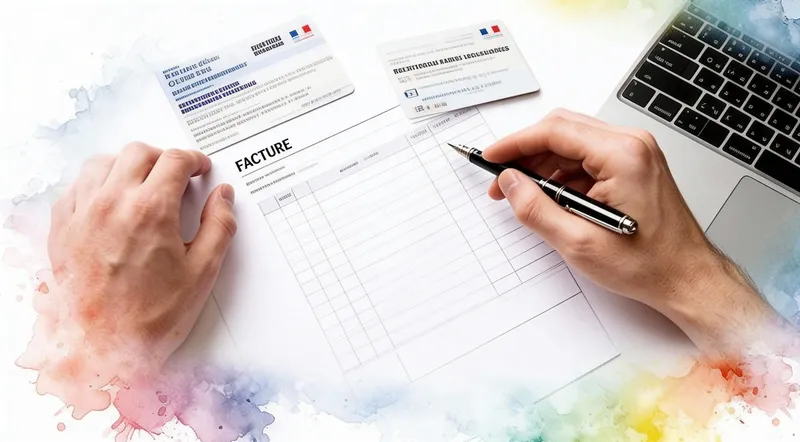
This question comes up often, and the answer is straightforward: no, a private individual without professional status cannot, legally, issue an “invoice” in the strict sense of the term in France. This document is reserved for registered businesses and professionals. But be careful, this doesn’t mean a transaction between you and a buyer should happen without leaving any trace.
The principle: why is invoicing so tightly regulated?
To see things clearly, you need to distinguish between two very different scenarios: an occasional small sale and an economic activity that becomes established over time. The French State closely monitors all sources of income, for obvious tax and social reasons. The word “invoice” is not trivial; it triggers very specific obligations, such as managing VAT or keeping accounts, which a simple private individual cannot do.
Think of the invoice as an official document that feeds into the economy’s general ledger. It’s a piece of the puzzle that lets the administration track commercial exchanges. As a private individual, you simply aren’t part of that circuit.
Occasional sales: a well-defined tolerance
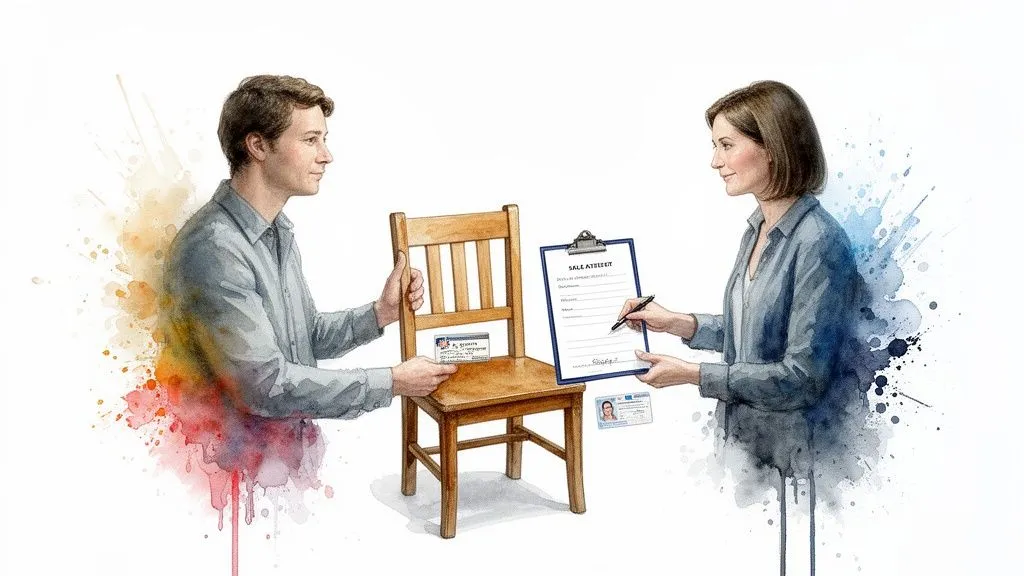
Selling an old bike or a chest of drawers on a secondhand platform? This isn’t a commercial act, but a one-off transaction. In this specific case, you don’t issue an invoice, but rather a sales certificate or a “receipt”. This paper serves as proof for both the buyer and yourself.
To be valid, this document must contain a few key pieces of information:
- The name and contact details of the seller and buyer.
- A clear description of the item sold.
- The date of the transaction.
- The price paid.
This transaction stays within the private sphere. One point of caution though: even this income, if it exceeds certain thresholds, may need to be mentioned on your tax return.
This simple decision tree will help you visualize the fundamental difference between an isolated sale and an activity that requires a professional framework.
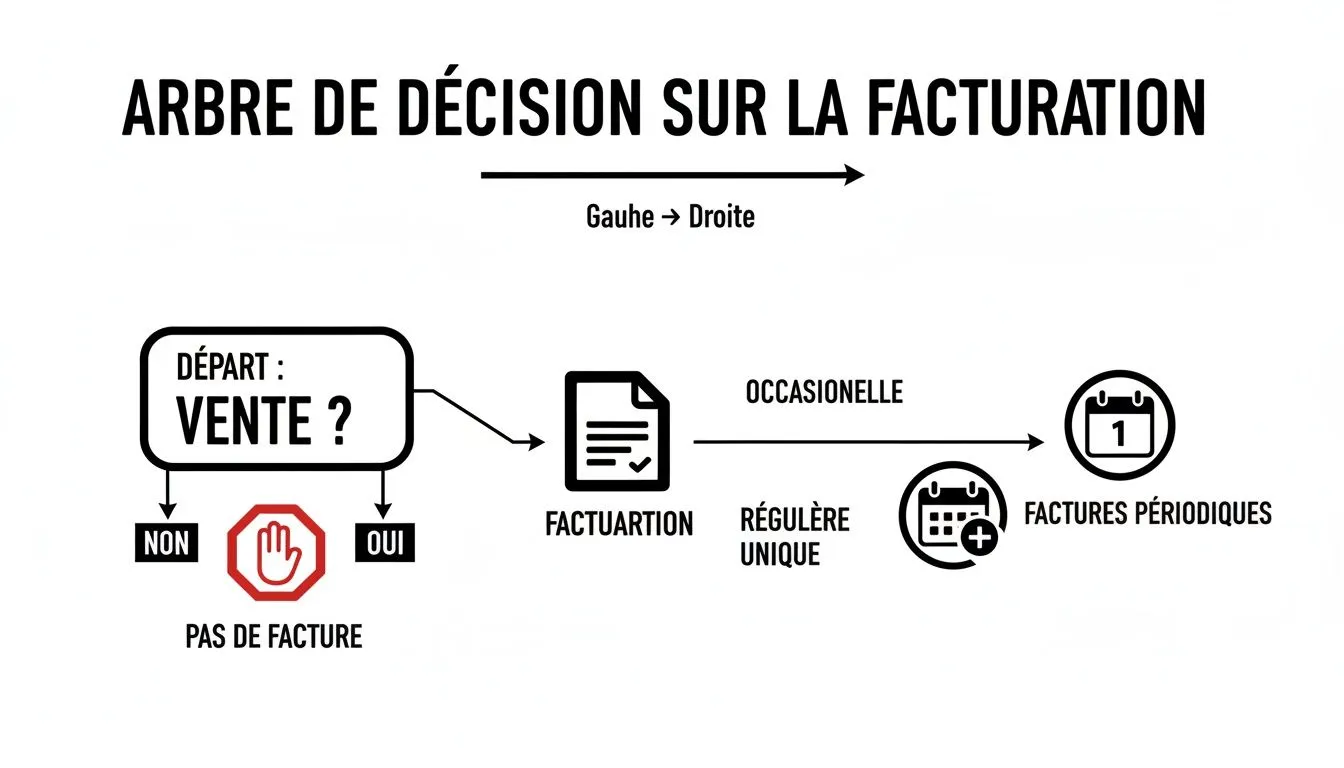
As this diagram shows, everything depends on the nature of your activity. Is it one-off or recurring? The answer to this question determines the type of document to produce and the obligations that come with it.
When selling becomes a habit
The tolerance for a sales certificate has its limits. As soon as the activity becomes regular, even for small amounts, the rules change. Are you starting to sell your creations every week? Offering your services on a recurring basis? Buying to resell? You’ve crossed the line: you’re now in the professional world.
Repeating commercial acts, even on a small scale, turns a simple transaction into a genuine economic activity. Ignoring this is a real risk, particularly that of being accused of undeclared work.
At that point, the question is no longer whether invoicing as a private individual is possible. It becomes: how do I get legal status so I can invoice with peace of mind? This is where solutions like micro-entrepreneur status really come into their own. They offer a simple, secure framework for declaring your income, protecting your activity and, above all, building trust with your clients.
To help you navigate between these different options, this table quickly summarizes which document to use depending on your situation.
Selling a good or a service: which document should you use?
This table quickly clarifies which document is appropriate for your situation, so you can act in full compliance.
| Your situation | Document to provide | Tax consequence | Our recommendation |
|---|---|---|---|
| Single, occasional sale (e.g. clearing out your attic). | Sales certificate or receipt. | Must be declared if the amount exceeds €5,000 (excluding specific goods such as precious metals). | Favor the sales certificate to keep a clear written record for both you and the buyer. |
| Repeated sales or regular services. | Invoice (mandatory). | Income must be declared as part of a business (e.g. micro-entreprise). | Set up micro-entrepreneur status. It’s simple, fast, and puts you in compliance immediately. |
In short, the choice of document is not trivial and depends entirely on the nature of your activity. Choosing the right solution from the start will save you a lot of complications.
Occasional sales: what legal framework applies to a private individual?
When you sell a personal item, like your childhood bike or a family piece of furniture, you don’t imagine having to juggle complex formalities. And that’s true — for a transaction that stays purely exceptional, there’s no question of setting up a business. But be careful, this tolerance doesn’t mean anything goes. A minimum set of rules applies so that everything goes smoothly, both for you and for the buyer, and above all to stay on the right side of the tax authorities.
Think of this sale as a small contract. Even if it’s not an “invoice” in the strict sense of the term, a written document is your best protection against misunderstandings. We’ll instead talk about a sales certificate or a “receipt”, a simple paper that formalizes the transaction.
What should your sales certificate contain?
For this document to have real value and be usable as proof if needed, it must be perfectly clear. It’s a bit like the identity card of your sale, and every piece of information matters to avoid any future disagreement.
Here are the elements you must not forget:
- The full identity of the seller and the buyer: Your first and last name, address, as well as those of the buyer. This is the basis for knowing who is selling to whom.
- The date of the sale: It marks the exact day the item changes ownership.
- A precise description of what you’re selling: Be as detailed as possible. For an item, note the brand, model, condition (new, used, scratched on the side…), in short, everything that characterizes it. This cuts short any claims like “I didn’t think I was buying that!”.
- The transaction price: Indicate the amount in figures and, for extra security, in words.
- The signatures of both parties: The famous “read and approved”. The signature seals the agreement and confirms that everyone agrees on the terms.
Remember to make this document in two copies, one for you and one for the buyer. It’s your safety net if a disagreement arises later.
Don’t forget to declare the income!
This is the step that people tend to forget, yet it’s crucial. A sale, even a one-off one, brings you money. And this money, the tax authorities expect you to declare it. Burying your head in the sand could cost you dearly in the form of a tax reassessment, even for a small amount.
The fact that you aren’t a professional doesn’t make this income invisible. Online sales platforms, for example, are increasingly required to report information to the tax authorities. Playing the transparency card is by far the best strategy.
Not having a business status doesn’t exempt you from your tax obligations. Any income, even if exceptional, must in principle be declared to avoid unpleasant surprises.
Fortunately, the process is much simpler than it seems. No complex paperwork reserved for businesses. You simply need to add this income to your annual tax return.
How do you actually declare these earnings?
To do things properly, you’ll need the supplementary form no. 2042 C PRO. Don’t be put off by the mention “PRO”: this form is also used to declare non-professional income.
The amount you received must be reported under the Non-Commercial Profits (BNC) category. By doing this, you regularize your situation and protect yourself from any problems.
Good to know: most sales of used goods (furniture, appliances, clothing…) can be exempt from tax if the unit sale price doesn’t exceed €5,000. This rule does, however, have exceptions, particularly for precious metals or certain works of art.
In short, by taking the time to draft a sales certificate and declare your earnings, you turn a simple transaction into a clean, transparent act with no risk of complications. It’s the best way to sell with complete peace of mind.
The risks of non-compliant invoicing by a private individual
Not following the invoicing rules as a private individual isn’t just a minor administrative mistake. It’s a real legal and financial risk, one that can quickly turn a bit of extra income into a genuine nightmare. The consequences go well beyond a simple warning.
Danger number one, and the most serious, is having your activity reclassified as undeclared work. This offense, very severely punished in France, applies as soon as you carry out commercial acts repeatedly without declaring them. The penalties are heavy: fines that can reach up to €45,000 and even prison sentences for the most serious cases.
The tax and social consequences
Beyond the criminal aspect, the impact on your finances is direct. If the tax authorities discover undeclared income, they will launch a reassessment.
This reassessment isn’t limited to the tax you should have paid. It comes with penalties that really hurt:
- Tax surcharge: An 80% penalty is almost systematic for an activity considered hidden.
- Late interest: This accrues over the entire period during which you should have paid.
- Back social security contributions: URSSAF will also step in to claim its share, again with heavy surcharges.
The bill can very quickly climb to several thousand euros and seriously destabilize your financial situation.
The idea that a small activity can easily “fly under the radar” is now a myth. Online platforms, for example, are required to report their users’ income to the tax authorities, which makes detection much easier than before.
The problems for your business client
The risk doesn’t fall on you alone. For the business paying you, accepting a non-compliant “invoice” from a private individual is a very bad deal. Without a SIRET number, your document has no accounting value whatsoever.
For your client, this has two very concrete consequences:
- Unable to deduct the expense: The expense cannot be subtracted from their result. As a result, their taxable profit artificially increases.
- Unable to recover VAT: If the service was subject to VAT, the business simply cannot recover it.
In the end, your client pays more tax and loses money. This situation almost always leads to a conflict. It’s very likely that the business will turn against you to demand a proper document or the reimbursement of the amount paid, which will destroy your reputation.
The concrete example of the amateur graphic designer
Let’s take the case of Léo. A talented graphic designer, he tops up his monthly income by creating a few logos for shopkeepers in his neighborhood, paid “under the table”. At first, everything runs smoothly. He pockets a few hundred euros here and there, welcome pocket money.
One day, one of his clients, a fast-growing SME, undergoes a tax audit. The tax inspector notices several transfers to Léo’s account, with no official invoice to justify them. Léo’s client faces a reassessment and, to defend themselves, hands over their supplier’s details to the authorities.
For Léo, the axe falls. His activity is reclassified as undeclared work. He is billed thousands of euros in taxes, penalties and social contributions covering the past two years. A dramatic situation he could have entirely avoided by setting up micro-entrepreneur status. It’s free, it would have protected him, and it would have made his approach professional from the very start.
Becoming a micro-entrepreneur: the solution for invoicing legally
Faced with this legal headache and its very real risks, there’s a surprisingly simple and accessible solution to regularize your activity and issue proper invoices. Forget the idea of an insurmountable administrative burden. Think of it instead as a genuine tool for gaining freedom and security: micro-entrepreneur status.
This scheme is absolutely not reserved for large-scale projects. On the contrary, it was designed specifically for those who want to test an idea, top up their monthly income, or go freelance without burying themselves in mountains of paperwork. It’s simply the royal road out of the gray zone and into a professional framework for your activity.
Why micro-entrepreneur status is the best option
By choosing this status, you completely change the game. You move from private individual status, which legally cannot invoice, to that of a professional recognized by the State. This change instantly gives you the right to create 100% compliant invoices.
The advantages of this ultra-simplified scheme are numerous and fit perfectly with the needs of a business that’s just starting out or remains occasional.
- Free and ultra-fast setup: The process is entirely online, and above all, it’s free. In just a few clicks, you can get your SIRET number, the essential key to invoicing.
- Lighter accounting: No need to be a chartered accountant. Your main obligation is to keep a simple income ledger, recording what you take in as you go.
- Charges proportional to revenue: This is arguably the biggest advantage. You only pay contributions on the money you actually earn. If you earn nothing one month, you pay nothing. Zero stress.
This approach, where charges adapt to your income, lets you focus calmly on growing your activity. For step-by-step guidance through the process, our full guide on how to become a sole trader is here to help.
Getting a SIRET number: your passport to invoicing
The SIRET number isn’t just a string of digits. It’s tangible proof that your business exists in the eyes of the law. It must absolutely appear on all your invoices and professional documents.
Without this number, no invoice is valid, either for the tax authorities or for your client’s accounting. When you set up your micro-entreprise, you get it automatically. This opens every door:
- Issuing professional invoices that reassure your clients.
- Working with businesses, which, unsurprisingly, require proper documents.
- Accessing professional services (dedicated bank account, insurance, etc.).
Micro-entrepreneur status isn’t a mere formality. It’s a genuine springboard that gives you the credibility needed to build a lasting activity, with complete confidence.
Anticipating the future of invoicing
The world of invoicing is undergoing major change. France is preparing a large-scale reform with the gradual rollout of e-invoicing starting in 2026 for small businesses. The goal is simple: fight VAT fraud and lighten the reporting burden.
For freelancers, of whom there are more than 4 million in France, this is excellent news. This transition is a chance to further simplify management. In fact, 50% of businesses already expect a positive impact on their cash flow thanks to this reform.
By adopting micro-entrepreneur status today and using modern invoicing tools, you get ahead of the curve and make sure you’re perfectly ready for these new standards. To learn more, you can check the dedicated page on the impact of e-invoicing for freelancers on entreprendre.service-public.gouv.fr.
In conclusion, becoming a micro-entrepreneur is the safest, simplest and smartest answer to the question of invoicing as a private individual. This status gives you a protective legal framework, lighter obligations, and the professional credibility essential for growing your project with peace of mind, even if it’s just supplementary income.
How to create your first invoice as a micro-entrepreneur
Congratulations, you’re now a micro-entrepreneur! The time has come to get down to business: issuing your very first invoice. Far from being a simple administrative formality, this document is the showcase of your professionalism. It’s the key to getting paid legally. Don’t let it intimidate you — the process is much simpler than it looks.
Think of your invoice as the identity card of the transaction. Every piece of information on it matters and meets a specific legal requirement. This is what makes it undeniable and allows your client to include it in their own accounting without the slightest issue.
The checklist of mandatory details, so nothing gets forgotten
For an invoice to be valid in the eyes of the law, it must include a well-defined list of elements. The slightest omission can render it void. Here’s a step-by-step guide to make sure you leave nothing to chance.
- Your full identity: Your first and last name, followed by the mention “Entrepreneur Individuel” (or “EI”), your business address and, of course, your famous SIRET number. This is your official registration.
- Your client’s identity: Their name (or company name if it’s a business) and full address.
- The invoice number: This is an absolutely crucial point. Numbering must follow a logical, chronological sequence with no gaps. For example, start with F2024-001, then F2024-002, and so on.
- The issue date: The day you create and send the document.
- The service date: The day the service was completed or the goods delivered.
- A detailed description: Be precise. List each service or product, indicating the quantity and unit price excluding tax.
- The amounts: Clearly display the total excluding tax, the VAT amount (if you’re subject to it), and the total including all taxes due.
To help you visualize all this, we’ve prepared ready-to-use templates. Take a look at our sample invoice for a micro-entreprise.
The special case of VAT for micro-entreprises
The vast majority of micro-entrepreneurs start out benefiting from the “VAT exemption scheme” (franchise en base de TVA). Simply put, this means you don’t collect VAT on behalf of the State. The advantage? You don’t charge it to your clients, which lets you offer more competitive rates.
If this applies to you, one mention is absolutely mandatory on every one of your invoices:
“VAT not applicable, art. 293 B of the French Tax Code”
This short sentence carries real weight: it justifies the absence of VAT to the tax authorities and to your business clients. Forgetting it is a common mistake that can quickly create complications.
Automation: the key to perfect invoices, effortlessly
Let’s be honest: creating every invoice by hand in a spreadsheet quickly becomes repetitive and risky. One simple typo in a number, one forgotten legal mention… and it’s your credibility and your time that suffer. Fortunately, tools exist to free you from this burden.
A good invoicing software, like Bizyness, takes over. It automatically generates unique, chronological invoice numbers, remembers your clients’ details, inserts the mandatory legal mentions, and does the calculations for you. This guarantees that every document you send is perfectly compliant, without you even having to think about it.
This time saving becomes vital once your activity takes off. In a context where e-commerce generated 10.3 billion transactions, it’s not unusual for a freelancer to issue between 500 and 1,000 invoices per year. Automation is no longer a luxury but a real necessity for staying efficient and focusing on what you do best: your craft. To dig deeper into the topic, you can check INSEE’s analysis on digital invoicing.
How to simply declare the income you receive
Once your invoice has been issued and paid, congratulations! But the work isn’t quite finished. To be fully in order, you now need to declare this income to the tax authorities. Whether it’s for a small occasional sale or as part of your micro-entreprise, the process is much simpler than you might think.
The idea is to demystify these obligations. Once you understand the logic, managing your declarations becomes a simple formality, and you can focus on your activity with peace of mind.
For an occasional sale
Did you sell a good or provide a service on a completely one-off basis, without having professional status? The principle remains the same: this income must be known to the tax authorities. No need to panic, everything happens at the time of your annual tax return.
You’ll simply need to fill out the supplementary form no. 2042 C PRO. Don’t be put off by its somewhat technical-sounding name; it’s also intended for non-professional income. The amount you received must be reported under the Non-Commercial Profits (BNC) category. This is the small step that guarantees you’re fully in compliance and avoids any risk of reassessment.
For the micro-entrepreneur: management designed to be simple
If you’re a micro-entrepreneur, the process is a bit different, since it’s fully integrated into your status. Your main obligation is to declare your revenue (CA) to URSSAF. You’ll do this monthly or quarterly, depending on what you chose when starting out. It’s on the basis of this declaration that your social contributions will be calculated and collected.
As a micro-entrepreneur, consistency is key. Never forget to file your declaration, even if your revenue is zero. A simple omission can result in flat-rate penalties.
This step takes just a few minutes on URSSAF’s auto-entrepreneur website. If you want a step-by-step guide and practical advice, take a look at our full article on declaring micro-entrepreneur revenue.
The world of administrative management is undergoing major change, notably with the e-invoicing reform that will apply to all small and medium businesses by 2026 for better VAT tracking. Given that there are more than 32.7 million broadband internet subscriptions, you can imagine the sheer volume of digital transactions. A freelancer can easily exceed 2,000 transactions per year, which makes a centralized management tool almost essential to avoid getting lost. For more details, you can check the communications market figures on the ARCEP website.
The flat-rate withholding option: a clever way to control your tax
Micro-entrepreneur status hides a genuinely interesting tax option: the flat-rate withholding for income tax (versement libératoire). If you’re eligible (it’s subject to income conditions), you can choose to pay your income tax at the same time as your social contributions.
In concrete terms, it’s very simple: a small percentage of your revenue is withheld each month or quarter for tax purposes.
- First advantage: you pay your tax as you go. No more large lump sum to come up with the following year, which greatly eases your cash flow management.
- Second advantage: this rate is often more favorable than the standard progressive tax scale, especially if your household has other sources of income.
In short, this option gives you full visibility and drastically simplifies your management by merging social contributions and taxes into a single payment.
Your questions about invoicing as a private individual
Invoicing when you don’t have a registered business raises plenty of concrete questions. Let’s demystify all of it, by simply answering the most frequent questions so you can see things more clearly.
I’m selling my used car, do I need to make an invoice?
No, forget the word “invoice” for this kind of transaction. A private individual cannot, and should not, issue an invoice in the commercial sense of the term. To sell a personal item like your car, the only document that legally matters is the certificate of transfer (certificat de cession), which you may know as Cerfa form no. 15776.
This official paper proves that the car is changing ownership. That’s it. For a business buying it from you, this document has no accounting value. And for you, the good news is that the money from the sale generally isn’t taxable, except in the very rare case of a capital gain on a collector’s vehicle.
How many times a year can I sell or provide a service without setting up a business?
This is the trick question! There’s no “magic number” of sales allowed per year. What the tax authorities look at isn’t the number of transactions, but their habitual and recurring nature.
Imagine: you start selling your creations at a market every weekend, or you give guitar lessons to several students each week. Even if it’s a small supplement to your income, the tax authorities will quickly consider this an undeclared professional activity. To rest easy, the rule of thumb is simple: as soon as it becomes regular, setting up a micro-entreprise becomes necessary. It’s the only safe path.
What turns a one-off sale into a professional activity isn’t a figure, but intent and regularity. It’s better to be cautious to avoid an unpleasant surprise.
My client is a business and refuses my sales certificate. Is that normal?
Yes, and it’s actually quite logical from their point of view. A business has strict obligations: every expense must be justified by a valid accounting document, such as a proper invoice. This is what lets them deduct this expense from their result and recover the VAT.
A simple sales certificate made by a private individual? For their accounting, it’s as if it doesn’t exist. It contains no SIRET number, no VAT, and none of the mandatory legal mentions. This is why almost all businesses will require working only with declared professionals, capable of providing them with a real invoice.
Help, I’ve already sent an “invoice” without having a registered business! What do I do?
Don’t panic, but you need to act quickly to fix things. If it was truly a one-off, exceptional job, the most important thing is to remember to declare this income in the correct box on your next tax return.
On the other hand, if you sense that this kind of activity could happen again, don’t wait. Set up your micro-entrepreneur status right away. The process is free, done online, and instantly protects you from any risk of undeclared work. You’ll then be able to invoice legally and grow your activity with peace of mind.
To move from the gray zone to professional, stress-free management, a good tool makes all the difference. With Bizyness, you can create fully compliant invoices in a few clicks and automate your bookkeeping. Focus on your real job, not on paperwork. Discover how Bizyness can simplify your life today at bizyness.fr.
