

 Français
 Keeping Accounting Records Easily and Without Mistakes
Learn how to keep your accounting records efficiently. Our practical guide walks you through the methods for keeping accounting records fully compliant.

Keeping your accounting records is far more than just a box to tick on an administrative to-do list. It is a fundamental legal obligation in France. Behind this requirement lie very precise retention periods that exist to prove the validity of your transactions. Ignoring these rules exposes your business to serious financial and legal risks in the event of an audit or dispute.
Mastering the legal retention obligations
Archiving accounting records isn’t optional — it’s a requirement firmly rooted in French legislation. The logic is simple: ensure full transparency and traceability of every company’s economic activity.
These rules give the authorities, particularly the tax administration, the means to verify the consistency of your filings. If an auditor comes knocking, you need to be able to provide tangible proof of every entry recorded in your accounts.
The French regulatory framework, in brief
Several pieces of legislation set the rules of the game. The two pillars are the French Commercial Code and the Tax Procedures Book (LPF). These texts set minimum retention periods that protect both the state and your business.
In France, the subject is taken very seriously, especially to meet the requirements of tax audits. Article L102 B of the LPF allows the tax authorities to go back over a period of 6 years. But be careful — for full protection, Article L123-22 of the Commercial Code goes further: it states that accounting books and supporting documents must be kept for 10 years from the close of the financial year.
To fully grasp what’s at stake, here’s why this obligation matters so much:
- Legal proof: In the event of a dispute with a customer, a supplier, or even an employee, an invoice or a contract becomes irrefutable evidence.
- Tax and social security audits: URSSAF and the tax authorities can go back several years to check your filings. Without supporting documents, a reassessment is almost certain.
- Internal management: Well-kept archives make it easier to analyze past performance, prepare budgets, and make strategic decisions. It’s the memory of your business.
The deadlines you absolutely need to know
Even though the instinct is to think “10 years,” reality is more nuanced. Some documents have specific retention periods. Not knowing them can lead to costly mistakes.
For example, payslips must be kept for 5 years by the employer. But expert advice: it’s recommended to keep them much longer, since they’re essential for calculating an employee’s retirement rights.
The image below illustrates these deadlines for certain key documents and shows an underlying trend: businesses are increasingly turning to digital tools to simplify this complex task.
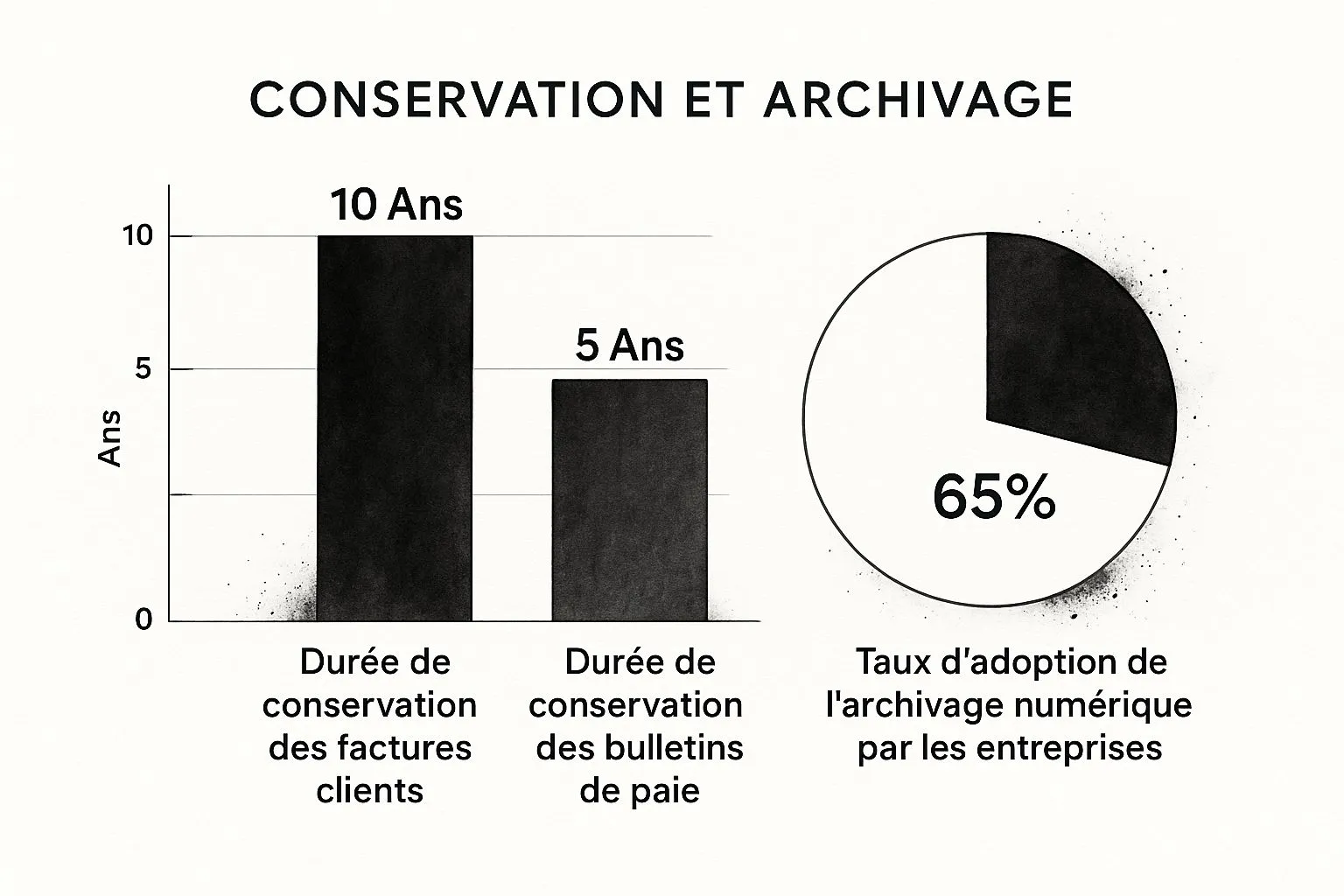
What this visual tells us is that even as digital archiving gains ground, mastering the legal deadlines remains an essential skill for any self-respecting entrepreneur.
Summary of legal retention periods by document type
To help you see things clearly without drowning in legal jargon, nothing beats a good summary table. It lets you visualize the obligations for each major document type at a glance.
This table shows the minimum mandatory retention periods for the main accounting, HR, and commercial documents in France, along with the associated legal references.
| Document type | Minimum retention period | Main legal reference |
|---|---|---|
| Accounting books and registers | 10 years after the close of the financial year | Commercial Code |
| Customer and supplier invoices | 10 years after the close of the financial year | Commercial Code / LPF |
| Tax returns (income tax, corporate tax, VAT) | 6 years from the tax year | Tax Procedures Book |
| Payslips | 5 years | Labour Code |
| Commercial contracts | 5 years after the end of the contract | Civil Code |
It’s crucial to understand that failing to respect these periods isn’t mere negligence. In the event of an audit, a missing document can be interpreted as an attempt at concealment. The consequences? Financial penalties that can quickly climb to several thousand euros.
In short, mastering these obligations isn’t just a matter of compliance. It’s real insurance for the sustainability of your business. For an even more detailed overview, our guide on which accounting documents to keep offers a comprehensive list.
Identifying the essential documents to archive
Facing the mountain of paperwork a business generates is a bit like setting off on an expedition without a map. Between invoices, contracts, and HR documents, it’s easy to feel lost. Yet, to properly keep your accounting records, the first step is simple: know exactly what needs to be kept.
It’s not just about ticking boxes to stay compliant. Every document matters and tells part of your company’s financial, commercial, and social story. Forgetting one leaves a gap — a weakness that can prove costly in the event of an audit or dispute.
Accounting records: the heart of your management
Think of accounting records as the backbone of your business. They justify every entry in your books and prove that your transactions actually took place. Without them, your accounts have no evidentiary value. It’s therefore vital to identify and file them with the utmost rigor.
Here are the must-haves:
- Customer and supplier invoices: The most direct proof of your commercial exchanges. A missing invoice during a VAT audit? That’s the risk of a deduction being rejected and an immediate tax reassessment.
- Purchase and delivery orders: These tend to be underestimated, but they’re crucial in the event of a dispute. Imagine a customer disputing a delivery: the signed order form is your best weapon to prove you met your commitments.
- Business bank statements: They let you track and justify every movement on your accounts. Essential for bank reconciliation, a key step in making sure your books match the reality of your cash position.
- Receipts and expense reports: For all those small day-to-day expenses, these supporting documents are mandatory. Without them, you can’t deduct them from your taxable income.
The scenario to avoid at all costs
A company forgets to archive a purchase order for a €30,000 project. The client refuses to pay part of the invoice, claiming certain tasks weren’t included in the original scope. Without the detailed, validated purchase order, the company struggles to prove its good faith. Result: it ends up accepting a loss of €8,000 to avoid a long and costly lawsuit.
HR documents: an employer’s responsibility
If you have employees, the HR side of your archiving takes on major importance. Personnel-related documents are scrutinized closely by bodies such as URSSAF. An incomplete personnel register or a misplaced payslip can quickly be seen as negligence — or worse.
The documents to keep carefully are:
- Payslips: Proof of salary payments and social security contributions.
- The single personnel register: This document, which lists every employee’s start and end dates, must be kept continuously up to date. In the event of a labour inspection, it must be produced on the spot.
- Employment contracts: They formalize the employer-employee relationship and serve as a reference in case of disagreement.
Retention obligations in France aren’t limited to tax matters — they also cover HR and commercial areas. For example, employers must keep payslips for 5 years, while the single personnel register must be kept for at least 5 years after the last registered employee leaves. For a full overview of the legal deadlines, you can check the details on the French public service website.
Legal and tax documents: the guarantors of your compliance
Finally, a last category of documents attests to your company’s legal existence and its tax standing. Their absence can call into question the very legitimacy of your structure.
Remember to carefully archive:
- The company’s articles of association: This is your company’s birth certificate. Every amendment to the articles must also be kept.
- Tax returns: Whether for VAT, corporate tax (IS), income tax (IR), or the CFE (local business tax), they prove you’re in good standing with the tax authorities.
- Management reports and minutes of general meetings: They trace the history of the major decisions made by directors and shareholders.
Clearly identifying these three broad document families is the foundation of calm, effective archiving. It’s what lets you set up a logical filing system where every document has its place and can be found easily. Quite simply, it’s the best insurance against oversights that can prove very, very costly.
Paper or digital: how to choose your archiving method?
The decision is made — your accounting records will be kept. But the real question is how? Between mountains of archive boxes and the lightness of the cloud, the choice isn’t just a matter of preference. It’s a strategic decision that will directly impact your costs, your day-to-day efficiency, and the security of your data.
On one side, physical archiving. The traditional, tangible method we’ve always known. On the other, digital archiving — fast, accessible from anywhere. Each of these approaches has its own rules, advantages, and constraints. Let’s dive into both worlds together to help you see things clearly and choose the strategy that truly fits your business’s reality.
Physical archiving: the traditional path — but is it still relevant?
Paper archiving is the historic method. You carefully file your invoices, contracts, and receipts in binders, then in boxes that end up in a dedicated room or with a service provider. Simple in appearance, right? Yet this method hides a complexity and costs that tend to be heavily underestimated.
The first problem is space. The volume of paper piles up at breakneck speed, and every square meter has a cost. For a very small business, it starts with an overflowing cabinet, but for a growing company, you’re quickly talking about an entire room sacrificed for storing documents.
And beyond simple storage, physical management raises very concrete problems:
- Risk of deterioration: Paper is fragile. Water damage, a fire, or simply wear over time can render your documents illegible. And an illegible document, in the eyes of the authorities, is a document that doesn’t exist.
- Access, a real headache: Trying to find a specific invoice from five years ago can quickly turn into a treasure hunt. That time spent digging through dusty boxes is time you’re not spending on your core business.
- Relative security: Who really has access to the archive room? The risk of loss, theft, or even unauthorized access is very real.
Of course, physical archiving isn’t entirely without merit. For very small structures with a very low document volume, it can seem simpler to set up at first. No need for a technology investment, just discipline and a few shelves. But be careful — this simplicity is only a facade that cracks as soon as the company grows a bit.
Digital archiving: much more than just scanning
Going digital isn’t just about scanning your papers and dropping them into a folder on your computer. For your archiving to be compliant, it must guarantee three things: the integrity, authenticity, and durability of your files. In short, your digital documents must have exactly the same evidentiary value as their paper originals.
A digital document only has legal value if it’s kept under conditions that guarantee its integrity. Article 1379 of the Civil Code is very clear: a reliable copy has the same evidentiary force as the original. This necessarily requires a secure scanning process and storage that prevents any modification.
To reach this level of trust, several technical tools are essential:
- The reliable audit trail: This is essentially your invoice’s logbook. It traces its entire journey, from creation to archiving, and proves it has never been altered.
- Qualified timestamping: It affixes a certain date and time to a document. It’s irrefutable proof that it existed at that precise moment.
- The electronic signature: It guarantees both who signed the document and that its content hasn’t been altered since.
Once these conditions are met, the benefits are enormous. Access to information is nearly instant, wherever you are. A simple keyword search saves you precious time. No more physical storage costs, and security is massively improved thanks to data encryption and automatic backups.
So, paper or digital: head-to-head
To help you make the right decision, let’s put the two methods side by side.
| Criterion | Paper archiving | Digital archiving |
|---|---|---|
| Cost | High over the long term (space, materials, wasted time) | Upfront investment (software, scanner), then marginal cost |
| Accessibility | Slow and limited to a single physical location | Fast, remote, and simultaneous for multiple users |
| Security | Vulnerable to physical risks (fire, water, theft) | Very high (encryption, backups, access management) |
| Compliance | Simple in theory, but requires flawless organization | Requires meeting technical standards for evidentiary value |
| Space | Significant and constantly growing | None (everything is on servers or in the cloud) |
In short, paper archiving can still do the job for a micro-business just starting out. But for any structure looking to be more efficient and secure its back office, moving to digital is no longer optional — it’s a given. Your final choice will depend on your document volume, your access needs, and your willingness to invest in tools that will make your life easier for years to come.
Setting up an archiving process that actually works
Knowing the retention rules is good. But without a concrete system, shared by the whole team, you quickly end up drowning in a disorganized pile of papers and digital folders with incomprehensible names. The goal isn’t to build an overly complex machine, but to define a simple, logical method so that archiving becomes a reflex rather than a chore.
Whether you’re still on paper, have gone fully digital, or are somewhere in between, the key is the method. A good process turns a legal obligation into a real management tool that secures your business and saves you precious time.
Build a logical filing structure
The first cornerstone is a simple, intuitive filing plan. Picture a clear structure where every document has a designated place. That’s the end of anxious searches to lay your hands on that famous invoice from three years ago.
To get started, you can begin with the major document families:
- Accounting: Customer invoices, supplier invoices, bank statements, etc.
- HR: Employment contracts, payslips, DSN filings.
- Legal & Tax: Articles of association, VAT returns, tax packages.
Then, refine further. Within the “Supplier Invoices” folder, for example, you can create subfolders by year, then sort by supplier name. The key is to find a logic that makes sense to you and stick to it. Once it’s clear in your head, put it in writing as a one-page memo — an “archiving charter” — so everyone is on the same page.
Adopt a file-naming convention
In the digital age, a file’s name is just as crucial as its content. By adopting a clear, unique naming rule, you make sure everyone speaks the same language. It’s the most effective way to find any document in just a few clicks.
Here’s a structure that has proven itself: YYYY-MM-DD_DocumentType_ThirdPartyName_Reference.
For example, invoice F2023-123 from your supplier “Alpha Services,” dated October 15, 2023, would be named: 2023-10-15_Invoice_AlphaServices_F2023-123.pdf.
The benefits are immediate:
- Chronological sorting happens automatically.
- You can identify a document without even opening it.
- Keyword search (date, type, name) becomes a breeze.
This takes a bit of discipline at first, that’s true. But the time saved and peace of mind it brings over the long run are invaluable.
Adopting a strict naming convention is like giving every document a precise address. You no longer search blindly — you go straight to the right place. It’s one of the pillars of good document management for businesses covered in our dedicated article.
Define who does what (and who sees what)
Who’s in charge of archiving purchase invoices? Who can view payslips? These questions are fundamental to avoid misunderstandings and, above all, to guarantee the confidentiality of sensitive information.
The simplest approach is to designate an “archiving lead” within the team. Note that their role isn’t to do everything themselves, but to be the guardian of the process. They make sure the rules are followed and support other team members.
Also think about setting access rights, particularly for your digital folders. Not everyone needs to view financial data or personnel files. Use your server’s or cloud solution’s features to assign precise permissions: who can just read, who can edit, who can delete.
Don’t forget to purge your archives
Properly keeping your accounting records also means knowing when to get rid of them. Keeping archives beyond the legal deadlines serves no purpose. Worse, it can put you at odds with GDPR, which requires that personal data not be kept longer than necessary.
To manage this lifecycle, you need to build an “expiry date” into your system.
- For cardboard boxes: A clear label reading “Destroy after 12/31/2033” does the job perfectly.
- For digital files: A simple reminder in a shared calendar is enough. Some electronic document management (EDM) software can even automate destruction alerts.
Schedule an annual or biannual review to sort through and securely destroy (shredder for paper, permanent deletion for digital) documents that have reached the end of their life.
What are the real benefits of going digital?
Moving to digital to keep your accounting records isn’t just about modernity or fewer stacks of binders. It’s a genuine strategic decision that directly affects the core of your business: its performance, its security, and of course, its profitability.
In fact, this shift completely changes how you relate to financial information. An administrative chore suddenly becomes a real asset.
Cutting your costs, visible and invisible
The first obvious benefit is, of course, lower costs. No more spending on reams of paper, ink cartridges, binders, or printer maintenance. These direct savings are immediate.
But the most interesting part is often hidden elsewhere. Have you ever thought about the cost of the space you devote to your physical archives? In big cities, every square meter counts. And then there’s the cost of human time: all those hours spent looking for an old invoice, filing papers, or making photocopies…
Take the example of a simple paper expense report. A government study found that processing it manually costs a business an average of €50, once you factor in everyone’s time and storage. Going digital slashes that cost and gives you a much clearer view of your cash flow. France Num’s full analysis on the topic is quite telling.
Instant access to information for better decisions
With digital archives, the information you need is a click away, not at the bottom of a dusty cardboard box. This immediate, secure access, from any computer or smartphone, really changes day-to-day life.
Imagine having to find a transaction for a customer or provide a receipt to your banker. Instead of a search that could take hours, a few seconds are enough.
This responsiveness has a direct impact on the quality of your decisions. You can:
- Analyze your spending in real time to keep your budget under control.
- Prepare your VAT returns without stress, with all supporting documents neatly organized.
- Respond immediately to a request from the tax authorities, which conveys an image of seriousness and control.

The visual above, taken from the France Num guide, shows clearly that going digital goes well beyond simple scanning. It’s an entire process that gets optimized, from data entry to archiving, for greater efficiency and flawless compliance.
How to successfully transition to digital
Beware — going fully digital doesn’t happen by improvisation. It’s not enough to start frantically scanning everything. For it to work, you need a method, a structured and lasting approach.
Here are a few key steps to get you started.
First, choose the right tools. An electronic document management (EDM) solution or invoicing software like Bizyness, which includes evidentiary-value archiving, is an excellent starting point. What matters is that the tool is simple and complies with French legislation.
Next, set new ground rules. How are your suppliers’ invoices scanned? Who validates them? Spell it all out in a small archiving charter, even a simple one.
Finally, think about training. Even if you work alone, take the time to get familiar with your new processes. If you have a team, involve them from the start. They need to understand the point of it to adopt good habits.
Going digital simplifies administrative life more than you’d expect. You can finally focus on your real job, while being certain you’re fully compliant. This is especially true for freelancers, for whom every minute counts. In fact, document management is a key aspect we cover in our guide on tax optimization for sole traders.
Ultimately, going digital is no longer a choice but a given for any business that wants to be more agile and more secure. It’s the best way to keep your accounting records intelligently and turn a legal obligation into a strategic advantage.
A few frequently asked questions about document retention
Even with the rules in mind, archiving always raises very practical questions. That’s normal. When you’re deep in the day-to-day, real-life situations create doubt. Let’s dive into the most common questions to help clarify things.
The idea here is simple: give you direct answers, without unnecessary jargon, so you can manage your archives with more peace of mind. Whether you’re just launching your business or looking to optimize your system, these clarifications will be useful.
What should you do with paper documents once they’ve been scanned?
This is THE big question about going paperless. You’ve scanned an invoice, it’s archived electronically, and your system guarantees its evidentiary value (reliable audit trail, file integrity, etc.). Can you finally get rid of the paper original? The answer is yes, with one small nuance.
Officially, Article A102 B-2 of the Tax Procedures Book allows you to discard the paper original if its digital copy is reliable. That’s excellent news for freeing up space.
That said, purely as a precaution, many experts — myself included — recommend keeping the originals of the most strategic documents (a major contract, a notarized deed, a commercial lease) for a few years. For everyday documents like supplier invoices or expense reports, once compliant scanning has been done, you can recycle them without worry. The key is having absolute confidence in your scanning process.
How do you handle archiving when you close your business?
Closing your business doesn’t end your archiving obligations. Quite the opposite. The obligation to keep accounting records continues even after the company is struck off the register. The legal deadlines themselves don’t change.
In practice, you need to arrange to keep your archives for the entire remaining period.
- If you were operating as a company, this task generally falls to the liquidator.
- For a sole proprietorship, this responsibility falls directly on you.
Never forget this: even after closing up shop, the tax authorities can launch an audit covering your years of activity. Keeping simple, quick access to your archives for 10 years for accounting purposes and 6 years for tax purposes is your best peace-of-mind insurance.
Do emails have real evidentiary value?
An email can absolutely serve as evidence, but it all depends on the context and the stakes. For a small business agreement, a simple email exchange may be enough. For a significant financial commitment, it’s often too weak on its own.
For an email to have solid evidentiary force, it needs to be “reinforced.” Here are a few field-tested best practices:
- Archive crucial emails by saving them as PDFs, including the technical headers (sender, date, etc.).
- Use electronic signature solutions to validate an agreement or document sent by email.
- Formalize the exchange quickly with an official document, such as a purchase order or contract, summarizing the agreed terms.
My advice: think of emails as a good starting point for evidence, but never rely on them alone for your most critical transactions.
What about documents stored on servers abroad?
With cloud tools, our data travels. It’s very common for it to be hosted on servers located outside France. Is that a problem? Not necessarily, as long as you follow a few golden rules.
The crucial point is your ability to provide any document to the French authorities on request, without delay. It doesn’t matter where the server is physically located. In addition, your storage provider must guarantee a level of security and confidentiality that complies with GDPR.
It’s up to you to make sure your cloud solution, even if it’s American or Irish, meets French requirements for data retention and access. It’s worth double-checking their terms and conditions.
Simplify your life and ensure effortless compliance. With Bizyness, keeping your accounting records becomes automatic and secure. Focus on growing your business — we’ll take care of the rest.
Discover how Bizyness can transform your document management today.
