

 Français
 Keeping accounting records as an e-commerce seller: the practical guide
Simplify how you keep accounting records for your e-commerce business. Legal retention periods, digital solutions and tips for full compliance.
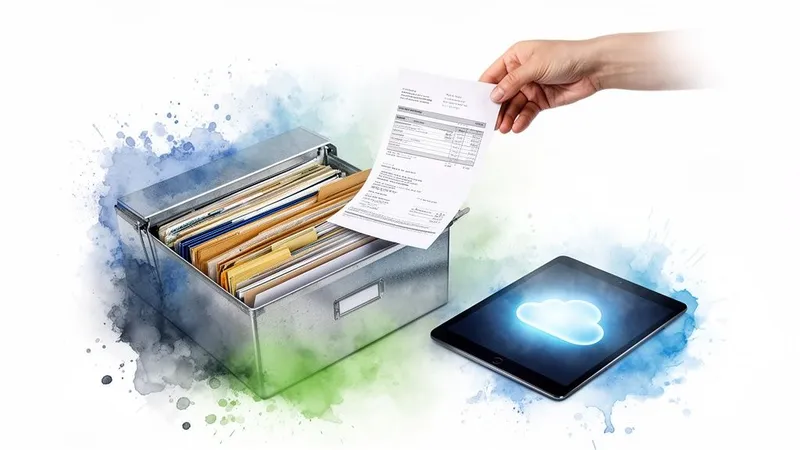
Keeping accounting records is far more than a simple administrative formality. It’s a legal obligation that requires you to keep track of every supporting document for a minimum period, which is generally 10 years. For an e-commerce seller, that means scrupulously archiving every invoice, every sales report and every bank statement, whether on paper or in digital format, so you can produce everything in the event of a tax audit.
Why keeping your accounting records properly is vital for your e-commerce business
Think of your online store’s archives not as a pile of paperwork, but as your company’s “black box.” Every document you keep is tangible proof of your decisions, your transactions and, ultimately, your good faith. For a seller managing hundreds, even thousands, of transactions through platforms like Shopify, Amazon or Stripe, this traceability is simply essential for staying in business.
Managing your accounting archives well is therefore not just about ticking a box. It’s a genuine strategic pillar that protects your business’s financial health.
Protection against tax audits
Let’s be clear: today’s tax audits are largely computerized. The tax authorities can sift through thousands of lines of transactions in the blink of an eye, notably thanks to the well-known Fichier des Écritures Comptables (FEC, the accounting entries file). In this context, well-organized, complete archives are your best line of defense.
A single missing or non-compliant supporting document can be enough to get your entire set of accounts rejected. The result? A tax reassessment, and often hefty penalties. Keeping your documents properly isn’t optional — it’s real insurance.
Simply being able to quickly produce a specific document, even one several years old, proves your seriousness and can defuse situations that could otherwise become very costly.
The key to compliance for international e-commerce
Things get even more complicated as soon as you start selling abroad. Managing VAT through the one-stop shops (OSS/IOSS) brings its own set of documentation requirements. Every sale you make outside France must be backed by a properly issued invoice, showing the correct VAT rate, and of course kept according to the rules.
Poor management at this level can quickly turn into a headache:
- VAT declaration errors that pile up and end up being costly.
- The inability to prove the origin and destination of a transaction during an audit.
- Administrative tangles with tax authorities in several countries.
Fortunately, modern tools like Bizyness are now available to simplify this process. By connecting directly to your sales platforms, they can collect, sort and archive every document automatically. This automation not only keeps you compliant, but above all gives you invaluable peace of mind so you can focus on what really matters: growing your e-commerce business.
Which documents should you keep, and for how long?
Knowing which documents to keep and for how long is really the cornerstone of stress-free accounting management. For an e-commerce seller, the list can quickly seem endless: every sale, every purchase, every bank movement generates a supporting document. Fortunately, even though the rules come from different legal sources, they’re fairly clear.
What you need to understand is that two main legal frameworks govern your obligations. On one side, the French Commercial Code imposes a long-term view. On the other, the French General Tax Code sets specific deadlines for tax audits. The whole art lies in juggling these two requirements.
Legal retention periods: the duel between commercial and tax law
The rule that almost everyone knows is the one set out in Article L123-22 of the French Commercial Code. It imposes a strict retention period of 10 years for most accounting documents, counted from the closing of the financial year. This covers the well-known mandatory accounting ledgers (journal, general ledger), but also all the documents supporting the entries, such as your invoices. To learn more, feel free to read our article on document retention periods.
At the same time, tax law, through the Book of Tax Procedures, sets a statute-of-limitations period of 6 years. That’s the period during which the tax authorities can go back in time to audit your returns and ask you for explanations. Be careful: this shorter period does not cancel out the 10-year commercial obligation.
The golden rule is simple: always go with the longer period. Even though the tax risk expires after 6 years, you still have the obligation to produce a document in the event of a commercial dispute, for example, for up to 10 years.
The essential list for an e-commerce seller
Specifically, which documents should you archive no matter what? For an online seller, the list goes well beyond simple invoices.
Here are the essential documents:
- Sales and purchase invoices: The most basic proof of your business activity. Every transaction, whether it comes from Shopify, WooCommerce or a marketplace, must have its corresponding invoice, safely kept.
- Purchase and delivery orders: These documents prove that there was indeed a commercial agreement and that you delivered the goods. They’re vital for building a reliable audit trail.
- Bank statements: They’re the bridge between your financial flows and your accounting, justifying every incoming and outgoing payment.
- Platform sales reports: Reports from Shopify, Amazon or Stripe aren’t just simple exports — they’re supporting documents in their own right. They detail sales, commissions, fees… in short, they’re essential for accurate accounting.
- VAT supporting documents: All declarations (VAT, OSS/IOSS) and the documents used to prepare them must be kept. This is your shield in the event of a tax audit.
This timeline perfectly illustrates the lifecycle of an accounting document, from the transaction through to the end of its archiving period, including any audits along the way.
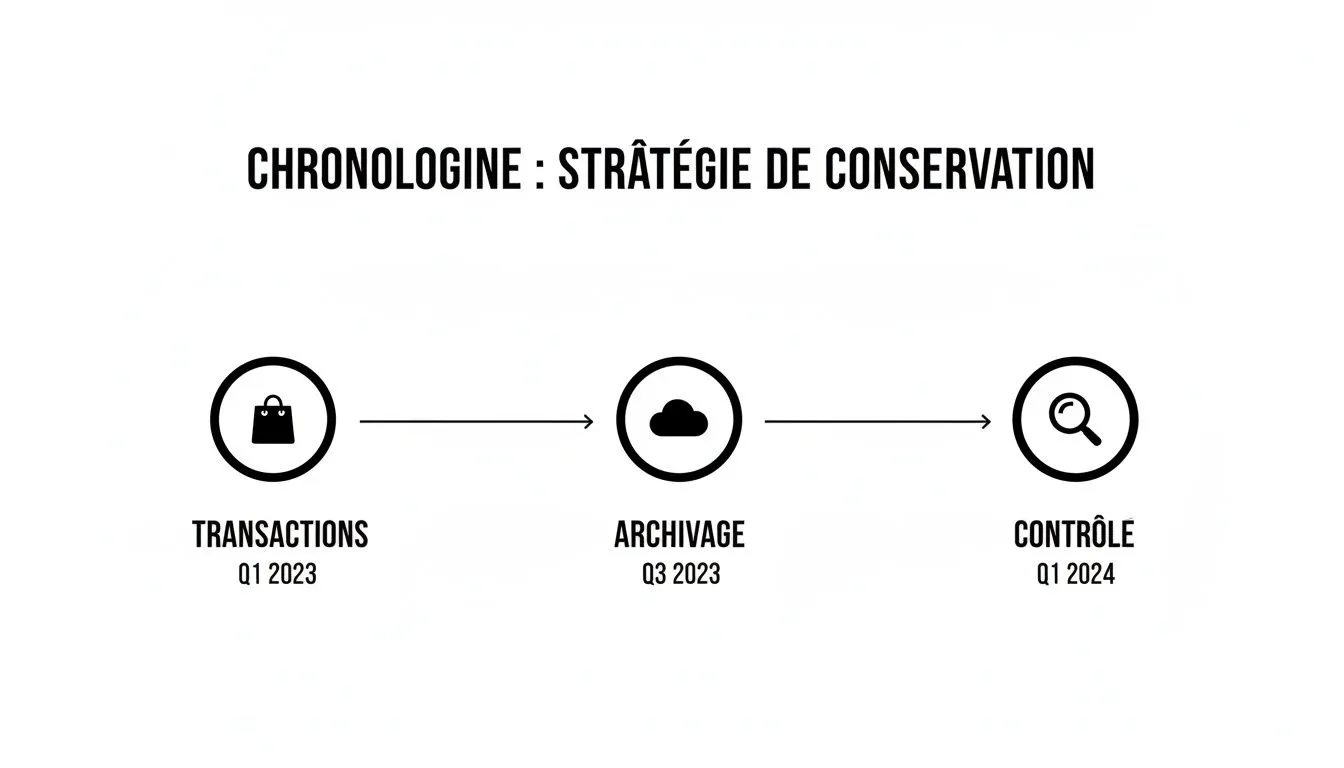
This visual clearly shows that your retention strategy needs to be planned from the outset to ensure compliant archiving and to face audits with confidence.
Summary table of retention periods
To make things easier, nothing beats a good table. It lets you see at a glance the obligations for each type of document.
This table summarizes the minimum retention periods for each type of accounting and commercial document, specifying the legal basis.
Legal retention periods for the main accounting documents
| Document Type | Retention Period (Commercial Code) | Retention Period (General Tax Code) | Start of the Period |
|---|---|---|---|
| Accounting books and ledgers (general ledger, etc.) | 10 years | 6 years | Closing of the financial year |
| Customer and supplier invoices | 10 years | 6 years | Closing of the financial year |
| Purchase and delivery orders | 10 years | 6 years | Closing of the financial year |
| Banking documents (statements, cheque stubs) | 5 years | 6 years | Date of the transaction |
| Tax returns (VAT, corporate tax, CFE) | - | 6 years | Tax year + 1 year |
| Company bylaws | 5 years after deregistration | - | Deregistration from the Trade and Companies Register (RCS) |
| Commercial contracts | 5 years | - | End of the contract |
This overview highlights how complex the deadlines are and how important it is to be methodical. The goal is to leave no document behind, because a single oversight can be very costly. This is where tools like Bizyness come in: they’re designed to automate the collection and filing of these documents from the moment they’re created, ensuring you meet every deadline without even having to think about it.
Paper or digital archiving: what’s the best strategy for an e-commerce seller?
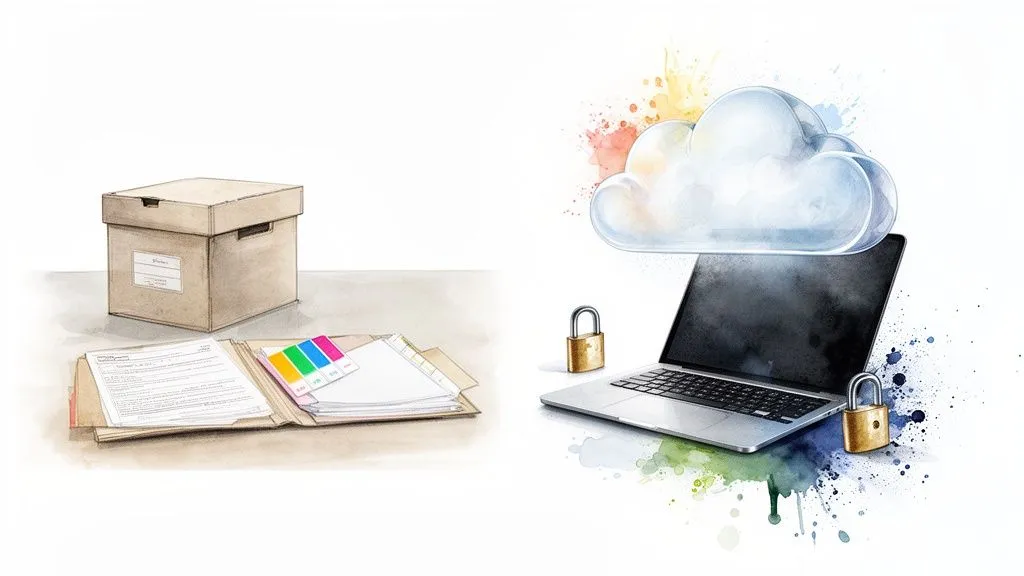
When it comes to keeping accounting records, an e-commerce seller has to make a crucial choice: stick with paper or switch to digital? Think of your archives as a safe. The paper version is that good old physical safe, filled with binders and boxes. It’s tangible, you can touch it, but it’s also at the mercy of a water leak or, worse, a fire.
By contrast, the digital safe lives in the cloud. You can access it from anywhere, at any time, and it’s immune to physical accidents. But its real strength lies not only in its flexibility. It’s in its ability to be secure and, above all, to meet the tax authorities’ strict requirements. It’s no longer just about “storing,” but about guaranteeing the integrity of every document for years.
The legal value of both formats
You still often hear that paper carries more weight, that it’s more “official” in the eyes of the law. It’s a persistent misconception, but a completely false one. In France, the law is very clear: an accounting document has exactly the same legal value whether it’s on paper or in digital format.
This parity is a real breath of fresh air for e-commerce sellers, who generate a huge volume of transactions and digital documents. Whether it’s paper or files, the retention obligation remains 10 years. The treatment is identical.
Be careful, though: this equivalence isn’t a blank cheque. For digital documents, there are very strict rules to follow.
For a digital invoice to be as solid as a paper original in the event of an audit, it has to tick three boxes: guaranteeing the authenticity of its origin, the integrity of its content and its readability throughout the retention period.
This is exactly where simply saving a file to a hard drive or a Google Drive reaches its limits.
Pros and cons for an e-commerce business
The choice between paper and digital should above all be pragmatic. Let’s weigh the pros and cons, keeping in mind the realities of online selling.
Paper archiving, a traditional but limited method
- Pros: It’s a simple method that requires no technical skills. For a very small business with a handful of invoices per month, it can seem sufficient at first.
- Cons: For an e-commerce seller, the drawbacks quickly become a nightmare. It’s time-consuming (printing, filing, storing), it costs a lot in storage space, it’s vulnerable to loss or damage, and finding a specific invoice during a tax audit can turn into a real headache.
Digital archiving, an obvious choice for online selling
- Pros: It fits perfectly with an e-commerce business’s workflows. The time savings are huge thanks to automation. Access to documents is instant and secure, and storage costs are minimal. And above all, it radically simplifies collaboration with your accountant.
- Cons: The main challenge is choosing the right solution. It absolutely must guarantee legal compliance, particularly with timestamping and formats that can’t be altered. A simple folder on your computer isn’t enough; you need a genuine electronic document management solution.
For an e-commerce seller, the debate is really quickly settled. The volume, speed and very nature of the transactions make digital not just preferable, but simply essential.
The key concept: the reliable audit trail
The tax authorities don’t just glance at an invoice. What they want is to be able to reconstruct the complete journey of a transaction, from start to finish. This is what’s known as the reliable audit trail.
This concept is the pillar that gives your digital archives their full evidential value. The idea is to create a logical, proven link between several documents to justify that a transaction actually took place.
Here’s how this trail is built in practice:
- The customer’s order: The starting point, recorded in your Shopify store or your Amazon account.
- The sales invoice: The official accounting document you issued for that order.
- The delivery note: Proof that the product was actually shipped, then received.
- The payment transaction: The trace of the financial flow recorded by Stripe or PayPal.
A worthwhile digital archiving solution must be able to link these four elements without the slightest ambiguity. Technologies such as timestamping (which certifies the creation date of a document) and the use of secure formats like PDF/A are fundamental to building this trail. Tools like Bizyness are specifically designed to build this traceability automatically, linking every sale to its invoice and its payment, giving you effortless compliance.
The penalties for poor record-keeping
Ignoring the rules on keeping accounting records isn’t just a minor administrative oversight. It exposes your e-commerce business to a direct financial risk. Far from being a mere formality, rigorous management of your archives is essential insurance. If you can’t produce the right documents during an audit, the consequences can quickly become very severe.
Understanding these risks isn’t meant to scare you, but rather to help you grasp what’s at stake. The tax authorities, with their increasingly powerful, automated tools, leave very little room for error or oversight.
Rejection of your accounts
The first risk, and probably the most serious, is the outright rejection of your accounts. Concretely, this means the tax authorities consider your records unreliable. In the absence of valid supporting documents — missing invoices, untraceable purchase orders — they may conclude that your accounts don’t reflect the economic reality of your business.
When this happens, the authorities are entitled to reconstruct your revenue and profits themselves. And needless to say, this reconstruction, often based on estimates and sector averages, is rarely in your favor.
Rejection of your accounts opens the door to assessment by default. The tax authorities recalculate your taxes based on their own estimates, generally adding hefty penalties for serious non-compliance.
Tax reassessment and financial penalties
The logical next step after your accounts are rejected is a tax reassessment. The authorities correct the amount of tax you should have paid. But the story doesn’t end there. This reassessment almost systematically comes with penalties and late-payment interest.
Let’s look at a few concrete examples that will speak to any e-commerce seller:
- Lost purchase invoice: Imagine you buy a batch of products for €10,000 excluding VAT. Without the invoice, there’s no way to prove this expense. The result? The authorities add this €10,000 back into your taxable profit and deny you the right to deduct the corresponding VAT (€2,000).
- Failure to provide the FEC: The Fichier des Écritures Comptables is a mandatory step. Failing to provide it, or providing a non-compliant version, exposes you to a minimum fine of €5,000 per audited year. If the audit covers three years, the math adds up fast.
- Failure to invoice: If you’re unable to justify some of your sales with properly issued invoices, a steep fine of 50% of the amounts involved can be applied.
These penalties aren’t theoretical. They’re the everyday reality of tax audits when record-keeping falls short.
Risks beyond tax matters
The stakes aren’t limited to your relationship with the tax authorities. Poor archive management can weaken your business on other fronts as well.
- Commercial disputes: Without a proper purchase order or contract, how do you prove your rights against a supplier who fails to deliver, or a customer acting in bad faith? It’s next to impossible.
- URSSAF audits: If you have employees, you must be able to produce all the payroll-related documents to justify that social security contributions were correctly calculated and paid.
- Difficulty selling your business: One day, you might want to sell your e-commerce business. The prospective buyer will carry out an audit (due diligence). Incomplete or disorganized archives send an extremely negative signal, which can drive down your company’s valuation, or even derail the sale entirely.
As you can see, organizing your archives well isn’t just a constraint. It’s a pillar of your company’s security and value. Tools like Bizyness are specifically designed to automate this collection and archiving process, ensuring you have reliable, accessible evidence at all times.
How to set up a reliable archiving system, step by step
Moving from theory to practice may seem a bit daunting, but trust me, building a solid system for keeping accounting records is entirely within reach for an e-commerce seller. The secret is to follow a clear, logical roadmap. The idea is to turn what looks like a complex constraint into a smooth, secure and, as much as possible, largely automated process.
Let’s walk through how to build this system, step by step, to ensure your compliance and, above all, your peace of mind.
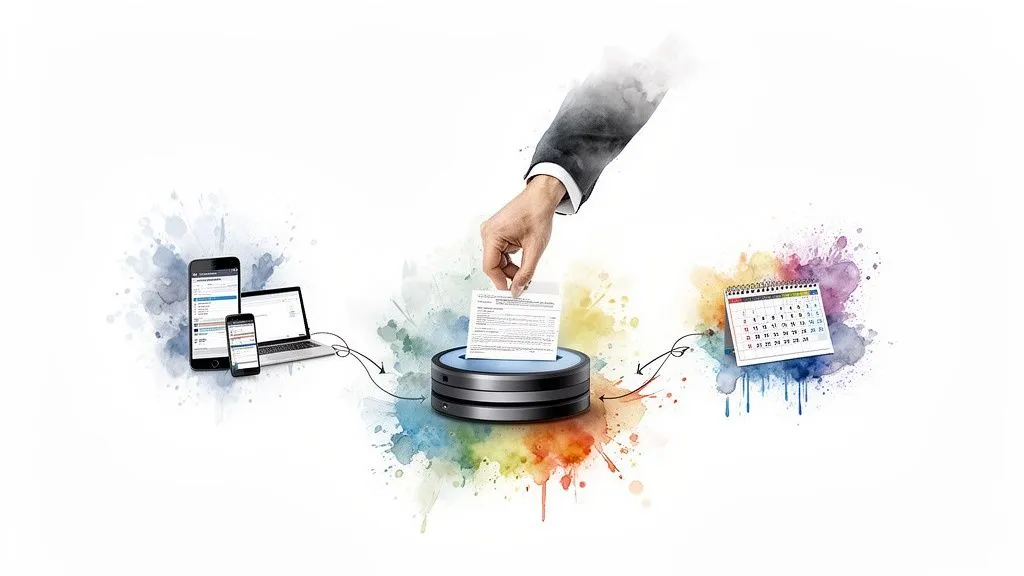
1. Centralize all your revenue sources
This is the starting point, absolutely fundamental for an e-commerce seller: take stock of and consolidate all your financial flows. Your sales surely don’t come from a single place. You might be juggling your Shopify store, a presence on Amazon, and direct payments via Stripe or PayPal.
Each of these platforms generates its own documents: sales reports, invoices, commission statements… Leaving this information scattered around is the best way to lose track and create gaps in your accounting.
The goal, then, is to connect all these sources to a single system capable of retrieving the data automatically. Tools like Bizyness, for example, are designed to integrate with these platforms, pulling in information in real time to give you a unified, overall view of your business.
2. Choose your archiving method and tools
As we’ve seen, for e-commerce, digital is the obvious choice. So the real question isn’t “paper or digital?” but rather “which digital tool should I choose?” Be careful: a simple folder on your computer or a Dropbox account isn’t enough to meet the legal requirements.
Your archiving solution absolutely must guarantee three things:
- Document immutability: once an invoice has been archived, no one should be able to modify it.
- Traceability: the system must be able to prove who uploaded the document and when, thanks to timestamping.
- Longevity: your files must remain readable and accessible throughout the 10-year legal period.
A good archiving system isn’t just a storage space. It’s a genuine digital safe that certifies the integrity of your accounting records and builds that reliable audit trail the tax authorities require.
To go further, integrating technologies such as AI-powered document analysis can really boost the efficiency and accuracy of your filing.
3. Define a collection and filing procedure
Even though automation is your best friend, you still need to set clear ground rules. For your system to run smoothly, you need to define a simple procedure for handling all your documents, including those not automatically generated by your sales platforms, such as your suppliers’ invoices.
Here’s a small checklist to help you:
- Receiving purchase invoices: Centralize their arrival at a dedicated email address, or use a solution that lets you scan them with a simple photo.
- File naming: Adopt a logical naming convention and stick to it (for example:
YYYY-MM-DD_SupplierName_InvoiceNumber.pdf). - Digital filing: Create a folder structure that makes sense to you (by year, by document type, by supplier).
- Processing frequency: Set a rhythm for processing these documents (daily, weekly) to avoid getting overwhelmed.
4. Schedule regular, secure backups
Even the best cloud system isn’t foolproof. Redundancy is the key to security. In addition to your legally compliant archiving, put a regular backup policy in place for all your data.
The well-known 3-2-1 rule is an excellent habit to adopt: keep at least 3 copies of your data, on 2 different types of media, with at least 1 copy off-site (away from your office). In practice, this could mean a backup on an external hard drive in addition to your main cloud solution.
5. Make it easy for your accountant to access your records
Your archiving system shouldn’t be an impenetrable fortress. Your accountant needs simple, secure access to your documents to do their job, particularly to prepare your VAT returns and your balance sheet.
A modern solution should let them have their own access. This saves them from constantly having to chase you for documents and lets them consult the Fichier des Écritures Comptables (FEC) directly. If you’d like to learn more on this topic, take a look at our article on FEC file obligations. It’s a huge time-saver for everyone and really streamlines your accounting management.
Questions and answers about keeping accounting records
Even after going through the rules and best practices, some gray areas often remain. Let’s clear things up by answering the questions you’re most likely to have as an e-commerce seller.
Do I really need to print and store Shopify or Stripe invoices?
The answer is simple: no, absolutely not. French law is very clear on this and puts a digital document on equal footing with its paper twin. No need to sacrifice a forest for every invoice generated by your sales tools.
What matters, on the other hand, is guaranteeing two crucial points: the integrity of the document (it must not be modifiable) and its readability throughout the 10-year legal period. For that, you need a solid digital archiving system. A solution capable of automatically centralizing and archiving these invoices in line with best practice is therefore ideal.
What happens to my accounting archives if I close my online store?
That’s an excellent question, and a point that’s often overlooked. The obligation to keep your accounting documents for 10 years doesn’t magically disappear the day you cease your business activity. Quite the opposite — it follows you.
As the business owner, you remain responsible for keeping these documents and must be able to produce them on request. Before shutting down for good, make sure all your archives are stored somewhere safe, durable and accessible. It’s your only protection in the event of a tax audit that could crop up several years later.
The retention obligation is tied to the documents themselves, not to the existence of the company. It’s a responsibility that follows you personally, even after your business venture has ended.
How do you prove a digital invoice is authentic during an audit?
This gets to the heart of digital archiving. For the tax authorities, the authenticity of a document doesn’t depend on its format, but on what they call a “reliable audit trail.”
In practice, that means you need to be able to trace the complete path of a transaction, from start to finish, without any gaps. You must be able to link the initial order, the invoice, proof of delivery and the payment transaction.
For this trail to be considered reliable, a few technical elements are essential:
- Timestamping: It serves as irrefutable proof certifying the creation or receipt date of the document.
- A non-modifiable format: PDF/A, for example, was specifically designed for long-term archiving and locks the document against any changes.
- Data traceability: Your system must keep a record of every stage in the document’s life.
By combining all these elements, you strengthen the legal standing of your digital archives and can face any audit with complete peace of mind.
Bizyness, the accounting and financial automation platform built for businesses that sell online, helps you handle these obligations without even thinking about them. Discover how to turn your accounting into a strategic advantage at bizyness.fr.
