

 Français
Knowing your tax rate as a sole trader (auto-entrepreneur)
Knowing your tax rate as a sole trader is part of good financial management. This tax rate lets you plan the cash flow needed to cover all your charges.

Knowing your tax rate as a sole trader (micro-entrepreneur) is essential to the sustainability of your business. Since the tax system has some quirks, it can be a trap for novice entrepreneurs who too often confuse revenue with profit margin. You need to plan cash flow to cover your taxes and social contributions, as well as VAT if you’ve exceeded the exemption threshold.
Knowing your income tax rate as a sole trader
As a micro-entrepreneur, you’re considered a sole trader. As a result, you’re subject to personal income tax rather than corporate tax. Your micro-business income is therefore added to your household’s other income for the calculation of your tax rate, which lets you estimate the amount owed.
This calculation happens in three steps.
1 — Applying the flat-rate allowance specific to sole trader status
Since a sole trader’s expenses aren’t deductible, sole traders benefit from the micro-tax regime, which applies a flat allowance as compensation.
Remember that to benefit from this tax regime specific to sole traders, you must not exceed the thresholds set, which for 2023 are:
- €77,700 for services falling under the BIC (industrial and commercial profits) or BNC (non-commercial profits) categories, and for unregulated liberal professions or those covered by Cipav for retirement insurance;
- €188,700 for commercial activities and the provision of accommodation (except furnished rentals, which fall under the €77,700 threshold).
These thresholds apply over a full calendar year, i.e. from January to December. If you set up your micro-business during the year, they’re calculated pro rata temporis, meaning proportionally to the time elapsed.
The percentage of this allowance depends on your activity. It was estimated to correspond to your business expenses, including charges and equipment depreciation.
The rates are as follows:
- 34% for liberal professions and services;
- 71% for trade (buying and selling goods) and property rental;
- 50% for services.
If your revenue is low, you’ll benefit in any case from a minimum flat-rate allowance of €305.
2 — The family quotient for determining your tax rate
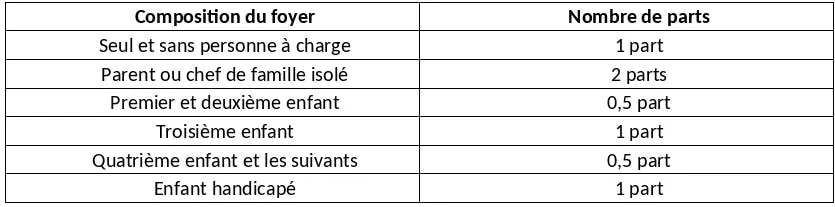
Once the allowance has been applied, you know the amount of income that will be taxed. It’s then up to the tax authorities to determine your family quotient (QF), based on your household’s total income and taking into account your household composition, expressed as a number of shares.
The scale is as follows:
3 — The progressive income tax scale in 2023
The last criterion for knowing your tax rate is the progressive income tax scale. It rises proportionally with your income bracket. For the 2023 tax return, covering 2022 income, the scale is as follows:

The final withholding tax option
There is an option reserved exclusively for sole traders called the final withholding tax (versement libératoire). To be eligible, your reference tax income for year N-2 must not exceed €26,070 per share of your tax household.
The final withholding tax lets you pay your income tax at the same time you declare your revenue to URSSAF, which can be done monthly or quarterly, depending on your choice. To know your tax rate for the final withholding tax, you again need to refer to the nature of your activity. It is:
- 1% for sales activities or accommodation services, except for furnished residential rentals, for which the rate is 1.7%;
- 1.7% for BIC-category services;
- 2.2% for services or liberal activities falling under BNC.
It’s important to run simulations to find out whether opting for the final withholding tax makes sense for you. Indeed, if your revenue is low enough that you’re not taxable, you’ll pay more than you should and won’t be reimbursed. Conversely, if your revenue is high enough that you’d normally fall into a higher tax bracket, you come out ahead, since no additional amount can be claimed from you later.
Knowing your tax rate for trade association fees for shopkeepers and craftspeople
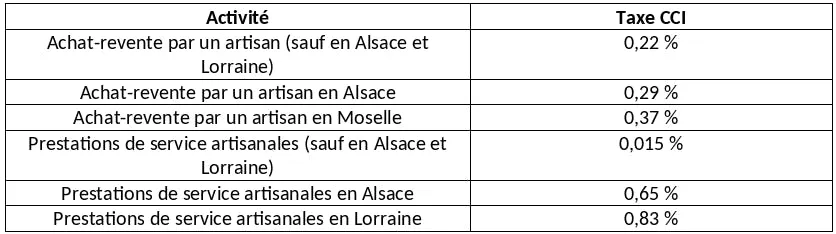
The trade association fee helps fund the CCI (Chamber of Commerce and Industry) and the CMA (Chamber of Trades and Crafts). Craftspeople and shopkeepers are therefore the only categories concerned.
To know your tax rate for the CCI, refer to the table below.

Furnished-rental landlords and those under BNC, including liberal professions, are not subject to the CCI tax.
To know your tax rate for the CCI, refer to the table below.
Some activities may qualify for exemptions. Contact your Chamber of Trades and Crafts or your CFE (business formalities center) to find out the conditions for your personal situation.
Knowing your tax rate for social contributions
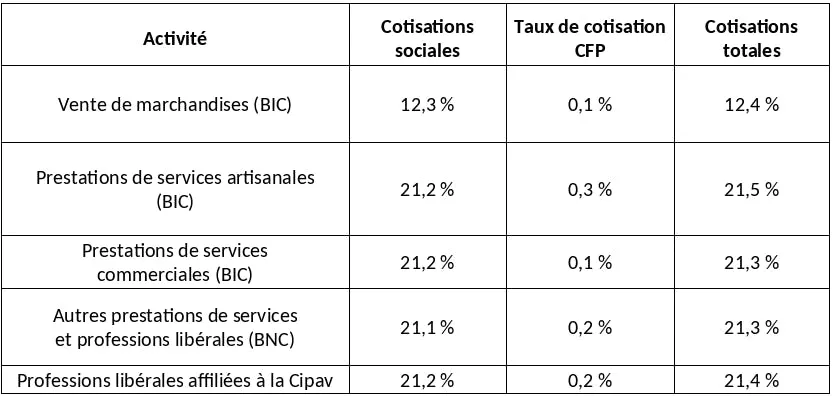
Social contributions aren’t part of taxation. Nevertheless, as a sole trader, they represent additional amounts you’ll need to pay. These social contributions fund your mandatory social protection. They cover:
- health and maternity insurance;
- basic and mandatory supplementary retirement;
- family allowances;
- disability and death coverage;
- daily allowances (for craftspeople and shopkeepers only);
- CSG/CRDS (social security contributions).
Alongside paying your social contributions, you’ll also be required to contribute to the CFP (Vocational Training Contribution).
Knowing your social contribution rate by activity
It’s essential to know your tax rates so you can plan the funds needed in your cash flow when the various taxes come due. Check each year for any changes that may have occurred, so you’re not caught off guard by tax rates that can increase.
