

 Français
Late payment penalties calculation: 2026 guide
Master the calculation of late payment penalties. Our guide gives you the formula, the rate and concrete examples to protect your cash flow.
Let’s be direct: a late payment isn’t just a line item lingering in your books. It’s a real spanner in the works of your business. For many entrepreneurs, this wait weighs heavily on cash flow and slows growth. Calculating late payment penalties is therefore not a mere formality. It’s an essential lever to protect your finances and enforce healthy business relationships.
Late payment penalties: a management tool, not just a sanction

Whether you’re an online seller or a service provider, every day of delay is a day your money works for someone else. That money should be reinvested in stock, put toward your marketing, or simply used to pay your own expenses. Late payment penalties exist precisely to offset that harm.
But their role doesn’t stop there. Above all, they are strongly deterrent. Simply stating the conditions clearly on your invoices and quotes sends a signal of rigor and professionalism. You show that your cash flow is a priority, which naturally encourages your clients to respect payment terms.
The concrete impact on your cash flow
A client who pays late is essentially granting themselves an unwanted line of credit, at your expense. Think about it: if you sell on platforms like Shopify or work as a freelancer, your own expenses are often due immediately. If a B2B client pays you at 60 days instead of the agreed 30, your entire working capital requirement explodes.
Applying penalties helps restore some balance. It’s a sound practice for your business, and solutions exist to help you with managing unpaid invoices and protecting your cash flow.
A clear, consistently applied late payment penalty policy is not aggressive at all. It’s simply good management practice, one that protects your business and establishes a balanced relationship with your business partners.
How to turn this constraint into a strategic advantage
Rather than suffering delays as an inevitability, see penalties as a steering tool. They give you real leverage during follow-ups. Instead of a simple “Have you had a chance to look at my invoice?”, you can inform the client that penalties of X euros are now due. The effect is often immediate.
This mechanism matters all the more since the phenomenon is far from anecdotal. Studies already showed that in 2024, nearly 25% of B2B invoices in France were paid with significant delay.
By building late payment penalty calculation into your routine, you turn a tedious administrative task into a smooth, non-confrontational process. It’s a remarkably effective way to discourage bad payers and let you focus on what matters: growing your business.
Understanding the legal framework: your best ally against unpaid invoices
Before calculating anything, it’s essential to have a clear grasp of the rules of the game. The French Commercial Code sets the framework, specifically Article L441-10. Don’t see this as an administrative burden, but rather as a shield to protect your cash flow and build healthy relationships with your business clients.
The law is very clear on this: as soon as a business client fails to pay an invoice by its due date, you are entitled to claim late payment penalties. It’s automatic, from the very first day of delay. There’s no need to wait or send a formal notice for this right to apply.
The real question is: what interest rate should you apply? The law gives you some latitude, but within limits. So you need to clearly distinguish between the rate you set in your contracts and the one that applies by default.
Contractual rate vs. statutory rate: how to choose
You have two options for setting the penalty rate. Whichever you choose, it must appear in black and white in your terms and conditions of sale and on every invoice.
- The contractual rate: You set it yourself. The only constraint is that it cannot be lower than three times the statutory interest rate in force. This is the most flexible option, letting you define a rate truly suited to your sector and dissuasive enough.
- The statutory rate (default): If you haven’t specified anything in your documents, the law imposes a default rate. It corresponds to the European Central Bank’s (ECB) refinancing rate, plus 10 points.
In practice, it’s always better to define your own contractual rate. This lets you not only opt for a higher percentage than the minimum, but also clearly display the rules from the outset. To go further on this topic, you can check our full guide on payment terms for invoices between businesses.
How to set a rate that is both fair and effective
The goal isn’t to set a “punitive” rate that could be deemed abusive and backfire on you. The simplest and most common approach, because it’s easy to justify, is to align with the default rate formula while stating it explicitly in your terms and conditions.
In practice, most businesses use the following formula: ECB semi-annual refinancing rate + 10 points.
For example, with an ECB rate of 4.50%, your late payment penalty rate would be 14.50%. That’s a figure with real weight, one that genuinely encourages your clients to honor their commitments.
Tip from the Bizyness team: Don’t hesitate to set a rate around 12% or 15%. This is not perceived as aggressive by your clients at all — it’s simply a sign of sound, rigorous management. A rate too close to the legal minimum will have almost no impact on small invoices.
Keep in mind that this mechanism isn’t meant to “trap” your clients, but to secure your business. In fact, calculating late payment interest in 2026 is a well-defined procedure designed to compensate for financial harm.
Don’t forget the €40 flat-rate compensation!
In addition to the percentage-based late payment penalties, the law provides another very concrete tool: a flat-rate compensation to cover your collection costs.
Since 2013, for every invoice paid after its due date, you have the right to claim a fixed sum of €40. This compensation has several advantages:
- It is systematic and adds on top of the late payment penalties.
- It is due per invoice. If a client has 3 overdue invoices, you can claim 3 x €40, or €120.
- You don’t need to justify the costs incurred (time spent, cost of a letter, etc.).
As with the penalty rate, this compensation must be mentioned on your invoices and in your terms and conditions. Forgetting it exposes you to a fine. It’s an excellent way to offset, even modestly, the time you lose chasing bad payers.
The penalty calculation formula, explained simply
Let’s now get to the heart of the matter: how to actually calculate these late payment penalties. It can seem a bit intimidating at first, but the formula is actually quite logical. Once you understand each element, applying it becomes second nature. It’s an essential tool for asserting your rights and, above all, protecting your cash flow.
The basic formula you need to know is as follows:
Amount due incl. VAT x (Interest rate / 100) x (Number of days late / 365)
Let’s break it down together so you can use it without the slightest hesitation.
The 3 key elements of the formula
For your calculation to be accurate and undisputable, you need to master each variable. A simple mistake on any of these points, and your entire claim could fall through.
- The amount due incl. VAT: Simply put, this is the total invoice amount, including VAT, that remains unpaid. If your client has made a deposit or partial payment, the calculation applies only to the remaining balance.
- The interest rate: This is the rate you (normally) set in your terms and conditions of sale. If you haven’t specified anything, don’t worry — the statutory rate takes over by default (the ECB refinancing rate + 10 points).
- The number of days late: Here we’re talking about the number of calendar days elapsed between your invoice’s due date and the date you finally receive full payment.
Choosing the right rate is often what raises the most questions. To make things clearer, here’s a diagram summarizing the logic to follow.
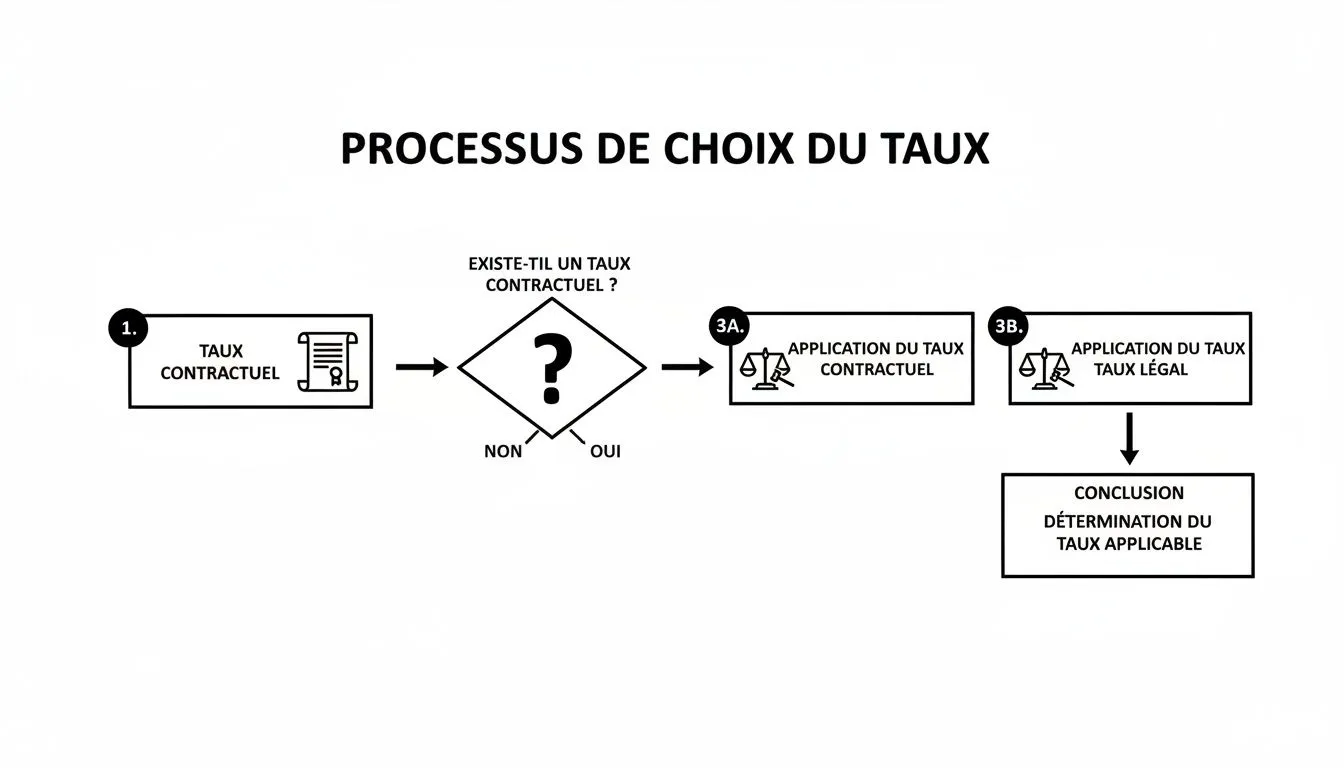
This visual makes it clear: priority is always given to the rate you’ve defined in your own business documents. The only condition is that it respects the legal floor.
Counting days late: the foolproof method
Counting days is a frequent source of errors, so let’s be precise. The calculation starts the day after the due date shown on the invoice. That’s a golden rule.
Let’s take a concrete example: an invoice is due on May 15. The first day late is therefore May 16. The count stops on the day you see the full payment land in your bank account. If your client finally pays on May 30, you’ll count 15 days late (from May 16 to May 30 inclusive).
A question that often comes up with clients: what about leap years? To keep things simple, the practice accepted by the administration is to always divide by 365 days, even in a leap year. No need to complicate things.
Never forget the €40 flat-rate compensation!
This is the small bonus many people forget, yet it’s crucial. On top of the late payment penalties you’ve just calculated, the law allows you to add a flat-rate compensation for collection costs. Its amount is fixed: €40.
This compensation is a real asset:
- It is due per overdue invoice, not per client. If a client has three unpaid invoices, you can claim 3 x €40 = €120.
- You have no supporting documents to provide regarding the costs actually incurred for your follow-ups (time spent, cost of a call, etc.).
- It is not subject to VAT.
This €40 sum is therefore added directly to the penalty amount. The final formula is thus:
Total amount to claim = Late payment penalties + €40 flat-rate compensation
It is absolutely essential to mention this compensation (and the penalty rate) in your terms and conditions and on your invoices. Forgetting it exposes you to an administrative fine, which would be a shame.
Putting it into practice: concrete examples
To make all of this perfectly clear, nothing beats a few worked examples. The table below simulates situations you might encounter. Here we use an annual rate of 12.50% (corresponding to the ECB refinancing rate plus 10 points, a fictional value for the purpose of this 2026 example).
Examples of penalty calculations for your business
| Invoice amount incl. VAT | Days late | Detailed penalty calculation | Flat-rate compensation | Total to claim |
|---|---|---|---|---|
| €1,500 | 20 days | (€1,500 x 12.50%) x (20 / 365) = €10.27 | €40 | €50.27 |
| €8,000 | 45 days | (€8,000 x 12.50%) x (45 / 365) = €123.29 | €40 | €163.29 |
| €500 | 90 days | (€500 x 12.50%) x (90 / 365) = €15.41 | €40 | €55.41 |
| €12,500 | 60 days | (€12,500 x 12.50%) x (60 / 365) = €256.85 | €40 | €296.85 |
As you can see, even for “small” delays, the total amount to claim quickly becomes significant, largely thanks to the flat-rate compensation. It’s an approach that has a real, deterrent impact.
Ultimately, the calculation is fairly simple once you have the right figures. The real challenge is often staying rigorous about tracking dates and consistently applying the procedure. Our full guide on late payment penalties offers more tips for making this a natural part of your routine.
Putting the numbers into perspective: concrete examples for sellers and service providers
Enough theory, let’s get practical. To truly master late payment penalty calculation, nothing beats a few real-life scenarios drawn from entrepreneurs’ daily experience. Let’s see how the formula applies to cases you may already have encountered.
To keep things simple, we’ll use a contractual rate of 12.00% per year in our first examples. It’s a fairly common and sufficiently deterrent rate. Just as a reminder, the magic formula is:
(Amount incl. VAT x Interest rate) x (Days late / 365)
Case 1: The marketplace seller facing a B2B unpaid invoice
Imagine: you sell specialized equipment via a marketplace, and a business client placed an order for €3,200 incl. VAT. The invoice was payable at 30 days, but 50 days have now passed since the due date.
In practice, the calculation goes like this:
(€3,200 x 12.00%) x (50 / 365) = €52.60
Don’t forget to add the flat-rate compensation, which is a systematic right.
- Late payment penalties: €52.60
- Flat-rate compensation: €40.00
- Total to claim: €92.60
For an invoice of this size, the amount quickly becomes more meaningful. It’s a solid argument to spell out in your reminder letter.
Case 2: The SaaS software publisher and its overdue subscription
Now let’s take a software publisher waiting for payment of an annual subscription worth €980 incl. VAT. Their client, another company, has been dragging their feet for 75 days.
We apply the same logic:
(€980 x 12.00%) x (75 / 365) = €24.16
In the end, you’re entitled to claim:
€24.16 (penalties) + €40.00 (compensation) = €64.16
Even on a more modest sum, you can clearly see the effect of the flat-rate compensation. That €40 offsets some of the time and energy you spend chasing what you’re owed.
Case 3: The e-commerce shop and that annoying “small” unpaid invoice
A small B2B invoice of €450 incl. VAT for products you shipped. Payment is 30 days late.
The penalty calculation gives an amount that might seem negligible:
(€450 x 12.00%) x (30 / 365) = €4.44
You might be tempted to let it slide for such a small sum. Mistake! This is where the flat-rate compensation changes the whole picture. The total amount to claim is actually €4.44 + €40.00, or €44.44. That’s nearly 10% of the invoice’s original amount!
Applying penalties systematically, even for small amounts, is a matter of principle. It sends a clear message to your business clients: you keep a close eye on your accounts and don’t tolerate delays.
Advanced case: when the late payment spans two half-years
Things get slightly more complicated if you use the statutory rate (based on the ECB rate) and the delay spans a period during which that rate changes. As a reminder, it’s updated every six months. In that case, you need to split the calculation in two.
Take an invoice of €5,000 due on June 15. Your client ends up paying on August 15, or 61 days after the due date.
- In the first half-year, the ECB rate was 4.50% (a penalty rate of 14.50%).
- On July 1, it changed to 4.25% for the second half-year (a rate of 14.25%).
You need to break your calculation into two parts:
- From June 16 to June 30 (15 days): (€5,000 x 14.50%) x (15 / 365) = €29.79
- From July 1 to August 15 (46 days): (€5,000 x 14.25%) x (46 / 365) = €89.83
The total penalties therefore amount to €119.62. Add the €40 compensation, and you get a total amount of €159.62 to claim.
Juggling these rate changes by hand quickly becomes a headache and a source of errors. A simple invoice of €10,000 that’s 60 days late at a fixed rate of 12% already generates €197.26 in interest. Add the €40 compensation, and it’s nearly €238 to recover. This is exactly where tools like Bizyness show their value: they integrate up-to-date rates and automate these complex calculations for you. For more on the precision of these tools, you’ll find excellent resources on this specialized blog. It’s the best guarantee for applying the correct amount, error-free, and strengthening the credibility of your follow-ups.
What if you stopped calculating penalties by hand?
Calculating late payment penalties is one of those administrative tasks that eats up precious time, especially as the number of invoices climbs. You quickly end up with a spreadsheet, juggling dates and rates… It’s not just tedious, it’s also an open door to errors. A wrong formula, a miscounted day, an oversight, and it’s your cash flow and your credibility that suffer.
Fortunately, technology is here to make life easier. By handing this task to a dedicated tool, you gain efficiency, reliability and, frankly, peace of mind.
The real power of automation: continuous monitoring
Beyond the calculation itself, the real challenge is monitoring. Knowing at all times which invoice is overdue, for how many days, and for what amount. This is where management software like Bizyness completely changes the game, working for you in the background.
No more manual daily checking of your invoices! The tool handles everything:
- It centralizes your invoices and keeps an eye on every due date.
- It instantly identifies any invoice whose payment term has been exceeded.
- It calculates penalties day by day, applying the correct rate (yours or the statutory one) and the exact number of days late, with no action required on your part.
This connected environment is the foundation of sound financial management. It’s precisely why more and more entrepreneurs are looking to automate administrative tasks so they can finally focus on what actually grows their business.
How does it fit into your daily routine?
The appeal of a solution like Bizyness is that late payment penalty calculation is no longer a separate chore. It’s a function that fits naturally into your invoicing and client follow-up routine.
In practice, you log into your dashboard in the morning and see an alert for an unpaid invoice. With one click, you prepare a reminder. The email is already drafted, and the penalty amount along with the €40 flat-rate compensation are already included. Simple, fast and professional.
A well-designed dashboard gives you a clear overview to act quickly and effectively, as shown in this example.

With this clear visibility, you know exactly which follow-ups to prioritize, relying on figures that are reliable and always up to date. No more need to reach for a calculator.
The time you get back is considerable. You no longer have to chase down information or wonder whether your calculation is correct, especially when a delay spans two half-years with different ECB rates.
For an online seller who has to manage stock, marketing and customer service, automating collections isn’t a luxury. It’s essential to growing the business without drowning in admin work.
By adopting a tool that handles this tracking, you apply your payment policy systematically and professionally. Every follow-up is credible, backed by precise calculations that comply with the law. You free up your mind to focus on what matters: growing your business.
Frequently asked questions about late payment penalties
Late payment penalty calculation is a topic that brings up plenty of very concrete questions. To help you see things clearly and act with confidence, we’ve gathered here the questions entrepreneurs ask us most often. Here are direct answers, drawn from our experience, to clear up any remaining doubts.
Do I need to send a formal notice before claiming penalties?
No, and that’s great news for simplifying your process. Late payment penalties are due automatically, by right. What does that mean in practice? Simply that they apply automatically from the first day of delay, without you needing to send a reminder or a formal notice by registered letter.
This is a real lever for businesses. You can react quickly and show your client that the collection process has begun. A simple penalty invoice or a reminder mentioning their amount is enough to make the point.
A good client is late paying — am I obliged to apply penalties?
Absolutely not. You remain the sole master of your business relationship. If a normally reliable client is going through a rough patch, you’re perfectly entitled to make a gesture and not claim these fees. That’s a decision that’s entirely up to you.
Be careful, though, to distinguish between this commercial gesture and your legal obligations. Even if you decide not to invoice them, mentioning the penalty rate and the €40 flat-rate compensation remains mandatory on all your invoices and in your terms and conditions of sale. Forgetting it exposes you to a fine.
Not invoicing penalties is a business choice; not mentioning them is a violation. The distinction matters a great deal. Keeping these mentions protects you and leaves the door open to act should the situation get complicated.
Are late payment penalties subject to VAT?
The answer is a categorical no, and it’s a question we get asked all the time. Neither late payment penalties nor the €40 flat-rate compensation are subject to VAT.
Why? Because the tax authorities don’t consider them the counterpart of a service or product sale. It’s financial compensation. The amount you calculate is therefore a net amount, to be invoiced as is. No need to add VAT.
What if my client refuses to pay the penalties?
A client who pays the main invoice but ignores the penalties remains your debtor. The sum you’re claiming constitutes a debt in its own right. If your friendly reminders go unanswered, you’re entitled to move to the next step.
This can start with a formal notice letter (this time it is necessary to launch a procedure) and go as far as a court order to pay. Having a penalty calculation that is accurate, legal, and clearly displayed on your business documents gives considerable weight to your case before a court. It’s a debt, and the law is on your side to recover it.
Manually tracking every due date and calculating penalties can quickly become a headache, a source of errors and wasted time. Bizyness automates this entire process for you. Our platform detects delays, calculates penalties at the applicable rate and includes them in clear, professional reminders. You’re freed from this mental load and can focus on what really matters: growing your business.
To see how to secure your cash flow effortlessly, take a look at https://www.bizyness.fr.
