

 Français
Late payment reminders: the guide to getting paid on time
Transform your late payment reminder process. Discover concrete strategies to secure your cash flow and preserve your customer relationships.
A reminder for an unpaid invoice is far more than a simple administrative formality. It’s the first essential step in reminding a client of their commitment and, above all, protecting the cash flow that keeps your business running. Before even thinking about more restrictive measures, a well-handled reminder is often the key to unlocking the situation.
Why unpaid invoices are a real poison for your growth

A client paying late happens. But when delays pile up, the impact goes well beyond a missing line in your balance sheet. It’s a brake that concretely paralyzes the development of your business.
Every euro that doesn’t come into your accounts on the expected date is a euro you can’t reinvest. Think about it. That money could have gone toward buying stock, launching an advertising campaign, or investing in a new tool. Instead, it’s stuck, creating a domino effect that puts your cash flow under strain and makes you miss opportunities.
The very concrete impact on your business’s daily life
Let’s picture the scenario. You planned to order raw materials to launch a highly anticipated new product. But several of your major clients still haven’t settled their invoices. The result? You don’t have the funds needed to pay your supplier, and this promising project falls behind.
This financial tension seeps in everywhere and can quickly become problematic:
- Paying salaries: A lack of liquidity can make it difficult to pay your team on time, which inevitably generates stress and uncertainty.
- Investing for the future: The budget you’d set aside for that new software or more efficient machine? It’s frozen while waiting for payments.
- Keeping your partners’ trust: If your clients’ delays force you to pay your own suppliers late, it’s your reputation that takes a hit.
An unpaid invoice isn’t just a loss of revenue. It’s a loss of opportunities. It ties up resources that should be driving your growth.
The phenomenon is far from anecdotal, and it’s growing. A recent study revealed that more than 62.6% of businesses have faced unpaid invoices, a 11.6% increase in one year. Worse still, nearly 30% of them handle more than 10 unpaid invoices per year, representing a considerable administrative and mental burden. To dig deeper into the topic, the customer risk analysis on Leanpay.io is very insightful.
Understanding these stakes shows that a good late payment reminder strategy isn’t a chore, but a vital function for the survival and growth of your business.
Building solid foundations to avoid unpaid invoices

Let’s be honest, the best reminder for an unpaid invoice is the one you never need to write. Protecting your cash flow and client relationships is largely decided upstream. It’s a preventive strategy that starts well before the invoice is issued, right from the first business exchanges.
The secret is to set a framework so clear and professional that misunderstandings or oversights become nearly impossible. The goal is to make payment natural and smooth, not to create a source of stress. It’s a small upfront time investment that will earn you priceless peace of mind down the line.
Rock-solid terms and conditions of sale
Your terms and conditions of sale are your shield. They should absolutely not be a vague copy-paste found online. This document must be tailored to your business, be crystal clear and, above all, formally accepted by your client before you begin anything.
Make sure to include clauses that truly protect you:
- Payment terms: Leave no room for interpretation. Write in black and white “payment due within 30 net days,” for example.
- Late payment penalties: It’s your right, so use it. Mention the applicable rate and don’t forget the flat-rate €40 collection fee compensation.
- Accepted payment methods: Clearly list the options (bank transfer, direct debit, credit card…).
Well-drafted terms and conditions set the rules of the game from the outset and provide a solid legal basis for your actions if things get complicated. This is the foundation for then establishing clear payment terms on your invoices and securing your revenue.
An impeccable invoicing process
A simple typo on an invoice can turn into several weeks of payment delay. That’s why a rigorous invoicing process isn’t optional, it’s a necessity.
Get into the habit, before every send-out, of doing one last check of the critical information: the client’s exact legal name, their address, the business registration number, and above all, the email address of the right person in the accounting department. An invoice that lands in the wrong inbox is an invoice that sleeps.
Think of every invoice as a mini-contract. Its accuracy is a mark of your professionalism and has a direct impact on how quickly you’ll get paid.
Using an invoicing tool like Bizyness to automate the creation and sending of your invoices changes everything. No more risk of human error or oversight. The system ensures that compliant invoices always arrive at the right place, putting all the odds in your favor for on-time payment.
The human, gradual approach to chasing an unpaid invoice
Faced with an overdue invoice, our first instinct might be to send a fairly direct message. Yet experience shows that skipping steps and sending a formal notice right away can easily damage a client relationship built on trust. A graduated approach isn’t just more diplomatic, it’s also far more effective at getting you paid quickly.
The key is to start from the assumption that a first delay is often a simple oversight. Most of the time, it’s not bad faith, just an invoice that fell through the cracks of a busy day-to-day. By adopting a progressive method, you handle the situation tactfully, preserving the business relationship while remaining firm about what’s owed to you.
The idea is simple: gradually turn up the pressure. Start with a friendly reminder, almost a courtesy, and move toward more formal communications only if necessary.
This infographic clearly illustrates the process to follow, step by step, for management that’s both human and structured.
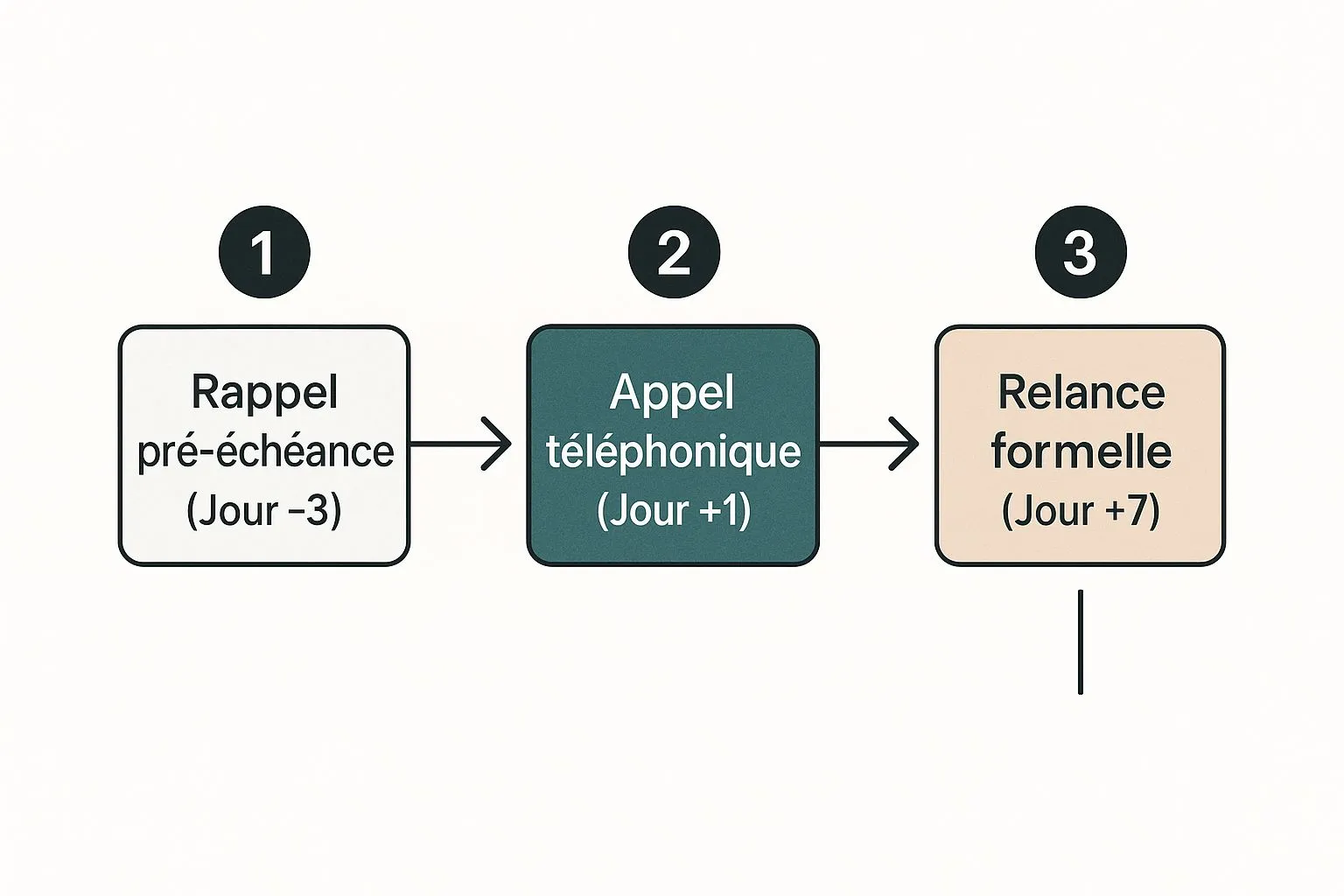
This diagram shows how each action logically follows the next, allowing you to maintain constructive pressure without ever tipping into aggressiveness.
To summarize this approach, here’s a table outlining the different phases, the ideal moment to act, and the tone to adopt.
Reminder phases and recommended actions
This table summarizes the graduated approach, from the preventive reminder to formal action, specifying the timing, channel, and objective of each intervention.
| Reminder phase | Key timing | Preferred channel | Tone and objective |
|---|---|---|---|
| Preventive reminder | 3 to 5 days before the due date | Friendly and helpful. Remind of the due date and confirm the invoice was received. | |
| Direct contact | 1 to 2 days after the due date | Phone call | Empathetic and open. Understand the reason for the delay, defuse tension and obtain a commitment. |
| Formal reminder | 7 to 10 days after the due date | Formal email | Professional and direct. Reiterate the unpaid amount, provide details and attach the invoice. |
| Final notice | 20 to 30 days after the due date | Email or registered letter | Firm but courteous. Announce next steps (formal notice) if payment is not made. |
This structure gives you a clear framework so you’re never caught off guard and always know what the next logical step is.
Phase 1: the courtesy reminder (before the due date)
Ultimately, the best reminder is the one you never need to send. Sending a short courtesy email three to five days before the due date is a practice that changes everything. This isn’t a reminder, it’s proactive customer service.
The objective is twofold:
- Help your client: You kindly remind them of the approaching due date, which is often perceived as valuable help.
- Anticipate problems: It’s the perfect moment to make sure the invoice was properly received and that there’s no blockage on their end (an issue with the service, an invoice lost in spam, etc.).
A short message is enough. Something like: “Just a quick note to let you know that our invoice #123 will be due on [date].” By the way, to save precious time, you can absolutely automate your reminder emails without losing authenticity.
Phase 2: direct contact (right after the due date)
If the deadline has passed by a day or two, pick up your phone. It’s often far more effective than yet another email. A call is more personal, more direct and much harder to ignore.
The purpose of this call isn’t to demand, it’s to understand. An open question like “Hello, I’m calling about our invoice #123. Have you run into any difficulty settling it?” can defuse any tension.
In most situations, you’ll get a simple explanation (an oversight, the accountant on vacation) and a promise of payment. Be sure to note the agreed date and confirm it with a summary email right after your conversation.
Phase 3: the formal reminder
If a week has passed and, despite your initial contacts, nothing has moved, it’s time to formalize your approach. This is where the first real reminder email comes in.
The tone remains professional but becomes more direct. The email subject must be crystal clear: “Reminder – Invoice #123 pending payment”. In the body of the message, restate all the essential information: the invoice number, the amount, the due date, and above all, attach the document again. This is an essential step before considering firmer action.
How to write reminder messages that finally get a response
We’ve all received those automatic, cold, impersonal reminders that go straight to the trash. The secret to a late payment reminder that works is standing out from the crowd. It requires a subtle blend of psychology, precision and professionalism.
The idea isn’t to corner your client, but to make things as easy as possible for them. Think about it: every message should be a helping hand to get them to resolve their situation. The right tone, all the information at hand, and a clear action to take. Those are your best weapons.
The structure of a message that hits the mark
An effective reminder email relies on a simple but devilishly efficient structure. No need for long speeches, get straight to the point.
- A subject line that leaves no room for doubt: The client should understand what it’s about in a second. A simple
Reminder - Invoice #XXXX pending paymentis perfect. It’s professional, it’s clear. - A no-nonsense recap of the facts: In the body of the email, be direct. Don’t make your client play detective. Simply restate the invoice number, its amount and its due date.
- The invoice, always attached: This small detail changes everything. No more room for excuses like “I never received the invoice.” It’s the most common objection, and you’ve just swept it aside.
- A clear action to take: Always end with a clear instruction. A direct payment link is ideal. Otherwise, simply invite them to contact you if there’s a problem.
If you’re looking for inspiration, our article on writing a reminder letter for an unpaid invoice offers concrete, ready-to-use templates for every situation.
Adapting the tone to each stage of the process
The tone you use should of course evolve. A first friendly reminder won’t sound the same as a third reminder, necessarily firmer. It’s a matter of calibration.
Personalization makes all the difference. A message that starts with “Dear Mr. Smith” will always carry more weight than a simple “Hello.” You’re addressing a human being, not a case number. That’s the basics.
This human approach is all the more crucial as payment difficulties multiply. Take rent as an example: the frequency of reminders sent as early as 5 days of delay has risen from 6.12% in 2020 to nearly 20% today. This shows that delays are occurring earlier and earlier. To go further on this point, you’ll find interesting statistics on the situation of unpaid debts in France on Lamy-Immobilier.fr.
Ultimately, a well-crafted message doesn’t just demand money; it protects your client relationship. By remaining courteous but firm, you assert your professionalism while keeping the door open to a solution. It’s this balance that turns a simple late payment reminder into a genuine management tool.
When is it time to hand things over to a debt collection professional?

Even with the best reminders in the world, there are times when the situation gets stuck. Your client goes silent, multiplies empty promises, or disputes the invoice with bad-faith arguments. These are unmistakable signals. At this stage, persisting internally becomes a pure waste of time and energy.
Knowing how to identify this point of no return is a strategic decision, not a failure. It’s simply the moment when calling on an expert becomes the best option to protect your cash flow and, let’s be honest, your peace of mind. You then move out of the amicable phase and into a more formal approach.
External amicable collection or straight to court?
Before considering heavy artillery, a smart first option is to hire a debt collection agency. It will take over your reminders, but with entirely different weight. Its goal? Find a resolution without going to court, using its experience to negotiate and apply professional pressure.
Only if this attempt fails does the legal route become an option to consider. It’s a heavier, longer and more costly process, involving a bailiff or a lawyer. The simplest and most common procedure remains the payment order, perfect for debts the client can’t seriously dispute.
Delegating collection doesn’t mean declaring war. It’s above all handing the case to a mediator whose job it is. You maximize your chances of recovering your money while freeing yourself from an enormous burden, both administrative and emotional.
Choosing the right partner and anticipating costs
The choice of professional will mainly depend on the invoice amount and the complexity of the case.
- Debt collection agency: This is the ideal partner for the amicable phase. The model is often win-win, as it gets paid on success with a percentage of the amounts it recovers for you. An excellent solution for maintaining pressure without spending money upfront.
- Bailiff (or judicial officer): Becomes essential for all official proceedings, such as serving a payment order or enforcing a judgment (a seizure, for example).
- Lawyer: Their involvement is relevant for thorny cases, especially if the client seriously disputes the debt and a solid legal argument needs to be prepared for court.
Deciding to delegate is a crucial step in properly managing your business. To master all the nuances of this process, don’t hesitate to consult our complete guide on the various customer debt collection strategies. The idea is always to choose the solution offering the best return on investment for your business.
Frequently asked questions about late payment reminders
Dealing with an unpaid invoice is a bit like navigating a minefield. You often have plenty of questions in mind. To help you see things more clearly and act with confidence, we’ve gathered the most common questions.
What is the legal deadline to act?
The law gives you a certain amount of time, but in practice, you should never wait. For a debt between businesses, the statute of limitations is 5 years. If your client is an individual, this period is much shorter: only 2 years.
Time is your worst enemy when it comes to collection. Every passing day reduces your chances of seeing your money again.
Concretely, don’t wait for the deadline. A reminder sent as early as the first week of delay shows that you closely track your accounts and that you’re serious. That’s the key to getting paid quickly.
Can I charge late payment penalties right away?
Yes, without hesitation. It’s a right. Late payment penalties are automatically due starting from the first day following the invoice’s due date. You don’t even need to send a reminder for them to apply.
Also consider the flat-rate compensation for collection costs, set at €40. It’s a fixed amount you can claim in addition to the penalties. The only prerequisite? Make sure all of this is clearly stated in black and white in your terms and conditions of sale.
Does a simple reminder email have legal value?
Email is perfect for the first reminders, the ones known as “amicable.” It’s simple, fast and leaves a written trace of your efforts. It’s proof that you attempted to resolve the situation.
However, when the tone hardens and it’s time to move to a formal notice, a registered letter with acknowledgment of receipt becomes essential. It’s the only document that indisputably proves your client actually received your official request. This is the paper trail that will carry weight if things need to go further.
What if my client disputes the invoice?
This is a classic way to avoid paying. If a client disputes the quality of the work or the amount, your responsiveness is crucial. Don’t let it drag on.
Respond immediately, in writing, dismantling their arguments point by point. Provide tangible evidence to support your position:
- The quote they signed
- The purchase order or delivery note
- The email exchanges where they approved the various steps
Your silence could be interpreted as an acknowledgment that their complaints are well-founded. Show that you’re confident in your rights and the quality of your work.
Stop letting unpaid invoices weigh down your cash flow. With a tool like Bizyness, you can automate your invoices and reminders to focus on what really matters: growing your business. Discover how Bizyness can secure your cash flow today.
