

 Français
Managing Multiple Projects at Once: The Complete Guide
Discover how to manage multiple projects at once with proven strategies, powerful tools and concrete methods.

Why juggling multiple projects has become unavoidable

In today’s professional landscape, adaptability and versatility have become essential qualities. Managing several projects at the same time is no longer reserved for an elite few — it is now an indispensable skill for success. This shift is profoundly changing how businesses operate and what they expect from their people.
Picture a conductor leading several instruments at once. Each plays its own part, but it’s the overall harmony that creates the symphony. Likewise, a professional must coordinate different projects, each with its own goals, deadlines and teams, to achieve optimal overall performance.
The impact on careers and businesses
This ability to manage multiple projects has a direct impact on careers. Professionals who master this skill are more in demand, gain access to positions of responsibility, and often earn higher pay. They demonstrate rigorous organization, effective time management and resilience under pressure — all qualities employers value.
These skills make them valuable assets to the company. Their effectiveness contributes to better productivity and to reaching goals faster. The dynamism of the French economy reinforces this trend.
The rise in investment projects and business creation makes managing multiple projects simultaneously essential. In 2024, France recorded more than 1.07 million business creations. This sustained growth requires entrepreneurs to manage several projects effectively in order to succeed. Find out more about business growth in France
Sectors where this skill is highly valued
Some sectors particularly value multi-project management. In digital marketing, web development or project management, the ability to run several campaigns, websites or client projects at once is essential. The growth of e-commerce and start-ups amplifies this demand for versatile profiles.
Opportunities for your professional development
Learning to manage multiple projects is an investment in your future. This skill strengthens your employability, lets you seize new opportunities, and helps you grow professionally.
It’s a major asset for meeting the demands of the French job market and positioning yourself as a competitive candidate. Mastering this art opens the door to more stimulating roles and faster career progression.
The fatal traps that sabotage your projects
Managing several projects at once is a stimulating challenge — but also a perilous exercise. A single misstep can jeopardize every initiative involved. Unfortunately, the evidence is clear: most attempts at multi-project management end in failure. This section exposes the critical mistakes, sometimes made even by experienced professionals.
The multitasking myth
Contrary to popular belief, our brains cannot actually perform several tasks at the same time. What we call multitasking is in reality rapid switching between different tasks. This illusion of parallelism comes at a cost: scattered attention, frequent mistakes and lower quality work. Picture yourself writing an email while answering the phone and sitting in a meeting. The result is inevitably underwhelming.
Forgetting the unexpected
Just like in life, projects rarely unfold in a straight line. The unexpected is inevitable. Ignoring it is like building a project on fragile foundations. The sudden absence of a key team member, a supplier’s late delivery, or a last-minute change to the specifications can derail the whole process. It is therefore essential to build a safety margin into your planning to cope with these uncertainties.
Lack of prioritization
Juggling several projects requires rigorous prioritization. Without a clear system for identifying the most important and urgent tasks, you risk spreading yourself thin and spending precious time on low-impact activities. Like a site manager who focuses on finishing touches before the foundations are laid, poor prioritization can lead to a catastrophic outcome. It can also spark conflicts between teams competing for resources and attention.
Poor communication
Clear, effective communication is the backbone of successful multi-project management. Lack of information, misunderstandings and contradictory instructions create confusion, generate errors and hurt team motivation. Using the right communication tools, holding regular meetings, and documenting decisions are all practices that foster effective communication. You might also be interested in: How to master tax optimization as a sole trader
Burnout
Managing several projects at once can lead to work overload and chronic stress. Left unmanaged, these factors can lead to burnout, with damaging consequences for both individual and team health and performance. In France, this is a major issue for businesses. A 2025 study found that only 29% of French companies complete their projects on time, illustrating how difficult it is to effectively run several projects in parallel. Discover more project management statistics. Putting stress prevention and workload management mechanisms in place is therefore essential.
Before presenting concrete data, here is a summary table of project performance statistics in France, comparing success and failure rates in multi-project management.
| Indicator | Percentage | Impact |
|---|---|---|
| Projects completed on time | 29% | Business performance |
| Projects completed late | 71% (estimated) | Productivity loss, additional costs |
| Projects cancelled | Data not available | Loss of investment, reputational impact |
This table highlights the significant challenge that managing multiple projects represents for French companies. The low percentage of projects completed on time underscores the need to improve project management practices and focus on the points discussed above.
The methods that truly transform your approach
Managing several projects at once demands a rigorous method and flawless organization. Adopting powerful tools and effective practices is the key to avoiding chaos and maximizing efficiency. This guide explores the frameworks recognized and used by top-performing professionals, such as agile methods, Kanban, and hybrid approaches.
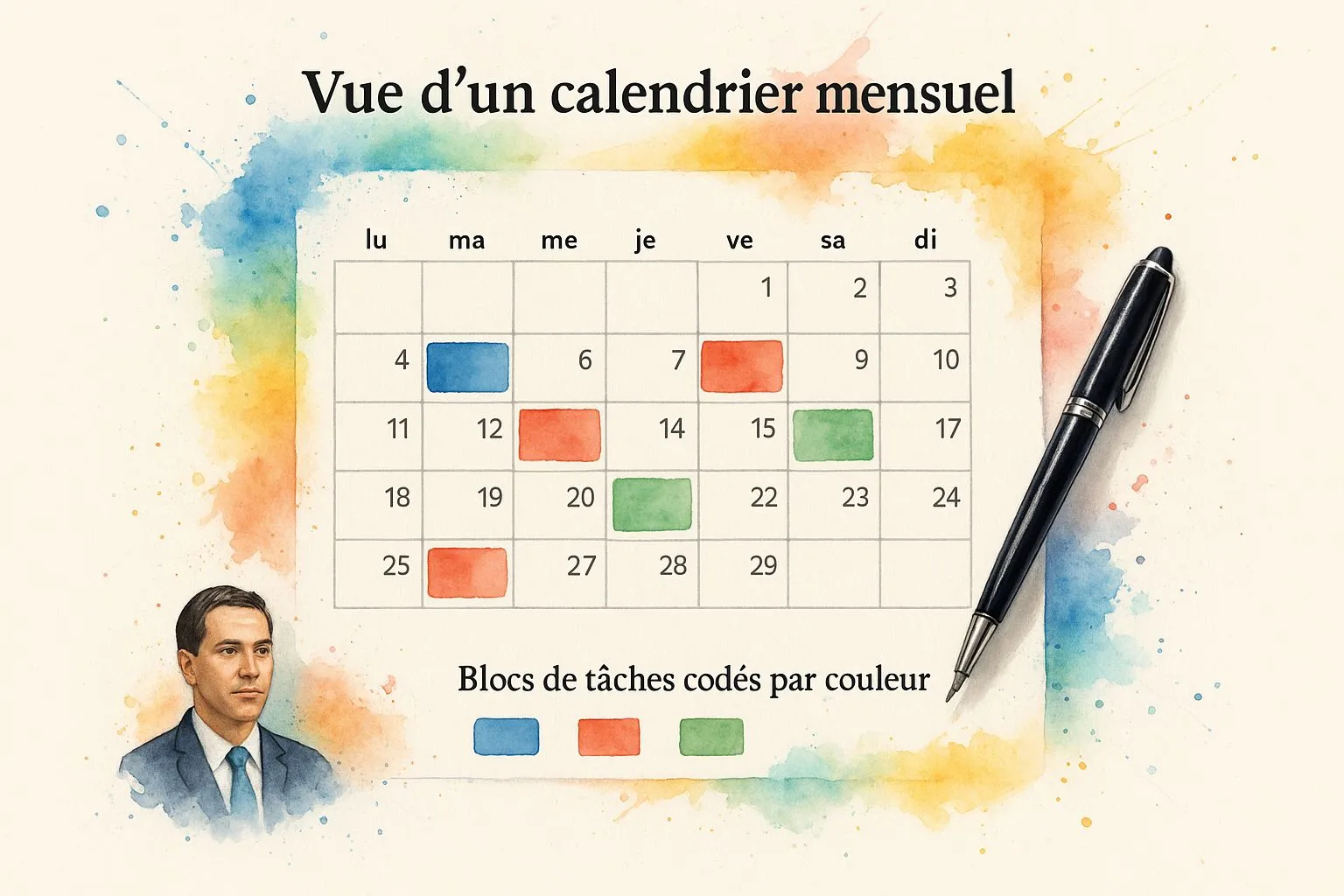
The infographic above shows a monthly calendar with color-coded tasks, illustrating how visual organization can simplify multi-project management. This overview makes it easy to spot periods of overload and potential conflicts between different projects.
Adapting methods to your context
Agility is an iterative approach that emphasizes flexibility and adapting to change. It comes in several flavors, such as Scrum and Kanban. Scrum is particularly well suited to complex projects with dedicated teams, while Kanban focuses on visualizing workflow and limiting work in progress.
Which method to choose depends on the nature of your projects, the size of your teams, and your company culture. For example, a start-up developing a new product might favor Scrum, while a communications agency managing many small client projects might opt for Kanban.
To help you choose the most suitable method, here is a comparison table:
To better understand the different approaches, here is a comparison of the most widely used methodologies:
Comparison of the main multi-project management methodologies
Comparative analysis of the pros and cons of each methodological approach
| Methodology | Advantages | Disadvantages | Suited sectors |
|---|---|---|---|
| Agile (Scrum) | Flexibility, adaptation to change, stronger collaboration | Requires an experienced team, can be complex to set up | Software development, marketing, innovation |
| Kanban | Workflow visualization, limits work in progress, simplicity | Less structured than Scrum, can be hard to adapt to complex projects | Customer support, maintenance, production |
| Hybrid | Combines the advantages of different methods, adaptable to context | Can be tricky to set up and manage, requires a good understanding of the different methods | Large projects, matrix organizations |
This table highlights the strengths and weaknesses of each method, allowing you to choose the one that best fits your needs. The hybrid approach, combining several methods, offers great flexibility but requires more advanced expertise.
Prioritization: the key to success
Prioritization is a fundamental element for effectively managing several projects. It’s essential to identify the most important and urgent tasks for each project. Methods such as the Eisenhower matrix (importance/urgency) or the MoSCoW method (Must have/Should have/Could have/Won’t have) can help you clarify your priorities and allocate resources optimally.
This lets you focus on high-impact actions and avoid spreading yourself thin on secondary tasks. Good prioritization is the guarantee of better time management and greater efficiency.
Creating synergies between projects
Beyond managing each project individually, it’s possible to create synergies between them. Identifying common ground, shareable resources and opportunities for collaboration helps optimize resource use and speeds up the achievement of your goals.
For example, a skill acquired on one project can be applied to another, or market research done for one project can benefit another. Tapping into these synergies is a powerful lever for gaining efficiency and profitability.
Examples of French companies
Several French companies have successfully adopted agile methods for multi-project management. Companies such as BlaBlaCar or Deezer have set up agile organizations to respond to the rapid changes in their markets. Their experience demonstrates the benefits of agility in terms of responsiveness, collaboration and performance.
In conclusion, mastering project management methods, clear prioritization and the pursuit of synergies are the keys to successfully managing several projects at once. Adapting to context and choosing the right tools are essential for optimal management.
The tools that revolutionize your efficiency

Forget generic advice! This section explores the concrete tools used by seasoned project managers to run several projects at the same time. From collaborative platforms to automation solutions, we analyze the best-performing solutions on the market.
Choosing the right tools: a practical guide
Selecting the right tool depends on several criteria: budget, team size and project complexity. A tool that’s overly sophisticated for your needs can become counterproductive. The ideal is to find solutions that fit naturally into your current ways of working.
Adopting the right project management tools significantly improves performance. Organizations using integrated platforms for multi-project management see a 34% increase in productivity and a 28% reduction in time spent on administrative tasks. Want to dig deeper? For effective administrative management, also check out our guide: How to master your company’s administrative management.
Essential tool categories
-
Collaborative platforms: By centralizing communication, document sharing and task tracking, these platforms offer an overall view of project progress and simplify team coordination. Asana, Trello and Monday.com are commonly used examples.
-
Project management software: Tools like Jira and Wrike offer more advanced features for planning, time tracking and resource management. They’re particularly well suited to complex projects and large teams.
-
Time management tools: Toggl Track and Clockify let you track the time spent on each task and optimize its management. They help identify time-consuming tasks and improve individual and collective efficiency.
-
Automation tools: Zapier and IFTTT automate repetitive tasks, such as generating reports or sending notifications, freeing up time to focus on the strategic aspects of your projects.
Integration and adoption: the key to success
Integrating a new tool takes time to adapt. It’s essential to train your teams on how to use it and to confirm that it meets their needs. Don’t hesitate to try out several solutions before settling on your final choice.
Reviews and comparisons
Feedback from other users and comparisons available online are valuable resources. They help you identify each tool’s strengths and weaknesses and select the solution best suited to your context. By consulting these resources, you benefit from other professionals’ experience and avoid costly mistakes.
In conclusion, choosing powerful tools is fundamental to effectively managing several projects at once. By opting for solutions suited to your needs and integrating them into your processes, you optimize your productivity and successfully achieve your goals.
Orchestrating your teams without losing your mind
Managing several projects at once with different teams can quickly become a real headache. How do you make sure everyone has the information they need and that resources are allocated effectively? This practical guide offers strategies for optimizing team coordination and maintaining productive collaboration.
Communication: the cornerstone of collaboration
Clear, concise communication is essential to avoid information overload. Each team should receive the information relevant to its work, without being swamped with unnecessary messages. Using collaborative tools, such as Slack or Microsoft Teams, helps centralize exchanges and facilitate information sharing.
Creating a dedicated communication channel for each project is a good practice for filtering information and avoiding confusion. Short, regular meetings are also important for keeping teams in sync, tracking project progress and quickly identifying blockers.
Priorities: managing the inevitable
Juggling several projects inevitably involves conflicting priorities. A transparent system for defining and ranking the needs of each project is essential. The MoSCoW method (Must have, Should have, Could have, Won’t have) is a valuable tool for making informed decisions about resource allocation.
By involving teams in the process of setting priorities, you build buy-in and motivation. This system helps ensure that resources are allocated to the most important tasks and avoids frustration linked to poorly defined goals.
Motivation: the fuel of performance
In a multi-project environment, the risk of demotivation is higher. It is therefore crucial to recognize and value each team member’s efforts. Clear goals, regular feedback and celebrating successes are essential to maintaining a high level of engagement.
To boost team motivation, don’t hesitate to explore innovative solutions for organizing events. Resources like innovative corporate event ideas can inspire you. Managing workload is also crucial to prevent burnout. Fair task distribution and limiting the number of simultaneous projects per team member are key to preserving team well-being. In certain sectors, such as new-build construction in France, multi-project management is a major challenge. The high volume of ongoing projects requires complex, rigorous coordination. Check out the statistics for the new-build construction sector.
Versatility and collaboration: winning assets
Multi-project management offers the opportunity to develop team versatility and strengthen cross-department collaboration. By encouraging internal mobility and skill-sharing, you build a culture of continuous learning and mutual support.
This approach optimizes workload distribution, makes it easier to cover absences, and lets you capitalize on everyone’s expertise. It also contributes to better team cohesion and smoother internal communication.
Best practices: learning from the best
Draw inspiration from companies that excel at multi-project management. Analyzing their methods and tools can give you ideas for improving your own organization. For example, some companies use visual management systems to track project progress in real time.
Others have adopted agile methods for more flexible, adaptive project management. Studying these concrete examples will let you refine your practices and improve your teams’ efficiency.
Measuring what really matters to improve
To succeed in managing several projects at once, rigorous tracking of performance indicators is essential. These key performance indicators (KPIs) provide valuable data for assessing project progress and making informed decisions. The goal is not to get lost in a mass of data, but to focus on the metrics that truly matter.
Identifying the relevant metrics
Which metrics to track depends on your goals. If your priority is meeting deadlines, focus on the task completion rate and the number of days behind schedule. If your main goal is profitability, monitor actual spend against planned budget and the return on investment of each project. Like a pilot monitoring speed, altitude, fuel and heading, you need an overall view of your projects through relevant indicators.
Building effective dashboards
A well-designed dashboard synthesizes each project’s key data and lets you visualize essential information at a glance. It helps you quickly spot strengths and weaknesses. Much like a car’s dashboard, it displays crucial information (speed, fuel level, etc.) without drowning you in technical detail. It should be clear, concise and easy to understand. Using charts and color codes makes the data easier to read and analyze.
Anticipating problems through early warning signs
KPIs can alert you to potential problems before they become critical. A slight increase in time spent on certain tasks, a budget overrun on a specific line item, or a drop in team motivation are early warning signs to take seriously. By spotting them quickly, you can step in and adjust your strategy before the situation worsens. It’s like a doctor diagnosing an illness at an early stage: a quick response improves the chances of recovery.
Adjusting your strategy in real time
Regularly tracking your KPIs lets you adapt your strategy in real time. Facing a delay, you can reallocate resources, adjust priorities or renegotiate deadlines. If a project goes over budget, you can identify expenses to optimize or find alternatives. This flexibility is essential for effectively managing several projects at once and maximizing your chances of success. To learn more, read our article on How to master your company’s cash flow.
Concrete examples and reporting tools
Many companies have improved their performance through a data-driven approach. They use powerful reporting tools like Tableau or Power BI to track their KPIs, analyze data and make fact-based decisions. These tools let you create custom reports, interactive charts and dynamic dashboards. By mastering them, you can present your results convincingly and demonstrate the positive impact of your multi-project management. Data analysis helps identify best practices and continuously optimize your processes. For example, analyzing time spent on different tasks helps identify bottlenecks and implement solutions to improve your teams’ efficiency. Using hard data strengthens the credibility of your analyses and facilitates strategic decision-making.
Your action plan for success starting today
You now have everything you need to effectively manage several projects at once. This section offers a concrete action plan you can put into practice immediately, applying the most effective strategies.
Priority steps for a quick start
For an optimal start, focus on these essential actions:
-
Prioritization: Use the Eisenhower matrix (importance/urgency) or the MoSCoW method to determine the priority tasks for each project.
-
Communication: Set up appropriate communication tools and schedule regular meetings to keep teams in sync and share information.
-
Organization: Choose a project management tool (Trello, Asana or another) suited to your needs and your way of working (Agile, Kanban, hybrid).
The essential tools to acquire first
Don’t rush into complex tools. Favor simple, effective solutions:
-
A task management tool: Trello, Asana or Todoist are excellent starting points for organizing your tasks and tracking their progress. They make it easy to visualize the status of each project.
-
A shared calendar: Google Calendar or Outlook Calendar let you sync deadlines and availability. This is essential for avoiding scheduling conflicts and optimizing planning.
-
A communication platform: Slack or Microsoft Teams make communication and information sharing easier. They centralize exchanges and let you create channels dedicated to each project.
Fatal mistakes to avoid at all costs
To maximize your chances of success, avoid these common pitfalls:
-
Multitasking: Focus on one task at a time for better efficiency and higher-quality work.
-
Neglecting the unexpected: Build slack into your planning to handle unforeseen events and delays.
-
Lack of communication: Communicate clearly and regularly with your teams to avoid misunderstandings and disagreements.
-
Neglecting team motivation: Value your team members’ work to maintain their engagement and motivation.
Checklists and templates for practical application
Here are a few examples of adaptable checklists and templates:
-
Project kickoff checklist: Defining goals, identifying resources, setting a budget, creating a schedule.
-
Meeting minutes template: Date, attendees, topics discussed, decisions made, action items.
-
Budget tracking template: Planned spend, actual spend, variance, corrective actions.
Step-by-step progression for gradual adoption
Adapt your approach to your experience level and the complexity of your projects. Start by applying the basic principles to a few projects, then gradually increase the workload.
Evaluating and adjusting your strategy
Regularly tracking your performance is essential. Analyze the results, identify areas for improvement, and adjust your approach. This iterative process will keep refining your practices.
You’re now ready to manage multiple projects. By applying this advice, you can achieve your goals and maximize your performance. To simplify managing your business, discover Bizyness. Simplify your management with Bizyness.
