

 Français
Mandatory Invoice Details for Sole Traders: The Complete Guide
Discover everything about mandatory invoice details for sole traders (auto-entrepreneurs) for perfect compliance. Invoice with confidence using our detailed guide.
As a sole trader (auto-entrepreneur), thinking of an invoice as a simple piece of paper requesting payment would be a mistake. It’s much more than that: it’s a legal document that seals a transaction, secures your cash flow and builds your credibility. To be valid, it must absolutely include several mandatory details. A single omission can cost you dearly and weaken your business.
Why flawless invoicing is vital for your micro-business
Think of your invoice as the identity card of the service you’ve just delivered. Its role isn’t limited to triggering payment. It builds a relationship of trust with your client and, above all, it protects you in the event of a problem or dispute. Solid invoicing is simply the foundation of sound management.
Every piece of information, from the invoice number to the VAT mention, has its reason for being, both legal and practical. A small mistake or omission can quickly turn this simple administrative formality into a real headache. And the consequences can be financial: fines can climb up to €15 per missing or inaccurate detail, capped at 25% of the total invoice amount.
A well-made invoice isn’t a chore, it’s a protection. It strengthens your professional image, helps your clients pay you faster and gives you peace of mind in the event of an audit. It’s the ABC of a business built to last.
The boom in the number of micro-businesses changes the game
The growing popularity of the sole trader status makes this rigor even more essential. Today in France, micro-business creation accounts for more than 64% of the 1.11 million new businesses, representing 716,200 recent registrations. This incredible momentum shows just how crucial it is for every new entrepreneur to master the basics, such as mandatory invoice details, to keep their venture on track. You can also learn more about the French entrepreneurial model.
In this highly competitive context, with precise rules to follow, flawless administrative management becomes a real asset. By mastering the rules of the game, you avoid the classic pitfalls and can focus on what matters: growing your business. This guide is here to give you all the keys to get there.
The foundation of mandatory details for every invoice
Every invoice you send is, in a way, the identity card of your transaction. It must be flawless. For a sole trader, this means a series of mandatory details that must appear on every document, without exception. This is the foundation that guarantees the legality and clarity of your business dealings.
An omission, even a minor one, can weaken your file in the event of an audit and expose you to penalties. Let’s look together at how to build a solid invoice, step by step.
Clear identification of the parties
Before even talking numbers, an invoice must answer a fundamental question: who is selling to whom? This is the basis for perfect traceability.
For your micro-business, you must absolutely include:
- Your first and last name, followed by the mention “EI” or “Entrepreneur Individuel” (sole trader).
- The address of your registered office, which is very often your home address.
- Your SIREN number (9 digits) and your SIRET number (14 digits).
The same rigor applies to the client. State their full name if they are an individual, or their company name for a business, along with their billing address.
This infographic nicely summarizes the key areas never to forget on an invoice, from the date to the identification of each party.
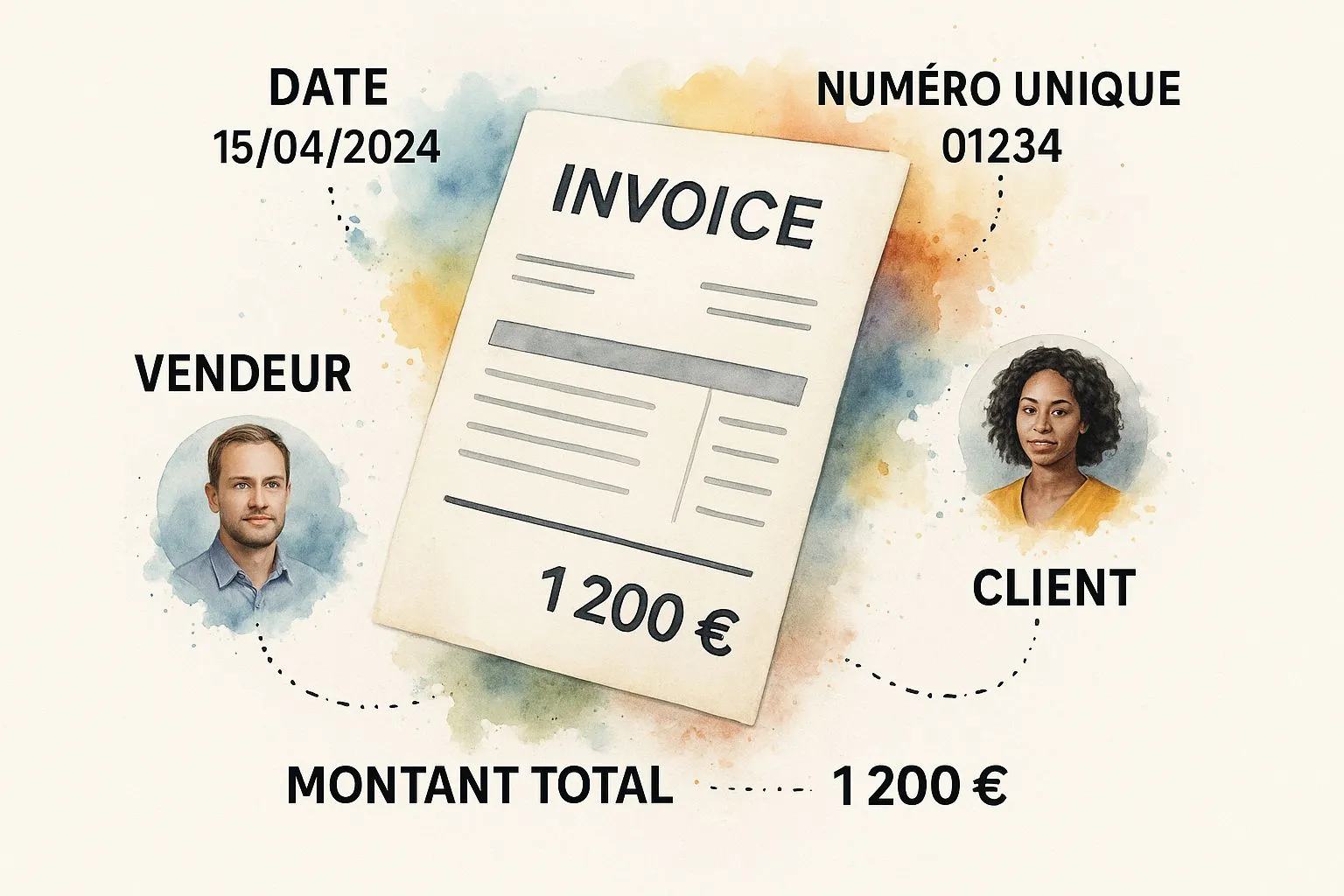
You can clearly see how the logical arrangement of this information makes the document immediately readable and easy to check, whether for you, your client or the authorities.
Numbering and dating: a golden rule
Now that the parties are identified, every invoice must have its own unique, dated signature. Two elements are crucial here: the issue date and the invoice number.
The issue date is simply the day you create and send the document. It marks the official starting point for payment deadlines.
The invoice number is even more critical. The law requires chronological and continuous numbering, without any gaps. In practice, you can neither skip a number nor have two invoices with the same identifier. It’s a safeguard against fraud.
Example of valid numbering:
You can adopt a simple format like 2024-001, 2024-002, 2024-003, etc. The important thing is to maintain a logical sequence that proves no invoice was “lost” or added retroactively. A good habit is to use invoicing software like Bizyness, which manages this sequence automatically and without risk of error.
The service details and the amount due
Now we get to the heart of the matter: describing what you’re being paid for. Every line of your invoice must describe the service or product sold as clearly as possible.
For each line item, you must indicate:
- The precise description of the service or good.
- The quantity (number of hours worked, number of items, etc.).
- The unit price excluding tax (VAT-exclusive).
The total amount due must appear clearly at the bottom of the document. Since most sole traders benefit from the VAT exemption scheme (franchise en base), this will most often be the total amount excluding VAT. This is the sum that seals the transaction and that your client commits to paying you.
To make sure you don’t forget anything, here’s a handy summary table. Use this table as a reminder to quickly check that all essential information appears on your invoices before sending them.
Checklist of essential invoice details
| Mandatory detail | Why it matters | Concrete example to use |
|---|---|---|
| Your full contact details | So it’s clear who is issuing the invoice (legal requirement). | Jean Dupont EI, 10 rue de la Paix 75001 Paris |
| Your SIREN/SIRET number | This is the official registration number of your micro-business. | SIREN: 123 456 789, SIRET: 123 456 789 00012 |
| Client’s contact details | To clearly identify who the invoice is addressed to. | Société ABC, 25 avenue des Champs-Élysées 75008 Paris |
| Invoice number | To ensure consistent bookkeeping with no “gaps”. | Invoice no. 2024-052 |
| Issue date | This is the starting point for legal payment deadlines. | Date: 15/10/2024 |
| Service details | To transparently justify the amount billed. | Logo creation - 1 unit - €500 excl. VAT |
| Unit price excl. VAT | Allows the total calculation to be understood. | €50/hour; €120/item |
| Total amount excl. VAT | The final sum your client must pay you. | Total due: €500 |
| VAT mention | Mandatory, even if you don’t charge VAT. | ”VAT not applicable, art. 293 B of the French Tax Code” |
This summary will help you automate your checks and ensure every invoice you send is fully compliant.
VAT for micro-businesses: understanding the mechanism to invoice correctly
VAT management… This is a topic that can seem intimidating when you’re starting out. Yet it’s an essential aspect of invoicing for micro-businesses, and how it works is much simpler than it looks. Think of it as a switch: at first it’s set to “OFF”, but if your business grows, you’ll need to flip it to “ON”.
By default, as a sole trader, you benefit from a very advantageous scheme: the VAT exemption scheme (franchise en base de TVA). In practice, this means you don’t need to charge VAT to your clients. The price you display is the price they pay, full stop. It’s a real advantage for staying competitive, especially in the early days.
This simplicity comes with a requirement: a mandatory mention must absolutely appear on your invoices. Without it, your document isn’t compliant.
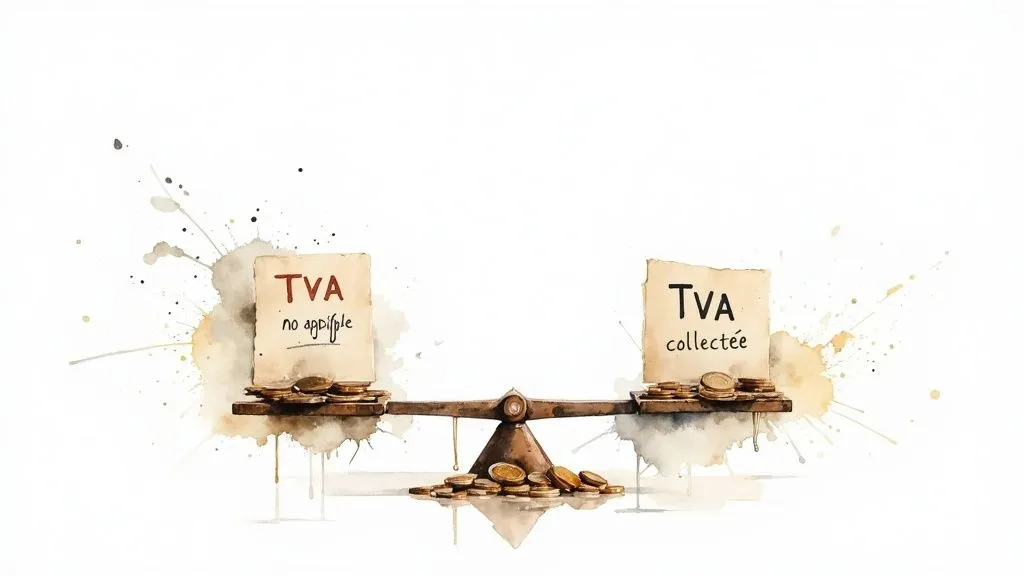
The mention never to forget under the VAT exemption scheme
As long as you’re under this scheme, every invoice must include the magic phrase: “VAT not applicable, art. 293 B of the French Tax Code”. It’s a small line, but it carries great importance. It signals to your client and to the tax authorities that you’re not liable for this tax. It’s easy to forget, but it can be penalized during an audit.
In short, the amount excluding tax (VAT-exclusive) on your invoice is identical to the amount including all taxes (VAT-inclusive). No VAT calculations to perform, no return to file. Simple and efficient.
This comfortable situation, however, isn’t permanent. If your revenue exceeds a certain threshold, the switch changes position.
What to do when you exceed the thresholds?
This VAT exemption scheme is tied to revenue caps. For 2025, these thresholds are €39,100 for services and liberal professions, and €91,900 for the sale of goods.
If you exceed these amounts, you become liable for VAT. Far from being a penalty, this is above all an excellent sign: your business is doing well! But this change requires new invoicing habits.
Here are the steps to follow:
-
Request an intra-community VAT number: This is the first thing to do. Contact your Business Tax Department (SIE) to obtain it. This number must then be displayed on all your invoices.
-
Start applying VAT: You’ll need to add the VAT rate corresponding to your activity (most often 20%, but reduced rates exist) to the price of your products or services.
-
The total amount excluding VAT
-
The VAT rate applied to each line item of service or product
-
The total amount of VAT collected
-
The total amount including all taxes (VAT-inclusive), which is the final sum your client will have to pay.
This transition requires a bit of organization. To master all the details, feel free to check out our complete guide on VAT for sole traders on their invoices. The secret is to anticipate this shift so it happens smoothly, without disrupting your cash flow or your client relationships.
Adding legal and activity-specific mentions
Beyond the basic information, a sole trader’s invoice sometimes needs to include very specific mentions to be fully compliant. It’s a bit like adding special clauses to a contract: they depend on your activity and the agreements made with your clients. Think of them as a way to protect your work and clarify the rules of the game from the outset.
Failing to include them means risking leaving the door open to misunderstandings or, worse, payment delays. These mentions are there to anticipate questions and avoid disputes.
Setting payment terms
Clearly defining when and how you want to be paid is the basis. This information must appear in black and white on your invoices, especially if you work with business clients. This creates a clear, reassuring framework for everyone.
Here’s what you must absolutely specify:
- The payment deadline: This is the due date by which your client must pay you. You can either indicate a specific date (“Payment expected by 30/11/2024”) or a duration (“Payment within 30 days of the invoice date”).
- Late payment penalties: If payment doesn’t arrive on time, the law allows you to apply penalties. You must state the rate you apply, which cannot be lower than three times the legal interest rate in effect.
- Recovery compensation: This mention is mandatory for all your business clients. It’s a flat fee of €40, automatically due in the event of late payment, to cover your collection costs.
Here’s a standard wording you can reuse:
“In the event of late payment, a penalty equal to three times the legal interest rate will be applied, along with a flat-rate compensation for collection costs of €40 (decree no. 2012-1115 of October 2, 2012).”
With this simple sentence, you’re legally covered and you encourage your clients to meet deadlines. To see how to concretely incorporate these clauses, take a look at some invoice examples for sole traders that illustrate different layouts.
Mentions for tradespeople and regulated professions
If you carry out a trade or regulated activity, additional information must be added to the list. Their purpose? To guarantee your professionalism and reassure your clients about the quality and safety of your services. It’s a genuine proof of your seriousness.
One of the most important is the one concerning your mandatory professional insurance. Whether it’s Professional Civil Liability (RC Pro) or ten-year warranty coverage for construction trades, you must absolutely mention it on your invoices.
The information to provide is very specific:
- The name of your insurer along with their branch’s contact details.
- The geographic coverage of your policy (for example: “Mainland France”).
Thanks to these details, your client can easily verify that you’re properly insured in case something goes wrong. It’s an essential trust signal in many sectors.
Ensuring traceability with the quote
Finally, if your invoice follows a quote that the client signed and accepted, it’s a smart move to reference it. This creates a direct and undeniable link between the initial agreement and the payment requested.
Simply add a line such as: “Invoice following quote no. DV2024-015, signed on DD/MM/YYYY”. This traceability is valuable, as it cuts short any potential dispute over the amounts billed. Everyone knows that this matches what was agreed upon.
Creating compliant invoices with the right tools
Knowing the list of mandatory details for a sole trader’s invoice inside out is one thing. But applying them flawlessly every single time is another matter entirely. Fortunately, you’re not alone facing this administrative mountain. Two main options are available to create invoices that are both professional and compliant.
The first is the “homemade” method, often using a spreadsheet like Excel. It’s free, everyone has it, but beware: it requires iron discipline. The biggest pitfall? Breaking the famous chronological numbering of your invoices. A small slip that can quickly turn into a headache during an audit.
The advantages of invoicing software
The other path, much more peaceful, is to adopt invoicing software. These tools are designed for freelancers. They automate a good part of the work and, above all, drastically reduce the risk of human error.
Using a dedicated tool isn’t a luxury. It’s a real working comfort.
- Peace of mind: Invoice templates already include all the legal mentions. And if the law changes, they’re updated for you. No more need to constantly check whether you’re still compliant.
- Automatic numbering: The software handles the logical sequence of invoice numbers. It’s one less mental burden, and you’re certain never to make a mistake.
- A huge time saver: In just a few clicks, your invoice is ready, sent, and you can even track whether your client has paid it.
For a sole trader, time is money. Every hour spent on paperwork is an hour you’re not spending on your clients or growing your business.
How to choose the right tool for your micro-business
The market is overflowing with solutions, from free tools to get started to more comprehensive platforms like Bizyness. The right choice really depends on you: your invoicing volume, your specific needs and, of course, your budget.
Don’t see good software as an expense, but rather as an investment. It’s the assurance of sending documents that are legally flawless, and that peace of mind is priceless.
To find the right fit, make sure the tool is easy to use. Check that you can customize it at least a little (with your logo, for example) and that it offers clear payment tracking. The ability to create a quote and then turn it into an invoice with one click is also a real plus that makes life easier.
The idea is to find yourself an ally that relieves you of the administrative chore. To help you sort through the options, our comparison guide on the best invoicing software for sole traders can give you a good starting point. Choosing the right tool is one more step toward a stronger business and calmer day-to-day management.
Frequently asked questions about sole trader invoicing
Even with the best guide in the world, you’ll always run into practical cases that raise doubts. That’s perfectly normal. This section is here to directly answer the most common questions and give you clear solutions. The idea is to help you clear the ground so that invoicing becomes a simple formality.
Whether it’s fixing a small typo on an invoice already sent or billing a client on the other side of the world, each situation has its own rules. By mastering these few points, you’ll gain peace of mind and avoid the small mistakes that can quickly complicate your management.
How do you correct an error on an invoice already sent?
This is THE big question. Once an invoice has been issued and sent, it’s set in stone. Consider it a final accounting document. It is therefore strictly forbidden to modify or delete it, even for a simple typo. So what do you do?
The only proper way to handle this is to issue a credit note. This document simply cancels, wholly or partially, the invoice in question.
Here’s how to proceed, step by step:
- Create a credit note: This document must include the same mandatory details as a normal invoice, but you must clearly state “Credit note” or “Avoir” on it.
- Link it to the original invoice: This is essential for traceability. Add a mention such as: “Credit note relating to invoice no. [number of the invoice to be cancelled]”.
- Issue a new, correct invoice: Once the credit note is created, you can finally generate a new invoice with the correct information. It will carry a new number, so as not to break your invoice sequence.
This method may seem a bit cumbersome, but it guarantees spotless, transparent bookkeeping. In the event of an audit, everything will be perfectly clear.
Can you invoice a client before receiving your SIRET number?
The answer is a resounding no. This is a non-negotiable point. Your SIRET number is the identity card of your micro-business, proof that it legally exists. Without it, you simply don’t have the right to issue any official document, let alone an invoice.
Invoicing without a SIRET number means risking being accused of undeclared work, with all the penalties that entails.
The trick if a client is pressuring you: Have them sign a quote. A quote is a commercial commitment that secures the assignment for both of you. The invoice, on the other hand, can only be issued once you have your precious SIRET number in hand.
How long do you need to keep your invoices?
The tax authorities are very clear on this point: you must keep all your invoices (those you send to your clients and those your suppliers send you) for 10 years. Note that this period doesn’t start from the invoice date, but from the closing date of the accounting period.
This requirement is fundamental. It allows the authorities to check your accounts in the event of an audit and protects you in case of a dispute with a client or supplier. Whether in paper or digital format, make sure they’re properly stored and easily accessible. Good invoicing software is often the simplest solution for secure archiving.
Does invoicing a client abroad change anything?
Of course! Working with clients based in the European Union or elsewhere in the world is a great thing, but it does require adapting your invoices somewhat.
- For a client in the EU: If they’re a business, you must ask for their intra-community VAT number and include it on your invoice, in addition to your own (even if you’re not liable for VAT).
- For a client outside the EU: Generally, it’s simpler. You invoice excluding tax. For services, the mention “VAT exemption - article 262 1° of the French Tax Code” is often required.
One last tip: if you’re not invoicing in euros (€), always remember to clearly specify the currency on the invoice. This avoids unpleasant surprises and misunderstandings at payment time.
Don’t let paperwork hold your business back any longer. With Bizyness, creating compliant invoices becomes child’s play. Our tool handles the mandatory details for you, manages numbering without you having to think about it, and archives your documents securely. You save time to focus on what really matters: your craft.
Discover how Bizyness can simplify your life today.
