

 Français
 Mandatory invoice information: the complete guide to compliant invoicing
Master every piece of mandatory invoice information with our guide. Avoid errors and penalties with clear explanations, examples and a checklist.

An invoice isn’t just a piece of paper to claim what you’re owed. It’s above all a legal and accounting document that commits your business. A simple omission, such as your SIREN number or late-payment penalties, and the whole machine can seize up, leading to financial penalties or tension with your clients.
Why a simple invoicing mistake can cost you dearly
Every year, thousands of entrepreneurs, often pressed for time or simply misinformed, leave out a key piece of information on their invoices. The problem is that the consequences go far beyond a mere administrative slip. Think of your invoice as the final contract that seals your service: if one clause is missing, the whole thing can fall apart.
The volume of invoices exchanged in France is staggering: we’re talking about more than 2 billion invoices between businesses every year. To manage these flows, the tax authorities don’t take it lightly. A single missing mandatory mention can cost you a fine of 15 euros. And that’s not all: this amount is multiplied by the number of errors, on every invoice concerned. For those interested in the numbers, you’ll find detailed statistics on invoice exchanges on billup.com.
But fines are only the tip of the iceberg. Sloppy invoicing can also:
- Slow down your cash collection: a client is perfectly entitled to refuse to pay a non-compliant invoice.
- Damage your brand image: repeated errors don’t look professional and erode trust.
- Turn your bookkeeping into a headache: invalid documents complicate everything, from VAT returns to the annual financial statements.
Consider this guide your roadmap for making invoicing a simple formality. We’re going to break down every mandatory mention together so you can invoice with confidence, secure your cash flow, and say goodbye to the stress of penalties, including late payment penalties on invoices.
Decoding mandatory mentions: the foundation of every invoice
To be valid, an invoice must be the identity card of the transaction. Every piece of mandatory invoice information is a piece of the puzzle that, once assembled, tells the whole story: who sold what, to whom, when, and for how much. Leaving out these elements is a bit like presenting an ID card with no name or photo. The document instantly loses all its value.
This information isn’t a mere formality. It forms the basis of your accounting and tax traceability, an absolutely crucial point in the event of an audit. A small error on these fundamentals can be enough to get the invoice rejected by your client or by the tax authorities, leading to payment delays and headaches you could do without.
Clearly identifying the parties to the transaction
The first step, and it’s non-negotiable, is to precisely identify the seller and the buyer. It’s like the names on a contract: without them, the agreement has no value.
For your business (you, the seller), you must indicate:
- Your company name (or your first and last name if you’re a sole trader).
- The full address of your registered office.
- Your SIREN or SIRET number, which is your business’s unique registration number.
For your client (if they’re a professional), you must mention:
- Their company name (or their name).
- Their billing address, which isn’t always the same as the delivery address.
Leaving out these details opens the door wide to disputes and doubts about the legitimacy of the transaction.
Chronology, a golden rule
Every invoice must carry a unique number that follows a continuous, chronological sequence, without a single gap. Imagine reading a book: you can’t jump from page 20 to page 23. This continuity is proof that no invoice was “forgotten” or slipped in later, thereby guaranteeing the integrity of your accounting.
A unique invoice number based on a continuous sequence isn’t a suggestion, it’s a strict legal requirement. It’s at the heart of the reliable audit trail that the tax authorities look for during an inspection.
This numbering can be based on the year (for example, 2024-001, 2024-002) or be a simple sequence (1, 2, 3…). What matters is that the logic is respected and that there’s no break.
The image below perfectly illustrates the risks you take in the event of an invoicing error, ranging from a simple tax penalty to criminal sanctions.
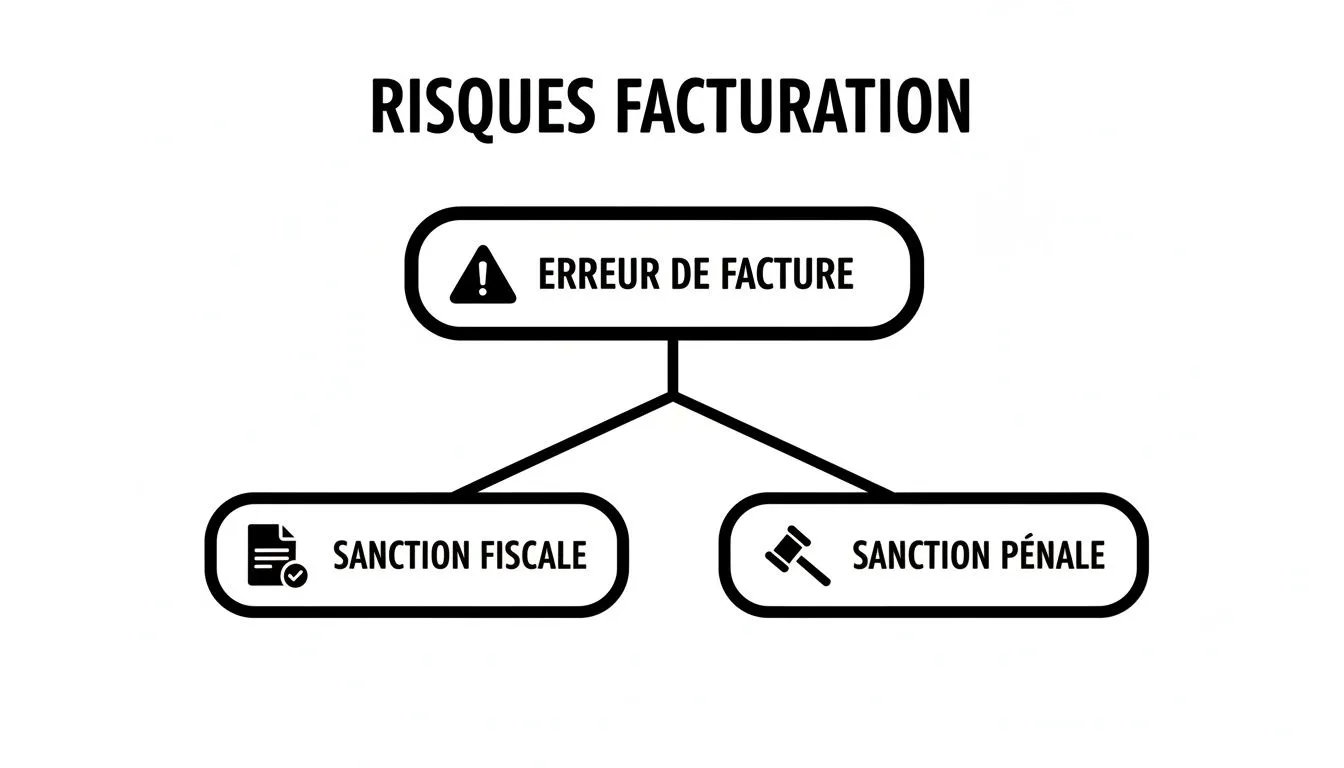
This diagram clearly shows that a simple error on a fundamental mention can have very serious financial and legal consequences for your business.
Finally, the dates. They’re essential for placing the transaction in time. You must indicate the issue date of the invoice and the date of the sale or the service performed. These two dates can differ, but their presence is mandatory to define the starting point of your obligations, notably for VAT chargeability.
The numbers: how to correctly state the price and VAT
Let’s now tackle the heart of the matter: the financial section of your invoice. This is often where errors creep in, and they can be costly. Clear invoicing of amounts is a mandatory mention that not only ensures transparency but also speeds up your payments and shields you from disputes.
For each product sold or service rendered, precision is essential. You must indicate the unit price excluding tax (net of VAT). This is the raw value of your work. By multiplying it by the quantity, you get the total net amount for that line. This base is essential, since everything else follows from it.
VAT, an absolute point of vigilance
Value Added Tax, or VAT, is undoubtedly the most technical element. It’s not enough to add it at the end; each line of your invoice must clearly state the VAT rate applied to it.
In France, several rates can apply, so it’s crucial not to get it wrong:
- The standard rate of 20%: the most common, it applies to the majority of goods and services.
- The intermediate rate of 10%: you’ll encounter it in catering, certain renovation work, and passenger transport.
- The reduced rate of 5.5%: it applies to products considered essential, such as food, books, or energy subscriptions.
Special case: if you’re not liable for VAT (for example, as a micro-entrepreneur benefiting from the VAT exemption threshold), you must justify it. The mention “VAT not applicable, art. 293 B of the French Tax Code” is then mandatory. To get a clearer picture, our guide on calculating VAT is an excellent resource.
Warning: a VAT error is never trivial. If you apply too low a rate, the tax authorities can claim the difference from you during an audit, along with penalties. And this applies even if you never collected that amount from your client.
The total due: the figure everyone is waiting for
Finally, the invoice must present a clear and unambiguous summary of the amounts. This is a mandatory invoice mention that allows your client to understand what they’re paying.
This final block must clearly show:
- The total amount excluding tax (net), meaning the sum of all your services.
- The total VAT amount. If you applied different rates, it’s good practice to break down the total for each rate.
- The total amount including all taxes (gross), which is the sum your client must pay you.
This clear structure is far more than a mere formality. It reflects your professionalism, makes life easier for your accountant (and your client’s!), and lays the foundations for a healthy business relationship.

Handling special cases and specific mentions
Beyond the common core of information, certain specific situations will require you to add particular mentions to your invoices. These aren’t mere details, but legal obligations that depend directly on your status, your activity, or the terms of the sale.
Forgetting one of these mentions is a bit like presenting an ID card missing essential information. Your invoice could lose its legal value, and your business would be needlessly exposed to penalties. These clarifications are there to define the framework of the transaction clearly, protecting both your client, who has all the information, and your business.
Mentions that depend on your status
Your legal status is the first factor to consider. Each status has its own requirements, and it’s crucial to know them so your invoices are beyond reproach.
- For micro-entrepreneurs: if you’re under the VAT exemption threshold, one mention is non-negotiable: “VAT not applicable, art. 293 B of the French Tax Code”. This is an absolute obligation. Without it, your client could believe you’re collecting VAT, which would constitute a serious error.
- For tradespeople: your registration with the Trades Register (Répertoire des Métiers) is a mark of expertise. If your activity requires mandatory professional insurance (think of the ten-year warranty in construction), you must include your insurer’s contact details and your policy’s geographic coverage.
- For members of an approved management centre (CGA): membership in a CGA gives you access to tax benefits. To benefit from them, you must clearly state it by adding the sentence: “Member of an approved association, payment by cheque and bank card is accepted”.
Protecting your cash flow with the right mentions
Some mentions aren’t tied to your status but are absolutely vital to your business’s financial health. They set the rules of the game for payment and give you a solid legal framework in the event of a delay, a well-known scourge for SMEs and freelancers.
Remembering these mentions means anticipating payment problems before they even arise. It’s a proactive approach that secures your revenue and professionalizes your business relationships.
To encourage your clients to pay on time, here are three elements you should never forget:
- The payment term: be explicit about the due date. If you don’t specify anything, the default legal term applies, namely 30 days after receipt of the goods or completion of the service.
- Late payment penalties: you must indicate the interest rate that will apply in the event of late payment. The law prohibits you from setting a rate lower than three times the legal interest rate. This simple sentence has a significant deterrent effect.
- The flat-rate compensation for collection costs: between professionals, the law is clear. In the event of late payment, a compensation of €40 is automatically due to cover collection costs. This mention is mandatory and puts you in a position of strength should a dispute arise.
Understanding the risks to avoid them better
Failing to include mandatory mentions on an invoice isn’t just a minor administrative oversight. It exposes you to real risks, both financial and legal. The consequences can weaken your cash flow and tarnish your image faster than you’d think.
Think of a non-compliant invoice as a shaky contract: it opens the door to disputes, slows down payments, and, in the event of an audit, puts you directly in the tax authorities’ crosshairs. Every missing piece of information is a crack in your business’s legal protection.
Tax penalties: a bill that adds up fast
The first, and most common, sanction is the tax fine. For each missing or incorrect mention, the fine is €15. That may seem trivial, but the total climbs quickly. Imagine three pieces of information missing from ten of your invoices: 3 x 10 x €15 = €450. The bill can add up over a year of activity.
Fortunately, there’s a safeguard: the total fine per invoice cannot exceed 25% of its total amount. Even so, for a small business or a freelancer issuing many invoices, these cumulative penalties can end up weighing heavily.
This strict rule has a clear objective: ensuring transparency in commercial exchanges, which is crucial for VAT collection and the fight against fraud.
Criminal penalties: a risk never worth taking
If the errors are serious and repeated, you leave the realm of a simple administrative fine and enter criminal territory. There, the stakes are entirely different. We’re talking about intentional fraud or particularly serious negligence.
The consequences can be very severe. Failure to invoice is an offense that can cost up to €75,000 in fines for a sole trader. For a company, the bill can reach €375,000, and even be increased to 50% of the amount that should have been invoiced. To dig deeper into the subject, you can check the details of these penalties.
But the risks don’t stop at fines. Sloppy invoicing damages your credibility, complicates your relationships with your clients, and can even prevent you from claiming what you’re owed in the event of non-payment. Knowing these rules well is the foundation for securing your business from the outset.
How electronic invoicing saves the day
Faced with all these rules and the risk of getting it wrong, it quickly becomes clear that automating invoicing is no longer a luxury but a real lifeline. Using a tool designed for this turns an administrative chore into a simple, fast, and above all secure process.
Rather than checking your checklist of mandatory invoice information yet again, invoicing software like Bizyness does the work for you. It automatically includes the right information based on your status. Are you a micro-entrepreneur? The software automatically adds the mention “VAT not applicable, art. 293 B of the French Tax Code.” No need to think about it.
This automation puts an end to compliance stress and saves enormous amounts of time. No more spending hours looking for which mention to add or fearing an omission that could prove costly. In just a few clicks, your invoice is ready and fully compliant.
Automation, your safeguard for staying compliant
A good invoicing tool is like a safety net. It doesn’t just add the basic mentions; it also handles the details that make all the difference:
- Bulletproof numbering: the software guarantees a logical, gap-free sequence of numbers, a non-negotiable requirement of the tax authorities.
- Always accurate calculations: the net totals, VAT amounts, and gross total are calculated instantly. Say goodbye to human calculation errors.
- Clear payment terms: late payment penalties and the flat-rate compensation are added systematically, strengthening your position in the event of non-payment.
Automation isn’t just a time-saver. Above all, it’s insurance against errors, protecting your cash flow and giving your business a far more professional image.
The interface below shows how a tool like Bizyness lets you centralize the creation of all your documents in a single place.

With this overview, you manage your invoices and quotes with remarkable efficiency, while drastically reducing the risk of oversights.
A head start on mandatory electronic invoicing
Switching to a dedicated tool today is all the smarter as mandatory electronic invoicing is fast approaching. It’s a major change for all businesses in France. From September 1, 2026, it will apply to large companies and mid-sized enterprises (ETI). Then, small and medium-sized businesses and micro-businesses will follow starting September 1, 2027.
By choosing an online invoicing solution like Bizyness now, you’re preparing your business’s future with complete peace of mind. You get ahead of the curve by mastering a system that will soon become the norm for everyone. It’s the guarantee of being compliant today, and ensuring a smooth transition tomorrow, without stress or last-minute scrambling.
Answering your questions about mandatory mentions
Even with the most thorough guide, very practical questions always come up when issuing an invoice. That’s normal! Here are the questions that come up most often among entrepreneurs, with direct answers to help you see things more clearly.
The idea is to give you practical solutions so you never have to second-guess yourself again when sending an invoice.
Can I modify an invoice that’s already been sent?
The answer is no. Once an invoice has been issued and sent to your client, it’s considered final. It cannot be modified or deleted; this is a golden rule to guarantee the reliability of your accounting.
So what should you do in case of an error? The only legal option is to issue a credit note. This document cancels, in whole or in part, the original invoice. You can then create a new, correct invoice. This is the only method that ensures perfect traceability of your operations, a detail that matters in the event of an audit.
Is the word “Invoice” really essential?
Yes, and it’s non-negotiable. The word “Invoice” must appear clearly in black and white on the document. Be careful: a signed quote, a purchase order, or a delivery note never replace an invoice, even if they look similar and contain similar information. Forgetting this word can render your document non-compliant, and worse, cause your client to lose their right to deduct VAT.
This is the most fundamental mandatory mention. It’s what gives the document its legal value and triggers accounting and tax obligations for you and your client. A habit worth always keeping.
How do I maintain continuous numbering if I switch software?
Switching invoicing tools is a classic situation in the life of a business. The key is to never break the logical sequence of your invoice numbers. It’s very simple to manage: before creating your very first invoice on your new software, you just need to set the numbering counter.
For example, if the last invoice on your old system was numbered “2024-087”, the first one you issue with the new tool must be “2024-088”. Continuity is maintained, and your accounting stays flawless.
Leave no room for doubt anymore. With Bizyness, every invoice is guaranteed compliant, automatically including the correct numbering and all mandatory mentions suited to your status. Simplify your invoicing today at bizyness.fr.
