

 Français
 Mandatory Mentions on a Sole Trader Invoice - Complete Guide
Discover everything about the mandatory mentions on a sole trader invoice to comply with the law, invoice correctly and secure your business easily.
As a sole trader (micro-entrepreneur), treating invoicing as a simple formality to tick off your to-do list is a mistake you can’t afford to make. A flawless invoice, containing all the mandatory mentions, is much more than a piece of paper: it reflects your professionalism, is the key to being paid on time, and is your shield against penalties.
Why perfect invoicing is non-negotiable
Every invoice you send is a kind of legal business card. For your client, receiving a clear, complete and professional document immediately builds trust. It’s a mark of seriousness that, take it from experience, often speeds up payment. Everyone wants to work with organized people.
But beyond the image it projects, having compliant invoices is your legal armor. A well-made invoice is solid proof of the transaction. If you ever face a dispute or a client dragging their feet on payment, this document will be your best ally in asserting your rights.
The financial risks of an incomplete invoice
The tax authorities do not take invoicing rules lightly. Forgetting a single mandatory mention can cost you €15 per error. If you have several omissions on the same invoice, the fine is capped at a quarter of its amount, but the total can quickly add up.
Worse still, failing to issue an invoice at all for a service is punished far more severely. This is an administrative fine that can climb up to €75,000, as set out in Article L. 441-9 of the French Commercial Code. The details are available on the Legifrance website if you want to dig deeper.
When you’re starting out, every euro counts. Underestimating the impact of a small invoicing mistake can quickly turn a profitable project into a financial and administrative headache.
Much more than an obligation, a growth strategy
Ultimately, rigorous invoicing management is one of the pillars of a healthy, sustainable business. In concrete terms, it allows you to:
- Maintain healthy cash flow: clear, accurate invoices get paid faster. It’s as simple as that.
- Simplify your bookkeeping: compliant documents make tracking your revenue and your URSSAF declarations much smoother.
- Anticipate audits: always being in order gives you incredible peace of mind, freeing you to focus on what really matters: your craft.
Adopting this discipline is part and parcel of good administrative management for sole traders. You thereby turn a legal constraint into a genuine asset for your growth.
The information that identifies you as a professional
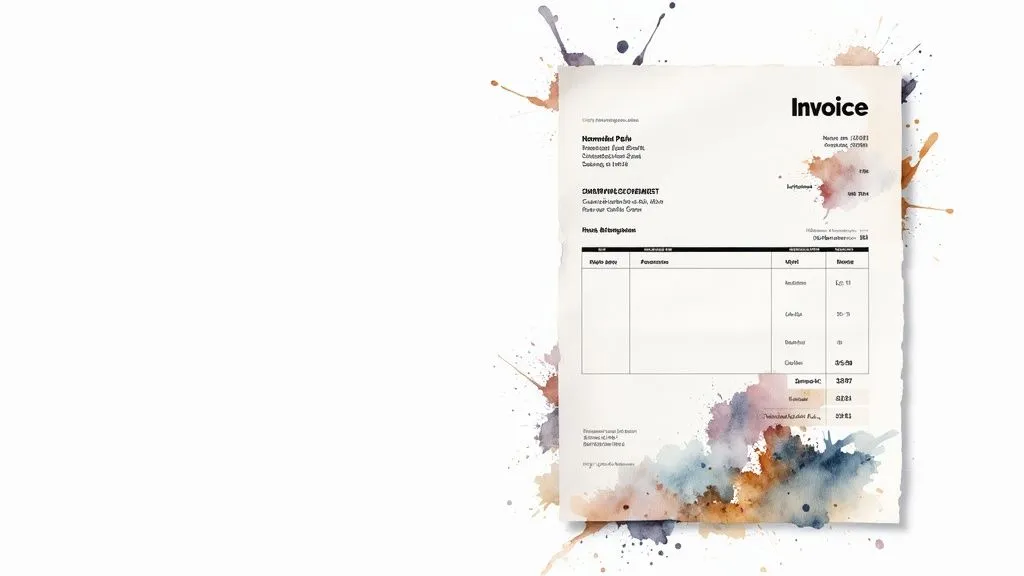
Think of your invoice as your micro-business’s ID card. It’s the very first block of information your client will read, the one that anchors your legitimacy in the transaction. Every detail matters to establish your credibility and stay fully compliant.
These mentions aren’t there for decoration. They allow the tax authorities, URSSAF and your clients to know precisely who you are. They are simply the foundation that makes your invoice valid.
Your personal and professional information
Let’s start with the basics: your identity. Your invoice must include your first and last name. This is the starting point of your responsibility as a business owner.
Right after that, one detail has become absolutely crucial since 2022. You must include the mention “EI” or “Entrepreneur Individuel” (Sole Trader) next to your name. Concretely, if your name is John Smith, it should read “John Smith EI” or “Entrepreneur Individuel John Smith.” This is a legal requirement that clarifies your status, and there’s no way around it.
Next comes your professional address, also known as your registered office address. This is the address you declared when setting up your micro-business. Make sure it’s always accurate and up to date.
Don’t rush through this part by treating it as a mere header. It’s your official signature. The slightest error can cast doubt on your professionalism and the document’s validity.
The unique identification numbers
Beyond your name, certain numbers prove that your business is properly registered and recognized by the State. They are the administrative proof of your existence.
Here are the identifiers you should never forget:
- The SIREN number: This is your business’s identity number, made up of 9 digits and issued by INSEE. It never changes, even if you move or change your business activity.
- The SIRET number: Made up of the 9 digits of the SIREN, followed by 5 more digits (the NIC code). It identifies the address of your business activity. Most sole traders only have one.
Depending on your sector, other numbers may be required. If you carry out a craft or commercial activity, your registration number with the National Business Register (RNE) or the Trade and Companies Register (RCS) must also appear.
For total peace of mind, it’s essential to master not only the invoicing rules but also, more broadly, your business’s legal notices. This will give you a complete picture to secure all your documents and exchanges. With these elements, a simple piece of paper becomes a solid commercial and legal document that protects both you and your client.
Identifying the client and describing the service: the heart of your invoice
Once your details are properly in place, we move on to the essentials: who you’re invoicing and for what work. This is really the crux of the matter. A simple mistake on the client’s name or a description of your work that’s too vague, and you can be sure payment will drag on. I’ve seen this situation repeat itself time and time again.
The idea is to draft an invoice so crystal clear that your client won’t have a single question to ask. If everything is clear, there’s no reason to dispute it, and so the payment goes out faster. This is one of the mandatory mentions on a sole trader invoice with the most direct impact on your cash flow.
Who exactly is your client?
Client identification must be flawless. The approach varies slightly depending on whether you’re working for an individual or a business.
- For an individual: It’s fairly simple. Their first name, last name and address are enough. In theory, they can refuse to have their details appear, but in practice this is extremely rare.
- For a business: Here, you need to be even more rigorous. You must indicate its company name (the official name of the business) and its registered office address. Be careful, this isn’t always the same as the address where you carried out the work!
This distinction matters, as other rules follow from it, such as the application of late-payment penalties, which, as a reminder, only apply to transactions between businesses.
Take a look at this infographic — it perfectly sums up why precision is your best ally for avoiding headaches.
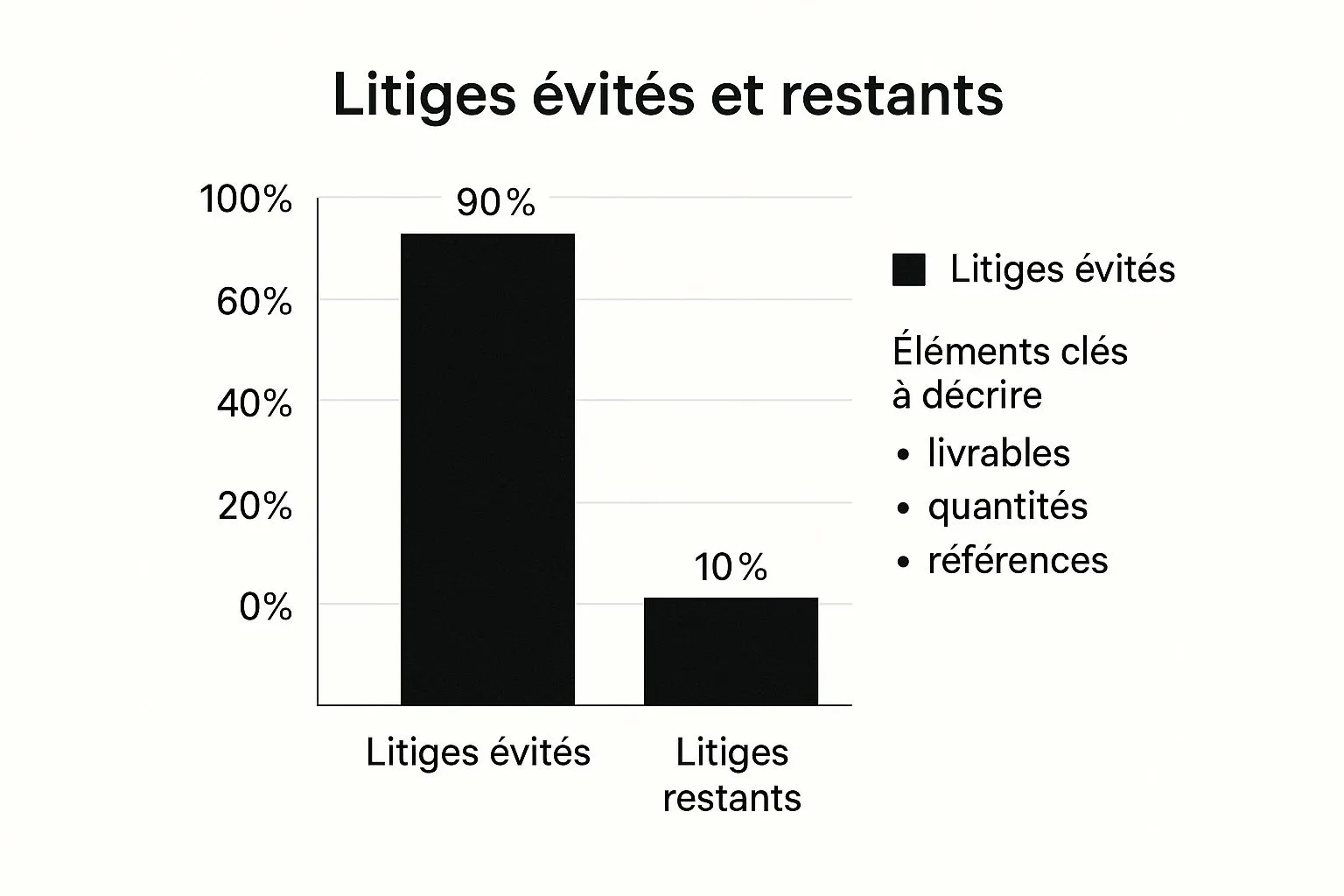
As you can see, being clear on just three points in your service descriptions can save you from 90% of disputes. It’s well worth taking the time.
How to properly describe what you’ve done
Ban vague descriptions like “consulting assignment” or “content creation.” To be beyond reproach and easy to understand, every invoice line should concretely explain what you delivered.
Think of your invoice as a summary of your contract. If something goes wrong, this is the document that will serve as evidence and remind everyone what was agreed. Precision is your best insurance.
For each product or service, get into the habit of detailing your work like this:
- The exact deliverable: Be specific. Instead of “web development,” write “Creation of 5 pages for the XYZ website (Home, About, Services, Blog, Contact).” That’s immediately more meaningful.
- The quantity and unit price: Your client should understand the calculation. For example, “12 hours of photo retouching at €50 excl. VAT/hour” is much clearer than a lump sum. Same goes for “3 illustrations for social media at €150 excl. VAT/unit.”
- The references that matter: If a quote was signed, mention its number. This links the documents together and keeps a logical trail of the whole project.
By breaking down your services this way, you make your work tangible and your rate fully justified. If you’re looking for inspiration, take a look at these sole trader invoice examples; they show clearly how to arrange this information. By making this effort toward clarity, you turn a simple administrative formality into a genuine mark of trust and professionalism.
Decoding the financial mentions on your invoice
Now let’s tackle the financial heart of your invoice, the part where every figure counts. A small mistake here can quickly turn into a headache: late payment, questions from the client, or even complications with the authorities. It’s better to be meticulous.
It all starts with a detail that’s anything but minor: numbering. It’s the foundation of sound bookkeeping.
Every invoice you issue must carry a unique number. More importantly, these numbers must follow one another without interruption, forming a continuous chronological sequence. No gaps, no duplicates. A simple trick that many entrepreneurs use is to add a yearly prefix, like 2024-001, 2024-002, and so on. It’s clean, logical, and instantly shows how serious your management is in the event of an audit.
The structure of the amounts due
Once numbering is sorted, let’s move on to the details of what your client owes you. Clarity is your best ally. The goal is simple: your client should understand at a glance what they’re paying for.
For every product sold or service rendered, clearly state the unit price excluding VAT. If you’ve negotiated a discount or rebate, you absolutely must mention it, whether line by line or on the overall total. This is a mandatory piece of information that justifies the final amount invoiced.
The golden rule is transparency. Your client should be able to redo the calculation in their head. A crystal-clear invoice inspires confidence, and an invoice that inspires confidence is often paid faster. It’s an essential lever for maintaining healthy cash flow.
The crucial case of VAT
Managing VAT is probably the most technical aspect of invoicing for a sole trader, as it all depends on your situation. When starting out, most of us benefit from the VAT exemption scheme (franchise en base). This is the default regime.
If that’s your case, it’s simple: you don’t charge VAT. In return, one mention is absolutely mandatory on all your invoices: “VAT not applicable, art. 293 B of the French Tax Code.” Your prices are therefore shown excluding VAT, and the total excluding VAT equals the net amount due.
But watch out, this regime doesn’t last forever. As soon as you cross certain revenue thresholds (€91,900 for the sale of goods, €39,100 for services in 2024), you switch over and become liable for VAT. At that point, your invoices need to evolve:
- The “VAT not applicable…” mention must disappear.
- Your intra-community VAT number must appear.
- Each line must state the VAT rate applied (generally 20%).
- The total must be broken down: Total excl. VAT, VAT amount, and Total incl. VAT.
To make things clearer, here’s a short table summarizing the fundamental differences.
Summary of mentions by the sole trader’s VAT regime
| Mention | Sole trader under the VAT exemption scheme | Sole trader liable for VAT |
|---|---|---|
| Legal VAT mention | ”VAT not applicable, art. 293 B of the French Tax Code” | None (the mention is removed) |
| VAT number | Not required | Mandatory |
| Price breakdown | Unit price excl. VAT | Unit price excl. VAT, VAT rate, VAT amount |
| Total due | Net amount due (= Total excl. VAT) | Total excl. VAT, Total VAT, Total incl. VAT |
This table highlights the necessary adjustments. Becoming liable for VAT is a major milestone in the life of a micro-business. To navigate this change with confidence, our complete guide on sole trader invoices and VAT is a valuable resource.
Mastering these financial rules isn’t just an administrative formality. It’s what ensures your invoices get paid on time and are legally sound.
Handling special cases and specific mentions
In the life of a sole trader, no two assignments are alike. Your invoices must therefore adapt to each situation. Certain mentions, far from being mere details, are genuine legal obligations that protect your business and reinforce your credibility.
Overlooking these specifics might seem trivial, but it can undermine the validity of an invoice and, by extension, your protection in the event of a dispute.
Let’s take a very concrete example: regulated professions. If you’re a tradesperson in the construction industry, mentioning your professional insurance is essential. This refers to your ten-year professional liability insurance (assurance décennale).
This information must be perfectly clear: the name and address of your insurer, as well as the geographic coverage of the policy. For a client committing to a large project, this is a mark of seriousness and trust.
Invoicing another business: what you need to know
When your client is another business (this is B2B, business to business), the law is very strict about payment terms. The goal is simple: fight against late payments that can jeopardize your cash flow.
On this type of invoice, three elements are non-negotiable:
- The payment due date: the exact day the payment must be made.
- The late-payment penalty rate: the percentage that will apply if your client pays you late.
- The flat-rate compensation for collection costs: a fixed amount of €40, automatically owed by the business client from the first day of late payment.
This mention isn’t just a formality. It’s your first legal shield. It has a deterrent effect and gives you a legal basis to claim what you’re owed without launching into complex procedures.
The scenarios that change the game for your invoices
Your day-to-day life as a freelancer will bring you face to face with situations outside the usual framework. Knowing how to identify them and adapt your invoices is a real mark of professionalism.
Imagine you’re subcontracting for a construction company. You’ll very likely be affected by the VAT reverse charge mechanism. In concrete terms, it’s not you but your client (the main contractor) who will collect and pay the VAT. Your invoice must therefore be issued excluding VAT and carry the mandatory mention: “Reverse charge” (Autoliquidation).
Another common situation: you’re invoicing a client based in another European Union country. If they are a VAT-registered business there, you must include their intra-community VAT number on the invoice. In this case, the sale is generally exempt from VAT in France. You’ll then need to add a mention such as “VAT exemption, article 283-2 of the French Tax Code.”
These examples clearly show that an invoice is not a fixed document. Mastering these specific mandatory mentions on a sole trader invoice is the key to staying compliant, whatever assignment you’re given.
Your questions, our answers on invoicing
Invoicing, especially when starting out, raises plenty of questions. That’s completely normal. Let’s unpack together the points that can seem complex, so you can invoice with total peace of mind. Here are clear, direct answers designed to guide you.
Can I make my invoices in Word or Excel?
The quick answer is yes, technically, it’s possible. As long as all the mandatory mentions of a sole trader invoice appear on it and your numbering follows a flawless logic, the law doesn’t formally prohibit it.
But in practice, I strongly advise against it.
The biggest problem? Lack of credibility with the tax authorities. How do you prove that a Word file hasn’t been edited after it was issued? It’s nearly impossible. An auditor could easily doubt the integrity of your entire bookkeeping.
To avoid this headache, the best option is to adopt invoicing software. These tools are designed exactly for this: they generate secure, tamper-proof numbering, ensure your documents are compliant, and protect your data. It’s a small step for you, but a big step for your peace of mind.
Oops, I made a mistake on an invoice that’s already been sent. How do I fix it?
The golden rule is simple: you never delete an invoice that has been issued. Think of your books as a ledger: you can’t tear out a page. To correct the situation, the only clean, legal solution is to issue a credit note.
This document, also called a credit note, exists precisely to cancel or amend a previous invoice. It must include the number of the original invoice it’s correcting, whether for a full cancellation or just a small adjustment.
A credit note is a bit like your official “correction fluid.” It cancels out the error while leaving a clear trail of the correction. This is essential for transparent bookkeeping. Once the credit note is created, you can issue a new, correct invoice, with a brand-new number.
Is an invoice always mandatory for an individual client?
It depends on the situation. For a service, you must provide a receipt (the equivalent of an invoice for individuals) as soon as the amount exceeds €25 incl. VAT. If your client asks you for one, you must also give it to them, even for €1.
For the sale of goods, an invoice becomes mandatory if the client requires it or as part of a distance sale, such as through an e-commerce site.
My expert advice? Get into the habit of systematically invoicing, for everyone, all the time. The benefits are numerous:
- You look professional: It reinforces your credibility and your client’s trust.
- It’s solid proof: In the event of a dispute over payment or the service, the document stands as evidence.
- It simplifies your management: Your revenue tracking is spot on, with no gaps.
How long do I need to keep my invoices?
On this point, the law is very clear and leaves no room for interpretation. The Commercial Code and the tax authorities agree: you must keep all your invoices for 10 years.
Note that this rule applies both to the invoices you send (your sales) and those you receive (your purchases). And this obligation doesn’t stop if you cease your micro-entrepreneur activity.
The best insurance against loss or damage? Digitize everything and make regular backups, whether on the cloud or an external hard drive. You can never be too careful.
Don’t let administrative paperwork slow you down any longer. With Bizyness, you can automate the creation of 100% compliant invoices, track your payments at a glance, and keep total control over your cash flow. All from a simple, intuitive interface. Free up time for what really matters: growing your business. Try Bizyness for free today.
