

 Français
Mandatory Quote Information: Your Guide to Compliance
Discover everything about mandatory quote information to ensure compliance. Protect your business and your clients with our complete guide!

Let’s be clear: a quote isn’t just a piece of paper with a price scribbled on it. It’s much more than that. It’s the document that lays the foundations for a future collaboration, that builds trust and protects you legally — both you and your client. Ignoring the mandatory information is a bit like building a house without solid foundations.
A compliant quote: far more than an obligation, a real asset
Many entrepreneurs still see the quote as an administrative chore. Big mistake. Think of it instead as the first building block of your client relationship. It’s the document that turns a simple sales conversation into a mutual commitment, creating a healthy, transparent working framework.
A well-crafted quote, with all the mandatory information, is your best ally. It acts as a safety net, defuses potential conflicts before they even arise, and answers every question your client might have.
Mutual protection for you and your client
Every piece of information on this document matters. The precise identification of both parties, the details of the services, the payment terms… it’s all there to secure the engagement. For your client, it’s the certainty of knowing exactly what they’re buying. For you, it’s the guarantee of being paid for work that was clearly defined.
A complete, compliant quote isn’t just a legal requirement. It’s a moral commitment, a promise of transparency. You show your client that you’re a serious professional who respects them, and that’s the key to building a lasting relationship.
This rigor is directly reflected in client satisfaction. The numbers speak for themselves: businesses that take care with their quotes report a satisfaction rate 20% higher. If you want to dig deeper, the site vosfactures.fr has an excellent article on the importance of legal mentions.
Looking beyond mere compliance
Mastering the art of the quote means using a powerful tool in service of your business. It’s not just ticking boxes to be in order. It’s:
- Polishing your brand image: A clean, clear quote without a single typo radiates professionalism. It instantly builds trust.
- Clarifying things upfront: No more misunderstandings. The scope of the mission, the deadlines, the total cost… it’s all written down in black and white, with no room for interpretation.
- Simplifying your own management: With a numbered, dated quote, your bookkeeping and project tracking become child’s play.
- Improving the client experience: From the very start, you send a strong message: your business is structured, serious, and reliable.
Ultimately, taking the time to draft flawless quotes is a direct investment in the reputation and solidity of your business. It’s a small effort for big rewards.
Who’s committing, and to what? The essential information on your quote
For a quote to hold up and be legally valid, it must first answer a simple question: who are the two parties making the commitment? It’s a bit like a film’s opening credits: you introduce the main characters before the action starts. Without this clear introduction, there’s no way to know who’s doing what, and the plot can quickly go sour.
This identification is really the cornerstone of all the mandatory information on a quote. It sets a framework, a sound and transparent foundation that protects both you and your client.
This is a step you can’t skip. A simple oversight here could render your quote completely useless in the event of a dispute.
Your company information: showing your credentials
The first thing to do is introduce yourself. Your client needs to know exactly who they’re dealing with. Your quote must therefore display all the key information about you, without holding back.
Here’s the list of essential elements:
- Your business name: The official name of your company.
- Your address: The full address of your registered office, not just the city.
- Your SIREN/SIRET number: This unique 14-digit identifier is proof that your business legally exists.
- Your intra-community VAT number: Mandatory if you charge VAT.
- Your company’s legal form: Specify whether you’re an LLC, corporation, sole trader (micro-entrepreneur), etc.
Think of this information as your company’s ID card. By displaying it clearly, you show that you’re a serious, compliant professional. It’s an excellent way to build trust from the very first contact.
Identifying the client: who are you talking to?
In the same spirit, it’s just as crucial to precisely identify your client. The offer needs to be clearly addressed to them. Here, the required information is simpler, but just as important: the client’s full name (or their business name if it’s another company) and their billing address.
This small precaution avoids a lot of confusion, especially if the address where you’ll be working differs from the client’s address.
Time markers: the framework of your proposal
To round out the picture, three final pieces of information are vital. They allow you to place your offer in time and track it.
- The date of the quote: This is the official starting point of your proposal.
- A unique quote number: Essential for your bookkeeping, this number should follow a logical, gap-free sequence. To make your life easier, feel free to draw inspiration from our guide on quote templates to properly structure your documents.
- The validity period of the offer: This is the length of time during which you commit to the prices and terms stated. If nothing is specified, a quote is generally considered valid for 3 months.
French regulation, especially in sectors like construction, doesn’t take these details lightly. The Ministry of the Economy often reminds businesses: this information protects the consumer and guarantees the seriousness of professional dealings. You can find more details on the regulation of construction quotes if you want to dig deeper.
Detailing the services for full transparency
Once each party’s identity is clearly established, it’s time to tackle the heart of the matter: your commercial proposal. This is really where everything is decided. This part of your quote must leave no room for doubt, interpretation, or the slightest misunderstanding.
Think of this section as a great chef’s recipe. If you just write “Chocolate cake” on the menu, your client will never know whether there are nuts, a particular icing, or a molten center. On the other hand, if you list every ingredient with its exact weight, everything becomes crystal clear. Your quote should work on this same principle of clarity to inspire trust and professionalism.
Know this: a precise description of the services is one of the most important pieces of mandatory information on a quote. It’s your best shield against disputes that might arise later.
How to structure the perfect service line
The golden rule is simple: every service, every product you offer should have its own line on the quote. This method not only makes your offer clear, but also makes life easier if the client asks for an adjustment, such as adding or removing an item.
For each line, here’s what you absolutely must include:
- The exact nature of the service: Be as specific as possible. Don’t settle for a vague “Painting.” Prefer instead: “Wall preparation, application of two coats of matte acrylic paint over a 25 m² surface.”
- The quantity: Use the most logical unit for your trade. This could be hours of labor, square meters for flooring, units for products, or a flat rate for a service package.
- The unit price excluding tax (net of VAT): This is the base rate for a single unit of your service or product.
- The applicable VAT rate: Don’t forget to indicate the VAT rate that applies to this particular line (20%, 10%, 5.5%, or even 0% if you’re under the VAT exemption scheme).
The goal is clear: your client should be able to read each line and immediately understand what they’re buying, why it costs that price, and how the total is calculated. This transparency is simply the key to a healthy, lasting business relationship.
Concrete examples for different trades
Theory is all well and good, but nothing beats concrete examples to really understand. Let’s see how this logic applies in real life.
For a plumber: Instead of a vague “Leak repair,” break it down like this:
- Travel and diagnosis: 1 flat rate - €50 excl. VAT
- Supply and installation of a sealing gasket: 2 units - €15 excl. VAT/unit
- Labor (hourly rate): 1.5 hours - €60 excl. VAT/hour
For a marketing consultant: Rather than “Social media strategy,” try:
- Audit of existing accounts: 1 flat rate - €400 excl. VAT
- Creation of an editorial calendar (30 days): 1 unit - €500 excl. VAT
- Writing and scheduling of 12 posts: 1 flat rate - €600 excl. VAT
By adopting this level of rigor, your quote becomes a genuine sales tool. It justifies your rates, highlights the scope of your work, and reinforces your professional image. This is a crucial step, which you can explore further in our complete guide on creating a quote from A to Z. By mastering this aspect, you lay solid foundations for the rest of your client relationship.
Presenting the financial and payment terms

After carefully describing the services, it’s time to get down to the numbers. This is a critical step. Financial clarity is the cornerstone of any solid quote — the moment when a simple list of services turns into a genuine commercial proposal that your client can evaluate and accept with full confidence.
A financially well-constructed quote leaves no room for doubt about the final amount. It’s one of the most effective pieces of mandatory quote information for guarding against misunderstandings and disputes. The goal is simple: your client should understand at a glance how the total cost was calculated.
Breaking down the total cost
To ensure perfect transparency, the law requires a clear breakdown of the price. Think of this part as a financial summary that must be absolutely crystal clear. Your quote must clearly show:
- The total excluding tax: This is the sum of all your services, before any tax is added.
- The VAT breakdown: If you’re subject to it, you must list each applicable rate (for example, 20%, 10%) and the amount it represents for each.
- The total including tax: This is the final amount the client will pay. No more, no less.
And if you’re under the VAT exemption scheme, as is often the case for micro-entrepreneurs? You must state this with the legal mention: “VAT not applicable, Article 293 B of the French Tax Code.”
Never underestimate the impact of this section. The Federation of Sole Traders estimates that a quote with clear financial terms increases the chances of it being signed by 33%. Transparency isn’t just a legal requirement — it’s a real sales argument.
Specifying payment terms and deadlines
A quote isn’t just a pricing proposal. It’s a preview of the contract, a document that sets the financial rules of the game. Clearly defining the payment terms is therefore essential to secure your cash flow and lay a sound foundation.
These terms must answer some very concrete questions:
- Deposit: Should a deposit be paid upon signature? If so, how much? A deposit of 30% of the total is common practice.
- Balance payment: When is the remaining amount due? Upon delivery? Thirty days after the end of the assignment?
- Accepted payment methods: Specify how the client can pay you: bank transfer, check, etc.
These few lines, simple as they are, create a clear framework from the outset. They save you from awkward conversations about money once the project is underway or finished. Anticipating these points in your mandatory quote information is a mark of professionalism that reassures the client and protects your business.
Understanding when a quote becomes a legal obligation
We often tend to see the quote as a simple commercial gesture, a formality for presenting prices. That’s a good starting point, but in many cases, it’s much more than that. The law makes it a genuine legal obligation, a document designed to protect the consumer and ensure full transparency before any commitment is made.
Failing to comply with this rule isn’t just administrative negligence. It’s exposing yourself to real penalties. To secure your business and work with peace of mind, it’s therefore essential to know precisely in which cases the law requires you to issue a proper quote.
Sectors and situations under scrutiny
Certain trades are particularly under the regulatory spotlight. The principle is simple: for any repair, troubleshooting, or maintenance service in the construction and home appliance sectors, a detailed quote is non-negotiable.
This covers a wide range of professions, including the most common:
- Construction work: masonry, electrical, plumbing, painting, etc.
- Personal services, as soon as the monthly amount reaches or exceeds €100 including tax.
- Moving services.
- Healthcare services not reimbursed by health insurance, when the amount exceeds €70.
The idea behind this obligation? To let the client compare offers and make an informed decision, especially in moments of vulnerability, such as a broken water heater in the middle of winter.
The thresholds that change the game
Beyond specific sectors, a simple amount threshold can make a quote mandatory. Even if your trade isn’t listed above, you must always provide a quote for any service with a total equal to or greater than €500 including tax. The same applies to custom-made services, which is the daily reality for many tradespeople.
Lawmakers have also set a general rule that applies to most services: as soon as the estimated amount exceeds €1,500, a detailed quote is required. This provides extra security for larger financial commitments.
The law’s logic is clear: the greater the financial stakes or the more personalized the service, the more the consumer needs a precise contractual framework before saying “yes.”
Don’t forget that the quote is only the first step. Once the job is done, you’ll need to issue an invoice. To make sure you don’t omit any crucial information, check out our guide on mandatory invoice information.
The image below summarizes the key information not to forget on your quote, including its validity period.
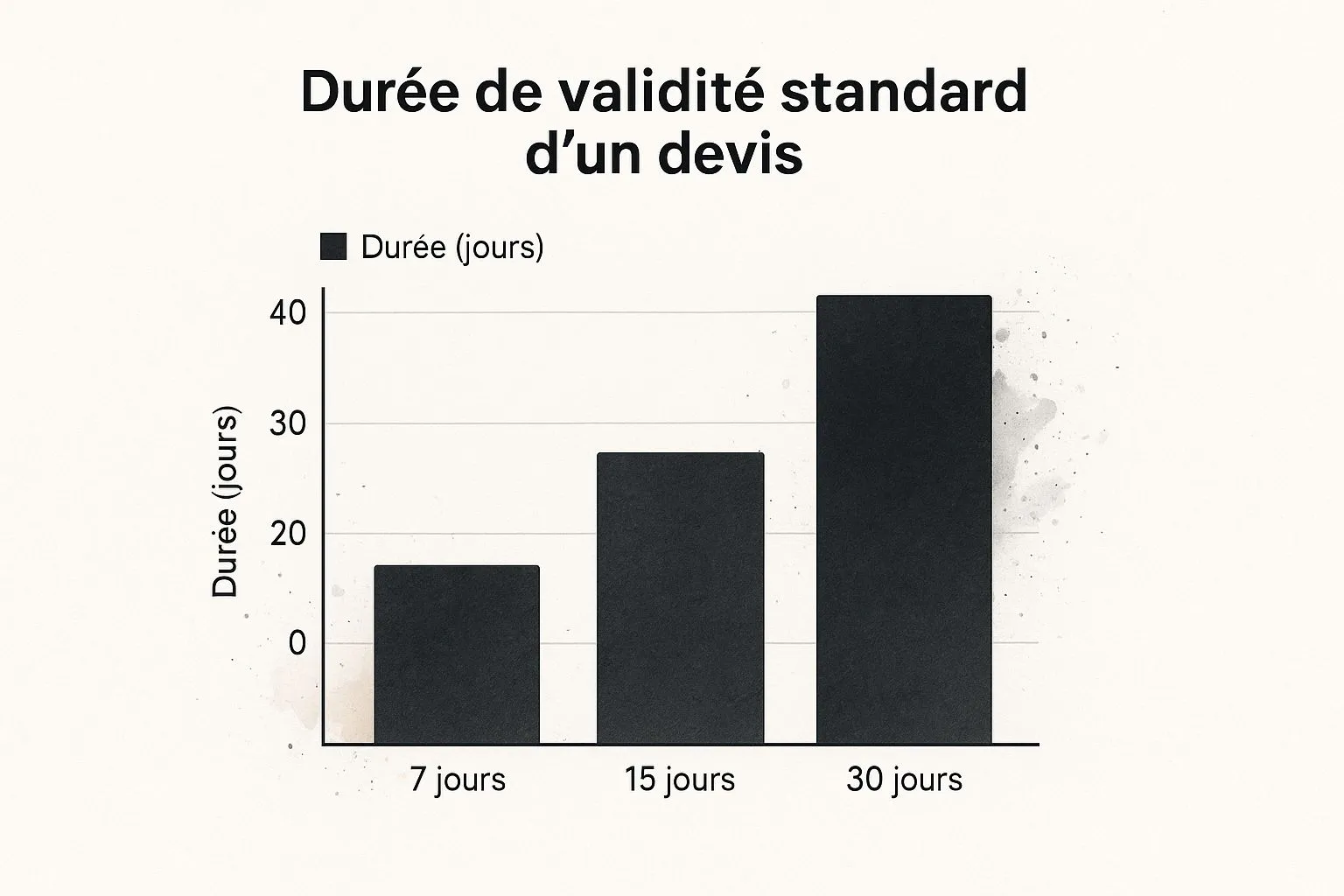
Setting this period, most often around 30 days, is excellent practice. It protects you from your own suppliers’ price increases and encourages your client to decide more quickly.
To make things even clearer, here’s a table summarizing the most common situations where issuing a quote isn’t optional, but mandatory.
Summary of cases where a quote is mandatory
This table summarizes the main situations where French law requires a detailed quote to be issued.
| Situation | Detail of the obligation | Sectors concerned (Examples) |
|---|---|---|
| Work and repairs | Quote mandatory before work begins, regardless of the amount. | Construction, plumbing, electrical, locksmithing, home appliances. |
| Personal services | Quote mandatory if the monthly service exceeds €100 including tax. | Home help, childcare, tutoring, gardening. |
| Moving | Quote mandatory and free for any moving service. | Moving companies for individuals and businesses. |
| Healthcare (non-reimbursed procedures) | Quote mandatory if fees exceed €70. | Osteopathy, cosmetic surgery, dental implants. |
| High amount | Quote mandatory for any service over €1,500. | Intellectual services, event planning, coaching. |
Knowing these rules inside and out not only keeps you compliant with the law, but also strengthens trust with your clients from the very first contact.
The questions everyone asks about quotes
Even after studying the theory on mandatory quote information, an entrepreneur’s day-to-day life always holds its share of surprises. Between legal subtleties and unforeseen situations with clients, it’s easy to feel a bit lost. It’s perfectly normal to look for clear, practical answers.
Think of this section as your cheat sheet. Let’s go through the most frequently asked questions together so you can handle every situation with confidence and professionalism.
Can a quote be modified after it’s been sent?
Picture a quote as a snapshot of your offer at a given moment. Once you’ve sent it to your client, that snapshot is frozen. You can’t touch it up unilaterally.
If an adjustment is needed, whether on your side or at the client’s request, the golden rule is to create a new quote. This new quote must carry a different number and, ideally, state that it cancels and replaces the previous version. It’s the only way to make sure everyone is on the same page before starting anything.
Does a signed quote have the value of a contract?
Absolutely. It’s even the central point of the whole process! When your client signs the quote, often accompanied by the famous handwritten mention “Approved” or “Approved for work,” the document changes status. It becomes a genuine contract that binds both parties.
By signing, the client commits to paying you the agreed amount in exchange for the services you’ve listed. On your side, you commit to carrying out the work exactly as described. This is the act that seals your agreement and officially kicks off your collaboration.
What should you do if a client refuses to pay?
This is the situation everyone dreads, but it can happen. If a client doesn’t pay their invoice even though the quote was signed and the work carried out in accordance with it, that quote becomes your main weapon. It’s irrefutable proof of their commitment.
Here’s the step-by-step process to follow:
- A friendly reminder: Always start with a simple, cordial reminder. An email or phone call is often enough to resolve the situation.
- A formal notice: If silence persists, it’s time to move up a level. Send a formal notice letter with proof of delivery. This is a formal act that sets a final payment deadline before considering legal action.
- Debt collection proceedings: As a last resort, if payment still hasn’t come through, you can initiate debt collection proceedings, for example via a payment order through the competent court.
Is it legal to charge for a quote?
Yes, it’s perfectly legal, but there’s one non-negotiable condition: the client must be clearly informed of this before you start working on it. If you don’t specify anything, the law assumes the quote is free.
Charging for a quote is fairly common practice for services that require genuine analysis, a site visit, or an in-depth technical study. If you go this route, don’t forget to state the cost. A good business practice is also often to deduct this amount from the final invoice if the client decides to work with you.
How should you react if the final cost exceeds the quote?
This is the classic scenario, particularly in the construction trades where unforeseen issues are common. If work not originally planned becomes necessary, you absolutely cannot quietly add it to the final invoice.
The only valid procedure is to pause the job and draft an amendment to the original quote. This document must list the new tasks and their cost in detail, and must be signed by the client before work resumes. Acting otherwise exposes you to a refusal of payment for anything beyond the original quote. It’s a protection for your client, but also for you.
Navigating these rules, from creating fully compliant quotes to tracking payments, can quickly become a headache. Bizyness was designed to relieve entrepreneurs of this mental load by automating much of the process. Create flawless quotes and invoices in just a few clicks, track your payments, and stay legally at ease. To find out how to take back control of your administrative management, take a look at Bizyness.
