

 Français
 The guide to online business accounts for sole traders
Find the best online business account for sole traders. Compare offers, discover the benefits, and manage your finances with ease.
So, what exactly is an online business account for sole traders? Think of it as a regular bank account, but built entirely around your independent activity. Everything happens through an app or website, with services designed to make your life easier, and above all, at rates far more affordable than traditional banks.
Why an online business account will change your daily life
Starting out as a sole trader (micro-entrepreneur) is a great adventure. But financial management can quickly turn into a headache. Mixing personal expenses with business transactions in a single account is a bit like trying to follow two conversations at once: you end up losing the thread. An online business account for sole traders isn’t just a formality — it’s a genuine asset for growing your business.

Think of it as a clean line you draw. On one side, your personal life. On the other, everything related to your business. This separation is the key to healthy management and a clear view of your business’s financial health.
Financial clarity that makes all the difference
The number-one advantage is visibility. With a dedicated account, every euro coming in or going out is clearly tied to your business activity. And that makes a huge difference day to day.
- No more sorting for your filings: All your income is in one place. Your revenue declarations to URSSAF become quick, easy, and error-free.
- Track your profitability: A single glance tells you whether you’re making money, where your expenses are going, and how you could cut costs.
- Gain peace of mind in case of an audit: If the tax authorities come knocking, presenting a 100% business bank statement is proof of rigor and transparency that immediately smooths the process.
In France, 1,111,200 new businesses were recently created, and 64.5% of them were sole-trader (micro-entrepreneur) businesses! This surge shows just how appealing this status is, particularly because tools like online business accounts simplify management. To learn more about entrepreneurship in France, you can read this article from LegalPlace.
This momentum proves it: digital solutions have become the right hand of successful independents. Choosing an online business account for sole traders isn’t just a management decision. It’s a genuine strategic choice for running your business with precision and, above all, with far more peace of mind.
Let’s clear up the bank account requirement once and for all
The question of a bank account for sole traders is a classic. It’s often one of the first headaches: do I need to open one? And does it have to be a “business” account? Let’s clear things up so you can start off on the right footing, stress-free.
The law — specifically the 2019 PACTE law — simplified things. The requirement to have a bank account separate from your personal account isn’t automatic. It only applies if your revenue exceeds €10,000 for two consecutive years.
Dedicated account or business account: the nuance that changes everything
Watch out — there’s an important subtlety to grasp: the law refers to a “dedicated” account, not a “business” account. What does that mean? Simply that you need a second current account, in your own name, used exclusively for your business.
Imagine you have two wallets. In the first, you put money for groceries, movies, personal bills. In the second, you only put money from clients, and you only use it to pay suppliers or buy equipment. That’s exactly what a dedicated account is. This simple separation, even if you’re below the €10,000 threshold, is an excellent management habit.
Mixing personal and business finances is the number-one mistake freelancers make when starting out. Not only does it make tracking your cash flow impossible, but in the event of a tax audit, it can quickly turn into a real nightmare.
Having a dedicated account gives you a clear view of your business’s health. The problem? Many traditional banks balk at the idea of opening a plain current account for business use. They’ll often push you toward their “business” offers, which are pricier and not always suited to your actual needs. This is where the online business account for sole traders comes in and becomes an obvious choice.
This solution ticks every box: it keeps you compliant with the law (by properly separating your money flows) while giving you access to tools designed for independents. You gain clarity over your finances, which is crucial for running your business well and anticipating expenses. If this topic interests you, our guide on tax optimization for sole traders is for you.
In short, even though the law only requires a dedicated account past a certain revenue threshold, choosing an online business account from the start is a genuine strategic choice. It guarantees a simpler daily routine and lets you manage your finances like a pro, wherever you are in your journey.
The very real benefits of an online business account
Far more than just a legal obligation, an online business account for sole traders is a genuine asset for your business. It’s not just about putting up a wall between your personal and business finances — it’s about equipping yourself with powerful tools that radically simplify your daily life.
Choosing this solution is, above all, a pragmatic choice. The precious time you used to spend combing through statements to prepare your URSSAF declarations can now go toward finding new clients or focusing on your core business.
Save a huge amount of time on admin
One of the most tangible benefits is automation. A good online business account syncs with your bank transactions, making cash-flow tracking child’s play.
No more manually checking off every transaction! Picture this: a client pays you, the payment is instantly categorized and ready to be entered into your income ledger. This fluidity lifts an enormous weight off your shoulders.
Make real savings
Traditional banks aren’t gentle with business customers. Account-maintenance fees can quickly add up, averaging around €20 per month for a basic plan. For a sole trader just starting out, that’s a significant cost that piles up month after month.
By contrast, online business accounts slash prices with far more attractive offers. You’ll find free plans or ones under €10 a month. These very real savings let you reinvest that money where it’s most useful: new equipment, an ad campaign, training…
The image below perfectly sums up the gap in speed and cost between opening an online account and a traditional one.
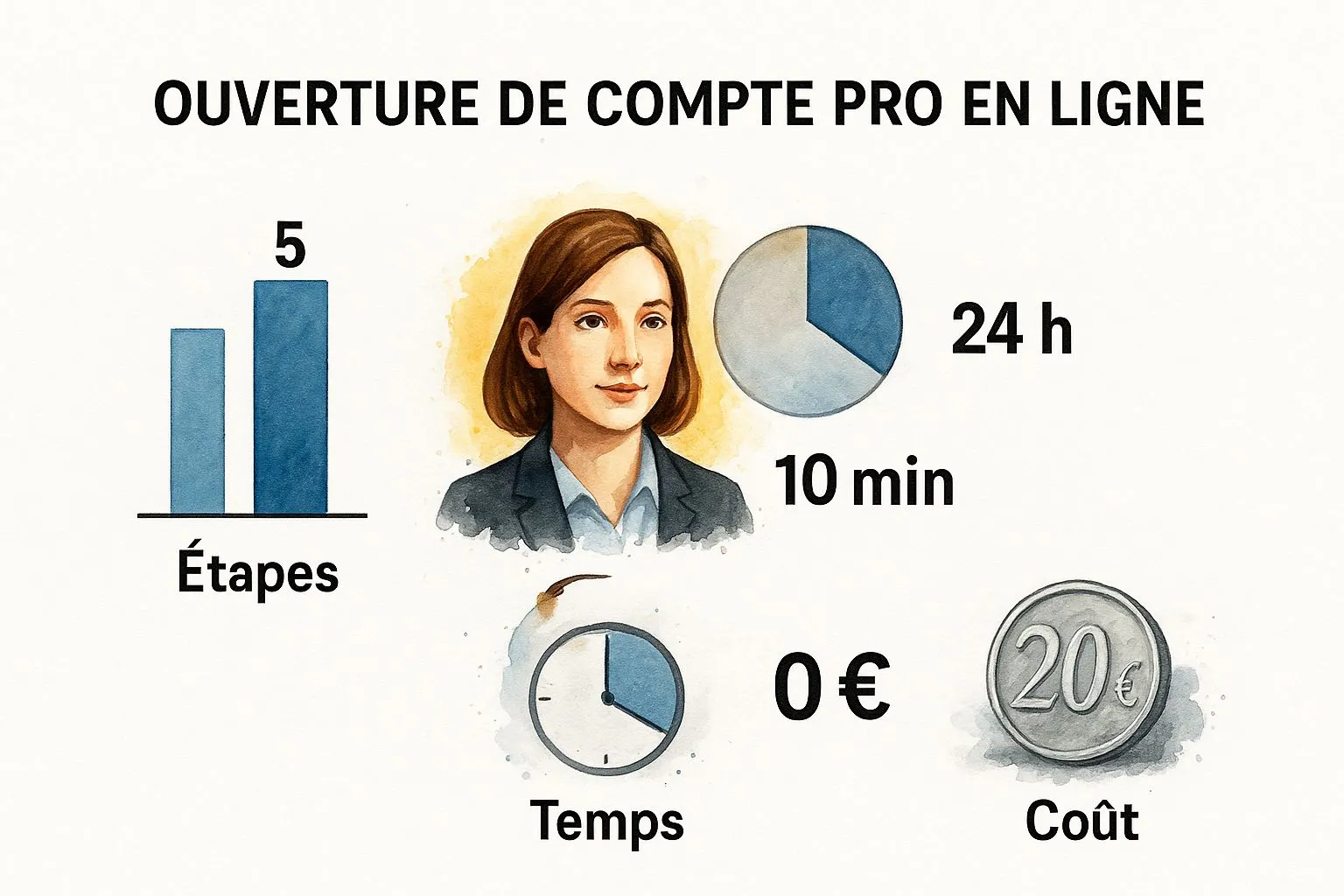
The numbers speak for themselves: the online process is not only faster, but also more affordable from the outset.
To see things more clearly, here’s a quick comparison of the two approaches:
Online business account vs. traditional bank account comparison
This table highlights the key differences between an online business account offer (neobank) and a business account at a traditional bank for sole traders.
| Criteria | Online business account (Neobank) | Traditional business account (Traditional bank) |
|---|---|---|
| Monthly fees | Often free or < €10/month | Generally €20 to €40/month |
| Opening process | 100% online, fast (a few minutes) | Branch appointment, paper documents, longer process |
| Management tools | Built-in (invoicing, quotes, revenue tracking) | Often basic or a paid add-on |
| Accessibility | Via mobile and web app, 24/7 | Physical branch with opening hours, dedicated advisor |
| Cheque/cash deposits | Limited or not possible | Easy at a branch or via ATMs |
| Credit/overdraft offers | Often limited or unavailable | More developed, personalized offers |
In short, the choice really depends on your needs. If you’re after agility, low fees, and built-in tools, an online account is a powerful ally. If you need face-to-face contact and access to complex financing products, a traditional bank still holds certain advantages.
Access genuine management tools
This is where the online account really shows its strength. It’s no longer just a place where your money passes through, but a true cockpit for running your micro-business.
Your online business account turns your smartphone into a control center for your business. From creating invoices to tracking payments, everything is within reach, wherever you are.
Most of these accounts include features specifically designed for freelancers and independents:
- Creating quotes and invoices that comply with the law, directly from your app.
- Real-time dashboards to visualize your revenue trends at a glance.
- Simplified accounting export to ease your filings and work with an accountant, if you have one.
Let’s take a concrete example: a freelance graphic designer can create and send a professional quote in just a few clicks between two appointments. Once the project is accepted and paid, the invoice is generated automatically and the payment is reconciled without them lifting a finger. This kind of smart integration is exactly what makes an online business account for sole traders an essential strategic partner.
How to find the perfect online business account for your business
Choosing an online business account for sole traders can quickly feel like a headache. You’re overwhelmed by offers, each one more tempting than the last. Yet the process is much simpler than it looks if you approach it with a bit of method. The goal isn’t to find the “best” online bank in absolute terms, but the one that fits your actual situation perfectly.

The very first thing to do is get a clear picture of your profile. A consultant working from home who handles a few large invoices a month won’t have the same needs as a craftsperson taking a string of small card payments at markets. It’s just common sense.
Ask yourself the right questions, very concretely. Do you take physical payments? Do you still need to deposit cheques or cash? Does your business involve international transfers? The answers to these questions are key to building your own framework for comparing offers.
Beyond the headline price: read the fine print on fees
Cost is often the crux of the matter. But be careful not to be blinded by a cheap monthly subscription. The final bill can quickly climb because of hidden fees you didn’t see coming. A close look at the fee schedule is therefore essential to avoid unpleasant surprises.
Take the time to break down these points:
- Account maintenance fees: Some offers are advertised as free but can hide fees if you don’t carry out a certain number of transactions each month.
- The cost of the bank card: Of course, there’s the price of the card itself. But above all, check the payment and withdrawal limits. Do they match your activity volume?
- Transaction commissions: If you plan to use a mobile card reader (payment terminal), this point is crucial. Every percentage taken from your payments adds up.
- Transfer fees: SEPA transfers are almost always free — that’s the standard. But what about instant transfers, or more importantly, transfers outside the euro zone?
By being rigorous in this analysis, you’ll be able to compare like with like and identify the offer that’s genuinely the most economical for your way of working.
Focus on services that truly simplify your life
A good online business account for sole traders isn’t just a place where your money sits. It’s a genuine management partner, a tool that should save you time and bring you peace of mind day to day.
Don’t fall into the trap of “gimmicky” features. What matters are concrete solutions to your everyday problems. A good built-in invoicing tool will always be more useful to you than a metal bank card.
Here are the services that really make the difference:
- Built-in invoicing tools: Being able to create compliant quotes and invoices directly from your banking app is a phenomenal time-saver. No more juggling between several pieces of software.
- Bank synchronization: This is key. The ability to connect your account to a management tool like Bizyness automates your entire tracking, makes your revenue declarations ultra-simple, and gives you a clear view of your cash flow.
- Responsive customer support: The day something goes wrong, you’ll be glad you can reach a human advisor quickly. Don’t hesitate to test their responsiveness by chat or phone before signing up.
- Professional insurance: Some offers include useful insurance (professional liability, legal protection…). This can represent significant savings compared to taking out a separate policy.
If the sole-trader (micro-entrepreneur) status is so successful, it’s largely thanks to its administrative simplicity. A well-chosen online business account fits perfectly into that logic: it simplifies the management of cash flows, invoices, and declarations. To learn more about this underlying trend, you can read this article on new micro-business creation in France on abcbourse.com. Ultimately, by choosing an account that fits who you are, you give yourself the means to run your business more calmly and focus on what really matters: your core work.
Connect your account to your tools for truly optimized management
Your online business account for sole traders should never be a mere information silo. Think of it instead as the heart of your financial ecosystem. It’s a hub that, once connected to your other tools, can automate a good part of your daily routine and simplify your life.
The real magic of modern accounts is bank synchronization. This technology lets your account communicate in real time with your other management software. Forget the days of manually checking off every transaction on an endless Excel spreadsheet!
Automation working for your cash flow
Let’s take a very concrete example: connecting your business account to a management tool like Bizyness. As soon as you activate synchronization, every movement on your bank account is automatically pulled in, categorized, and reconciled against your invoices and quotes.
Picture the scenario:
- You issue an invoice from your management tool.
- Your client transfers payment to your business account.
- Thanks to the connection, the payment is spotted almost instantly.
- Your software updates the invoice and marks it as “Paid.” All without you having to do a thing.
This mechanism, known as automatic bank reconciliation, frees you from an enormous administrative burden and drastically reduces the risk of human error.
Bank synchronization completely changes the game. You move from manual management, chasing down information, to a proactive, automated system. Information comes to you, already sorted and ready to analyze.
This overall visibility is essential for running your business well. You know at all times where you stand on cash flow, which invoices are still outstanding, and how your micro-business’s financial health really looks.
The Bizyness dashboard below perfectly illustrates how this information can be summarized to help you make decisions quickly.
This visual clearly shows the clarity an integrated solution brings. At a glance, you get a full overview of your finances.
Radically simplify your obligations
Beyond the time saved day to day, this automation has a direct impact on your legal and administrative obligations. Declaring your revenue to URSSAF becomes much simpler, since all your incoming payments are already recorded and totaled for you.
And if you exceed the VAT exemption thresholds, managing VAT also becomes much easier. If this topic interests you, our full guide on VAT for sole traders explains all the rules you need to know.
In short, connecting your business account to your tools isn’t a luxury. It’s a smart strategy for gaining time, peace of mind, and precision.
Pitfalls to avoid when choosing your business account

Choosing an online business account for sole traders seems simple at first glance. Yet a few poor choices can quickly turn a good deal into a real headache. Knowing the most common pitfalls means you can make a calm decision suited to your business.
Mistake number one? Being blinded by a headline price, especially “free” offers. The reality is that this “free” often hides a forest of hidden fees: overpriced instant transfers, high card-payment commissions, or even fees if your account stays inactive.
Another common pitfall is underestimating the importance of limits. Picture the scene: you’re about to buy essential equipment and your card is declined. Limit reached! A good business account should offer payment and withdrawal limits that keep pace with your revenue, even during a big spike in activity.
The details that make all the difference
It’s easy to assume all accounts are alike. Big mistake. As they say, the devil is in the details. Overlooking the quality of customer service or the relevance of built-in management tools is a decision that can cost you dearly in the long run.
Here are the pitfalls to absolutely dodge:
- Neglecting customer service: Unreachable or slow support can literally paralyze your business when facing an urgent problem. Before signing up, why not test their availability?
- Opting for a personal account: Even if you only use it for your business, a standard current account isn’t built for that. Banks can close it without notice, and above all, it will never offer you management tools like invoice creation. To learn more about this, take a look at our article on invoicing for sole traders.
- Forgetting synchronization: An account that doesn’t communicate with your management tools, like Bizyness, opens the door to hours of manual data entry. And manual entry means a risk of errors.
In a market where sole-trader registrations have slightly declined by 0.2%, every optimization to your management matters to stay competitive. A high-performing online business account gives you exactly that agility. To dig deeper, you can check INSEE’s statistics on business creation.
By avoiding these mistakes, you’re not just choosing a bank account. You’re equipping yourself with a genuine partner to support your growth.
Answering your last questions
Choosing the right business account is an important step. So it’s entirely normal to still have a few doubts. Let’s clear up the last questions that often run through sole traders’ minds.
Can I use my personal account for my business?
Technically, yes, but it’s a very, very bad idea. The law allows it as long as your revenue doesn’t exceed €10,000 over two consecutive years. Past that threshold, a dedicated account for your business becomes mandatory.
But honestly, mixing your personal and business expenses is the best way to lose track. You’ll never really know if your business is profitable, and your revenue declarations will become a real headache. Worse still, traditional banks really don’t like it. If they see too many business transactions on your personal account, they can close it without notice, since it violates their terms and conditions.
What documents do I need to open one?
Rest assured, everything has been designed to be simple and fast. To open your online business account for sole traders, you’ll only need three things:
- A valid ID (identity card or passport).
- Proof of address less than 3 months old.
- Your SIRENE registration certificate, the official document proving your micro-business exists.
How long does opening an account take?
This is where the magic of going online kicks in! No more branch appointments and days of waiting. Opening an online business account generally takes less than 10 minutes, stopwatch in hand. Everything happens from your computer or phone, from submitting documents to validation.
A question that comes up often: is it secure? Absolutely. Neobanks and other online solutions take security very seriously. They use the same encryption and two-factor authentication (2FA) technologies as major banks and are overseen by the same regulators. Your money is just as well protected.
Ready to level up and free yourself from paperwork? See for yourself how Bizyness can simplify your day-to-day management by discovering our solution at https://www.bizyness.fr.