

 Français
Optimizing expense report management in your business
Our complete guide to simplifying expense report management. Discover practical strategies and tools for a smooth, efficient process.

Expense report management is far more than a simple administrative formality. It concerns the money your employees advance on behalf of the company. Managing this process well means ensuring everyone is reimbursed quickly, that you stay compliant with the law, and ultimately, that your teams are more satisfied.
Why optimizing expense report management is a strategic issue

We all tend to see expense reports as a chore. For employees, it’s paperwork. For accountants, a mountain of receipts to check. But if you look more closely, you realize the stakes go well beyond simple data entry. A poorly designed process is a source of hidden costs, frustration, and even legal risk.
The direct impact on your employees’ morale
Put yourself in the shoes of a sales rep who advances several hundred euros for a business trip. If they have to wait more than a month to see their money again, it quickly becomes a problem for their personal budget. And let’s be honest, that doesn’t exactly help keep motivation up.
Reimbursement time is an absolutely crucial factor. In France, where 80% of executives regularly file expense reports, how quickly they get reimbursed has a direct impact on their morale. A recent study is very clear on this point: 89% of executives are satisfied when they’re paid in under a week. That figure drops to 52% when the wait exceeds a month. For more on this topic, the full analysis on the impact of reimbursement delays is very insightful.
Reimbursing quickly isn’t a favor. It’s simply a mark of respect for the commitment of employees who advance money on behalf of the company.
The financial and legal risks of an outdated system
Beyond the human aspect, manual or improvised management is an open door to all sorts of problems. A small data entry error, a misplaced receipt, an expense that doesn’t comply with internal rules… all of this represents a financial loss and a risk in the event of an audit.
Specifically, here are the dangers lying in wait:
- Excessively high processing costs. The time an employee spends filling out their form, a manager spends approving it, and an accountant spends checking everything… that’s work time with a significant cost.
- Non-compliance risks. Without rigorous controls, you expose yourself to an URSSAF reassessment. Every expense must be justified and justifiable. To make sure you’re well-informed, take a look at our complete guide on the definition of an expense report.
- A total lack of visibility. With Excel spreadsheets and paper receipts, it’s impossible to get a clear, real-time view of expenses. How can you manage a budget under these conditions?
Building a clear, fair expense policy
Before even starting to look for software, there’s a priority task: the expense policy. It’s the cornerstone of good expense report management. Without a solid, well-known framework, you open the door to misinterpretation, misunderstandings, and often, frustration.
The goal isn’t to scrutinize every expense, but rather to set fair ground rules for everyone. A good policy should be seen as a help, a guide that makes employees’ lives easier, not as yet another administrative constraint.
Setting reimbursement caps that make sense
The first thing to do is define realistic reimbursement limits. Applying the same cap for a meal, whether your employee is in Paris or in the provinces, simply doesn’t make sense. The key is to be logical and flexible.
Consider adjusting these caps based on concrete, objective criteria:
- Geographic area: A business lunch in a Parisian business district doesn’t cost the same as one in the regions. It therefore makes sense to adjust the amounts.
- Role and responsibilities: A sales director hosting a strategic client doesn’t have the same constraints as a technician on a service call. Caps should reflect these differences.
- The nature of the expense: It’s essential to clearly distinguish limits for accommodation, meals, transport, and the well-known mileage allowances.
This nuanced approach shows teams that you understand their reality on the ground. It’s a real sign of trust and reinforces a sense of fairness.
Clauses you must not forget
Your expense policy should be a genuine instruction manual. The more precise it is, the fewer questions and back-and-forths there will be with accounting. That saves time for everyone.
Here are the points on which you need to be uncompromising:
- Valid receipts: State clearly, in black and white, that only a detailed invoice (with VAT clearly shown) is accepted. A simple card payment slip isn’t enough for URSSAF.
- Submission deadlines: Set a clear cutoff date, for example before the 5th of the following month, for expense reports to be submitted. This helps smooth out the workload and ensures fast reimbursements.
- Non-reimbursable expenses: To avoid any misunderstanding, explicitly list what isn’t covered. The hotel minibar, parking fines, pay-per-view movies… Be clear.
A well-thought-out, well-explained expense policy is never seen as a constraint. It’s a framework that protects both the company and the employee, bringing transparency and predictability.
Also plan for the classic scenario: a lost receipt. Setting up a clear procedure, such as a sworn statement to be used only exceptionally, can save many situations. For ideas on structure, taking a look at a sample expense report is often an excellent starting point.
Finally, and this may be the most important part: communicate! Once the document is finalized, don’t just send it by email. Organize a short presentation, make it easily accessible on the intranet, and above all, make sure managers are the first to champion and explain these rules. A policy that is understood and accepted is a policy that works.
Setting up an effective approval process

Having a clear expense policy is the foundation. But for expense report management to be truly fast and frictionless, you need a smoothly running approval process. The goal is simple: put an end to the friction, errors, and endless back-and-forths that waste everyone’s precious time.
When the approval workflow is smooth, an administrative chore turns into a simple formality. Each person has their role, from submission to reimbursement. If the steps are logical and well defined, the machine runs itself.
Simplifying submission for the employee
It all starts with the employee’s experience. If they have to fight for an hour with an Excel spreadsheet and a stubborn scanner, chances are they’ll wait until the last minute to get to it. Simplicity is therefore your best ally for receiving expense reports on time.
For it to work, submission needs to be a breeze.
- Easily attaching receipts: The best approach is to let your teams photograph their receipts with their smartphone and send them directly. No more lost receipts or piles of paper to scan at the end of the month.
- Entering the right information, hassle-free: The form should guide the person step by step through entering the essentials: date, nature of the expense, gross amount, and of course, VAT when relevant. Modern tools with optical character recognition (OCR) can even pre-fill these fields, reducing the risk of error to almost zero.
A successful approval process starts with effortless submission. The fewer obstacles for the employee, the faster and more accurate downstream processing will be.
Clarifying the manager’s checkpoints
The manager is the first line of defense. Their role isn’t to redo the accounting, but to verify the consistency and compliance of the expense. Their approval needs to be quick so as not to create a bottleneck.
Specifically, the manager should focus on three key points:
- Compliance with internal policy: Does the expense respect the caps? Does it fall within authorized categories?
- Amount validation: Do the sums involved seem reasonable given the context?
- Consistency with the mission: Was this business lunch or trip genuinely tied to a legitimate professional activity?
For example, if a manager sees an expense report for a restaurant on a Saturday night for an employee who wasn’t traveling, they should be able to ask the question directly within the tool, without having to send a separate email.
Optimizing final checks by accounting
Once the manager has given the green light, the expense report lands with the accounting department for a final check before payment. At this stage, most of the work is already done, which greatly speeds up processing.
The accounting team then focuses on the final checks, such as correct accounting allocation and the validity of receipts for VAT recovery. When the process is well oiled, processing times shrink dramatically.
The average cost of processing an expense report in France is around 53 euros, over a period that often stretches from 20 to 30 days. Optimizing this workflow therefore has a direct impact, both financially and on team morale. If you’d like to dig deeper into these figures, feel free to discover the details on the impact of processing delays.
Once everything is validated, reimbursement is triggered. The cycle is complete, quickly and transparently for the employee. And everyone can get back to focusing on their real job.
Going paperless: digitization and digital archiving

Scanning your receipts to get rid of them is much more than a simple convenience. It’s a genuine opportunity to simplify administrative tracking, and it’s actually well governed by French law. By going digital, you eliminate the risk of losing documents and save precious time.
Saying goodbye to piles of accumulating paper receipts is no longer a luxury, but a necessity for modern expense report management. But be careful, digitization isn’t just about taking a photo. It’s a comprehensive approach that secures and streamlines the entire process.
For everything to be compliant, going digital must meet specific conditions. The goal? For your digitized receipts to hold the same legal value as the originals in the event of an audit. This is where a crucial concept comes in: probative-value archiving.
What is probative-value archiving?
To be able to confidently throw away paper receipts, their digital twin must guarantee three essential points. This is a prerequisite for complying with the expectations of URSSAF and the tax authorities.
Your archiving system must therefore certify:
- The authenticity of the document’s origin (who created it and when).
- The integrity of its content (proving it hasn’t been altered since creation).
- The readability of the receipt throughout its legally required retention period.
As you’ll have understood, a simple scan saved in a shared folder on a server is absolutely not enough. You need a robust system that produces a reliable copy, often using techniques such as timestamping, digital sealing, or electronic signature.
Choosing digitization means opting for security and efficiency. Ultimately, a well-archived digital document is far safer than a paper receipt that can be lost, torn, or fade over the years.
The very real benefits of digitization
The advantages of this transition are immediately visible. Did you know that managing a single expense report in paper format costs an average of 50 euros? This figure includes the time spent handling it, validating it, and physically storing it. Multiply that by the number of expense reports and by the 10 years of mandatory retention… and the savings quickly become substantial. To dig deeper into this topic, you can read the government’s recommendations on digitization.
But beyond the purely financial aspect, going digital changes daily life. Finding a specific receipt takes a few seconds, compared to long minutes flipping through dusty binders. The risk of loss becomes virtually nil, and communication between the employee, their manager, and the accounting department is much smoother.
Before choosing a tool, make sure it complies with current standards, such as NF 461 certification, and that it offers secure storage for the legally required retention period. It’s a strategic investment that will bring you a great deal of peace of mind.
How to choose the right automation tool
Automation is without question the most powerful lever for modernizing your expense report management. Choosing the right software isn’t just about saving time; it’s about rethinking the entire process to make it simpler, faster, and far more reliable. The problem is, faced with the jungle of available solutions, it’s easy to get lost.
The most common mistake? Getting seduced by gimmicks instead of focusing on the features that will have a real day-to-day impact. A flashy interface is useless if the tool doesn’t communicate perfectly with your accounting system. You need to approach this choice strategically, starting from your real needs on the ground.
The essential features to evaluate
To see things clearly, focus on what solves the most painful problems: endless manual data entry, the hunt for lost receipts, and lengthy approval delays. A good tool should act as a genuine assistant for your teams, not as one more constraint.
Four pillars form the basis of any truly effective automation solution:
- Optical character recognition (OCR): This is the feature that changes everything. The employee simply takes a photo of their receipt, and the app magically extracts the date, amount, VAT, and supplier name. Data entry errors drop to almost zero and the time savings are considerable.
- A mobile app that gets straight to the point: Your teams on the road need to be able to submit their expenses in seconds, wherever they are. The app should let them take a photo, glance at the data extracted by the OCR, and send the expense report for approval with a single click. Simple, fast, effective.
- Smooth accounting integrations: This is the crux of the matter. The tool needs to connect effortlessly to your accounting software. The end goal is to transfer validated entries automatically, without ever having to re-enter a single piece of information.
- Custom approval workflows: Every company has its own rules for approval. The software should let you define precisely who approves what, set up automatic alerts when caps are exceeded, and track the status of each expense report in real time.
The best tool isn’t the one with the most features, but the one that adapts best to your processes and simplifies life for every user, from the traveling sales rep to the accountant at the office.
Adapting your choice to the size of your company
Obviously, the needs of a 20-person SME aren’t those of a large international group. A small business will prioritize simplicity and an affordable price, while a large company will need advanced features for management control and reporting.
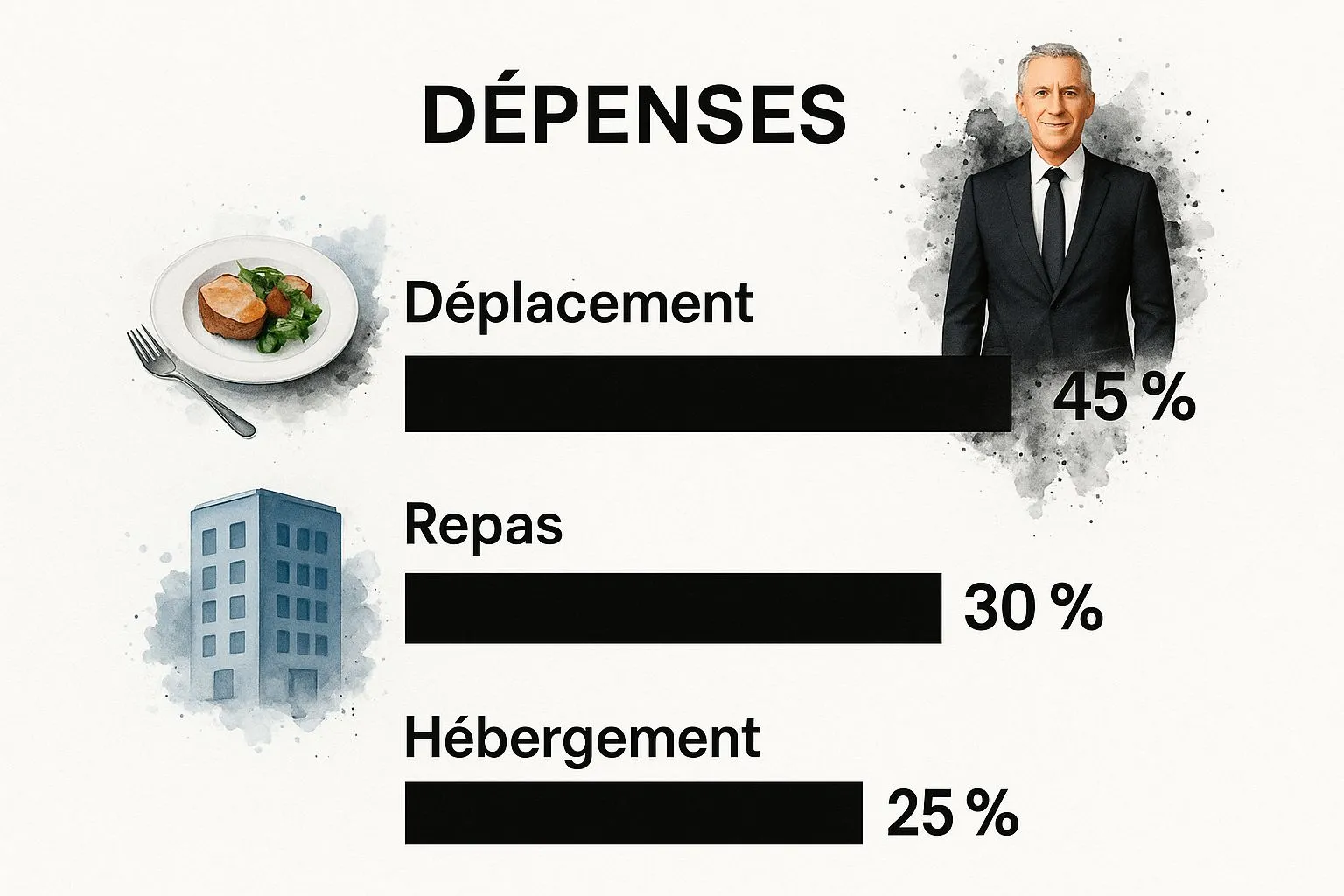
This image clearly shows that travel expenses (45%), meals (30%), and accommodation (25%) dominate. This confirms that you need a tool that handles these three categories perfectly, regardless of company size.
For an SME, a simple tool with a good mobile app and basic accounting integration will often do the job. The primary goal is to say goodbye to paper and centralize everything. For example, a consulting firm with 15 consultants will be perfectly equipped with a solution that automates the creation of expense reports and exports them to their accounting software.
For a large group, the criteria become more complex. You’ll need a tool capable of managing different expense policies by subsidiary or country, integrating with a complex ERP, and providing analytical dashboards to manage budgets. Data security and regulatory compliance (GDPR, etc.) then become absolute priorities.
To go further on this topic, feel free to explore the various strategies for automating administrative tasks; it will give you a broader view of the possible gains.
To help you visualize priorities based on your context, here’s a simple comparison table.
Comparison of key features of expense report management software
This table will help you evaluate tools based on the features that are truly essential for different types of businesses.
| Feature | Essential for micro/small businesses | Essential for mid-size/large groups | Main benefit |
|---|---|---|---|
| Mobile OCR | ✔️✔️ | ✔️✔️ | Immediate time savings for all employees |
| Basic accounting integration | ✔️✔️ | ✔️ | Eliminates double accounting entry |
| Simple approval workflows | ✔️ | ✔️✔️ | Speeds up the reimbursement process |
| Multi-currency management | ✔️ (for travel) | ✔️✔️ | Simplifies management of international travel |
| Advanced ERP integration | ✔️✔️ | Full synchronization with the information system | |
| Complex expense policies | ✔️✔️ | Cost control and internal compliance | |
| Advanced reporting and analytics | ✔️ | Supports decision-making and budget optimization |
This table clearly shows that while OCR is universally essential, features like ERP integration or complex expense policies only become crucial past a certain company size. Use it as a reading grid to avoid making the wrong choice.
FAQ: expense reports in practice
Rolling out a new expense report management policy often opens the door to a whole host of very practical questions. To help you see things more clearly and secure your practices, we’ve gathered here the most common questions we encounter in the field.
What is the legal deadline for reimbursing an expense report?
Contrary to what you might think, French law doesn’t set a precise figure. It simply refers to a “reasonable period” that the employer must respect.
In practice, the norm is often to reimburse with the payroll of the month following the submission of the expense report. This is a well-established and generally accepted practice. Be careful, though: if it drags on too long, a judge could consider it a fault on the employer’s part. The employee, who advanced money on behalf of the company, would then be entitled to claim damages for the harm suffered.
Never forget: fast reimbursement isn’t a favor to the employee, it’s an obligation. It’s a mark of respect for their financial commitment and a sign of healthy internal management.
Is a card payment slip enough as a receipt?
The answer is a categorical no. For the tax authorities and URSSAF, a simple card payment slip has no probative value. It proves a payment took place, but it says absolutely nothing about the nature of the expense.
A genuine receipt, the kind that protects you in the event of an audit, must include the following information:
- The exact nature of the product or service (for example, “Business meal,” not just “Total”).
- The total amount excluding tax and including all taxes.
- The VAT breakdown, essential for recovery.
- The supplier’s name and the exact date of purchase.
Without all this, the company cannot recover VAT. Worse, it opens the door to a tax reassessment.
What should you do if an employee loses a receipt?
The first instinct, and by far the best, is to contact the supplier to request a duplicate invoice. This is the only approach that guarantees full compliance.
If that option isn’t possible, there’s a fallback solution: the sworn statement. The employee must write a document describing the expense in as much detail as possible (date, location, amount, professional context). As the employer, you’re free to accept or reject this document. My advice: use this procedure sparingly. If it becomes a habit, it can look bad in the event of an audit.
Radically simplify your administrative management. With Bizyness, creating compliant documents and tracking your finances become child’s play. Focus on your growth, Bizyness takes care of the rest.
