

 Français
Paid Invoice Example: A Simple Guide to Creating One
Discover our paid invoice example and learn how to create one quickly. Protect your cash flow with our practical guide.
Picture the situation — a bit too familiar for some of us: a client insists they’ve paid their invoice, but a quick look at your cash flow tells a different story. Who do you believe? This is exactly where a paid invoice becomes your best ally. Far from being a simple piece of paper, it stands as irrefutable proof, a genuine legal and accounting safeguard that confirms in black and white that a transaction is truly complete.
What is a paid invoice and why does it matter so much?
In practical terms, a paid invoice is nothing more than a standard invoice with a crucial addition: the word “paid” (or “acquittée” in French). This simple addition officially confirms that you have received payment in full. Think of it as the final stamp that closes out your client’s debt. It turns a payment request into tangible proof that the financial obligation has been honored.
This document wears two hats. For you, as a business owner, it’s an essential accounting record that helps you track your cash flow and close your books with peace of mind. For your client, it’s the absolute guarantee that they won’t be chased for a debt they’ve already paid.
Standard invoice vs. paid invoice: don’t mix them up
At first glance, it’s easy to confuse an invoice awaiting payment with one that’s already been settled. Yet their roles and implications are radically different. A standard invoice represents a receivable — a sum of money you’re waiting to receive. A paid invoice, on the other hand, represents a completed transaction, a receivable that no longer exists.
Put simply, the difference mainly comes down to a few key pieces of information that change everything. The table below highlights those differences to help you see things more clearly.
Key differences between a standard invoice and a paid invoice
This table compares a standard invoice awaiting payment with a paid invoice to clarify their distinct roles in the sales cycle.
| Element | Standard invoice | Paid invoice |
|---|---|---|
| Status | Awaiting payment | Paid |
| Purpose | Request payment of an amount owed | Confirm receipt of payment |
| Proof | Proof of the receivable (what the client owes you) | Proof that the debt has been extinguished |
| Notes | Terms and payment due date | ”Paid” mention, payment date and method |
In short, while the first opens a receivable, the second closes it for good. The following infographic illustrates these points perfectly.
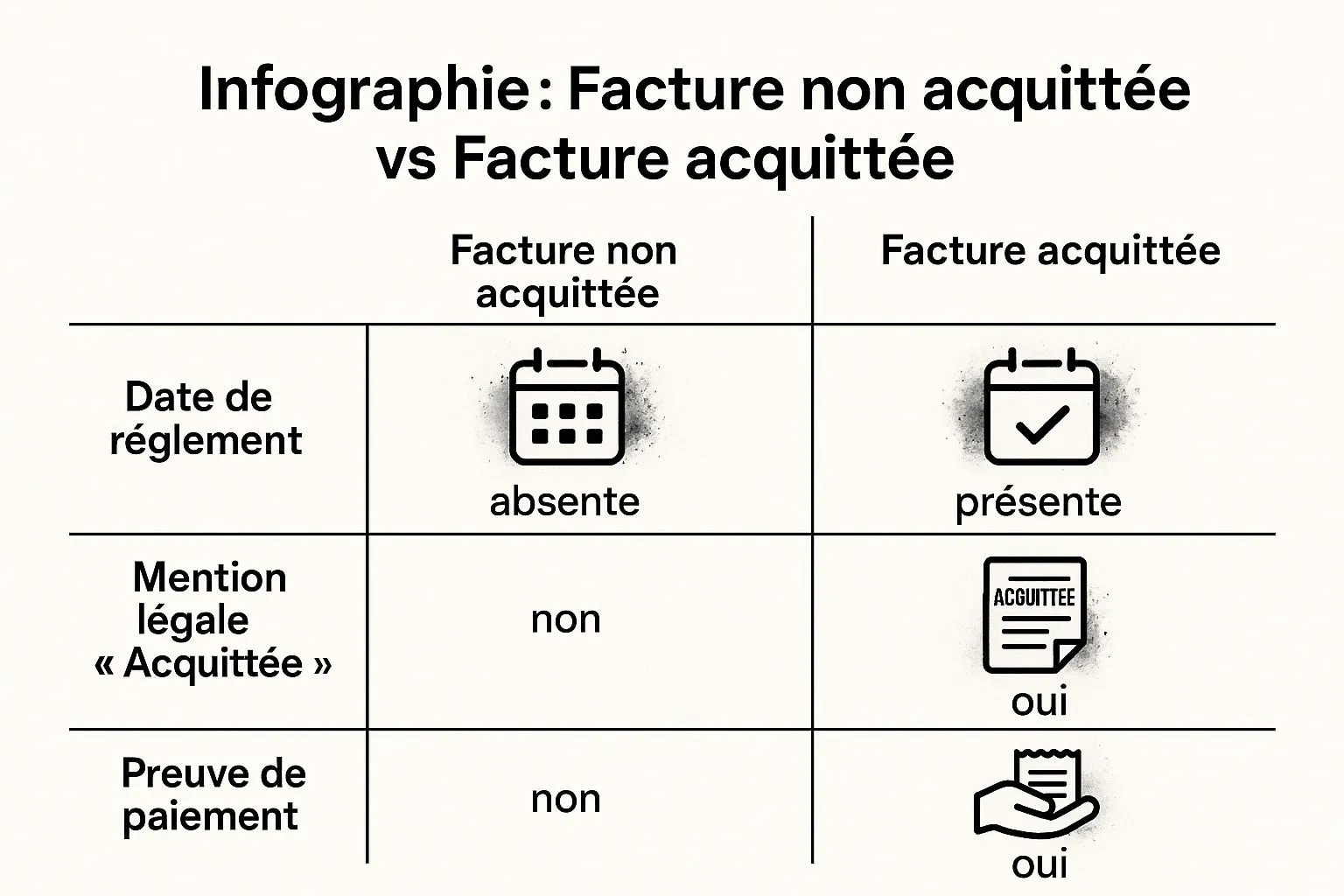
As you can see, it’s the addition of the payment details that gives the paid invoice its full legal and evidentiary value. This is what turns it from a simple request into a receipt.
The law is very clear on this. Under Article 1353 of the French Civil Code, it is up to whoever claims to be released from an obligation to prove it. The paid invoice is therefore the client’s number-one tool for demonstrating that they have indeed paid.
Ultimately, it acts as a shield for both parties, ensuring sound and transparent management. In case of doubt or dispute, it’s the document that settles the matter for everyone.
When does a paid invoice become essential?
Even though the law doesn’t systematically require it, a paid invoice is far more than a mere formality. Think of it as a good-management reflex, a safeguard for both you and your client. In certain situations, ignoring it is a bit like sailing blind through a storm.
The most common case? Cash payment. Unlike a bank transfer, a cash payment leaves no banking trail. The paid invoice then becomes the only solid, undisputable proof that the debt has indeed been settled. It protects everyone from a misunderstanding that could prove costly.
The situations where it’s your best ally
Beyond cash payments, other contexts make this document absolutely crucial for peace of mind. Sound business management also means anticipating these needs to keep your commercial relationships spotless.
Here are the moments when providing a paid invoice isn’t optional — it’s a necessity:
- In case of a dispute: A client acting in bad faith claims they never paid you? The paid invoice will end the debate instantly, whether amicably or in court. It’s your trump card.
- To activate a warranty: For valuable goods or services, a simple sales receipt is often not enough. Most manufacturers or suppliers will require a proper invoice bearing the word “paid” to activate the warranty.
- At the client’s request: It’s their strict right. Your client may need it for their own accounting or to obtain a refund. Refusing would not only be unprofessional but could also damage your relationship.
- To justify subsidies: If you receive grants or funding, the funding bodies will systematically request paid invoices. It’s the only way for them to verify that the funds were used as intended.
Put simply, the paid invoice is the document that officially closes a transaction. It turns a commercial exchange into a clean, closed case with no loose ends.
This traceability is also a pillar of your financial management. It helps you closely monitor compliance with payment terms, which are regulated in France (45 days end of month or 60 days net). Given that late payments strain the cash flow of nearly 20% of French SMEs, having proof of payment is a real asset. It gives you a clear view of your financial flows and helps you avoid penalties. To learn more, feel free to check the official information on inter-business payment terms.
The details you should never forget on a valid invoice
Turning a standard invoice into solid proof of payment doesn’t happen with a single stamp. For a paid invoice to be undisputable, it must include very specific information that gives it its full value, both legally and from an accounting standpoint. Without these details, its validity could easily be challenged.
Beyond the usual information found on an invoice, three specific mentions are absolutely crucial to attest to payment. Think of them as the three pillars that guarantee the solidity of your proof. Forgetting them means taking an unnecessary risk and weakening your accounting in the event of an audit or dispute.
The 3 key elements of a paid invoice
For an invoice to be considered properly paid, it must absolutely include the following information. It’s this combination that makes it so reliable.
-
The explicit mention “Paid on…”: A quick “paid” scribbled down isn’t enough. The wording must be clear, unambiguous, and above all include the exact date of payment. This is the date that officially marks the extinction of the debt.
-
The exact date the funds were received: This is a common mistake. The date to record isn’t the day your client signed their check, but the day the money actually landed in your bank account. Only that moment attests to the actual transfer of funds.
-
The payment method used: Specifying whether the payment was made by bank transfer, card, check, or cash adds an essential layer of traceability. For a check, you can even note its number; for a transfer, its unique reference.
By strictly following these three points, you ensure that every paid invoice example you issue is a robust, professional document. It’s a mark of seriousness that protects both your business and your client.
These details might seem secondary, but they make all the difference. They confirm not only that the invoice was settled, but also when and how. To go further on the topic, feel free to check our complete guide on the mandatory information on an invoice.
Enough theory — let’s move on to practice! To help you secure your transactions and save valuable time, nothing beats a few concrete examples.
Every payment situation has its own nuances. That’s why a single template can’t cover everything. Whether you’ve received full payment, a simple deposit, or several installments, it’s essential to adapt your document.
A good paid invoice example should above all reflect the financial reality of the transaction in order to be valid. That’s the secret to sound accounting and transparent relationships with your clients.
Case #1: Payment in a single installment
This is the most common and simplest scenario. Your client has paid the full amount owed? Perfect. All you need to do is take your original invoice and add the mentions confirming payment. It’s the cleanest way to close out a sale.
- The key mention to add: “Invoice paid on DD/MM/YYYY”.
- The detail that matters: Remember to specify the payment method (for example, “by bank transfer” or “in cash”).
- The goal: Provide definitive proof that the debt has been extinguished. Case closed!
Case #2: Payment with a deposit
Careful here, things get a little trickier. When a deposit has been paid, you must never mark the invoice as paid for its full amount. Your document should only attest to the sum you actually received, while clearly showing the remaining balance due. This avoids any confusion and secures your future collections.
The mistake you should never make: If you mark an invoice as fully paid after receiving only a deposit, you lose any legal recourse to claim the rest. Be rigorous and only certify the amount actually received.
Our ready-to-use templates for download
To make life easier, we’ve prepared tools you can use right away. Feel free to download our complete paid invoice template, available for various situations. These customizable Word and Excel documents include all the mandatory legal mentions to guarantee full compliance.
E-invoicing: your best ally for simplifying everything
Let’s be honest, managing invoices by hand feels a bit like a trip back in time. Digging through binders, checking your bank statement, then grabbing a pen to write “paid”… It’s a waste of time and, above all, an open door to oversights and errors. Fortunately, we’ve moved past that era.
Today’s invoicing software, like Bizyness, changes the game completely. Picture this: your client pays you, and the software automatically detects the transfer and matches it to the right invoice. In the blink of an eye, the document’s status changes, without you having to lift a finger.
This isn’t just about speed. It’s a real safeguard for your accounting. Every payment is tracked, dated, and linked to its invoice, giving you an impeccable audit trail in the event of a review.
Going digital is no longer a choice — it’s become a given. In fact, the 2023 France Num Barometer showed that 67% of French micro and small businesses already use invoicing software. Interestingly, 24% of them do so specifically to automatically track their paid invoices. That’s clear proof these tools are remarkably effective. For those who want to dig deeper, the data on business e-invoicing is very informative.
Automation, a guarantee of compliance and peace of mind
The automation offered by these tools is a huge advantage, especially for freelancers. In just a few clicks, you can generate a paid invoice example that complies with all the rules. If you’re a sole trader, that means less paperwork and more time to focus on what you do best. To learn more, take a look at our guide to invoicing for sole traders.
This shift is also gently paving the way for the upcoming mandatory e-invoicing reform in France. What’s good practice today will soon become the rule for everyone. Automating the “paid” mark will then become essential, making proof of payment simpler and more reliable than ever.
Frequently asked questions about paid invoices
Even with a good paid invoice example in hand, practical cases often raise doubts. That’s completely normal. To help clear things up, we’ve gathered here the questions that come up most often among business owners.
The idea is to give you simple, direct answers so that managing your proof of payment becomes second nature — a good habit that protects your cash flow and your client relationships.
Am I required to provide a paid invoice?
The answer is no, not systematically. In France, the law requires you to issue an invoice for any sale to a business, but it doesn’t require you to formally “mark it as paid.” It’s above all a good practice, a gesture of transparency that builds trust.
That said, if your client explicitly asks for one, you must provide it. It’s their right to request undisputable proof of their payment. Think of it as after-sales service that can save you plenty of headaches and potential disputes.
An important point to know: the Civil Code specifies that it’s up to the debtor (your client) to prove they have indeed paid their debt. By sending them a paid invoice, you’re giving them exactly the document they need to do so.
Is a receipt the same as a paid invoice?
Not really, even though the intent to prove payment is the same. The big difference lies in the document’s value. A paid invoice is a genuine accounting record. It includes all the legal information of a standard invoice (number, product or service details, VAT, etc.) and adds proof of payment on top. Its legal value is therefore very strong.
A simple receipt or sales slip is much lighter. It’s useful for confirming that a transaction took place, but it doesn’t replace a proper invoice for a company’s accounting or for activating a warranty, for example.
What should I do if my client only pays part of the amount or a deposit?
This is an essential point to watch out for. The golden rule is simple: never mark an invoice as fully paid if you’ve only received partial payment. If you do, you legally lose any means of claiming the remaining amount.
To do things properly, you need to be precise. Here’s how to proceed:
- For a deposit, write: “Deposit of €300 received on DD/MM/YYYY”.
- For a partial payment, write: “Partial payment of €150 paid on DD/MM/YYYY”.
Always keep the remaining balance due clearly visible on the document. This way, the invoice stays a faithful reflection of the situation, and you keep a clear record of what your client still owes you.
Stop juggling manual payment tracking. With a tool like Bizyness, bank reconciliation happens automatically, and your invoices are marked as paid the moment the money lands in your account. It’s a genuine time-saver and a real peace of mind. To see how to simplify your accounting, check out Bizyness and try it for free.
