

 Français
 The unpaid invoice reminder letter your clients will actually pay
Turn your unpaid invoices into cash. Our guide and reminder letter templates for unpaid invoices help you get paid without the stress.
An outstanding invoice isn’t just a line in your books. It’s a real stumbling block for your business, a direct obstacle to its growth and financial health. Every day that passes is money that isn’t coming in, money that keeps you from paying your own suppliers, launching that marketing campaign you’ve been planning, or simply covering your costs. Setting up a payment reminder letter for unpaid invoices system is therefore not a luxury, but a survival reflex to protect your cash flow.
The very real impact of unpaid invoices on your online business
A single small unpaid invoice can seem inconsequential. But once they start piling up, the snowball effect can quickly turn devastating. Whether you’re a Shopify seller, a SaaS founder, or a freelancer, every euro counts. A late payment isn’t just a number in a spreadsheet; it’s capital sitting idle instead of working for you.
This immediate shortfall holds you back. You delay restocking your best-selling product or launching a new offer because the funds you were counting on still haven’t arrived. This situation creates constant stress and eats up precious time chasing what you’re owed, instead of focusing on growing your business.
Numbers that don’t lie
The scourge of unpaid invoices is far more serious than people realize. In France alone, we’re talking about 56 billion euros in unpaid receivables every year. An astronomical figure, representing nearly 2% of French GDP, and still the leading cause of business failure.
These figures make clear that no one is immune. Even the strongest companies can find themselves in trouble because of bad payers. The stakes are clear: it’s time to stop enduring the situation and move to a far more organized, proactive approach.
Moving from reaction to anticipation
Your goal? Turn this thankless task of debt collection into a genuine advantage for your business. A well-oiled, automated reminder process doesn’t just get your money back. It shows you’re serious, educates your clients on your payment terms, and strengthens your professional image. By systematizing your reminders, you send a clear message: tracking your invoicing is a priority.
For an e-commerce seller, the benefits are concrete:
- More stable, predictable cash flow: You know when and how you’ll be paid.
- Considerable time savings: Automation frees up precious hours every week.
- An intact client relationship: Polite but firm reminders prevent a simple oversight from turning into a conflict.
A good reminder system isn’t a sign of distrust. On the contrary, it’s proof of a well-run business that protects its financial health in order to better serve its clients over the long term.
By understanding the nuances of late payments, you can put preventive and corrective actions in place to secure your business.
Building a reminder process that actually works
No more flying blind with unpaid invoices. To be effective, a good reminder strategy can’t be improvised. It relies on a precise schedule, where the right tone is used at the right moment to encourage payment without damaging the client relationship.
The method involves defining clear stages, each with a distinct goal: a friendly reminder, a polite but firm first alert, an escalation, and finally, a final warning before moving up a gear.
Why is a reminder schedule so crucial?
Timing is simply everything. A reminder sent too early can annoy a client who’s acting in good faith, while one sent too late reduces your chances of getting your money back quickly. Balance is key.
Picture this: a simple reminder email, sent two days before the due date, can prevent plenty of oversights. This simple, non-intrusive gesture shows that you’re organized without seeming aggressive. It’s a first step that’s often overlooked, but remarkably effective.
The day after the due date, the first official reminder comes into play. That’s when you politely restate the payment commitment and mention, for the first time, that late payment penalties provided for by law will apply.
The pace is then essential to maintaining constructive pressure.
- Preventive reminder (D-2): A simple, friendly email to jog your client’s memory.
- First reminder (D+1): The tone becomes more professional. This is the official signal of a late payment, mentioning the activation of penalties.
- Follow-up reminders (D+7 and D+14): More direct emails or texts to maintain contact and show that you’re not giving up.
- Final warning (D+21): A registered letter to mark the moment and clearly announce the next step: formal notice.
This table summarizes the approach to adopt for a structured, effective reminder process.
Strategic invoice reminder schedule
This table details the key steps of a reminder process, from the preventive reminder to the firm follow-up, specifying the timing, tone, and recommended channel for each action.
| Step | Timing (relative to due date) | Recommended channel | Tone to adopt | Main objective |
|---|---|---|---|---|
| Preventive reminder | D-2 | Friendly | Anticipate oversight | |
| First reminder | D+1 | Polite and firm | Activate legal penalties | |
| Weekly reminders | D+7 / D+14 | Email / SMS | Progressively firm | Maintain pressure |
| Final warning | D+21 | Registered letter | Firm | Prevent formal notice |
By following this rhythm, a well-oiled process makes it possible to recover 80% of receivables within 30 days. Regularity and progressiveness are your best allies. According to a study by Incwo, digitalization alone can reduce payment delays by 30% by eliminating oversights and standardizing communications.
The impact of an unpaid invoice at a glance
To fully grasp what’s at stake, let’s visualize the journey of an unpaid invoice and its direct consequences on your business.
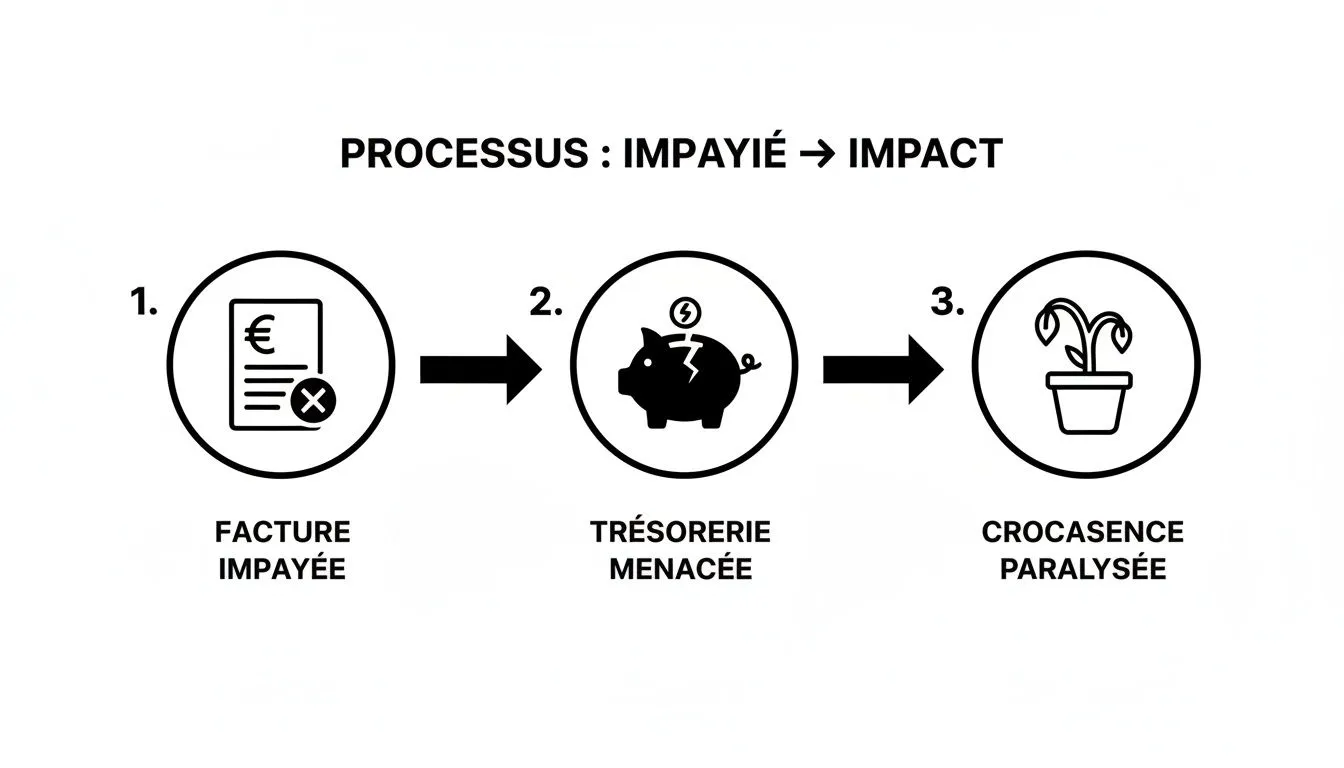
This diagram clearly shows how a simple late payment can quickly jam up your cash flow and, ultimately, slow your growth. It’s a domino effect no one wants to see triggered.
Fortunately, tools can take over. Platforms like Bizyness, connected to your payment solutions (Stripe, WooCommerce…), can automate these reminder sequences. The alert goes out at the right time, the message is sent without you having to think about it. You save precious time and ensure flawless consistency in your communication.
To go further and integrate these reminders into overall management, our guide on automating administrative tasks will give you all the keys.
Let’s take a concrete example: an e-commerce seller specializing in sports accessories. Thanks to an automated process, every unpaid invoice triggers a first reminder in under 48 hours. The result? Payment arrives before even the third reminder in 85% of cases. That’s the direct impact of a well-oiled system.
Tips from the field
Beyond the method, a few reflexes can make all the difference.
- Check the details upfront: Before even sending the invoice, make sure your client’s contact information is accurate. A simple mistake can cause needless delays.
- Craft your email subject lines carefully: Personalize them with the invoice number and your company name so they don’t get lost in the inbox.
- Be progressive, but not weak: The tone should evolve. Keep a cordial approach at first, but don’t hesitate to become more direct and factual if the situation calls for it.
- Archive everything: Every communication sent (email, text, copy of a letter) should be kept. This history will be your best asset in case of a dispute.
By applying this approach, your reminder process becomes more than a simple administrative task: it’s a genuine lever for securing your cash flow while preserving the quality of your client relationships. Regularity and adaptation are the watchwords. A well-calibrated follow-up can genuinely cut your unpaid invoices in half, starting from your very first billing cycle.
Your collections process starts well before litigation. It starts with a first reminder letter, thoughtfully crafted and sent at the right time.
Reminder templates that hit the mark
When reminding a client about a payment, every word matters. It’s not just about sending an email, but about crafting a message that combines psychology and legal framing to be effective.
Here are three approaches, from the softest to the most formal, to adapt your communication and maximize your chances of getting paid quickly.
First contact: the courteous reminder
Start gently. This first reminder, sent 2 or 3 days after the due date, works on the assumption that it’s a simple oversight. The goal is to jog the client’s memory without pressuring them.
- A clear email subject line: “Quick reminder regarding invoice [Invoice number]”.
- The context: Simply restate the amount and due date.
- An easy way out: End with a line inviting the client to reach out if they have a question or think there’s been an error.
I saw a freelance designer use this approach with a large company. The result? Payment was transferred in under 24 hours. The friendly tone defused the situation and reminded the contact that they’d simply forgotten to forward the invoice to accounting.
Second stage: the tone gets firmer
If the first reminder goes unanswered after a week, it’s time to step things up. The message stays professional, but becomes more direct and factual.
Dear Ms. Martin, Unless we are mistaken, invoice No. 67890 remains unpaid as of today. We would be grateful if you could settle it within 5 days. After this period, we will be required to apply the legal late payment penalties.
At this stage, you need to be more explicit:
- Mention the legal penalties (the ECB’s legal interest rate plus 10 points).
- Offer a solution, such as a payment plan, if you sense your client is having difficulties.
- Set a new, short deadline, such as 5 days, to create a sense of urgency.
A Shopify store I work with put this kind of systematic reminder in place. Within a week, they cut their payment delays by 40%.
The art of personalizing to convert better
You don’t address a loyal client the same way you address a new one. Personalization is what makes the difference between an ignored email and a payment received. Simply using the client’s first name can boost open rates by 26%.
- Reference your last exchange or their order. “I hope you’re enjoying the new features we’ve shipped…”
- Explain the impact: prompt payment on their part helps you maintain the quality of service they value.
- Stay consistent with your brand image. If you’re a friendly brand, keep that tone.
Setting up structured follow-up
To avoid losing track, it’s crucial to organize your follow-up. Number your reminders to keep a clear history and know exactly where you stand with each client.
| Reminder stage | When to send it? | Status |
|---|---|---|
| Courteous reminder | D+3 | Sent |
| Firm reminder | D+10 | Pending |
| Final notice | D+17 | To schedule |
In a well-written reminder, never forget to mention the invoice reference, the applicable penalties (ECB rate +10 points), and the flat-rate €40 collection fee. A period of 8 to 10 days is typically granted. To dig deeper into the topic, the guide on reminders from Alios.pro is an excellent resource.
Formal notice: the last step before legal action
When dialogue has broken down, the formal notice is the final warning before things get serious. It’s a formal act, sent by registered letter with proof of delivery, showing that you’re ready to take things further.
- The subject must be unambiguous: “Formal notice before legal proceedings”.
- The final tally: Restate the original amount, accumulated penalties, and the flat-rate fee.
- One last deadline: Grant 8 to 10 days to settle the debt and avoid a payment order procedure.
If this step yields nothing, the payment order procedure is often the fastest route. But for it to succeed, your file must be flawless and chronological. This is where your rigorous follow-up really pays off.
| Element | Description |
|---|---|
| Subject | Formal notice before legal proceedings |
| Deadline granted | 8 to 10 days after receipt |
| Penalties | ECB rate +10 points & flat-rate fee of €40 |
The case of e-commerce sellers: automation with Bizyness
For an e-commerce seller, handling unpaid invoices manually is a colossal waste of time. A tool like Bizyness lets you set up a reminder schedule and let the system work for you.
- Useful integrations: The connection with Stripe or WooCommerce ensures real-time payment tracking.
- Smart alerts: You’re notified as soon as a due date is missed.
- A centralized history: Every email sent is logged, which is perfect for building a solid case file if needed.
One of our clients, a D2C e-commerce seller, cut their average payment time from 45 to 15 days simply by automating their reminders with Bizyness.
By applying these methods, you could see your collection rate rise by 30% in under a month.
Mistakes you absolutely must avoid
Certain mistakes can undo all your efforts. Get in the habit of reviewing your process once a month to avoid these pitfalls.
- Check the due date: Chasing payment too early is just as harmful as chasing it too late.
- Adjust your tone: Don’t use threatening language from the very first contact. You risk alienating a client acting in good faith.
- Proofread yourself: A typo in the amount or invoice number undermines your entire approach.
Tracking and analyzing to improve
Your work doesn’t stop at sending the email. Measure the performance of your reminders.
- What’s your email open rate?
- The click-through rate on the payment link?
- Above all, the payment rate after each type of reminder?
These figures will help you refine your strategy and understand what works best for your customer base.
Know your rights: the legal framework around unpaid invoices
Far too many entrepreneurs start sending reminders without really knowing the law that protects them. Yet understanding this legal framework isn’t just a formality. It’s what gives your actions weight and lets you act with confidence.
Every reminder email you send already carries legal value. It serves as proof that you attempted an amicable resolution and that you were proactive. So make sure to archive all your communications, even the most informal ones.
The legal payment deadlines you shouldn’t forget
The law is very clear on payment deadlines, precisely to prevent abuse. Even though you can set your own rules in your terms and conditions of sale, there are limits you cannot cross.
- The default deadline: If nothing is specified on your invoice, payment is expected 30 days after delivery of the goods or completion of the service.
- The negotiated deadline: Between businesses, it’s possible to agree on a longer period, but never exceeding 60 days net from the invoice date.
- The “45 days end of month” option: A bit rarer, this method sets the due date at the end of the month in which the 45 days expire.
Keeping these rules in mind is the guarantee of issuing compliant invoices and sending reminders to your clients on solid, indisputable grounds.
Late payment penalties: a right you can exercise
As soon as the payment deadline has passed, the law gives you the right to apply late payment penalties. It’s automatic — you don’t even need a prior reminder for them to apply. They start accruing from the very first day of delay.
Calculating them is fairly simple. The interest rate is that of the European Central Bank (ECB), to which 10 points are added. For example, if the ECB rate is 4%, your penalty rate will be 14%.
Mentioning penalties as early as the second reminder is often very effective. It shows that you know your rights and that you’re serious, which is usually enough to unlock the situation. It’s an excellent psychological lever.
Don’t forget the flat-rate €40 fee
In addition to these penalties, the law allows you to claim a flat-rate fee of €40 to cover your collection costs. This amount is due for every invoice paid late, and you don’t need to provide any supporting documents. It’s a fixed sum that partly compensates for the time you spend chasing your money.
Moving to a registered letter: when and why?
If email reminders yield nothing, it’s time to formalize things. Your formal notice must imperatively be sent by registered letter with proof of delivery.
This letter carries dual importance:
- It becomes irrefutable proof of your efforts. No one can claim they weren’t warned.
- It marks the official starting point for potential legal action, such as a payment order.
Without this step, your chances of winning your case in court are very slim. Armed with this knowledge, every payment reminder letter for unpaid invoices you send is no longer just a simple reminder, but a legal act that protects your cash flow.
What to do when amicable reminders fail?
Despite your carefully crafted emails and polite calls, there’s radio silence. Your reminders go unanswered and the invoice still awaits payment. It’s clear that the amicable discussion has reached its limits. It’s the signal to change your tone and move to a more formal approach.
It’s time to move up a level, but always in a structured, by-the-book way.
The ultimate reminder weapon: formal notice
Your first concrete action will be to send a formal notice. This isn’t just another reminder, far from it. It’s a genuine legal act that marks a turning point in your process. Think of it as the last official warning before considering legal action.
For it to carry legal weight, its formal requirements are crucial. It must imperatively be sent by registered letter with proof of delivery. This is what will provide you with dated, indisputable proof that your client received it.
This document must include mandatory elements to be valid and to trigger the calculation of late interest (the so-called default interest). Make sure everything is included:
- The explicit mention “formal notice” in the subject line or body of the text.
- A clear summary of the dispute, with the reference of the unpaid invoice.
- The total amount claimed, including penalties already accrued.
- A precise, reasonable deadline for payment (generally, 8 to 15 days are granted).
- A clear warning that legal proceedings will be initiated if payment is not made within this period.
A formal notice turns your commercial request into a legal requirement. It’s the tipping point that opens the door to legal proceedings should the situation call for it.
And what if the formal notice isn’t enough?
If, despite this formal warning, payment still doesn’t arrive, legal solutions remain. One of the most common and effective options for receivables your client doesn’t dispute is the payment order procedure. It’s a relatively fast, inexpensive procedure, with the advantage of not requiring a lengthy court hearing.
In practice, you file a request with the competent court. You must include all supporting documents: invoices, signed quotes, purchase orders, and of course, proof of sending and receipt of your formal notice. If the judge deems your claim legitimate, they issue a “payment order.” A bailiff will then be responsible for officially serving it to your client.
This shows just how vital rigorous administrative tracking is. Every payment reminder letter for unpaid invoices, every email, every proof of delivery becomes a key piece of your file. To dig deeper, feel free to read our complete guide on collecting client receivables.
Having a solid, well-organized file is the key to winning your case quickly. It’s also a task that a good invoicing tool can greatly simplify.
Your questions about invoice reminders
When you start sending invoice reminders, certain questions come up again and again. Here are some concrete answers, drawn from our experience, to help you see things more clearly and become more effective.
Can you remind a client before the due date has even passed?
Yes, and it’s actually an excellent idea! Sending a small, courteous reminder 3 to 5 days before the due date isn’t really a reminder for non-payment, but rather a good-practice gesture. It’s proactive customer service.
This simple step helps avoid the plain forgetfulness that causes most delays. A friendly email with the invoice attached is more than enough and shows your client that you keep close track of your files, without the slightest aggressiveness.
How can I be sure the client actually received my reminder?
It’s the classic scenario: you send an email and… radio silence. Was it read? For email reminders, a simple trick is to enable read receipts in your mail client, whether on Gmail, Outlook, or another service. That way you’ll at least know if the message was opened.
If doubt persists, the simplest thing is to pick up the phone. A quick call helps clear the air: did the email land in spam? Is there a problem with the invoice? Direct contact is often the most effective option.
What should you do when a client simply doesn’t respond?
Silence can be heavy, but it shouldn’t paralyze you. Faced with a client who’s gone dark, you need to be methodical and vary your points of contact.
- Change channels. No luck with email? Try the phone. Sometimes a simple conversation is enough to unlock the situation.
- Be persistent, but always professional. Follow your reminder schedule to the letter, gradually increasing the firmness of your tone. Stay calm — aggressiveness is always counterproductive.
- Set a clear ultimatum. In your last reminder before escalating, be explicit: this is the final friendly warning before sending a formal notice.
A client who systematically ignores your reminders is sending a very negative signal. It shows a lack of consideration for your work. At that point, it’s time to move to more formal communication, such as a registered letter, to make your point and protect your rights.
When should late payment penalties be applied?
The law is very clear on this point: you’re entitled to apply late payment penalties from the very first day following the invoice due date. You don’t even need to send a reminder for this right to take effect.
That said, from a commercial standpoint, it’s often wiser not to bring them up in the very first reminder. Save this card for the second, firmer communication. Reminding the client of these legal penalties adds weight to your request and is often enough to speed up payment. Don’t forget either that the flat-rate fee of €40 for collection costs is also a right.
Managing unpaid invoices is a real discipline that demands rigor, from the first reminder all the way to formal notice. For e-commerce sellers, this task can quickly become time-consuming. Automation is then your best ally. A tool like Bizyness syncs with your online stores to generate your invoices and manage reminders automatically, protecting your cash flow without you having to think about it. Discover how to simplify your management at https://www.bizyness.fr.
