

 Français
Payment Terms: Your Guide to Mastering the Rules
Everything you need to know about payment terms to secure your transactions. Expert guidance on legal rules, clauses and best practices for your business.

In concrete terms, payment terms are the set of rules that state when and how a client must pay you. It’s not just a small administrative line on a quote. Think of it instead as the contract that secures your business relationship and, above all, protects your cash flow from unpaid invoices dragging on.
Why payment terms are the lifeblood of your cash flow
Think of your cash flow as your company’s fuel. Every unpaid invoice is a leak in the tank. One big overdue invoice, and you risk running on empty. Payment terms are there to plug the holes and keep the engine running smoothly.
Without clear rules, you’re working somewhat blind. You cross your fingers hoping your clients pay on time, but it’s a risky bet, especially when you’re self-employed and every euro counts. Well-defined payment terms turn this simple hope into a genuine agreement, in black and white.
Anticipating means already winning
The goal is simple: stop enduring and start taking control. No more spending your time chasing late-paying clients! By setting the rules of the game from the start, on the quote, you demonstrate your professionalism. The client knows exactly what you expect from them, which avoids a lot of misunderstandings and awkward conversations later on.
Clear payment terms aren’t a constraint you’re imposing. They’re proof that you’re organized and serious. They’re the foundation of a healthy client relationship.
This clarity brings very concrete benefits:
- Your cash flow is secured: you know (roughly) when the money will come in.
- You get paid faster: due dates are clear and accepted.
- Your follow-ups are legitimate: you have a solid legal framework to claim what you’re owed.
- You limit unpaid invoices: firm rules tend to discourage bad payers.
A genuine lever for your business
Managing your payment terms well isn’t just about protecting yourself. It’s a strategic tool. It’s what allows you to pay your own expenses, invest in new equipment, or plan for the future. Healthy cash flow gives you the peace of mind you need to focus on your real job: growing your business.
Overlooking this point means risking financial difficulties that were nonetheless avoidable. That’s why taking the time to properly understand your options isn’t a chore — it’s a necessity for the survival and success of your business.
Understanding the legal framework for payment deadlines

Defining payment terms isn’t just a commercial formality; it’s a genuine legal obligation. In France, the Commercial Code is very clear and sets strict rules governing payment deadlines. The goal? To prevent abuse and protect the cash flow of businesses, especially smaller ones like yours.
Ignoring these rules means risking having your own clauses invalidated in the event of a dispute, which would leave you particularly vulnerable. Think of these laws as the highway code of your finances: they set “speed limits” for payments so everyone can move forward safely.
The reference payment deadlines to keep in mind
The law provides standard deadlines that apply to all transactions between businesses. It’s a kind of safety net. If you don’t include any specific mention on your invoices or in your Terms and Conditions of Sale, one of these deadlines will apply by default.
-
The default deadline: 30 days. This is the basic rule. If nothing is specified, your client must pay you within 30 days of delivery or completion of the service. It’s simple, effective, and it protects you.
-
The negotiated deadline: 60 days maximum. You can absolutely agree with your client on a longer deadline. But be careful, the law sets an absolute limit: 60 calendar days after the invoice issue date. Not a day more.
-
The technical alternative: 45 days end of month. This is a slightly more complex but very common option. Payment must be made before the end of the month in which the 45-day period, calculated from the invoice date, expires.
Keep this in mind: these deadlines are absolute ceilings. Even with your client’s agreement, you cannot legally set a 90-day deadline. Such a clause would be deemed abusive and therefore completely null.
What happens in case of late payment?
Failing to meet these deadlines obviously has consequences. The law gives you tools to defend yourself, and this is where the clarity of your payment terms becomes crucial. To dig deeper into the topic, feel free to read our full guide on invoice payment deadlines.
When your terms are clearly specified on your business documents, you can apply penalties starting from the very first day of delay. And the best part is that you don’t even need to send a first reminder to do so.
- Late payment penalties: The rate must appear in your Terms and Conditions of Sale. If you omit it, don’t worry — the law provides a default rate: that of the European Central Bank, plus 10 points.
- The flat-rate compensation for collection costs: This is a fixed amount of €40 that is automatically added to your client’s debt for each overdue invoice.
Monitoring these deadlines is a real economic issue in France. According to the Observatoire des délais de paiement, the average delay recently reached 13.6 days. This growing figure puts enormous pressure on the cash flow of small businesses. If you’re interested in the topic, you can check the findings of the Observatoire des délais de paiement on economie.gouv.fr.
Choosing the right payment terms for each situation
Not all payment terms are equal. The ideal choice depends on a subtle balance between the nature of your client, the scale of the project, and, of course, your own cash flow needs. Navigating between these options is a bit like choosing the right tool for a specific job: the wrong choice can complicate things, while the right one makes everything flow smoothly.
There’s no one-size-fits-all solution, no magic formula. Offering upfront payment can be perfect for a small, quick job. On the other hand, it would be completely unrealistic for a months-long project requiring a significant investment from your client. The challenge, then, is to find the middle ground that secures your revenue without scaring off your prospect.
Upfront payment for immediate cash flow
Upfront payment is the simplest payment terms option and, let’s be honest, the most reassuring for you. The client pays you the full amount owed, either at the time of order or delivery. For a sole trader, it’s a genuine breath of fresh air for cash flow.
However, it can be a deterrent for the client, especially if the amount is high. It’s generally reserved for specific situations:
- For new clients: It’s an excellent way to “test” the reliability of a client you’ve never worked with before. A reassuring first step.
- For small orders: Ideal for low-value products or services, where a complex payment process would be completely disproportionate.
- For digital products: In selling online courses or software, immediate payment is the norm before granting access to the product.
The deposit to secure mutual commitment
Requesting a deposit, often 30% of the total amount, is an extremely common and healthy practice. It’s not just a cash advance; it’s above all the materialization of your client’s commitment. By paying this amount, they confirm their intention to work with you and validate the terms of the quote in black and white.
This approach is particularly recommended for:
- Long projects that require investment on your part (equipment purchases, research time, subcontracting).
- Securing your schedule by avoiding last-minute cancellations that create “gaps” in your calendar.
A deposit isn’t just about money. It establishes a relationship of trust and seriousness from the outset, creating a professional framework for the collaboration to come.
Payment on terms to offer flexibility
Payment on terms (30, 45, or 60 days) is the norm in B2B relationships, especially with large companies. It offers flexibility that your clients greatly appreciate, but it represents a significant risk for your cash flow. In short, you’re the one fronting the costs.
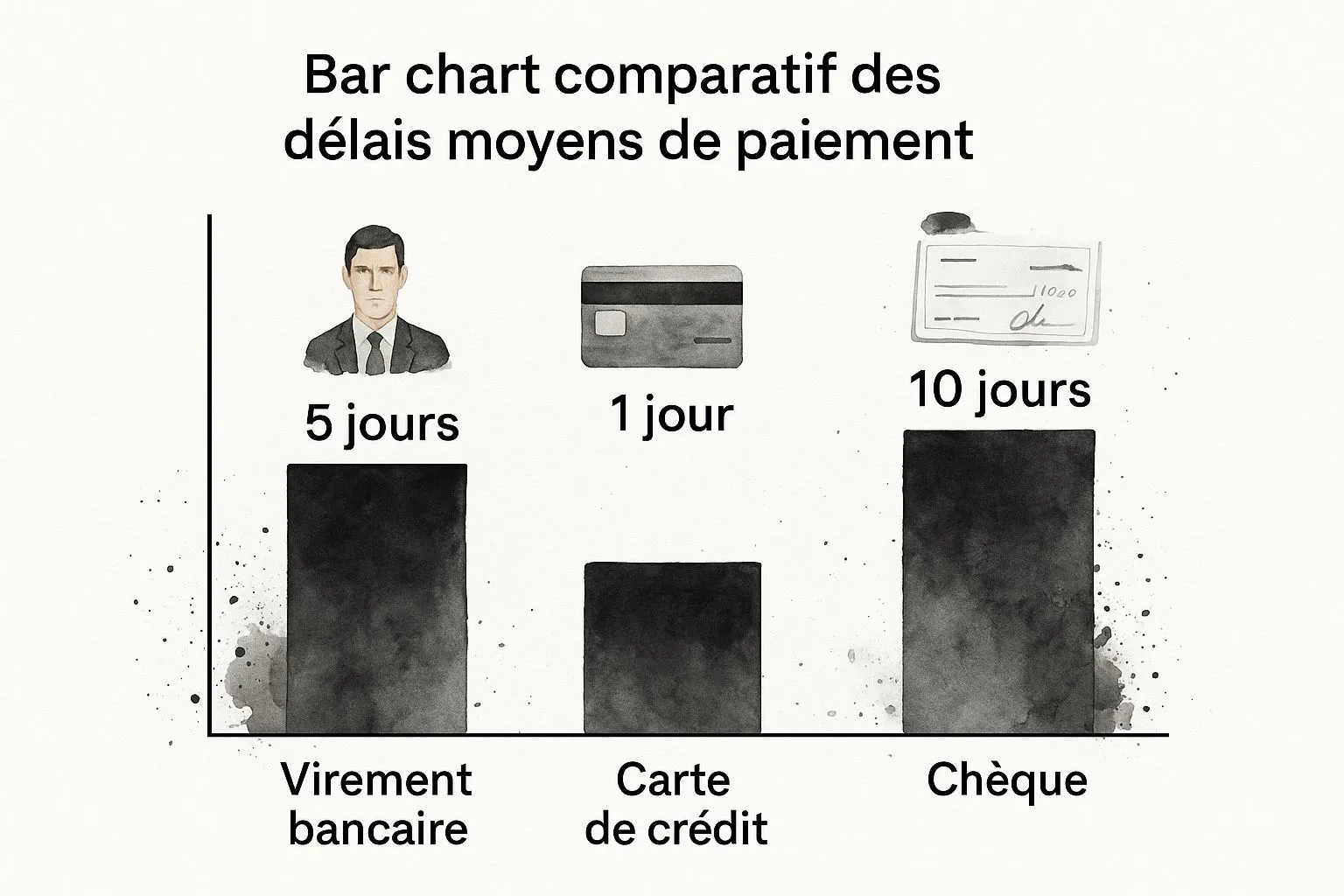
The following chart compares the average time to receive funds depending on the payment method used.
This visual clearly shows that credit card and bank transfer are significantly faster than checks. This is a key factor to consider when optimizing your cash flow.
Quick comparison of payment terms
To help you navigate, nothing beats a summary table. This table helps you choose the best option by analyzing the impact of each payment type on your cash flow, flexibility for the client, and the associated risk.
| Payment type | Impact on your cash flow | Flexibility for the client | Risk level for you |
|---|---|---|---|
| Upfront payment | Excellent. Money available immediately. | Low. Can be a deterrent for large amounts. | Very low. Payment is secured from the start. |
| Deposit | Good. Secures part of the cash flow at the start. | Medium. The financial effort is spread over time. | Low. The risk of non-payment on the balance exists but is reduced. |
| Payment on terms | Poor. You’re extending credit to your client, direct impact on cash flow. | High. Very comfortable for the client. | High. Significant risk of non-payment or late payment. |
Each option has its pros and cons. Upfront payment is ideal for security, the deposit creates a perfect balance, and payment on terms is a strong commercial gesture, but a risky one. It’s up to you to juggle intelligently between these three pillars.
Drafting payment clauses that truly protect you

Your quotes and invoices aren’t just paperwork. Think of them instead as legal shields. Well drafted, they can save you a lot of hassle and secure your cash flow. Effective payment terms aren’t just about stating a due date.
To be fully protected, you need to include clauses that anticipate problems and give you leverage. It’s like armor: each clause adds a layer of protection.
The trick is to phrase them clearly and with solid legal grounding so they’re indisputable. That’s how a simple invoice becomes a fortress against unpaid bills. By the way, to revisit the basics, feel free to check out our complete guide to creating a sole trader invoice.
The late payment penalty clause
This is your first line of defense. It has a clear deterrent effect and, above all, it allows you to claim financial compensation from the very first day of delay, without even needing to send a reminder. The law is on your side, provided it’s clearly written down.
Regulations are quite strict on payment deadlines between businesses. By default, it’s 30 days. But watch out, there are exceptions depending on the sector. For example, it’s 30 days maximum for transport, but it can go up to 55 days end of month for agricultural equipment.
An example clause you can copy and paste:
“In accordance with Article L. 441-10 of the French Commercial Code, any late payment results in the application of late payment penalties. These are due the day following the payment date shown on the invoice, without the need for a reminder. Their rate is equal to the interest rate applied by the European Central Bank to its most recent refinancing operation, plus 10 percentage points.”
Compensation for collection costs
In addition to penalties, the law provides a small allowance to cover your administrative efforts when you have to chase your money. This is a flat-rate compensation of €40, automatically added for each overdue invoice. It’s a right, so don’t forget to mention it!
A simple line to add:
“In addition to these penalties, a flat-rate compensation for collection costs of €40 applies, due as a matter of right. If the collection costs actually incurred exceed this amount, additional compensation may be claimed upon presentation of supporting documents.”
The powerful retention of title clause
This one is a real game-changer if you sell physical goods. In short, it states that you remain the owner of the goods until full payment has been made. If the client doesn’t pay, you have the right to reclaim your goods.
It’s a formidable legal tool, especially if your client runs into financial trouble.
Here’s a simple wording for this payment term:
- Clear, simple, and effective: “The seller retains ownership of the goods sold until full payment of the price, principal and incidental costs included, has been made. Failure to pay any of the installments may result in the goods being reclaimed.”
By intelligently combining these three clauses, you’re not just telling your client when they need to pay you. You’re putting in place a solid framework that actively protects your business from financial trouble.
Our practical tips for small businesses and sole traders
For a small business like yours, every invoice counts. It’s a bit like the fuel for your activity. So it’s not just about patiently waiting for the money to arrive, but about taking the initiative to secure your cash flow. The key? Anticipation. Setting up simple habits so that payment becomes a formality for your clients, not an obstacle course.
This approach starts well before the invoice is issued. It’s built from the very first exchanges, by laying healthy, clear foundations.
Take the temperature before committing
Before starting a large project, especially with a client you don’t know, a quick check can save you from major setbacks. Far be it from me to turn you into a private investigator, but there’s publicly available information that’s very easy to access.
Online platforms let you check a company’s apparent financial health for free. It’s a quick habit that gives you an initial idea of how reliable your counterpart is. Think of it like checking the weather before a long hike: a little caution never hurts.
Set up rock-solid invoice tracking
Don’t wait until the due date to wonder where your invoice stands. Proactive follow-up is your best insurance against delays.
- Acknowledgment of receipt: A simple email right after sending the invoice is enough. A “Hello, I’m confirming receipt of our invoice #XXXX” helps avoid the classic excuse of “Oh really? I never received it.”
- The friendly reminder: A week or so before the deadline, a courteous message often works wonders. “Just a quick note to remind you that our invoice is due next week. Feel free to reach out if you have any questions!”
- Smart automation: Use a good invoicing tool to schedule automatic reminders. It’s a huge time-saver and frees you from a considerable mental load, while ensuring consistent, professional follow-up.
Regular, courteous follow-up isn’t harassment. On the contrary, it’s a sign of a well-organized, serious business.
If a delay happens anyway, you need to act quickly. To find out how to proceed step by step, our guide on collecting outstanding client invoices will give you a clear and effective method to follow.
One last look around: your questions about payment terms
Even when you think you’ve covered everything, practice always raises its share of questions. That’s perfectly normal. So let’s go over the most common questions entrepreneurs ask, to give you clear, directly usable answers. The idea is to put your doubts to rest so you can manage your invoicing with confidence.
Here, we’ll skip the dense legal jargon. We’re talking practical, concrete matters to help you handle the situations you face day to day.
Can I really require a deposit from my clients?
Yes, without hesitation. Requesting a deposit isn’t just a right — it’s above all an excellent business practice. It’s a particularly sound habit to secure the launch of a large project or when working with a new client for the very first time.
To make it indisputable, the deposit must be clearly stated in black and white on your quote. The client’s signature on this document constitutes acceptance. There’s no amount set by law, but a deposit of 30% of the total amount is a widespread and well-accepted practice in many sectors.
What if a client refuses to sign the quote — should I start work anyway?
Definitely not! You need to resist the temptation to start work without a signed quote or a proper contract in place. It’s not just an administrative formality; it’s the material proof of the agreement that binds you. It’s this document that validates the scope of work, the price, and, of course, the payment terms.
Starting a project without this written agreement is a bit like heading out to sea without a compass. In the event of a disagreement or, worse, an unpaid invoice, you expose yourself to enormous risk, because proving what was agreed becomes an almost impossible task.
Do late payment penalties apply automatically?
Yes, in theory. The law states that late payment penalties and the flat-rate compensation for collection costs are due “as a matter of right.” In practical terms, this means they start accruing the day after the invoice due date, without you even needing to send a reminder.
But watch out, there’s one non-negotiable condition for being able to claim them: they must absolutely appear on your business documents.
- On your invoices: The penalty rate must be stated there. It’s a legal obligation.
- In your Terms and Conditions of Sale: This is the document that sets the framework for all your collaborations.
If you forget this mention, you simply won’t be able to claim these penalties in case of a delay.
How do I go about changing my payment terms with a regular client?
Changing the rules of the game partway through, especially with a loyal client, is never a decision you can make alone. Any change to payment terms must be the subject of a mutual, formalized, and unambiguous agreement.
The first step is to discuss it openly with your client. Explain why you want to adjust your terms. Once you’ve reached an agreement, it’s essential to put it in writing. This can take the form of an amendment to the original contract or simply signing your new Terms and Conditions of Sale.
Ready to say goodbye to invoice stress and time-consuming manual management? Bizyness is the tool designed for sole traders and small businesses who want to level up. Create compliant invoices in just a few clicks, track your payments in real time, and stay in control of your cash flow effortlessly. Simplify your daily routine today by discovering the Bizyness solution.
