
Pro Forma Invoice Examples: 6 Templates Explained for 2025
Discover our complete guide with each pro forma invoice example broken down. Master the creation of your documents for trade, services and more.
A pro forma invoice is far more than a simple quote. It is an essential business document that opens a discussion, secures an international transaction, or validates a complex project before any final invoice is ever issued. Yet its structure and use vary enormously depending on the industry, and mastering its subtleties can turn a simple exchange into a closed sale. An error or omission can lead to delays, misunderstandings with the client, or administrative hold-ups, especially internationally.
This article aims to clarify this process. We are going to break down in detail 6 concrete pro forma invoice examples, ranging from international trade to digital services, via manufacturing. For each pro forma invoice example, we won’t just present a template. We will analyze the essential fields, the drafting strategies to avoid disputes, and the tips for turning it into a genuine negotiation tool.
The goal is simple: to give you practical templates and actionable advice for creating documents that are clear, professional, and perfectly suited to each situation. You will learn how to secure your sales, professionalize your exchanges, and use the pro forma invoice as a strategic lever for your business.
1. Pro Forma Invoice for International Trade
The pro forma invoice is a fundamental document in international trade. Unlike a final commercial invoice, it acts as a detailed offer or quote, sent by the exporter to the importer before the transaction is finalized. Its role is to provide the buyer with all the information needed to make a decision, obtain import authorizations, arrange financing, or open a letter of credit.
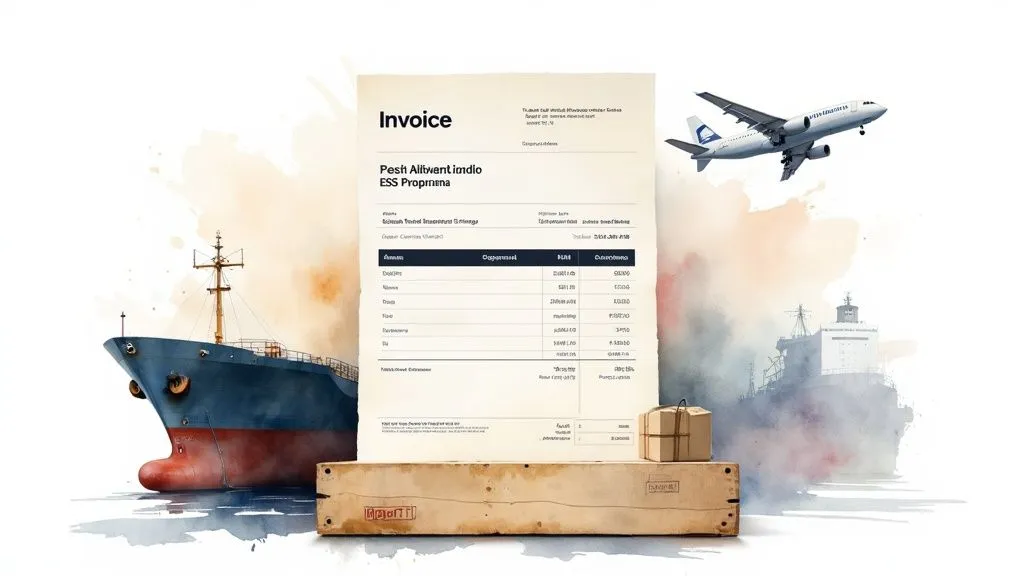
This type of pro forma invoice is essential because it aligns both parties’ expectations on the details of the transaction well before goods are shipped. It is a promise of sale that, once accepted, serves as the basis for creating the final commercial invoice.
Strategic analysis of this example
The effectiveness of an international pro forma invoice rests on its precision and clarity. It must anticipate all customs and logistics requirements to avoid delays and unexpected costs.
- Clarity of responsibilities: The use of Incoterms (e.g. EXW, FOB, CIF) is crucial. They precisely define who, buyer or seller, is responsible for costs and risks at each stage of transport.
- Customs precision: Including HS codes (Harmonized System) for each product is non-negotiable. An error in these codes can lead to customs penalties, seizures, or incorrect tariff classification.
- Financial security: Payment terms (e.g. SWIFT transfer, letter of credit) must be spelled out to secure the transaction for both parties.
Key point: The pro forma invoice in an international context is not just a commercial document, but a risk-management and logistics-facilitation tool. Its compliance is the first step toward a successful export.
Practical applications and tips
To use this pro forma invoice example effectively, here are concrete actions to implement:
- State a validity date: Raw material prices, exchange rates, and shipping costs fluctuate. Set a clear validity period (e.g. 30 days) to protect your margin.
- Detail your banking information: For international payments, include your full bank details (IBAN, SWIFT/BIC code) to avoid any payment error or delay.
- Ensure consistency: The final commercial invoice must exactly mirror the accepted pro forma invoice. Any discrepancy can lead to customs complications and disputes. To learn more about the structure of this document, check out our detailed guide on the pro forma invoice.
2. Pro Forma Invoice for Professional Services
For service businesses — whether consultants, marketing agencies, or freelancers — the pro forma invoice is an essential contracting tool. It acts as a detailed quote describing the scope, cost, and terms of the professional services before any work begins. Its main purpose is to set clear expectations and obtain the client’s formal agreement, thereby securing the business relationship before resources are committed.

This type of pro forma invoice turns a business proposal into a near-contractual agreement. Once accepted by the client (often via a signature), it serves as the reference document throughout the project and as the basis for final billing, whether on completion or in stages.
Strategic analysis of this example
The effectiveness of a services pro forma invoice rests on its ability to eliminate any ambiguity. Unlike selling a tangible product, a service can be subjective. This document must therefore precisely frame the collaboration.
- Defining the scope: The “Description of services” section is the most critical. It must be exhaustive, detailing deliverables, project phases, and what is not included, in order to avoid scope creep.
- Structuring payments: A payment schedule based on milestones (e.g. 30% upfront, 40% on delivery of the mockup, 30% on go-live) is strategic. It secures the provider’s cash flow and keeps the client engaged throughout the process.
- Managing the unexpected: Including clauses for change requests (“change orders”) or possible additional costs is an indispensable risk-management practice.
Key point: In the services sector, the pro forma invoice is as much a project-management instrument as a financial document. It sets the ground rules and protects both parties against misunderstandings.
Practical applications and tips
To use this pro forma invoice example to strengthen your client relationships and secure your revenue, follow these tips:
- Detail deliverables precisely: Instead of “Website creation,” write “Design of 5 pages (Home, About, Services, Blog, Contact) with contact form integration and responsive design.”
- Specify completion conditions: Clearly define what constitutes the end of the project and triggers final billing. For example, “The project will be considered complete after two rounds of client feedback and final validation by email.”
- Include your terms and conditions: Attach or reference your T&Cs, which spell out the terms in case of late payment, project cancellation, or intellectual-property disputes. To streamline this process, using invoicing software for service providers can automate the inclusion of these crucial elements.
3. Pro Forma Invoice for Manufacturing
In the manufacturing sector, the pro forma invoice is an indispensable planning and negotiation tool, especially for custom, bulk, or made-to-order products. This document is issued by the manufacturer to give the client a detailed quote that goes well beyond a simple price. It includes technical specifications, estimated production lead times, and cost breakdown before manufacturing begins.
This pro forma invoice example allows the buyer to validate the technical and budgetary feasibility of their project, plan their inventory, or integrate the product into a larger production chain. For the manufacturer, it is the document that formalizes the offer and protects both parties by clearly defining the scope of the order before committing costly production resources.
Strategic analysis of this example
The effectiveness of a manufacturing pro forma invoice lies in its ability to anticipate the complexities of production and align expectations. It must serve as a detailed preliminary contract, minimizing the risk of misunderstandings about the final product.
- Detailed technical specifications: It is crucial to precisely list materials, dimensions, tolerances, finishes, and other technical characteristics. This ensures the final product matches the client’s expectations exactly.
- Lead-time transparency: Clearly stating production lead times, including raw material sourcing, manufacturing, quality control, and shipping, is essential for the client’s planning.
- Protective clauses: Including specific clauses (e.g. raw material cost variation, force majeure) protects the manufacturer against contingencies that could affect margins and production capacity.
Key point: The manufacturing pro forma invoice is not a simple price quote, but a contractual roadmap defining the “what,” “how,” and “when” of a complex order, thereby securing the client-supplier relationship.
Practical applications and tips
To use this type of pro forma invoice and optimize your production processes, here are concrete actions to implement:
- Detail quality-control procedures: Specify the inspection steps and criteria that will be applied. This reassures the client about the final product’s quality and sets an objective standard in case of dispute.
- Include price-adjustment clauses: For long-term orders, include a price-indexing clause tied to raw material costs to protect your profitability against market volatility.
- Clarify packaging and logistics requirements: Precisely describe how products will be packaged, palletized, and shipped. A clear description avoids transport damage and unexpected additional costs.
4. Pro Forma Invoice for a Digital Product
In the digital economy, the pro forma invoice adapts to formalize the sale of intangible goods such as software, SaaS (Software as a Service) subscriptions, or online training. This document is sent to a potential client, often a business, to detail the cost of a license, service access, or a development project before any contractual commitment. It serves as a formal quote specifying service levels, included features, and terms of use.
For companies like Adobe, Microsoft, or Salesforce, this tool is indispensable in B2B sales cycles. It allows a complex offer to be presented in a structured way, including, for example, licenses for a certain number of users, add-on modules, or premium support services. The client’s acceptance of this pro forma triggers the creation of the service contract and final billing.
Strategic analysis of this example
The challenge with a pro forma invoice for a digital product is translating intangible services into a tangible, unambiguous offer. Clarity is key to avoiding misunderstandings about the scope of the services provided.
- Defining the scope: It is crucial to precisely list included features, limits (number of users, storage capacity), and access levels. For example, clearly differentiating a “Business” plan from an “Enterprise” plan.
- Hidden-cost transparency: Onboarding, data migration, or training fees must be explicitly stated. Omitting these costs can create significant friction after signing.
- Service commitment (SLA): For critical services, stating uptime guarantees or technical support response times adds significant value and justifies the price.
Key point: This pro forma invoice example doesn’t sell a product, but access to a solution. Its value lies in its ability to precisely define the terms of that access and the service guarantees that come with it.
Practical applications and tips
For a digital product pro forma invoice to convert a prospect into a client, it must be flawless:
- Clarify license terms: Specify the license duration (monthly, annual), renewal terms (automatic or manual), and cancellation policy.
- Detail technical support: State available support channels (email, phone, chat), business hours, and guaranteed response times (SLA). This reassures the client about the quality of after-sales service.
- Mention customization options: If integrations with other software or custom development are possible, describe them along with their associated cost. This demonstrates the flexibility of your solution and lets the client picture the outcome.
5. Pro Forma Invoice for Construction and Projects
In the construction sector and complex project management (engineering, industrial installations), the pro forma invoice is a strategic document. It goes well beyond a simple quote, acting as a detailed financial and operational proposal that lays out project phases, materials, labor costs, and projected timelines. Its purpose is to give the client a comprehensive view of the financial commitment and complexity of the project before any contract is signed.
This document is the cornerstone of planning, allowing the client’s expectations to be aligned with the provider’s technical and budgetary constraints. For large-scale projects such as building commercial buildings or infrastructure development, this pro forma invoice example is essential for securing financing and launching material orders.
Strategic analysis of this example
The effectiveness of a construction pro forma invoice depends on its ability to anticipate variables and clearly structure a long, complex project. It must be both a sales tool and an initial planning document.
- Cost granularity: The document must break down costs by phase or work package (foundations, structural work, finishing work). This structure, often based on a work breakdown structure (WBS), provides full transparency and facilitates budget tracking.
- Managing contingencies: Including contingency margins for unforeseen events (weather delays, supply issues) is a standard practice. It demonstrates professionalism and proactive risk management.
- Contractual framework: The pro forma invoice must clearly specify the approval process for change orders. This avoids future disputes over additional work not originally planned.
Key point: In construction, the pro forma invoice is not a simple estimate, but a genuine project roadmap. Its accuracy determines the profitability of the job and the client’s satisfaction.
Practical applications and tips
To maximize the impact of this pro forma invoice example, here are concrete actions to apply:
- Tie payments to milestones: Structure the payment schedule around the completion of key project phases (e.g. 20% after foundations are finished). This secures your cash flow and drives progress.
- Detail material specifications: Be extremely precise about brands, references, and standards for materials to prevent substitution with lower-quality products and ensure compliance with the specifications.
- Include administrative timelines: Factor in the estimated time needed to obtain building permits and mandatory inspections. These external factors have a direct impact on the overall project schedule. To streamline the creation of these documents, using invoicing software specialized for construction is strongly recommended.
6. Pro Forma Invoice for Wholesale and Distribution
In the wholesale and distribution sector, the pro forma invoice is a strategic tool for managing high-volume transactions. It serves as a formal quote for bulk purchases, seasonal orders, or the introduction of new product lines. This document allows retailers and distributors to plan their inventory investments, negotiate commercial terms, and secure financing before placing a firm order.
This type of pro forma invoice is crucial for B2B (Business to Business) relationships because it establishes a clear framework for complex orders. It is used by players such as fashion wholesalers supplying store chains, or food distributors like Sysco supplying supermarkets and restaurants. The document details not only prices but also the logistics and promotional terms that frame the collaboration.
Strategic analysis of this example
The pro forma invoice in distribution is not just a price quote; it is a negotiation and logistics-planning instrument. Its effectiveness depends on its ability to anticipate both parties’ needs to optimize the supply chain.
- Cash-flow management: By specifying payment terms and offering early-payment discounts, the wholesaler secures cash flow while the buyer optimizes costs. It is an essential negotiation lever.
- Inventory planning: Detailed delivery schedules (for example, partial deliveries, delivery windows) are vital. They allow the retailer to avoid overstocking or stockouts, ensuring optimal product turnover.
- Marketing and sales support: Including terms such as marketing development funds (MDF) or promotional support turns the invoice from a transactional document into a partnership agreement.
Key point: In wholesale, the pro forma invoice is a preliminary contract that aligns financial, logistics, and marketing objectives between supplier and distributor, laying the groundwork for a profitable business relationship.
Practical applications and tips
To make the most of this pro forma invoice example in a distribution context, here are concrete actions to implement:
- Include return policies: Clearly define the conditions for returning or exchanging unsold goods. This transparency is a strong sales argument and limits future disputes.
- Specify quality guarantees: Detail product guarantees and quality standards. This is an essential trust marker, particularly for food or electronics products.
- Detail promotional support: If you offer marketing support (POS displays, participation in advertising campaigns), price it and include it in the pro forma. This demonstrates the added value of your partnership beyond the product itself.
Comparison of the 6 typical pro forma invoice examples
| Type of Pro Forma Invoice | 🔄 Implementation Complexity | 💡 Resources Needed | 📊 Expected Results | 🏷️ Ideal Use Case | ⭐ Key Advantages |
|---|---|---|---|---|---|
| International Trade Pro Forma Invoice | Medium | Customs expertise, regulations | Faster customs clearance, financing | International exporters/importers | Facilitates licenses, reduces trade risks |
| Professional Services Pro Forma Invoice | Medium | Project management skills | Clear terms, client approval | Consultants, marketing agencies, freelancers | Clarifies scope, protects against scope creep |
| Manufacturing Pro Forma Invoice | High | Technical knowledge, production plans | Accurate planning, sourcing cycles | Custom product manufacturers, bulk orders | Supports production planning and sourcing |
| Digital Products Pro Forma Invoice | Low to Medium | Understanding of SaaS/licensing models | Subscription comparison, internal approvals | SaaS software vendors, digital platforms | Clarifies complex subscriptions and support options |
| Construction & Projects Pro Forma Invoice | High | Technical expertise, construction regulations | Project cost transparency, financing | Construction projects, heavy engineering | Cost transparency, early risk identification |
| Wholesale & Distribution Pro Forma Invoice | Medium | Inventory management, commercial negotiation | Inventory optimization, bulk purchase financing | Wholesalers, distributors, retail chains | Inventory planning, better purchasing terms |
Simplify Your Pro Formas: The Takeaways to Act On
At the end of our detailed exploration of the different types of pro forma invoices, a common thread emerges: this document is far more than a simple administrative formality. It is a strategic tool for communication, negotiation, and planning. Every pro forma invoice example analyzed, from international trade to digital services, highlights the importance of precision, anticipation, and clarity.
Mastering the pro forma invoice means laying the foundations for a transparent, professional client relationship. By providing a complete, unambiguous document, you eliminate potential friction, secure each party’s expectations, and speed up the sales cycle. It is a mark of credibility that sets savvy entrepreneurs apart.
Key Takeaways
To turn this knowledge into action, focus on these three fundamental pillars:
- Adapt to context: As we’ve seen, a pro forma for export doesn’t have the same requirements as a pro forma for a construction project. Customization isn’t optional — it’s a necessity. Always identify the critical information for your industry and your client (HS codes, incoterms, specific payment terms, etc.).
- Prioritize precision: Vague estimates lead to costly misunderstandings. Every line, from product descriptions to delivery terms, should be as precise as possible. This includes costs, timelines, and each party’s responsibilities. A precise pro forma is the best insurance against future disputes.
- Anticipate needs: A great pro forma invoice doesn’t just answer the client’s questions — it anticipates them. By including information on guarantees, return conditions, or next steps, you demonstrate professionalism and make it easier for your prospect to decide to buy.
Take Action: Your Next Step
Theory is essential, but practice is what delivers results. To apply these principles effectively without spending excessive time on them, automation is your best ally. Using the right invoicing tool lets you standardize your best practices, avoid data-entry errors, and ensure every document issued is compliant.
By integrating the lessons from each pro forma invoice example into a reliable management system, you don’t just save time. You build a solid sales process, strengthen your clients’ trust, and free up valuable mental bandwidth to focus on growing your business. The pro forma invoice then becomes a genuine performance lever, an instrument working for your success.
Ready to create professional, compliant pro forma invoices in just a few clicks? Bizyness is the management and invoicing tool designed for freelancers and SMEs in France, simplifying every step of the process. Try Bizyness today to turn your administrative management into a competitive advantage.
