

 Français
Writing a Winning Quote for a Professional Logo
Master every step of writing a clear, professional quote for a logo: pricing, essential clauses, templates and follow-up to win over your clients.
In my view, a logo quote should combine a clear presentation of your service, transparent pricing and a solid contractual framework. This trio quickly dispels doubts and makes the conversation with your client easier.
A good first impression comes from polished formatting, but also from details that reassure right away.
Structuring a quote for a logo
Always start with a clear header that includes your details and the client’s. This immediately sets a professional tone.
- Title and date to situate the document
- A precise description of the mission and the deliverable
- Pricing (excl./incl. VAT), with any options
- Payment terms, deadlines and the quote’s validity period
Each precise section avoids misunderstandings and speeds up decision-making.
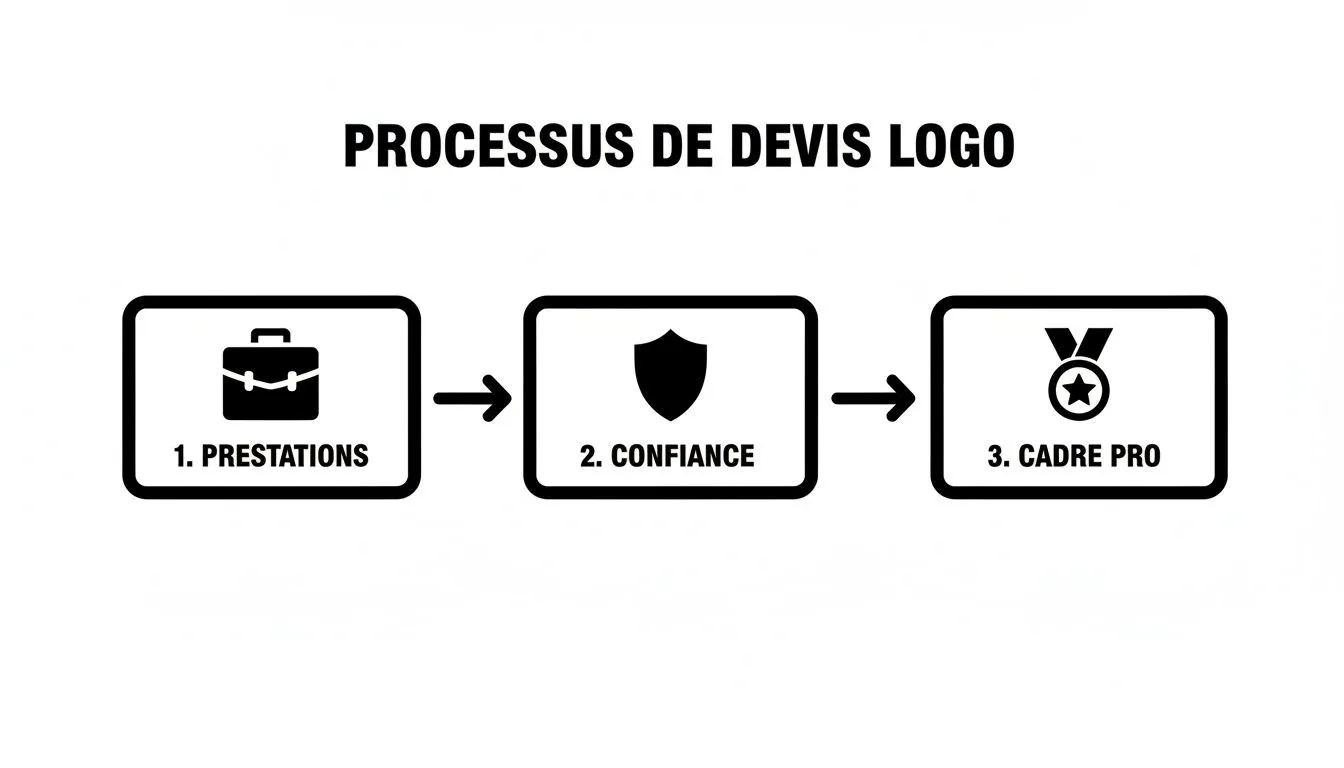
This infographic is a reminder that a clear quote builds trust before the first meeting even happens.
Key points of the quote
Before diving into the details, keep these fundamentals in mind:
| Key element | Why it matters |
|---|---|
| Description of the service | Helps the client understand the offer |
| Pricing (excl./incl. VAT) | Ensures financial transparency |
| Payment terms | Prevents disputes |
| Delivery timeline | Frames expectations and avoids misunderstandings |
Each line strengthens the credibility of your proposal and guides the client toward a quick approval.
To go further, here are a few tips from my own experience:
- Carefully proofread every amount to avoid typos.
- Adapt the vocabulary to the client’s industry — it’s an obvious plus.
- Add a small graphic element (your visual signature) as a watermark.
Adjusting the price to the complexity
Generally, a fixed price works well for projects with a clear, well-defined brief. On the other hand, an hourly rate is preferable whenever the request is likely to evolve.
- Choose a fixed price for simple, repetitive assignments.
- Plan for an hourly rate if the brief could change along the way.
- Add a revision clause once the moodboard is validated.
This flexibility lets you protect your margin while staying fair.
Common mistakes to avoid
- Not detailing the research and inspiration phase.
- Omitting the clause on usage rights.
- Neglecting the withdrawal or cancellation terms.
Anticipating these points avoids a lot of headaches and protects both parties.
Key actions to remember
- Check the accuracy of every figure before sending.
- Adjust your proposal to the client’s size and industry.
- Send a secure PDF along with a personalized message.
- Use Bizyness to automate follow-ups and tracking.
Ready to send your first quote?
Determining your pricing for a logo
Setting your prices for a logo can quickly become a headache. Yet by untangling two simple approaches — fixed price vs. hourly rate — you get a quote that is both clear and balanced. Each option has its strengths, depending on the type of brief and the client’s expectations.
On one hand, a fixed price sets a budget with no surprises for a well-scoped project. On the other, the hourly rate adapts to assignments that keep evolving. What matters is always including:
- the research and moodboard phase
- the creation of visual proposals
- revisions up to final delivery
Comparing fixed price and hourly rate
Before deciding, here’s an overview of the advantages and limitations of each method.
Comparison of fixed price and hourly rate
| Criterion | Fixed price | Hourly rate |
|---|---|---|
| Predictability | Budget locked in from the start | Adjusted based on actual time spent |
| Flexibility | Less flexible if the brief evolves | Ideal for frequent changes |
| Coverage of extras | Usually included up to N revisions | Billed per extra hour |
| Project tracking | Simplified, single timeline | Detailed breakdown of tasks |
Depending on the nature of the project and how clear the brief is, you’ll choose one or the other. A fixed price reassures on a clean-cut design; hourly billing protects your revenue when the brief remains fluid.
Estimating time and budget
To go from quote to reality, estimate your working hours precisely:
- Research and moodboard: 1 to 3 hours
- Sketches and initial proposals: 2 to 6 hours
- Adjustments and revisions: 1 to 8 hours
- Finalizing files (vector, PNG, PDF): 1 to 3 hours
This process usually adds up to 5 to 20 hours, but some highly detailed styles — vintage, illustrative — can exceed 30 hours.
A real-world example
- Minimalist logo for a tech start-up: fixed price of €800
- Full identity for a craftsman: €1,800 on an hourly basis (€60/h × 30h)
Expert tip
Plan for at least 20% margin to absorb unexpected changes.
In 2024, France set a record with 1,111,200 business creations. The average budget for a logo among specialized agencies ranges between €500 and €2,000. To learn more about these figures, head over to Tool Advisor.
Adjusting for the client’s sector
Your client’s profile strongly influences the average budget:
- Local SMBs: €500 to €1,000 as a fixed price
- B2B companies: €1,200 to €2,500 depending on expertise
- Fast-growing start-ups: packages starting at €3,000
Don’t forget the 30% deposit when the quote is signed. Other good practices:
- Clearly state the number of deliverables (versions, formats)
- Specify usage rights (web, print, exclusivity)
- Set a validity period for the quote (typically 30 days)
Defending your pricing without stress
Transparency in your presentation works wonders:
- Include a visual summary of the key steps
- Detail your working methodology
- Offer a timeline with clear milestones
A client who understands the value of each phase negotiates less.
“A transparent quote reduces post-proposal negotiations by 50%”
– testimonial from a well-known agency
To strengthen your position, lean on client feedback or your portfolio. A concrete demonstration of your successes builds trust.
Presenting your price range
Offer three clear formulas to guide the client’s choice:
| Offer | Description | Price (€) |
|---|---|---|
| Basic | 1 proposal + 2 revisions | 500 |
| Standard | 3 proposals + 5 revisions | 1,200 |
| Premium | 5 proposals + unlimited revisions | 2,000 |
- The basic offer suits smaller budgets
- The standard formula balances options and adjustments
- The premium package targets complex projects
Using industry benchmarks
Position yourself relative to the competition:
- Food industry: €600 to €1,200
- Events: €800 to €2,500
- Health and wellness: €1,000 to €3,000
- E-commerce: €700 to €2,000
Take seasonality and promotions into account. A tool like Bizyness centralizes this data to help refine your proposals.
To go further, check out our detailed guide on service pricing
Discover our complete pricing grid
In short, the choice between a fixed price and an hourly rate depends on how much flexibility your project requires. The fixed price is ideal for a well-defined scope; the hourly rate is perfect for handling changes. With this method, your logo quote becomes a solid, obvious commercial asset.
Writing a quote that complies with legal requirements
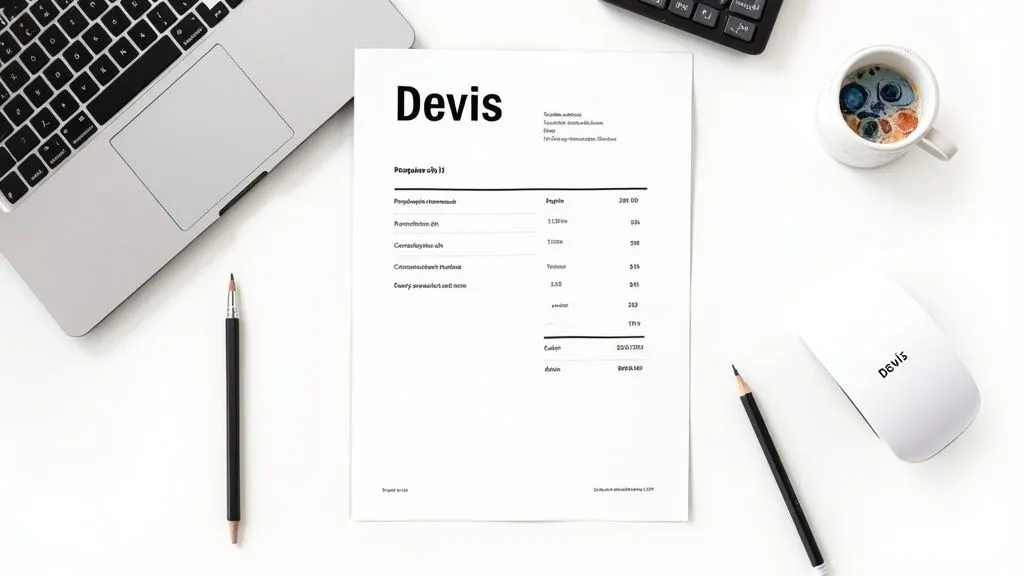
A logo creation quote must meet precise rules. These mentions provide legal protection and build trust from the very first exchange. Every detail matters to avoid misunderstandings and establish your professionalism.
Mandatory mentions on the quote
First and foremost, make sure to include all of the following legal and administrative information:
Mandatory mentions on the quote
| Element | Description |
|---|---|
| Full contact details | Postal address, SIRET number, phone and email |
| Precise description of the service | Details of the logo (typography, colors, delivered format) |
| Amount excl. VAT | Pre-tax amount for each service |
| VAT rate and amount | Applicable rate and corresponding amount |
| Payment terms | Terms, deadlines, deposit amount |
| Validity period | Period during which the offer remains valid |
| Withdrawal terms | Procedure and cancellation deadlines |
With this checklist, your quote gains clarity and complies with the French commercial code.
Annotated quote example
Imagine a freelancer offering to create a logo for a fixed price of €1,200 excl. VAT with 20% VAT. The offer is valid for 30 days, and the requested deposit is 30% upon signature.
Key strengths to highlight:
- Legible contact details: address, SIRET, email and phone.
- Detailed pricing: pre-tax amount, VAT rate and VAT amount.
- Payment terms: deadlines, payment methods and late-payment penalties.
A precise quote reduces clarification requests by 30% and speeds up signature.
Including tax mentions
Whether you’re subject to VAT or exempt, always specify your regime:
- Sole trader/micro-entrepreneur: add the mention “VAT not applicable, article 293 B of the French General Tax Code”.
- VAT-registered: detail the rate (5.5%, 10%, 20%) and the VAT amount.
Also don’t forget the validity period (typically 30 days) and the 7-day withdrawal right. In case of cancellation, state whether the deposit is kept or refunded.
For further insight, note that 150,000 monthly searches relate to logo quotes and that SMBs allocate an average of €800 to €3,000. Discover more insights on logo design trends.
Also read: find out more about the mandatory mentions on a quote to strengthen your legal security.
Tips for a clear presentation
An airy layout makes reading easier and highlights each section. Consider:
- Using boxes to emphasize totals.
- Adding simple icons to illustrate deliverables and deadlines.
- Offering a visual summary at the top of the document.
Electronic signature, which is legally valid, reinforces your professionalism and reassures your client.
Checking before sending
Don’t overlook this final step:
- Reread every mention to catch anything missing.
- Double-check the excl.-VAT, VAT and incl.-VAT calculations.
- Test opening the PDF on different devices.
A cross-check with a colleague or expert is the best guarantee of an error-free quote. Then send it as a secure PDF and keep the delivery receipt to limit disputes.
Bizyness automates the generation of compliant quotes by including all mandatory legal mentions. In just five minutes, Marie, a freelance visual communication designer, produced a precise, complete quote. Result: her client approved it within 48 hours thanks to a clear document.
A rigorous quote guarantees a peaceful client relationship. Take care of every detail, master your clauses and secure your business.
Including essential clauses
Writing precise clauses is like laying down rails: everyone knows where they stand. You avoid scope creep, protect your time and give the client a clear view of the project.
To avoid chasing endless approvals, anticipate needs:
- describe each version (color, monochrome, black and white)
- list the deliverables (.AI, .SVG, .PNG, .JPG)
- state the surcharge for an express deadline
Finally, an intellectual property clause removes any ambiguity about ownership of the logo. Also think about splitting rights if several creatives work together: credits, sharing, approvals — everything must be calibrated.
Usage rights
Usage rights are the backbone of the quote. You need to specify:
- exclusive or non-exclusive license
- authorized media (web, print, social networks)
- duration, territory and any restrictions
Don’t forget to detail the possibility of later modifications. And if the brief is delayed, mention a re-billing clause: beyond day 7, the hourly rate automatically applies.
Number of deliverables
Limiting the number of proposals helps you stay productive and meet your deadlines. Here’s an example package:
- 2 to 3 design directions for a simple logo
- vector and web-ready versions (.AI, .SVG, .PNG, .JPEG)
- an express option with shortened deadlines
- additional deliverables (favicon, mobile variant)
Each extra can become an additional fixed fee, adjusted to the client’s needs.
Revision limits
Back-and-forth rounds pile up quickly. You can offer 2 free rounds of revisions, then switch to an hourly rate or a small additional fixed fee.
“Limiting revisions to 2 rounds keeps the budget in check and speeds up approval.” – feedback from an agency
Also specify that each round must be approved in writing before moving to the next phase.
Delivery timelines
Breaking the process into clear stages helps you control timing:
- first proposal within 5 business days
- client feedback within 3 days
- final version 2 days after approval
- express option in 48 hours (+ 30% of the fixed price)
In August 2025, France hit a record with 102,961 businesses created, and agencies report a 28% increase in logo quote requests. To dig deeper into these figures, see this business creation trend.
Deposits and penalties
A 30% deposit at signature is the minimum to secure your cash flow. Specify the cancellation and refund terms:
| Clause | Default detail |
|---|---|
| Deposit | 30% at signature |
| Late penalties | 10% of the incl.-VAT amount per week of delay |
| Deposit refund | Non-refundable if cancelled less than 7 days out |
To stay fair, include a 7-day tolerance period before penalties apply. A weekly rate of 3 to 5% is typical.
Real-world examples
For a local SMB, I’ve often proposed:
- fixed price of €1,200 (3 deliverables, 2 revisions)
- €360 deposit upon order
- express delay (3 days) at + 20%
- 5% penalties after 7 days of delay
For a tech start-up project, the package looks like this:
- 5 initial proposals
- 3 free rounds of feedback
- .SVG, .PDF, .PNG exports
- 40% deposit of the total amount
Tips for customizing
Adapt each clause to the client’s context and the legal framework. Don’t forget to:
- mention the VAT exemption for sole traders/micro-entrepreneurs
- clarify the terms for express deadlines
- add a confidentiality clause if needed
- plan for post-delivery support for small adjustments
- define the preferred communication channel (email, platform, video call)
A detailed quote reduces pre-approval questions by 30%. To save time, use Bizyness and its ready-to-use clause templates: every point is already calibrated, you just need to adjust it.
Practical examples of logo quotes
To better understand, let’s explore three typical configurations: micro-business, SMB and start-up. Each corresponds to a different need and a specific budget. You’ll see how to structure your offers and reassure your client from the very first presentation.
Micro-business template
Here, simplicity and clarity come first. The idea is to avoid any misunderstanding about the total cost.
- Minimalist logo fixed price at €300 excl. VAT
- Hourly rate for research and revisions €50/h
- Full package (mobile variants and favicon) €450 excl. VAT
This clear breakdown helps the client anticipate each expense item. With Bizyness, you fill in these dynamic fields and produce a quote in under five minutes.
SMB template
When an SMB hires you, they expect a more polished service. Several steps, several deliverables, several iterations.
- Research and moodboard (4h at €60/h)
- Three design proposals (fixed price €800 excl. VAT)
- Up to five revisions included
- File export (.AI, .PNG, .SVG)
Expert tip
Enable automatic generation in Bizyness to pre-fill this data without redoing it every time.
Payment terms: 30% deposit at signature, balance on delivery.
Start-up template
A start-up often aims for a coherent brand identity from the outset. The quote covers the logo creation and a first visual guide.
- Express brand identity audit (2h)
- Logo + brand guidelines fixed price €1,500 excl. VAT
- Two additional versions at €200 excl. VAT each
- Delivery within seven business days
This premium format justifies a higher rate by offering comprehensive support.
Quote comparison table
| Context | Main fixed price | Hourly rate | Additional services |
|---|---|---|---|
| Micro-business | €300 excl. VAT | €50/h | Variants and favicon |
| SMB | €800 excl. VAT | €60/h | Moodboard, 5 revisions |
| Start-up | €1,500 excl. VAT | Included in fixed price | Brand guidelines and audit |
This table lets you see at a glance which offer best fits the situation.
Customization and automation
Before sending, always take the time to reread the brief. Every industry, every client has its own specifics.
To save time:
- Create a quote template in Bizyness
- Adjust the pricing fields and VAT based on status
- Export a secure PDF in a single click
“A clear quote increases the acceptance rate by 35%” – feedback from an agency.
Don’t forget to add:
- The number of free revisions
- “Express delivery” options with a surcharge
- Late penalties (3–5% per week)
Tips for adjusting your pricing
A few good practices to preserve your margin:
- Set the deposit between 30% and 40%
- Offer three distinct formulas (basic, standard, premium)
- Illustrate each offer with clear icons
- Limit the quote’s validity to 30 days
A well-thought-out template reduces post-send questions by 30%.
Saving time on prospecting
Automate the generation and sending of your quote:
- Enter the client’s details once
- Select the right template (micro, SMB, start-up)
- Customize pricing and deadlines
- Send from Bizyness and track opens in real time
Bizyness also handles automatic follow-ups and tracks your quote’s status.
With these three examples in hand, you’re ready to send a professional, clear quote tailored to each client’s profile.
Sending and tracking your quote effectively with Bizyness
Sending a logo quote is much more than just sending a document. With Bizyness, every step becomes an opportunity to strengthen your client relationship.
Automatic reminders are set up in no time. You know instantly when your prospect opens or interacts with your quote.
- Schedule follow-ups at D+3, D+7 and D+14
- Tailor the message to your recipient for more impact
- Keep a centralized history of every action
Writing a compelling cover message
The opening line should be clear, direct and personalized. A brief reminder of the initial need and the value you bring is often enough to capture attention.
“Hi [Name],
Thank you for your brief. Please find attached your logo quote, which perfectly reflects your visual identity. Feel free to reach out with any questions.”
To go further, consider:
- Highlighting a distinctive element of your offer
- Suggesting a response date to create a slight sense of urgency
- Attaching a link to your portfolio or a relevant case study
Integrating secure online payment
Letting your client pay right away boosts conversion. Bizyness supports credit cards and digital wallets, with no extra effort on your part.
Benefits of online payment
- Funds received within minutes
- Fewer risks of missed or delayed payments
- Automatic quote approval upon payment
60% of clients approve a quote faster with integrated payment.
Organizing targeted follow-ups
Rather than sending the same message to everyone, segment your contacts based on their behavior. Identify “hot” prospects (quote viewed for a long time) and follow up with them first.
- Friendly follow-up after the first opening
- SMS or email at D+7 for silent prospects
- Offer a phone call slot to address any remaining objections
Relevant follow-up significantly increases your chances of turning a quote into an order.
Examples of personalized follow-up
To hit the mark, tailor your follow-up to the type of client.
- Start-up prospect: “See how this logo will energize your image with investors.”
- Traditional SMB: “I can adjust the deliverables to fit your print and digital media.”
These personalized touches show that you truly understand their challenges.
Analyzing your quote’s performance
Without data, it’s hard to improve your process. The Bizyness dashboard gives you real-time tracking of your key indicators:
| Indicator | Average target |
|---|---|
| Open rate | 75% |
| Click-through rate on the quote | 40% |
| Conversion rate | 25% |
As soon as the open rate drops below 60%, test a new subject line or update your visual hook.
Finally, check out our full article on Bizyness invoicing to optimize your follow-up process.
Final tips
Regularly vary your email subject lines and surprise recipients with new visuals.
Stay professional while keeping a warm tone.
Track your conversion rate for each quote to continuously refine your approach.
With this process, you send, track and optimize your logo quotes smoothly and efficiently.
While Bizyness handles follow-ups and payment, you can focus on what matters most: creation.
FAQ
Still hesitating before sending a logo quote? Here are clear, proven answers to guide you.
How do I decide how many revisions to include in my quote?
Draw on your past experience to gauge the average time spent on each revision. Then set a base fixed price and offer an hourly rate for additional rounds of revisions.
- Estimate the average time per revision
- Base fixed price + hourly rate for each additional round
What mistakes should I avoid so payment isn’t held up?
Leave no ambiguity about the validity date, the excl.-VAT/incl.-VAT amounts, or the payment terms. The clearer it is, the easier it is for the client to decide.
- Validity period: 30 days
- Excl.-VAT and VAT amounts clearly displayed
- Detailed payment terms
Questions about business status
How do I adapt a quote for a sole trader/micro-entrepreneur?
Specify your regime (micro-BNC or micro-BIC) and add the mention “VAT not applicable, art. 293 B of the French General Tax Code” if it applies to you.
What document should I provide after the quote is accepted?
Generate a compliant invoice that carries over all the quote’s references: services, legal mentions, numbering and dates.
What’s the ideal validity period for a quote?
As a general rule, 30 days gives the client the time they need to decide. For an urgent proposal, go down to 15 days at most.
- 30 days recommended
- 15 days for express offers
How do I adapt a quote to the client’s industry?
Study the positioning of their competitors and adjust your services accordingly. For example:
- For an e-commerce business, offer web and mobile mockups
- For a craftsman, include print materials or signage
Follow-up after the quote
Schedule your follow-ups at D+7 and D+14 to stay present without being intrusive. Monitor your email open rate to refine your approach.
Keep a detailed history of every exchange; it’s a valuable asset for your future proposals.
“A clear quote and effective follow-up increase your chances of signing by 30%.”
Want to optimize how you manage your logo quotes? Discover Bizyness.
