

 Français
Perfect Quote Template: Create Your Professional Quote Template
Learn how to create a clear, legally compliant quote template. A complete guide for sole traders and SMEs to save time with an effective quote template.

Think of your quote as much more than a simple administrative formality. It’s actually your first real sales pitch, the document that can tip the scales and turn a simple contact into a loyal customer. It needs to inspire confidence at first glance.
Building the foundations of your professional quote
A solid, well-structured quote reflects your professionalism. The goal isn’t just to tick legal boxes, but to create a clear, compelling document that instantly makes people want to trust you. Even before your prospect reads the detail of your services, the clarity and look of your quote have already started convincing them.

Legal mentions: the foundation of trust
To build a quote template on solid ground, the first non-negotiable step is including all the mandatory legal information. These aren’t just administrative details; they protect you legally and reassure your client by offering full transparency.
French legislation clearly governs the content of a quote, particularly to protect consumers. The Directorate-General for Competition, Consumer Affairs and Fraud Control (DGCCRF) keeps a close watch and requires specific elements for a quote to be considered valid. It’s a guarantee for both parties. To stay up to date, the official government practical guides are an excellent resource.
Never forget: a quote signed with the words “Approved, good for agreement” carries the same legal weight as a contract. It commits you to carrying out the service, and your client to paying the stated amount. It’s a mutual commitment.
Here’s the information that must appear on your template:
- Your full identity: Legal business name, registered address, SIREN/SIRET number.
- The client’s details: Their name (or company name) and address.
- The issue date and validity period: A crucial point to protect yourself against a possible rise in your own costs.
- A precise, detailed breakdown: Every product or service must be listed with its quantity, unit price excluding tax, and a clear description.
- The total amounts: Clearly display the total excluding tax (net of VAT) and the total including tax (gross, VAT included), stating the applicable VAT rate(s).
Omitting even one of these mentions can render your quote void and weaken your position in the event of a dispute.
Getting the look right: your first impression
Beyond the legal framework, the design of your quote is your business card. A sloppy, rushed-looking document can cast doubt on the quality of your work, even if your offer is the most competitive.
It’s simple: include your logo, and use your brand’s colors and fonts. Your quote then becomes an extension of your brand image. Think about white space, clear headings, and readability. A well-designed layout helps your client find the information they’re looking for at a glance and understand the value you bring them. This attention to detail is often seen as a sign of professional rigor.
Incidentally, best practices for a quote are very similar to those for an invoice. If you want to go further, our guide on the simple invoice template offers other valuable tips.
How do you structure a quote so it’s clear and converts?
A messy quote opens the door to misunderstandings and, quite often, to a sale slipping through your fingers. The structure of your quote template isn’t just a formality; it needs to guide your prospect, walking them through the reading so they understand the value of what you’re offering. That’s what turns a price list into a real sales pitch.
The idea is to build a logical flow that anticipates the client’s questions. Every section should be crystal clear, leaving no room for doubt and justifying every euro charged.
Describe your services with surgical precision
The heart of your quote is the detail of your services. This is where you need to be most rigorous, both to protect yourself and to reassure your client. A vague line like “Website creation” is a guaranteed source of problems.
So be very specific. Use a bulleted list to break down exactly what you’ll deliver. For example, instead of that generic line, spell it out:
- Design of 5 unique pages (Home, About, Services, Blog, Contact)
- Integration of a custom contact form
- Basic SEO optimization for the main pages
- Implementation of a responsive design (adapted for mobile and tablets)
And perhaps even more important: specify what is not included. Stating in black and white that copywriting, purchasing stock photos, or monthly maintenance are outside the initial scope sets healthy boundaries and avoids a lot of frustration.
Pro tip: Think of your quote like a recipe. Every ingredient (the service) and every step must be listed clearly. It’s the only way to be sure the final result matches expectations, with no unpleasant surprises.
Present your pricing strategically
How you display your prices directly influences how your value is perceived. The goal isn’t to downplay the cost, but to justify it. For that, nothing beats a simple, readable table that groups descriptions, quantities, unit prices, and totals for each line.
There are several ways to bill, and each has its advantages depending on the nature of the project:
- Fixed price: Ideal for well-defined projects, like a “Logo creation” at €800 net of VAT. The client knows exactly what to expect, which is reassuring.
- Hourly rate: Perfect for consulting or work whose duration is unpredictable. For example, “SEO consulting” at €90/hour.
- Per-unit billing: Very practical when selling standardized products or services, like “Writing a blog post” at €150/unit.
Whichever method you choose, clarity comes first. If you mix several pricing models, be sure to group them by category. Your client should be able to instinctively understand how the total was calculated.
Highlight the totals and payment terms
Once they’ve read through the services, the client’s eye inevitably moves to the final amount. This part needs to be flawless. Clearly display the Total excluding VAT (net), then the breakdown of applicable VAT (or the different VAT rates), and finally the Total including VAT (gross). Making the latter bold helps it stand out immediately.
Right below, follow up with your payment terms. This is crucial information. Forgetting it guarantees back-and-forth emails that slow everything down. State clearly:
- The deposit amount (for example: 30% upon signing the quote)
- The payment schedule for the balance (upon delivery, within 30 days of receiving the invoice, etc.)
- The payment methods you accept (bank transfer, credit card…).
Clear terms are a sign of professionalism. They smooth out communication and make clients more inclined to sign quickly.
Adapting your quote template to your business status: sole trader or SME
Your company’s legal status isn’t just a line on an administrative document. It has very concrete consequences on how you should draft your quotes. Whether you’re a sole trader or run an SME, your quote must accurately reflect your legal and tax reality.
For a standard SME subject to VAT, the pattern is fairly simple: quotes show the amounts excluding tax (net), the applicable VAT rate, and the total including tax (gross). For a sole trader (micro-entrepreneur) benefiting from the VAT exemption scheme, however, the situation is different and calls for particular vigilance to avoid mistakes.
Sole trader: the mention that changes everything
The most common mistake I see among sole traders, and by far the riskiest, concerns VAT handling. If you’re under the VAT exemption scheme, you don’t collect it, so you don’t charge it. That’s an advantage, but it comes with a requirement: your quote must state this clearly to be legally valid.
This detail is absolutely crucial. Forgetting this mention could lead your client (or the tax authorities) to believe you simply omitted to apply the tax. That exposes them to a reassessment in the event of an audit, and you to unnecessary complications. The law is unambiguous on this point.
The phrase to never forget: On every one of your quotes, you must include the mention “VAT not applicable, art. 293 B of the French Tax Code.” My advice: place it prominently, right next to the total amount. That way, there’s no room for ambiguity.
Fortunately, this practice has become the norm. It’s estimated that nearly 85% of micro-entrepreneurs have adopted quote templates that include the mandatory legal mentions, such as the SIREN number or the “EI” designation for sole traders. This rigor has helped reduce disputes, especially since fines can reach up to €1,500. A good reason not to take the matter lightly.
Personalizing the quote to reflect your trade
Beyond legal requirements, your quote is above all a sales tool. It needs to speak to your client and justify the value of what you’re offering. It’s not just about listing prices, but about starting to tell a story.
- Are you a freelance consultant? Highlight the results and deliverables. Describe the key stages of your work (audit, action plan, follow-up) so your client immediately understands what they’re buying.
- Are you a tradesperson in construction? Precision is your best friend. Detail every item: materials with their references, labor costs, the different phases of the project. This is what justifies your price and proves your professionalism.
- Do you run an e-commerce business with custom products? The quote can be used to confirm a complex order. List the products, the customization options chosen, and shipping costs for full transparency before commitment.
Financial management is a major challenge for any independent professional. If you’re looking to optimize your income, I invite you to read our guide on tax optimization for sole traders, packed with practical advice.
Finally, think of your quote as a genuine sales pitch. A few subtle touches can make all the difference: a discreet link to your portfolio, one or two quotes from satisfied clients, or the logo of a professional certification. These reassurance elements strengthen your credibility and can be the little extra that convinces your prospect to choose you over someone else.
How to save time by streamlining your quote creation
Let’s be honest, paperwork can quickly become a time sink, keeping you from focusing on your core business. If you’re still spending hours creating each quote template by hand in a spreadsheet, you know exactly what I mean. It’s not just slow and repetitive, it also opens the door to calculation errors that can, over time, tarnish your professional image. It’s time to take back control.
For any entrepreneur looking to be more efficient, moving from manual management to invoicing software is a logical step forward. It’s not just a convenience, but a genuine productivity lever.
Ditch the spreadsheet, switch to a dedicated tool
At first, people often turn to spreadsheets like Excel. It’s free, and you feel in control. But you quickly realize that the time lost double-checking everything, and the risk of error, represent a very real hidden cost. Specialized software, like Bizyness, is designed precisely to remove these obstacles.
These tools radically change your approach. Instead of copying and pasting lines and re-checking your calculation formulas, you build a catalog of products and services once and for all. Each item or service, with its description and price, is saved and ready to use.
A professional quote is above all a quote without a single error. The great strength of invoicing software is that it removes the risk of human error in calculations. Your totals excluding VAT, the VAT itself, the total including VAT… everything is always accurate and compliant. It’s an immediate sign of seriousness to your clients.
On top of that, these solutions manage your client database. No more repetitive entry of contact details. Just select the right client, and all their information is automatically inserted into the document.
This visual sums up nicely how simple the process becomes with an automated tool.
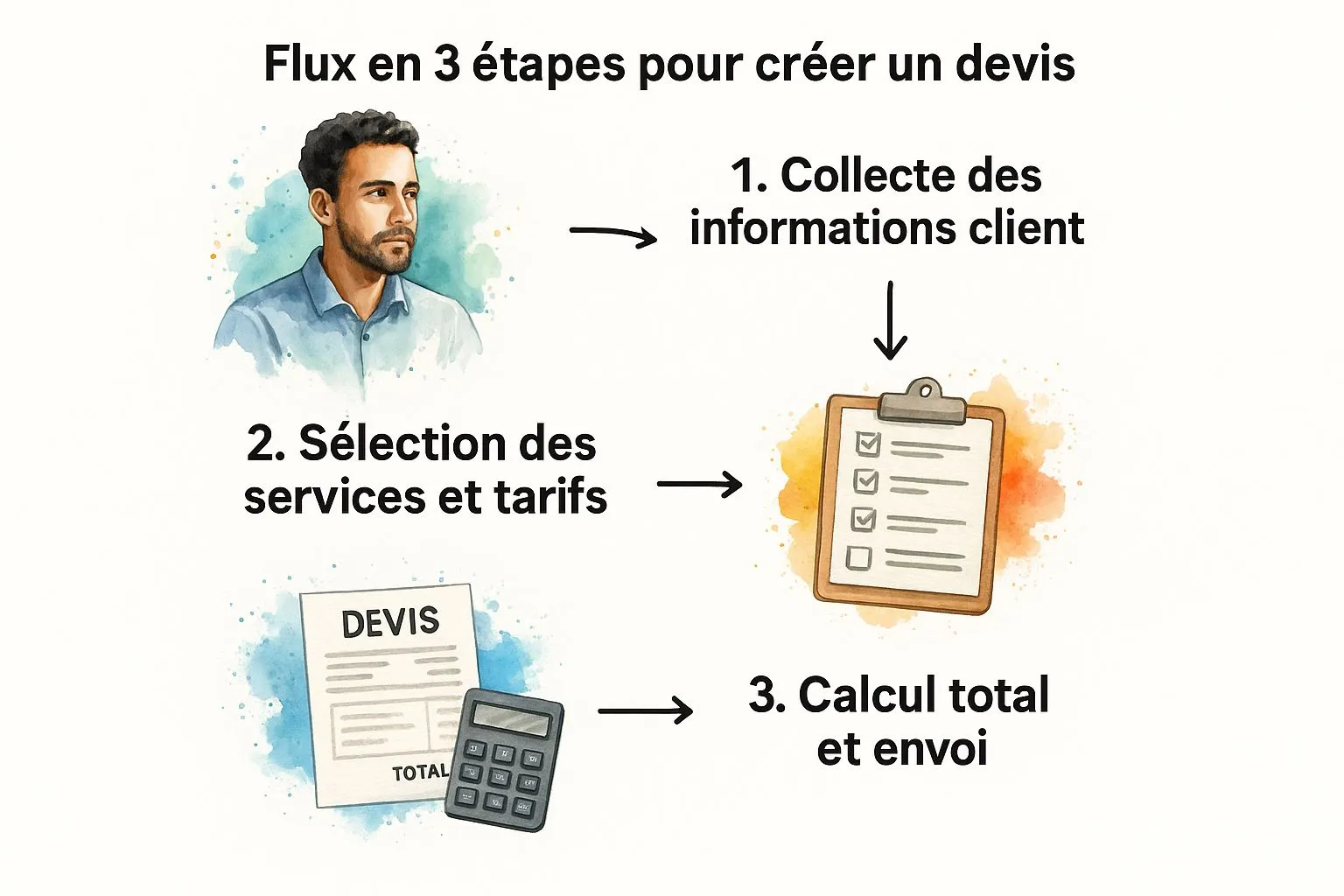
As you can see, it all comes down to a few clicks: gather the information, select the services, and send.
Your process for a quote ready in 5 minutes flat
With the right tool in place, creating and sending a complete, personalized quote in under five minutes becomes the norm. Here’s what a well-oiled workflow looks like:
- Add the client: If it’s a new contact, you enter their information once and for all. For an existing client, a quick search in your database is enough.
- Choose the services: You pick directly from your service catalog to add the corresponding lines. Just adjust the quantities, and all the calculations update in real time. Magic.
- Refine and check: This is the moment to add a personal note, check that the validity date works for you, and make sure the legal mentions are all there (the tool takes care of that for you).
- Send with one click: The quote is sent by email directly from the platform. The bonus? Many tools offer tracking that notifies you when your prospect opens, or better yet, accepts your offer.
This time savings is simply enormous. It frees you up to focus on what really matters: growing your business, finding new clients, and refining the quality of your services.
Common mistakes that undermine a quote’s credibility
A quote is much more than a simple price proposal. It’s a document that puts your word and your reputation on the line. The smallest detail that’s off, the tiniest mistake, can plant doubt in your prospect’s mind and, let’s be honest, cost you a contract. Trust is often won on these small things that show how serious you are.

Over time, you learn to spot the mistakes that keep coming up. Think of this list as one last check before hitting “Send,” to make sure your proposals command respect and protect you from misunderstandings.
Missing key information
This is the basics, and yet it still happens far too often. A quote with no validity date, for example, leaves the door open to potential problems. Imagine a client accepting it months later, while your own rates or raw material costs have gone up in the meantime. You’re stuck.
Similarly, vague or completely absent payment terms are an almost guaranteed source of friction. It’s the best way to end up chasing your money later.
- The immediate fix: Before every send, make it a habit to check these three crucial points: the validity period of your offer (generally, 1 to 3 months is enough), clear payment terms (deposit, balance, schedule), and an estimated start date for the service.
These elements set a clear framework for the business relationship and reassure your client: they’re dealing with a professional who knows their subject.
Vague descriptions and calculation errors
This is probably the most damaging mistake. A quote line that’s too vague, like “Website redesign,” doesn’t mean anything at all. It opens the door to every possible interpretation. Your client might picture ten complex features, while you’d only budgeted for five. Conflict is inevitable.
Calculation errors are just as damaging to your credibility. A simple addition mistake or an incorrect VAT calculation, and your entire proposal loses value. The client will rightly wonder whether the quality of your work will be just as sloppy.
The right habit to adopt: Take the time to detail every line item as precisely as possible, concretely listing the tasks included. For calculations, the simplest and safest approach is to use invoicing software. It automates totals and VAT application, guaranteeing a quote template that’s always flawless.
A lack of clarity around payment terms can also cause delays. If this topic interests you, our guide explains how to effectively handle chasing an unpaid invoice, a situation that very often stems from an unclear starting point.
Failing to meet legal obligations
Every business status has its own rules. For a tradesperson, omitting their trade register number is a mistake. For a sole trader benefiting from the VAT exemption scheme, forgetting the mention “VAT not applicable, art. 293 B of the French Tax Code” is an error that can prove costly in the event of an audit.
Here’s a short list of omissions to avoid at all costs:
- Not stating your SIRET number: It’s your company’s identity card, and it’s essential.
- Forgetting the legal structure: LLC, corporation, sole trader… The client needs to know exactly which entity they’re dealing with.
- Not detailing the breakdown: Every service or product must have its own line, with a quantity and a unit price.
- Not showing the net and gross totals: Price transparency is fundamental and non-negotiable.
Every mistake you avoid is one more step toward a smooth client relationship and a signed contract. Your quote is the first reflection of the quality you’re committing to deliver.
Frequently asked questions about quotes
Even with the most solid quote template, a few questions often remain. That’s completely normal. When you’re starting out, managing quotes raises all sorts of questions, both practical and legal. It’s the foundation for setting clear terms with your clients and protecting your business.
To help you navigate all this, I’ve gathered the questions that come up most often. The idea is to give you clear, direct answers so you can send your proposals with peace of mind.
Is a signed quote really as good as a contract?
Yes, absolutely. This is probably the most important point to understand. The moment your client signs the quote, adding the date and the famous handwritten mention “Approved, good for agreement” or “Read and approved,” the document changes status. It becomes a fully-fledged contract.
This simple act turns your proposal into a firm commitment for both parties. On your side, you commit to carrying out the service as described. On their side, your client commits to paying the agreed price. It’s the foundation of your business relationship.
Can you change a quote after sending it?
The short answer is no, at least not unilaterally. Once the quote is in your client’s hands, the offer is set in stone. You can’t decide on your own to change a price, adjust a line, or alter a condition.
If a change is genuinely necessary, whether on your initiative or at the client’s request, transparency is the way to go. The proper approach is to create a new document. You have two options:
- Draft a new quote that explicitly cancels and replaces the previous one.
- Create an amendment to the original quote, a document that supplements or modifies specific points.
Either way, this new document must be validated and signed by the client. This rigor will save you a lot of headaches and misunderstandings later on.
A quote isn’t a draft document. Each version is a snapshot of the agreement at a given moment. Any change requires a new formal agreement to guarantee legal certainty for both parties.
Is it really mandatory to write the word “Quote” on it?
Absolutely. The word “Quote” (or, at a stretch, “Business proposal”) must appear clearly on the document. This is what distinguishes it at a glance from an invoice, which represents a debt to be paid.
Forgetting this mention risks creating confusion for your client. And in the event of a problem or dispute, the absence of this term could weaken the legal standing of your proposal. It’s a small formality that ensures great clarity.
What validity period should you put on a quote?
Even though the law doesn’t require a specific duration, I strongly recommend setting one. Generally, a period of 1 to 3 months is a good balance.
Why does this matter so much? First, it protects you. The cost of raw materials or your suppliers’ rates can change. Setting a validity period prevents you from being locked into a price that’s no longer accurate. Second, it encourages your prospect to make a decision within a reasonable timeframe. If you don’t set one, your offer could be considered valid indefinitely, which is a significant risk.
Tired of juggling spreadsheets and worrying about legal mentions? Bizyness is the tool designed for sole traders and SMEs who want to create compliant quotes and invoices in just a few clicks, hassle-free. Save time, avoid errors, and refocus on your core business. Discover how to simplify your management today on the Bizyness website.
