

 Français
 6 Receipted Invoice Examples You Absolutely Need to Master in 2025
Discover our detailed analysis of every receipted invoice example, from the paper model to blockchain, for flawless and compliant accounting management.
A receipted invoice is irrefutable proof that a transaction has been settled — a crucial document for your bookkeeping and for the peace of mind of your business relationships. But beyond a simple “Paid” stamp, not all receipting methods are equal, and they don’t all meet the same needs. Between the traditional manual stamp and smart-contract validation on the blockchain, techniques have evolved radically.
Ignoring these nuances can lead to disputes, costly accounting errors and wasted time. For a freelancer, an online seller or a small business, mastering this aspect of invoicing isn’t optional — it’s a necessity for securing cash flow and professionalizing operations.
This complete guide was designed to give you far more than a simple receipted invoice example. We’re going to break down 6 concrete models, from the most classic to the most innovative. For each case, you’ll find a detailed strategic analysis, tactical points to apply and practical advice for choosing and implementing the method best suited to your business. Get ready to turn an administrative document that’s often overlooked into a real asset for your management, ensuring compliance, efficiency and peace of mind.
1. Professional Services Invoice with Stamp and Signature
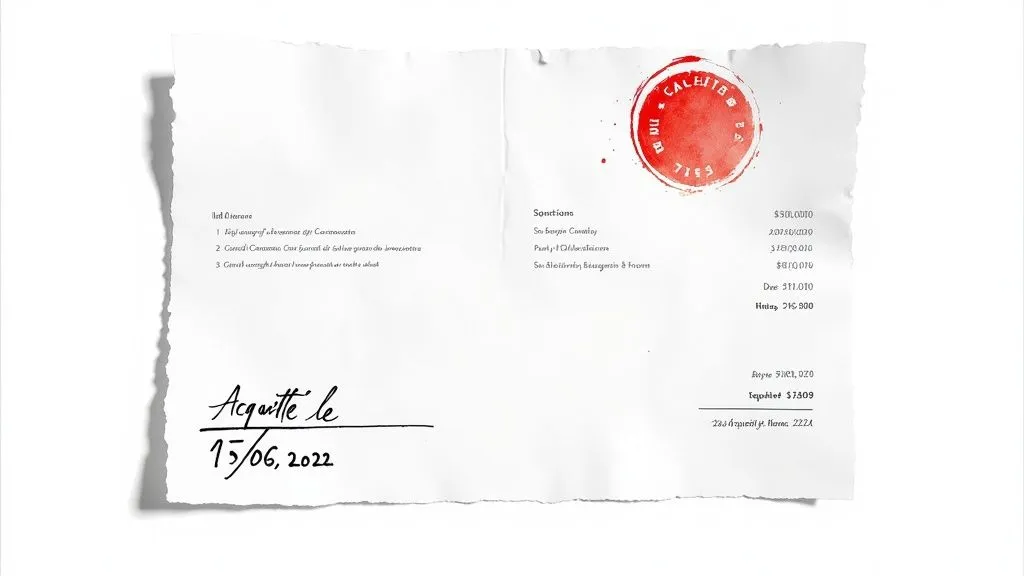
The most traditional and widely recognized method for receipting an invoice remains manually applying a signature and a stamp. This receipted invoice example is particularly common among independent professionals, tradespeople and small businesses that favor direct contact and physical proof of the transaction. The receipt is materialized by adding the words “Paid on [date]”, followed by a signature and the company stamp.
This approach, though classic, gives the document strong evidentiary value. It formally and physically attests that payment has indeed been received by the creditor. It’s often seen as a gesture of professional closure, strengthening trust between the supplier and their client.
Strategic Analysis and Use Cases
Using a stamp and signature is strategic in several contexts. For a carpenter, for example, handing over an invoice receipted this way after receiving payment by check or bank transfer officially closes out the job. Likewise, a law firm may receipt an accountant’s invoice for its records, providing irrefutable accounting proof.
Strategic Point: The physical act of signing and stamping an invoice creates tangible, hard-to-dispute proof. It’s particularly suited to transactions where formal confirmation is needed, or for businesses that haven’t yet fully digitized their invoicing process.
This method is ideal for payments made through non-instant means (check, bank transfer), since it confirms proper receipt of funds. It’s a mark of seriousness that reassures the client about the proper handling of their transaction.
Practical Tips and Implementation
To ensure the validity of your manually receipted invoice, follow these key steps:
- Clear Wording: Clearly state “Paid on” or “Received on”, followed by the exact date payment was received.
- Signature and Stamp: The signature must be that of a person authorized within the company. The company stamp, showing the company name, address and registration number, strengthens authenticity.
- Payment Details: It’s recommended to add the payment method (e.g., “Paid by bank transfer on 10/15/2024”). This provides useful extra information for bookkeeping.
- Retention: Always keep a digital (scanned) or paper copy of the receipted invoice for your own records.
By exploring the different options available, you’ll find there’s a wide variety of receipted invoice templates. To learn more and download examples, check out our detailed guide on the receipted invoice template.
2. Electronic Invoice with Certified Digital Signature
In the age of digitalization, invoice receipting is being modernized through qualified electronic signatures. This receipted invoice example relies on a cryptographic process that guarantees the document’s integrity and the signer’s identity, in compliance with the European eIDAS regulation. Once paid, the invoice is digitally signed by the supplier, giving it legal value equivalent to a handwritten signature.
This method is favored by companies handling large transaction volumes or operating in regulated sectors. It ensures perfect traceability, reduces processing times and secures exchanges. The word “Paid” or “Receipted” is embedded directly in the digital document before the signature certificate is applied.
Strategic Analysis and Use Cases
Digital signatures are strategic for organizations that need to guarantee non-repudiation and impeccable authenticity. For example, a large CAC 40 company using a solution like DocuSign can automatically receipt supplier invoices worth several thousand euros, creating a reliable, instant audit trail. Similarly, French public administrations use the General Security Framework (RGS) to validate transactions and receipt invoices, ensuring strict compliance.
Strategic Point: Certified electronic signatures turn the receipted invoice into a tamper-proof document. This is an essential approach for securing high-stakes transactions, automating accounting processes and meeting compliance requirements, particularly under mandatory e-invoicing.
This use case is especially relevant for the banking, legal and real estate sectors, where proof of payment must be beyond dispute. It also helps speed up cash flow by validating receipt of payment almost instantly.
Practical Tips and Implementation
To implement electronic signatures on your receipted invoices, consider the following points:
- Choose a Certified Provider: Opt for a qualified trust service provider recognized by ANSSI or compliant with the eIDAS regulation (e.g., DocuSign, Adobe Sign, Universign).
- Integration and Compatibility: Make sure the signature solution integrates easily with your invoicing software or ERP to automate the process.
- Team Training: Train your staff on the correct use of signature certificates and on digital security best practices.
- Evidence Backup: Set up a secure archiving plan for signed invoices and their associated certificates, to ensure long-term accessibility.
Moving toward digitally receipted invoices is a key step in digital transformation. To better understand the stakes and obligations, check out our full guide on e-invoicing for sole traders.
3. Paper Invoice with Receipt and Barcode
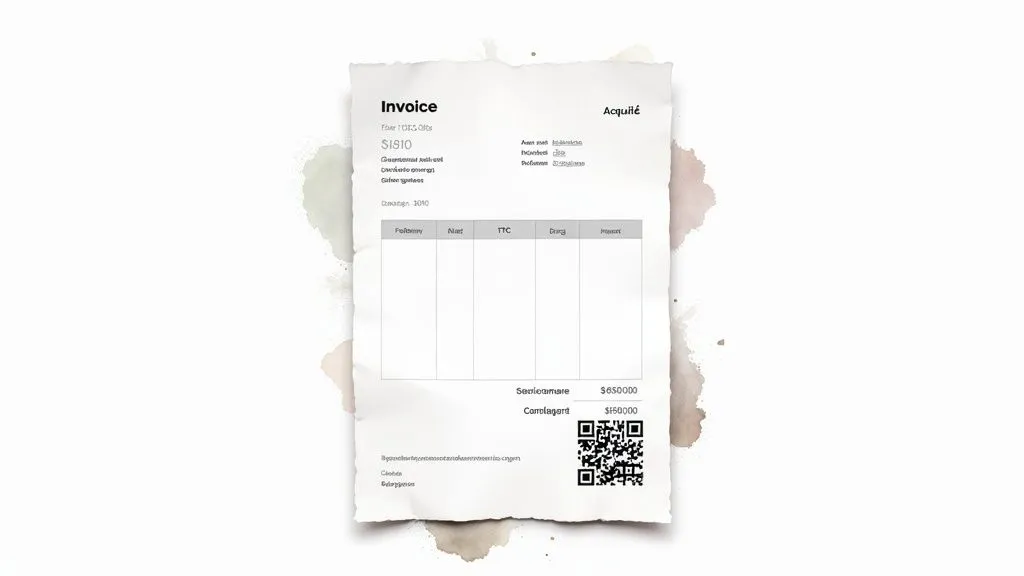
At the crossroads of traditional and digital, this receipted invoice example offers a hybrid solution. It combines the security of a paper document with the efficiency of digital tracking through an embedded barcode or QR code. The receipt can be shown with the classic “Paid on” wording, while also linking a unique code that, once scanned, updates the payment status in a management system.
This method greatly simplifies accounting reconciliation and real-time tracking. It’s aimed at businesses in the midst of digital transition, such as SMEs or local authorities, that need to manage both paper flows and digitized processes. The barcode acts as a bridge between these two worlds.
Strategic Analysis and Use Cases
The hybrid approach is strategic for organizations handling a large volume of transactions with clients who have varied payment habits. A local authority, for example, might issue public service invoices (water, school meals) with a QR code. The resident can pay online, while the accounting department can scan the payment stub received by mail to instantly receipt the invoice in their software. Similarly, a medical practice can use this system for its fee invoices, simplifying tracking for the receptionist and giving the patient clear proof.
Strategic Point: The barcode or QR code acts as a unique key linking the physical document to its digital record. This approach drastically reduces manual entry errors, speeds up payment processing and offers full transaction traceability.
This model is particularly relevant for businesses that want to modernize their management without fully abandoning paper, which reassures part of their customer base. It boosts internal productivity while maintaining external flexibility.
Practical Tips and Implementation
To effectively implement this hybrid invoicing system, consider the following points:
- Code Choice: Use recognized standards such as Code 128 for linear barcodes or QR codes for greater information capacity (payment link, invoice number, etc.).
- Data Synchronization: Make sure your invoicing software and your code-reading system are perfectly synchronized for real-time, error-free updates.
- Staff Training: Train your teams on how to use the scanner and understand the process, to ensure consistency between paper documents processed and digital updates.
- Clear Procedure: Define a clear procedure for when to scan the document (upon receiving the check, upon confirming the transfer) to maintain rigorous bookkeeping.
To master every nuance of this approach, it’s essential to fully understand the different ways to receipt an invoice.
4. SEPA Transfer Receipt with Structured Reference
In the age of automation, receipting invoices via SEPA transfer with a structured reference is a cutting-edge solution for businesses handling a high volume of transactions. This receipted invoice example relies on integration between the banking system and the accounting software (or ERP). Every invoice issued generates a unique payment reference (often in ISO 11649 format) that the client must include with their transfer. The system then automatically matches the incoming payment with the corresponding invoice and marks it as “paid”.
This method eliminates any manual intervention, drastically reduces the risk of errors and speeds up accounting reconciliation. It’s especially popular with large companies, public service providers (water, electricity) and government agencies, since it guarantees perfect traceability and considerable productivity gains for finance teams.
This simple decision tree illustrates the key questions to ask before opting for this automated receipting method.
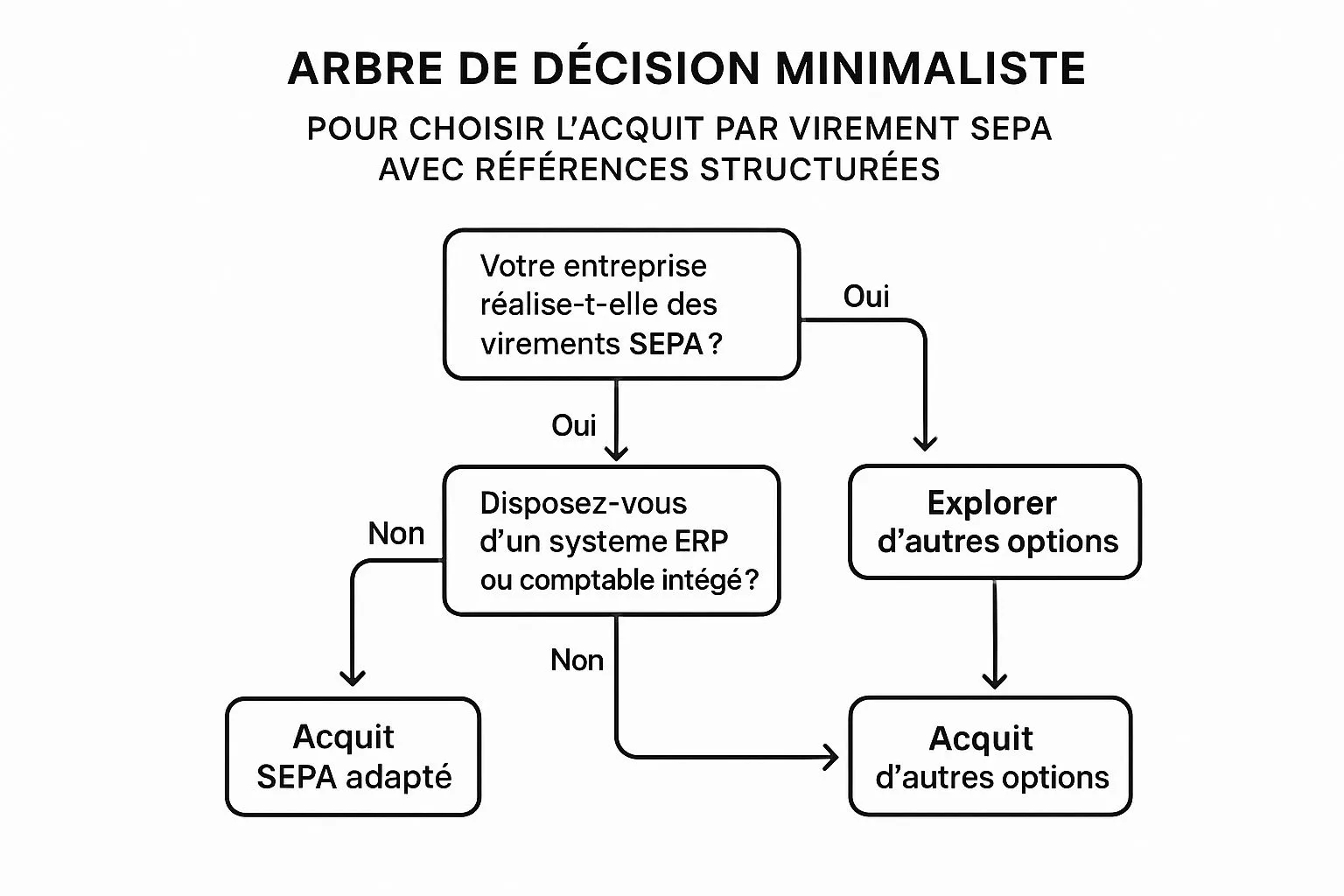
The infographic highlights that this approach is mainly relevant for businesses already equipped with integrated management tools and making SEPA transfers.
Strategic Analysis and Use Cases
Adopting a structured reference is a strategic decision aimed at optimizing cash flow and reducing administrative costs. For example, a large energy company using an ERP like SAP can process thousands of customer payments every day with no human intervention at all. The structured reference on the invoice lets SAP instantly link the transfer received to a specific customer’s consumption and update their account.
Similarly, the public sector in Belgium widely uses this system for paying taxes and duties. Each citizen receives a payment notice with a unique reference, ensuring funds are correctly and immediately allocated to the relevant services.
Strategic Point: Automating bank reconciliation through structured references turns invoice management from a time-consuming administrative task into a smooth, technology-driven process. It’s essential for companies aiming for efficient scalability.
This method is ideal for subscription-based or recurring-payment business models, where invoice volume is high and constant. It strengthens the reliability of accounting data and frees up time for higher-value tasks.
Practical Tips and Implementation
To effectively implement receipting via structured reference, consider the following points:
- Standardized Format: Use a recognized reference format such as the ISO 11649 standard (Structured Creditor Reference) to ensure compatibility with European banking systems.
- ERP/Accounting Integration: Make sure your accounting software or ERP can generate these unique references and process bank statement files (such as the CAMT.053 format) for automatic reconciliation.
- Clear Communication: Clearly indicate on the invoice where the client should enter the payment reference. Unclear communication can cancel out all the benefits of automation.
- Exception Handling: Set up a clear procedure for handling payments received without a reference or with an incorrect one, since these will require manual intervention.
5. Invoice Receipted via Blockchain with Smart Contract
At the forefront of technological innovation, the blockchain-receipted invoice represents a revolutionary approach. This receipted invoice example relies on smart contracts to automate and secure the entire process. The transaction and its receipt are recorded immutably and transparently on a distributed ledger, offering an unmatched level of trust and traceability.
In this system, payment by the client automatically triggers the execution of a smart contract, which updates the invoice status to “Receipted”. This confirmation is then recorded on the blockchain, creating tamper-proof proof accessible in real time to authorized parties. This method eliminates manual intervention and the risk of fraud or disputes.
Strategic Analysis and Use Cases
Adopting blockchain for invoice receipting is strategic for sectors where transparency and security are paramount. In the supply chain, giants like Carrefour or Walmart have launched pilot projects to track products and automate payments between suppliers. A payment triggers a smart contract that receipts the invoice, streamlining financial and logistics flows.
Similarly, fintech and insurance startups use this technology to automate compensation payouts. A verifiable event (e.g., a flight delay) can trigger a smart contract that pays out the compensation and receipts the corresponding transaction with no human intervention.
Strategic Point: Using blockchain and smart contracts turns the receipted invoice into a fully automated, transparent and tamper-proof act. It’s the ideal solution for complex transactions, multi-party ecosystems or environments where digital trust is a major concern.
This approach is especially relevant for international transactions, where it simplifies verification processes and reduces payment delays. It ensures all stakeholders share the same version of the truth.
Practical Tips and Implementation
For forward-thinking companies wanting to explore this technology, a gradual approach is recommended:
- Choose the Right Blockchain: Evaluate platforms such as Ethereum (for its flexibility) or Hyperledger (for private, permissioned frameworks) based on your privacy and performance needs.
- Regulatory Verification: Make sure using blockchain-based invoices complies with the accounting and tax regulations of your jurisdiction. The legal value of this digital proof must be confirmed.
- Pilot Projects: Start with a small-scale pilot project, for example with a trusted business partner, to test the process, identify technical challenges and measure return on investment.
- Team Training: Implementing this technology requires specific skills. It’s crucial to train your technical and finance teams on blockchain and smart contract concepts.
6. Receipting via Mobile App with Geolocation
In the age of mobility, invoice receipting increasingly happens in the field via dedicated mobile apps. This modern receipted invoice example is ideal for businesses with roaming teams, such as delivery services, maintenance technicians or tradespeople. The solution combines smartphone receipting with advanced security layers, such as geolocation and biometric authentication.
This digital process certifies not only receipt of payment but also the exact place and time of the transaction. For a delivery driver, for example, the app can generate a receipted invoice the moment the client pays, while recording GPS coordinates to prove the delivery actually took place at the expected address. This strengthens traceability and considerably limits the risk of disputes.
Strategic Analysis and Use Cases
Using a mobile app for receipting is strategic for optimizing field operations and strengthening transaction security. A maintenance technician visiting a client can have the service form signed digitally, trigger payment and instantly generate the receipted invoice, all from their tablet. The data, including the GPS location of the visit, is synced in real time with the company’s accounting system.
Strategic Point: Geolocation and digital signature create irrefutable, timestamped and geolocated proof of service and payment. This approach is crucial for businesses managing a high volume of on-site visits that need to minimize disputes over service or payment.
This method is particularly well-suited to last-mile delivery business models, home services or emergency call-outs. It automates a step that was once manual and administrative, reducing processing times and improving cash flow.
Practical Tips and Implementation
To effectively roll out a mobile receipting system, consider the following points:
- GDPR Compliance: Use of geolocation and biometric data must be transparent. Clearly inform your clients about the collection of this data and obtain their explicit consent, in compliance with the General Data Protection Regulation.
- Robust Offline Mode: Your teams may work in areas with poor connectivity. Make sure the app can function offline and sync data as soon as the connection is restored.
- Data Security: Security is paramount. Choose solutions that encrypt data stored on the device and during transfer to your servers.
- User Training: Support your mobile teams with clear training on using the app. Proper onboarding is essential to ensure adoption and effectiveness of the tool.
Comparison of the 6 Types of Receipted Invoice Examples
| Invoice Type | 🔄 Implementation Complexity | 💡 Resources Required | 📊 Expected Results | 🛠 Ideal Use Cases | ⭐ Key Advantages |
|---|---|---|---|---|---|
| Professional Services Invoice with Stamp and Signature | Low (simple manual process) | Minimal (paper, indelible ink) | Limited traceability, basic legal value | Small businesses, freelancers | Simplicity, low cost, manual bookkeeping |
| Electronic Invoice with Certified Digital Signature | High (technical integration and training) | Advanced IT systems, training | Maximum security, full audit trail | Large companies, public administrations | Legal security, speed, cost reduction |
| Paper Invoice with Receipt and Barcode | Medium (dual paper + digital management) | Moderate infrastructure, dual training | Double traceability, instant verification | SMEs going digital, traditional sectors | Gradual transition, moderate cost, fast verification |
| SEPA Transfer Receipt with Structured Reference | High (banking and ERP integration) | Robust IT, banking systems | Full automation, fewer errors | Large companies, utilities sector | Automation, time savings, bank traceability |
| Invoice Receipted via Blockchain with Smart Contract | Very high (emerging, complex technology) | Blockchain experts, specific infrastructure | Immutability, full transparency | Innovative projects, fintech, insurance | Cryptographic security, no intermediaries |
| Receipting via Mobile App with Geolocation | Medium to high (mobile development + security) | Smartphones, network, biometric skills | Geolocated proof, full mobility | Field services, deliveries, maintenance | Mobility, enhanced traceability, intuitive interface |
Your Receipting Strategy: Time to Take Stock
At the end of our exploration of the different receipted invoice models, one thing is clear: receipting is not a mere administrative formality. It’s a strategic act that reflects the maturity, reliability and efficiency of your business. Each receipted invoice example we’ve analyzed, from the most traditional to the most innovative, offers a distinct view of financial management.
We’ve seen that the traditional method of a manual stamp and signature (Example 1) retains its value for its simplicity and tangible nature, ideal for in-person transactions. At the opposite end, the blockchain-receipted invoice (Example 5) represents the future of payment certification, offering unmatched security and transparency, even though its implementation remains complex for most small and medium businesses. Between these two extremes, pragmatic, modern solutions like digital signatures (Example 2) or SEPA transfer receipting with structured references (Example 4) strike an excellent balance between security, accessibility and automation.
Summary of Strategic Lessons
Choosing your receipting method should be an informed decision, guided by several key factors:
- Transaction volume: Manual management is viable for a few invoices a month. Beyond that, automation via electronic systems or structured payment references becomes essential to avoid errors and save time.
- Your client profile: Institutional or large-company clients may require formal proof of payment such as a certified digital signature. Individuals will often be satisfied with a simple “Paid” note on a PDF invoice.
- Your security and traceability needs: If you operate in a sector where proof of payment is critical and potentially disputed, robust methods like qualified electronic signatures or, eventually, blockchain are preferable.
- Your technology ecosystem: Your choice should integrate smoothly with your existing tools (accounting software, CRM, mobile app). The goal is to streamline the process, not add a cumbersome extra step.
Next Steps for Optimal Management
Your mission now is to move from theory to practice. Don’t just copy a receipted invoice example — adapt it so it becomes a real tool serving your cash flow and your client relationships. A receipted invoice isn’t just the end of a transaction; it’s also the start of a renewed cycle of trust with your client and the guarantee of sound bookkeeping.
By choosing the right method, you’re not just proving a payment. You’re saving time, strengthening your professional credibility and building solid foundations for your business’s growth. It’s a minimal investment in thought for a major return in peace of mind and efficiency.
Ready to level up and automate the creation of your compliant invoices, receipting included? Discover how Bizyness simplifies invoicing for thousands of entrepreneurs, letting you generate a perfect receipted invoice example in just a few clicks. Try the platform and see for yourself how to optimize your financial management today at Bizyness.
