

 Français
Revenue and profit: tips for success
Discover how to optimize your revenue and profit with effective strategies. Boost your company's performance right now.

The fundamentals of revenue and profit, decoded

Understanding the difference between revenue and profit is essential for running a business well. Revenue is the total sum of sales made. Profit, on the other hand, is what remains once all costs have been deducted.
Take the example of a bakery: its revenue is the money earned from selling bread, pastries, and cakes. Profit is what’s left after paying for ingredients, rent, salaries, and other expenses.
This distinction, sometimes poorly understood, is nonetheless essential. It allows you to assess a company’s true financial health.
Decoding the different types of profit
There are several types of profit, each shedding light on a different aspect of company performance. Gross profit, for example, is revenue minus the direct cost of goods sold. For the bakery, that means sales revenue minus the cost of ingredients.
Operating profit, next, factors in operating expenses such as salaries, rent, and marketing costs. It reflects the profitability of the company’s core activity.
Finally, net profit is the final result after deducting all expenses, including taxes and interest. It corresponds to the actual profit generated by the company. Mastering these nuances is essential for meaningful financial analysis.
Revenue vs. profit: the importance of profitability
High revenue doesn’t guarantee success if profits don’t follow. A company can generate substantial revenue while remaining barely profitable, or even running at a loss.
Take an e-commerce business as an example. It may record a significant sales volume, but if its customer acquisition costs are too high, its net profit is likely to be low. Conversely, a small business specializing in a niche market may have more modest revenue, but far higher profitability thanks to higher margins.
In 2022, France had around 172,000 SMEs, contributing significantly to national GDP. This illustrates the important role these businesses play in the French economy. Learn more about French SMEs. Analyzing revenue and profit together makes it possible to assess a company’s real profitability and long-term viability.
Analyzing revenue and profit: an essential management tool
The combined analysis of revenue and profit provides crucial data for strategic decision-making. It helps identify growth levers, weaknesses to address, and ways to optimize resource management.
By comparing how revenue and profit evolve over several periods, it becomes possible, for example, to spot trends and anticipate potential difficulties.
Tracking these indicators also helps measure the effectiveness of actions taken and adapt strategy accordingly. A solid understanding of these two concepts is therefore fundamental to ensuring the sustainability and growth of any business, whether a start-up or an SME.
The ratios that make the difference for your profitability
Revenue and profit are two essential indicators. On their own, however, they don’t tell the whole story of your business. It’s financial ratios that reveal your activity’s true performance and profitability. Calculated from your revenue and profit figures, these ratios enable deeper analysis and more informed decision-making.
Gross margin: the first profitability indicator
Gross margin represents the difference between your revenue and the cost of goods sold (raw materials, production, etc.). It shows the profitability of your production or purchasing before accounting for other expenses. A high gross margin means you’re generating good profitability on each product or service sold.
To calculate it, use the following formula: (Revenue - Cost of goods sold) / Revenue x 100.
Operating margin: the profitability of your core activity
Operating margin, sometimes called the operating profit margin, measures the profitability of your core activity after deducting all operating expenses (salaries, rent, marketing, etc.). It shows how efficiently you manage operations.
A high operating margin demonstrates good cost control. The formula is: (Operating profit / Revenue) x 100.
Break-even point: when your revenue covers your expenses
The break-even point, also called the breakeven threshold, is the revenue level at which your business starts generating profit. Below this threshold, you’re operating at a loss. Knowing your break-even point is crucial for setting sales targets and steering your business.
It’s calculated as follows: Fixed costs / ((Revenue - Variable costs) / Revenue).
Sales conversion rate: the efficiency of your sales force
The sales conversion rate measures the percentage of prospects who become customers. It reflects the effectiveness of your sales and marketing efforts. A high conversion rate indicates strong sales team performance and an attractive value proposition.
The formula is: (Number of customers / Number of prospects) x 100.
Visualizing the ratios: a concrete example
The chart below illustrates the relationship between revenue, costs, and profit for a fictional company. It shows how these three elements interact to determine profitability.
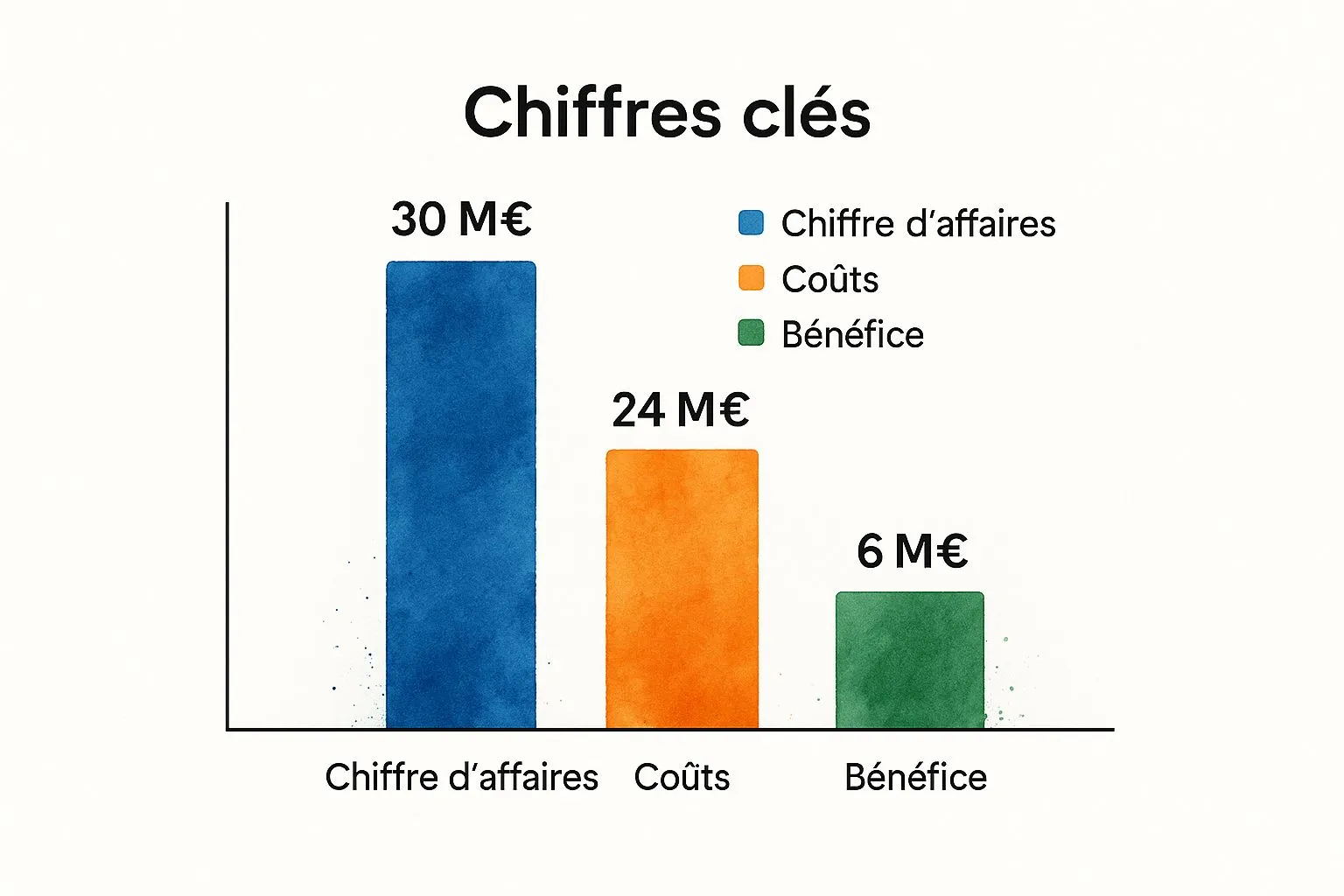
With revenue of €30M and costs of €24M, the company generates a profit of €6M. That represents a profit margin of 20%, indicating healthy and efficient resource management.
The importance of sector comparison
To fully understand your performance, it’s important to compare your ratios with those of your competitors and your industry average. This benchmark lets you position yourself relative to the market and identify areas for improvement.
The table below shows average profitability ratios for different sectors in France.
Profitability ratios by sector: where do you stand?
| Sector | Average gross margin | Average net margin | Revenue/profit ratio |
|---|---|---|---|
| Retail | 40% | 5% | 20 |
| Manufacturing | 30% | 8% | 12.5 |
| IT services | 60% | 15% | 6.67 |
| Restaurants | 70% | 10% | 10 |
Fictional data for illustration purposes.
By comparing your results with this data, you can identify strengths and weaknesses. Bizyness, a simplified management tool for small businesses, helps you track these key indicators and optimize your profitability. Solid analysis of your financial ratios is the key to sustainable growth and optimal profitability.
Anatomy of French sector performance

In France, the relationship between revenue and profit varies greatly by sector. Some, like large-scale retail, can post considerable revenue with relatively thin profit margins. Others, like the luxury sector, operate with more modest revenue but far higher margins. Understanding these mechanisms is essential for analyzing your own company’s performance.
Decoding sector differences
Several factors explain these gaps. The sector shapes cost structure, competitive intensity, and companies’ negotiating power. For example, capital-intensive industries, like the automotive industry, require massive investment, which impacts profit. Conversely, service sectors, like consulting, can operate with lower fixed costs and achieve higher profitability.
The nature of the product or service sold also plays a decisive role. Mass-market products, sold in large volumes, generate substantial revenue, but strong competition often limits margins. Luxury products, sold at higher prices, allow for larger margins despite lower sales volumes.
The French industrial sector: a concrete illustration
The French industrial sector, a pillar of the economy, perfectly illustrates this complexity. According to INSEE, in 2022 the value added at factor cost of industrial companies reached €308.48 billion. Yet payroll costs and employer contributions account for a substantial share of costs, at €157.04 billion and €65.23 billion respectively, directly impacting net profit. This context underscores the importance of rigorous cost management for French industrial companies.
The strategies of high-performing companies
Faced with these disparities, high-performing companies adopt specific strategies to optimize profitability. Some favor differentiation to justify higher prices and improve margins. Others rely on innovation to reduce production costs and gain a competitive edge.
Digitalization also contributes to improved performance. Tools like Bizyness help companies simplify their accounting management, automate certain tasks, and gain a clearer view of their finances. This better understanding of financial data makes it easier to identify optimization levers and boost profitability.
Concrete examples of sector strategies
- Tech sector: Heavy R&D investment to innovate and establish a market position, often with longer-term profitability.
- Food industry: Optimizing the supply chain to reduce costs and control prices.
- Luxury sector: Careful marketing and communication to enhance brand image and justify high prices.
These examples show that every sector presents its own specific challenges and opportunities. Analyzing sector performance allows companies to put their own results in perspective and identify best practices. By understanding their sector’s dynamics, they can adjust their strategies to maximize revenue and, above all, profit. Bizyness can support you in this process by providing the tools you need to steer your business and optimize profitability.
The strategies that boost revenue and profit at the same time

Growing revenue is essential, but profitability remains the ultimate goal. This article explores strategies for improving both performance indicators simultaneously. The goal isn’t just to sell more, but to sell better and more efficiently.
Price optimization: a performance lever
Adjusting prices can have a major impact on profitability. Dynamic price optimization, for example, allows you to adapt pricing based on demand, competition, and other variables. This method maximizes revenue without discouraging customers. Take the example of a hotel that adjusts its prices seasonally: higher prices during peak season and attractive deals during the off-season. It thereby maximizes both its revenue and its occupancy rate.
Customer segmentation: a targeted approach
Every customer is unique. Customer segmentation allows you to target specific groups with offers and pricing tailored to their needs and price sensitivity. By focusing on the most profitable segments, a company can boost profit without necessarily increasing sales volume. A clothing store, for example, might offer a loyalty program with exclusive discounts for its best customers, increasing their long-term value.
Smart automation: gaining efficiency
Automating repetitive, time-consuming tasks frees up time and resources. This reduces operating costs and improves productivity. Automating inventory management, for example, helps optimize stock levels, minimize storage costs, and limit the risk of stockouts. When exploring strategies to increase both revenue and profit, it’s worth considering whether low-code or no-code platforms could improve your digital solutions.
Improving the product mix: focusing on top performers
Analyzing the profitability of each product or service helps identify the best- and worst-performing offerings. By focusing on high-margin products and adjusting or discontinuing underperforming ones, a company improves its product mix and overall profitability. A restaurant, for example, can analyze the popularity and profitability of each dish to refine its menu.
Restructuring the value proposition: adding value
By offering bundled deals, complementary services, or premium options, a company can increase the perceived value for its customers and justify higher prices. A SaaS product, for example, might offer different subscription tiers with increasing features and services based on price.
Summary of tactics and their impact
The table below summarizes different optimization tactics, their impact on revenue and profit, and the timeframe and investment required.
Optimization tactics: real impact on your profitability
| Strategy | Impact on revenue | Impact on profit | Implementation timeframe | Investment required |
|---|---|---|---|---|
| Price optimization | Strong | Strong | Short/medium term | Low/Moderate |
| Customer segmentation | Moderate/Strong | Strong | Medium term | Moderate |
| Automation | Low/Moderate | Strong | Short/medium term | Variable |
| Product mix improvement | Moderate | Strong | Short/medium term | Low |
| Value proposition | Moderate/Strong | Strong | Medium term | Moderate |
By combining these strategies, companies can create a positive synergy between revenue and profit, ensuring sustainable growth and optimal profitability.
The financial secrets of CAC 40 champions
CAC 40 companies, symbols of French economic strength, regularly report substantial revenue and profit figures. How do they manage to sustain this profitability, especially in a sometimes unstable economic climate? Contrary to popular belief, their strategies, though sophisticated, can inspire SMEs.
Cost optimization: a constant priority
For CAC 40 companies, cost control is essential. They invest heavily in optimizing their value chain, from production to distribution. Supplier negotiations, process automation, and the pursuit of efficiency are their watchwords. Some bring services in-house to cut external expenses, while others outsource non-strategic functions to focus on their core business.
Revenue diversification: a key asset
To limit risks tied to dependence on a single market, CAC 40 companies diversify their revenue streams. They invest in new sectors, launch innovative products, and expand internationally. This strategy helps them better withstand economic fluctuations and seize new growth opportunities. L’Oréal, for example, operates across different segments of the beauty market, from mass market to luxury.
Hedging strategies: protecting margins
Faced with fluctuations in exchange rates and raw material prices, CAC 40 companies use hedging strategies to protect their margins. By using financial instruments, they guard against risk and ensure the predictability of their results. TotalEnergies, for example, uses these instruments to hedge against fluctuations in oil prices.
2023 results: remarkable performance
In 2023, the 35 CAC 40 companies that had published their results recorded combined net profit of nearly €144.2 billion, surpassing the €142 billion recorded in 2022. Their revenue reached €1.678 billion, slightly below the €1.721 billion recorded in 2022. In a complex global economic climate, these results demonstrate their resilience. More information on this data.
Innovation: an essential driver
Innovation is a major performance lever for CAC 40 companies. They invest heavily in research and development to design new products and services, optimize their processes, and stand out from the competition. Airbus, for example, continuously invests in research to develop more efficient, more environmentally friendly aircraft.
Adaptability and agility: the keys to success
In an ever-changing world, CAC 40 companies must be adaptable and agile. They need to respond quickly to market shifts, new technologies, and evolving consumer needs. Danone, for example, has adapted its product range to meet growing demand for organic and plant-based products.
Lessons for SMEs
While the strategies of CAC 40 giants may seem complex, some of their practices are applicable to SMEs. Cost optimization, revenue diversification, and innovation are all levers that SMEs can use to improve their revenue and profitability. Tools like Bizyness can support them by simplifying their accounting and financial management. By drawing on best practices, SMEs too can aim for operational and financial excellence.
Tax optimization as a lever for profitability
Poorly managed taxation can significantly impact your profits. This article explores legal tax optimization strategies in France, helping companies improve their profitability. Discover how to turn taxation, often seen as a constraint, into a genuine strategic asset.
Structuring your operations for effective optimization
Your company’s structure has a direct influence on your tax situation. Choosing the legal form best suited to your activity (SAS, SARL, EURL, etc.) and optimizing your internal organization are essential to minimizing your tax burden. For example, certain legal forms, particularly for young innovative companies, offer specific tax advantages. Rigorous management of financial flows and a solid understanding of applicable tax rules are also crucial to optimizing your structure.
Making the most of French incentive schemes
The French government offers numerous schemes to support businesses. Tax credits, exemptions, and grants can ease the tax burden and boost profitability. The Research Tax Credit (CIR) and the Innovation Tax Credit (CII) in particular encourage investment in innovation. Knowing about these schemes and how to benefit from them is therefore essential. Bizyness helps you identify the aid you’re eligible for and simplifies the administrative process.
Research and innovation tax credits: an asset for innovative companies
Companies that invest in research and innovation can benefit from substantial tax credits. The CIR and CII allow you to deduct part of your R&D expenses from corporate tax. These schemes are particularly attractive for startups and innovative SMEs. Effectively managing these tax credits can significantly improve net profit. Bizyness simplifies tracking these credits and managing your tax filings.
Costly mistakes to avoid
Tax optimization mistakes can happen even to well-established companies. Misinterpreting the rules, inadequate tracking, or incomplete documentation can lead to penalties. Staying informed about legislative changes and getting expert support is therefore essential. Bizyness provides resources and customer support to guide you through the process.
Integrating taxation into financial planning
Tax optimization shouldn’t be a one-off action, but an integral part of your financial planning. Anticipating the tax implications of your decisions helps optimize your profitability over the long term. Bizyness lets you simulate different scenarios and analyze the impact of your choices on your net profit.
Optimizing your taxes with Bizyness
Bizyness simplifies accounting and tax management for small businesses. The tool automates invoicing, VAT, and financial transaction management, giving you a clear view of your finances. With Bizyness, track your expenses, manage your tax credits, and optimize your taxes with ease. Focus on growing your business — Bizyness takes care of the rest. Discover how Bizyness can help you.
A concrete example of tax optimization
A software development company that invested €50,000 in R&D recovered €15,000 in tax credit through the CIR, improving its net profit. This example illustrates the positive impact of good tax optimization management.
A responsible approach to tax optimization
Tax optimization means using existing legal mechanisms to minimize your tax burden, not circumventing the law. A responsible and ethical approach is essential to maintaining the trust of your partners and ensuring your company’s long-term viability. Bizyness promotes tax optimization that is transparent and compliant with French law. By using Bizyness’s tools and resources, you can improve your revenue and profit while fully respecting tax rules.
Action plan: transforming your revenue-profit relationship
For a company, revenue growth is a key objective. However, an increase in revenue without a corresponding increase in profit can prove counterproductive. This action plan will guide you toward building profitable, sustainable growth.
Diagnosing your current situation: the first step
Before taking any action, an accurate analysis of your situation is essential. Start by calculating your key profitability ratios: gross margin, operating margin, break-even point, and conversion rate. Then compare this data with that of your competitors and your industry averages. This benchmark will highlight your strengths and weaknesses.
Identifying short-term optimization opportunities
After the diagnosis, focus on actions with fast impact that are easy to implement. For example, analyzing your product mix can reveal underperforming products. Removing them or adjusting their price can quickly improve your overall margin. Even a minor optimization of your pricing policy can have a substantial impact on your profit.
Building a roadmap for lasting improvement
Profitability is a long game. Define a long-term strategy focused on profitable growth. Your roadmap should include concrete, measurable actions:
- Cost optimization: identify your major expense categories and find ways to reduce them without compromising the quality of your products or services.
- Revenue diversification: exploring new markets, developing new products or services, or considering international expansion can stabilize and grow your revenue.
- Innovation: investing in innovation, whether in R&D, marketing, or processes, will help you differentiate yourself and increase your added value.
Concrete examples of successful transformations
Take the example of an SME selling handcrafted products online. By analyzing its data, it finds that its customer acquisition costs are high. It then focuses on content marketing and social media to attract customers organically. This strategy reduces its acquisition costs and increases its net profit.
Another example: a B2B services company. By segmenting its customer base, it identifies a group of highly profitable clients. It focuses its sales efforts on this segment and develops specific offers. The result: a significant increase in both its revenue and its profit.
Tracking key indicators
Regularly tracking your performance indicators is essential to measuring the effectiveness of your actions. Monitor how your revenue and profit evolve, along with your profitability ratios. This data will let you adapt your strategy and optimize your performance.
Reorienting your business model for profitable growth
The ultimate goal is to favor a balanced approach focused on profitability, rather than revenue alone. This may mean rethinking your business model, your offering, your processes, and your internal organization. Question your practices and explore new approaches.
Optimize your financial management and focus on growing your business with Bizyness. Simplify your accounting today!
