

 Français
SIRET vs SIREN: the difference explained for business owners
Discover the key difference between SIRET and SIREN. Our practical guide explains when and how to use each number for your business.
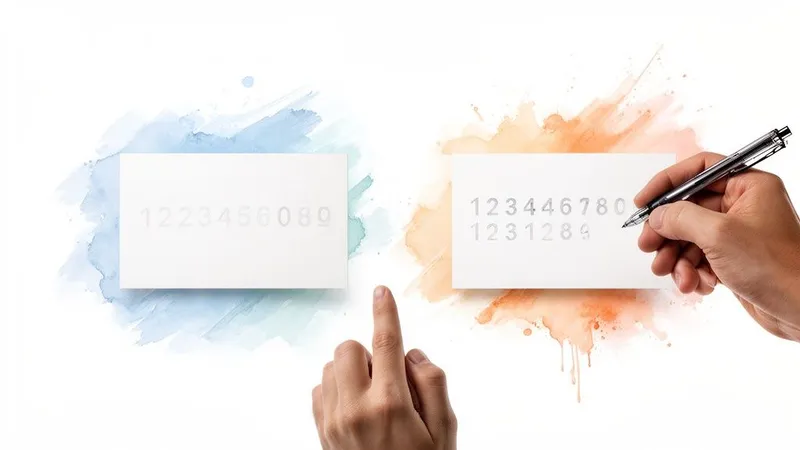
Even though the terms sound alike, the distinction between SIREN and SIRET is actually quite simple to grasp. The SIREN is your company’s identity card. The SIRET, on the other hand, corresponds to the address of each of your premises.
SIREN vs SIRET: the essential distinction for your business
In short, the SIREN is the unique number that follows your company throughout its existence, a bit like a social security number. The SIRET, meanwhile, geographically identifies each place of business.

Whether you run an online shop from your living room or an SME with several offices, mastering this difference is fundamental. These numbers, assigned by INSEE as soon as you register, are the cornerstone of all your dealings with the administration, your customers and your suppliers. A simple mistake can quickly turn into a headache: late payments, incorrect tax filings, even accounting problems.
In short: a company will only ever have one SIREN number, but it can absolutely have several SIRET numbers if it operates in different locations (a head office, a warehouse, a shop, etc.).
This logic is particularly relevant in e-commerce. Your head office, even if it’s your home address, has its own SIRET. If you open a warehouse tomorrow to store your products, this new location will receive a separate SIRET. Each number links an activity to a specific physical location.
To make things even clearer, the table below summarises the key points.
Quick comparison table: SIREN vs SIRET
This table highlights the fundamental differences between SIREN and SIRET numbers for an immediate understanding.
| Criterion | SIREN number | SIRET number |
|---|---|---|
| Purpose | Identify the company as a single legal entity | Identify a specific establishment or address |
| Format | 9 digits | 14 digits (the 9 SIREN digits + 5 NIC digits) |
| Uniqueness | One per company, for life | One per establishment (a company can have several) |
| Common use | Global contracts, Kbis extract, legal procedures | Invoices, payslips, local tax filings (CFE) |
This organisation ensures that every transaction (a sale, a hire) is correctly linked not only to the company (thanks to the SIREN), but also to the exact place where it took place (thanks to the SIRET).
This is an essential foundation, especially when starting out. If you’re just getting going, our article explaining how to become a sole trader can guide you through the first steps.
Understanding the structure of SIREN and SIRET numbers
To really grasp the difference between SIREN and SIRET, you first need to look under the hood and see how these numbers are built. It’s not just a random string of digits; their structure follows a very precise logic, put in place by INSEE to unambiguously identify every company and each of its places of business.

Once you’ve broken down these identifiers, you’ll never mix them up again. This greatly simplifies every step, whether administrative or commercial.
The structure of the SIREN number
The SIREN number (Système d’Identification du Répertoire des Entreprises) is the very first identifier your company receives when it is created. It always consists of 9 digits.
This number is both unique and permanent. It will follow your company throughout its existence, no matter whether you move, change your trading name, or pivot your business. Think of it as its social security number, its administrative identity card.
- Format: A string of 9 digits.
- Purpose: Uniquely identify the legal entity, i.e. the company as a whole.
- Lifespan: Permanent, from registration until deregistration.
The structure of the SIRET number
The SIRET number (Système d’Identification du Répertoire des Établissements), on the other hand, is longer, because it is also more precise. It always has 14 digits, split into two clearly distinct blocks.
In fact, its structure is nothing more than an extension of the SIREN:
- The first 9 digits: This is simply the company’s SIREN number.
- The next 5 digits: This is the well-known NIC (Numéro Interne de Classement). This unique code identifies a specific geographic location, whether that’s the head office, a shop, a warehouse or a simple office.
In short, a SIRET is the combination of the company’s identity (the SIREN) and a physical address (the NIC). This is why a company has only one single SIREN, but can have several SIRETs.
SIREN and SIRET are the pillars of the business identification system in France, managed by INSEE’s Sirene directory. The SIREN, with its 9 digits, is the unique identifier of each legal entity. The SIRET, with its 14 digits, adds a 5-digit NIC to precisely locate an establishment. For an online seller on Shopify or Amazon using a tool like Bizyness, this distinction is essential: when launching their shop, they will have 1 SIREN for their company and 1 SIRET for their head office. But if they open a warehouse for logistics, this new location will generate an additional SIRET. To dig deeper into the topic, you can learn more about the central role of the Sirene directory.
Where to find and check your identification numbers
Knowing where to find your SIREN and SIRET numbers, or those of your business partners, is a key step in securing your dealings. Fortunately, several official and reliable sources give you quick access to this information. The process is simple, whether it’s for your own company or a third party.
Your own identifiers are everywhere! They appear on most of your administrative and commercial documents. Take a look at:
- Your VAT returns or social security contribution filings (URSSAF).
- Your payslips, if you employ staff.
- The header of your invoices, quotes and purchase orders.
- Your Kbis extract or your Sirene directory status notice.
Public tools for instant verification
To verify a partner’s legal existence and confirm their information, INSEE’s public service is the ultimate reference. The Avis de situation Sirene website lets you obtain an official document in just a few clicks, free of charge, confirming a company’s status at a given moment.
Here’s what the search interface on the INSEE website looks like.
By simply typing in a company’s SIREN number, you get its full identity record. This record lists all of its active establishments and, as a result, all of its valid SIRET numbers.
Making a habit of this check is an excellent reflex to guard against fraud and ensure your transactions are compliant. It’s the guarantee that your partner is properly registered and that the information they give you is accurate. On that note, to lock down your data, feel free to check out our guide explaining how to find an intra-community VAT number.
Building this check into your onboarding process for a new customer or supplier is a simple step that genuinely strengthens the security of your business. Treat it as a non-negotiable step before entering into a commercial agreement.
To keep a CRM with reliable, up-to-date data, a good CRM enrichment guide will show you how to integrate these official identifiers. It’s an essential practice. Also, many modern management platforms, like Bizyness, automate these checks to make your life easier and minimise the risk of errors day to day.
When to use SIREN or SIRET in your operations
In the heat of the moment, the distinction between SIREN and SIRET can seem purely administrative. Yet knowing which number to use, and when, makes all the difference. It’s what keeps your documents compliant and smooths your dealings with the administration, your customers and your partners. In short, it’s the difference between calm, orderly management and back-and-forth that costs you precious time.
The golden rule is simple: the choice depends on the scope of your action. Does it commit the company as a whole, or does it relate to an operation tied to a specific location? Each number has a well-defined role, a bit like an ID card and a postal address.
SIREN, your company’s identity card
Think of the SIREN as your company’s unique, unchanging signature. It sits at the heart of its legal identity. You’ll use it for any act that commits your company as an entity, regardless of the number of offices or warehouses it has.
Specifically, it is required in these situations:
- Strategic contracts: For a bank loan, signing a commercial lease or an insurance contract, it’s the SIREN that identifies your company as a legal person.
- Central administrative procedures: When you create an account on payment platforms like Stripe or PayPal, it’s the company’s legal identity that gets verified, so via its SIREN.
- Fundamental legal documents: The Kbis extract, the true “identity card” of your company, is tied to the SIREN. Any change to the articles of association, such as a change of director or an increase in capital, is linked to this unique number.
The SIREN is the pillar of your legal existence. It’s the identifier your partners will look for first to confirm the health and legitimacy of your business before working with you.
The diagram below gives you a clear idea of the steps to follow to find the right SIRET number depending on the situation.
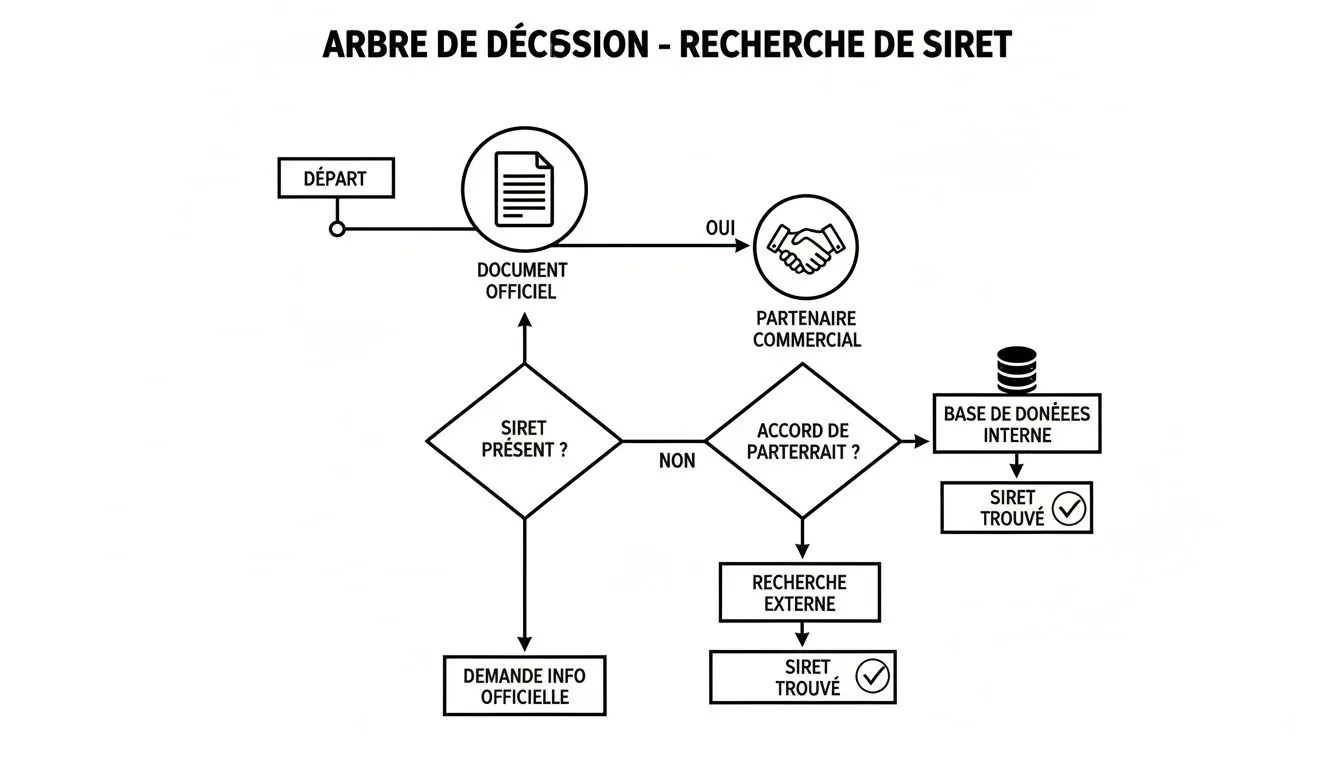
As this visual shows, finding a SIRET number often involves checking official documents, contacting the partner directly, or a simple search in public databases.
SIRET, the address of your business operations
The SIRET, meanwhile, anchors an action in geographic reality. It’s your “on the ground” identifier, essential for day-to-day operations and filings tied to a specific establishment.
The rule to remember: as soon as an operation can be linked to a specific address (a shop, a warehouse, an office), it’s the SIRET of that location that must be used.
Let’s look at the most common use cases:
1. Customer invoicing
This is a must. Every invoice you issue must compulsorily show the SIRET number of the establishment that made the sale or provided the service. For an online seller, this will most often be the SIRET of the head office or the warehouse the parcels ship from.
2. Tax and social filings
Most taxes and contributions are tied to a location.
- The CFE (Cotisation Foncière des Entreprises): This tax is based on the rental value of the property you use. You must therefore declare and pay it for each establishment, using its own SIRET.
- VAT returns: If you keep management accounts that track activity by site, each SIRET may have its own VAT flows to manage.
- Employee-related procedures: Payslips and URSSAF filings must always mention the SIRET of the employee’s actual place of work.
3. Registering on marketplaces
Platforms like Amazon or Cdiscount require your SIRET. Why? Because they need to pinpoint the exact location of your stock. This is essential for optimising their logistics, calculating shipping costs and handling returns efficiently. The SIRET guarantees they know exactly where each product comes from.
Using the right number is therefore not a mere formality. It’s what ensures the traceability, clarity and compliance of every action your company takes.
The impact of SIRET on your accounting and taxes
Rigorous management of your SIRET numbers is the cornerstone of sound accounting and tax filings free of nasty surprises. Far from a simple administrative formality, correctly assigning each transaction to the right establishment has a direct impact on your compliance and the relevance of your financial analysis. This is exactly where the distinction between SIREN and SIRET becomes crucial on a daily basis.

For an online seller, for example, every sale must be correctly linked to the right SIRET, whether that’s the head office or a warehouse. This good practice, often automated by tools like Bizyness, makes it possible to accurately break down revenue and costs by establishment. The result? A clear view of the profitability of each site.
SIRET, at the heart of your accounting compliance
Accuracy in the use of the SIRET is simply fundamental to producing reliable accounting records. Take the FEC (Fichier des Écritures Comptables), the file required during a tax audit: it must guarantee perfect traceability of transactions. A single SIRET error can be enough to call the validity of your entries into question and seriously complicate the administration’s checks.
This rigour matters even more if you manage several establishments. By correctly linking each financial flow, you can:
- Analyse the performance of each point of sale or warehouse completely separately.
- Simplify the consolidation of accounts at company level (i.e. at SIREN level).
- Generate a compliant FEC, where each entry is correctly located geographically.
Accounting by establishment is not a mere option, it’s an obligation. It ensures that every flow is tracked, from the initial sale through to the tax filing, securing your entire financial process.
For owners venturing into short-term rentals, it’s essential to master the guide to short-term rental regulations, an area where the SIRET is often required for tax procedures.
The direct tax implications of SIRET management
Beyond pure accounting, the SIRET is a central element of your tax filings. Incorrect assignment can quickly lead to costly errors and penalties.
1. VAT returns and international sales
For online sellers who sell internationally, the OSS (One-Stop Shop) and IOSS (Import One-Stop Shop) schemes simplify VAT reporting. However, these filings are tied to a specific SIRET. Using the wrong number can distort the amounts collected and declared, creating potentially explosive inconsistencies with customs and European tax authorities.
2. CFE (Cotisation Foncière des Entreprises)
The CFE is a local tax, calculated on the rental value of the property your company uses. Each establishment, identified by its SIRET, is taxed separately. A common mistake, such as forgetting to declare a new warehouse, can lead to a tax reassessment. Conversely, an accurate filing ensures you pay the right amount for each premises, no more.
Automated financial management turns this complexity into a much smoother process. By “mapping” each sale to its originating SIRET, dedicated platforms ensure your VAT returns and CFE calculations are always accurate. It’s the best way to protect yourself from tax risks. To go further on this topic, feel free to check out our article on accounting obligations for micro-entrepreneurs.
Common mistakes to avoid with your business numbers
Understanding the difference between SIREN and SIRET is one thing. Avoiding the classic mistakes that follow is even better. Because in practice, a simple slip on a document can have very real consequences, ranging from a late payment to more serious administrative trouble. It’s better to know these pitfalls so you don’t fall into them.
The most common confusion? Using the head office’s SIRET for everything, especially on invoices. This is a mistake, because the law is clear: you must use the SIRET of the establishment that actually made the sale or provided the service. If you’re an online seller and your products ship from a warehouse, it’s that warehouse’s SIRET that must appear on the invoice, not your office’s.
Forgetting to declare a new establishment
Another classic mistake: forgetting to declare the opening of a new establishment. Whether you’re launching a pop-up shop, a second office, or taking on a new warehouse to manage your stock, every new physical address linked to your business must be declared.
This process, which now goes through the single business formalities window (guichet unique), assigns you a new SIRET number. Skipping this formality is not a minor thing. The consequences can be tax-related, in particular for the CFE (Cotisation Foncière des Entreprises), a tax owed for each establishment.
Failing to declare an establishment means risking a tax reassessment. The administration can absolutely claim unpaid CFE from you, plus late-payment penalties on top. Rigorous management of your SIRETs is therefore simply essential to stay compliant.
Finally, people still sometimes confuse the SIREN with the intra-community VAT number. They are related, but not interchangeable. Your SIREN identifies your company in France. Your VAT number (which starts with FR, followed by two digits and your SIREN) is essential for your trade within the European Union.
To avoid these pitfalls, put simple habits in place. For example, prepare different invoice templates for each establishment, or add a small SIRET verification step to your process before sending an official document. These few safeguards will help keep you compliant day to day.
Your questions about SIREN and SIRET
We’ve covered the concepts, but a few practical questions often remain. Here are clear, direct answers to the most frequently asked ones.
Can a company have several SIREN numbers?
Never. A company is a single legal entity. As such, it has only one single SIREN number. INSEE assigns it at creation and it follows the company until it is dissolved, full stop.
Even if you move your head office, change your business activity or your legal status, this number will not change. It’s your permanent identifier, impossible to modify or transfer.
Put simply, the SIREN is to a company what a social security number is to an individual: unique and permanent. It’s the guarantee of reliable identification with every administration.
So how do you get a new SIRET number?
A new SIRET is created every time you open a new establishment. Whether it’s a second office, a warehouse, a physical shop or a simple storage point, you must declare it.
The process goes through the single business formalities window. INSEE registers this new address, keeps your SIREN unchanged (as we said, it never changes) and adds a new 5-digit NIC to it. There you go, you have a new SIRET!
Is the SIRET number mandatory on a quote?
Yes, absolutely. Just as with an invoice, the SIRET number of the establishment carrying out the service must appear on your quotes. The same logic applies to purchase orders.
It’s a legal requirement that links the commercial offer to a specific place of business. It’s a mark of professionalism and compliance that reassures your customers well before they sign anything.
Ready to automate your financial management? With Bizyness, every sale is turned into a compliant accounting entry, with no manual effort. Discover the solution at https://www.bizyness.fr.
