

 Français
 Sole trader invoice example: simple and clear
A perfect sole trader invoice example. Discover the mandatory details, templates and tips to invoice without errors and quickly.
When you’re a sole trader (micro-entrepreneur), a successful invoice example must above all be clear, professional and fully compliant with the law. It’s much more than a simple piece of paper: it’s tangible proof of your professionalism, the tool that secures your income and your best protection in case of a dispute with a client.
Why good invoicing is the key to your success
Invoicing is often seen as an administrative chore, a mere formality. Yet it’s actually one of the very first skills to master in order to build a lasting business. A well-made invoice is a bit like a firm handshake: it strengthens your image and immediately builds trust.
Think of your invoice as the business card of your cash flow. It has to be flawless. Every document you send is a promise of professionalism. A clean document, free of errors and with all the legal mentions, reassures your client and, believe me, encourages them to pay you faster.
Protecting your cash flow and your business
Rigorous invoicing is the true pillar of your financial management. It lets you know exactly where you stand, track your incoming payments, anticipate your revenue and effectively chase late payers. Without this tracking, you’re flying blind, and that’s the best way to put your micro-business at risk. It’s an essential discipline for keeping healthy cash flow.
To dig deeper into the topic, take a look at our full guide on administrative management for sole traders, which covers all these aspects in detail.
An invoice isn’t just a payment request. It’s the concrete result of a fulfilled contract, the mirror of your professionalism and the cornerstone of your bookkeeping. Neglecting it weakens the whole structure of your business.
The sole trader status is booming. As proof, between February 2024 and January 2025, the number of registrations jumped by 5.6%. But this popularity comes with increasingly strict obligations, notably with mandatory electronic invoicing arriving in September 2027. This reform aims to simplify things and strengthen traceability. You can read more about the changes ahead for sole traders on nouvelleviepro.fr.
By fully understanding what each sole trader invoice example involves, you turn a legal constraint into a real lever for growth.
Decoding the mandatory details on every invoice
Creating a proper invoice can seem intimidating at first. But in reality, it’s mostly a matter of method. Every piece of information has its place and its importance, not only to get paid, but also to protect you legally. Think of your invoice as a contract: every clause matters.
A simple omission can be costly. In the event of an audit, the tax authorities will not hesitate to apply a fine of €15 per missing or incorrect detail, capped at a quarter of the invoice’s total amount. Accumulated, these small errors can quickly weigh on your cash flow and damage your credibility.
The essential information: who you are and who you’re working for
The very first thing to do is identify yourself clearly. Your invoice must state your first and last name, followed by the legal mention “EI” or “Entrepreneur Individuel” (sole trader). Don’t forget your micro-business address and, of course, your SIREN number. It’s essentially the ID card of your business — there’s no way around it.
Next comes your client. You must indicate their full name or company name if they’re a professional, along with their address. This information is crucial for the document to be valid and for everyone to know who’s who.
This rigorous approach to invoicing rests on three fundamental pillars: the professionalism you project, the health of your cash flow and, of course, your legal compliance.
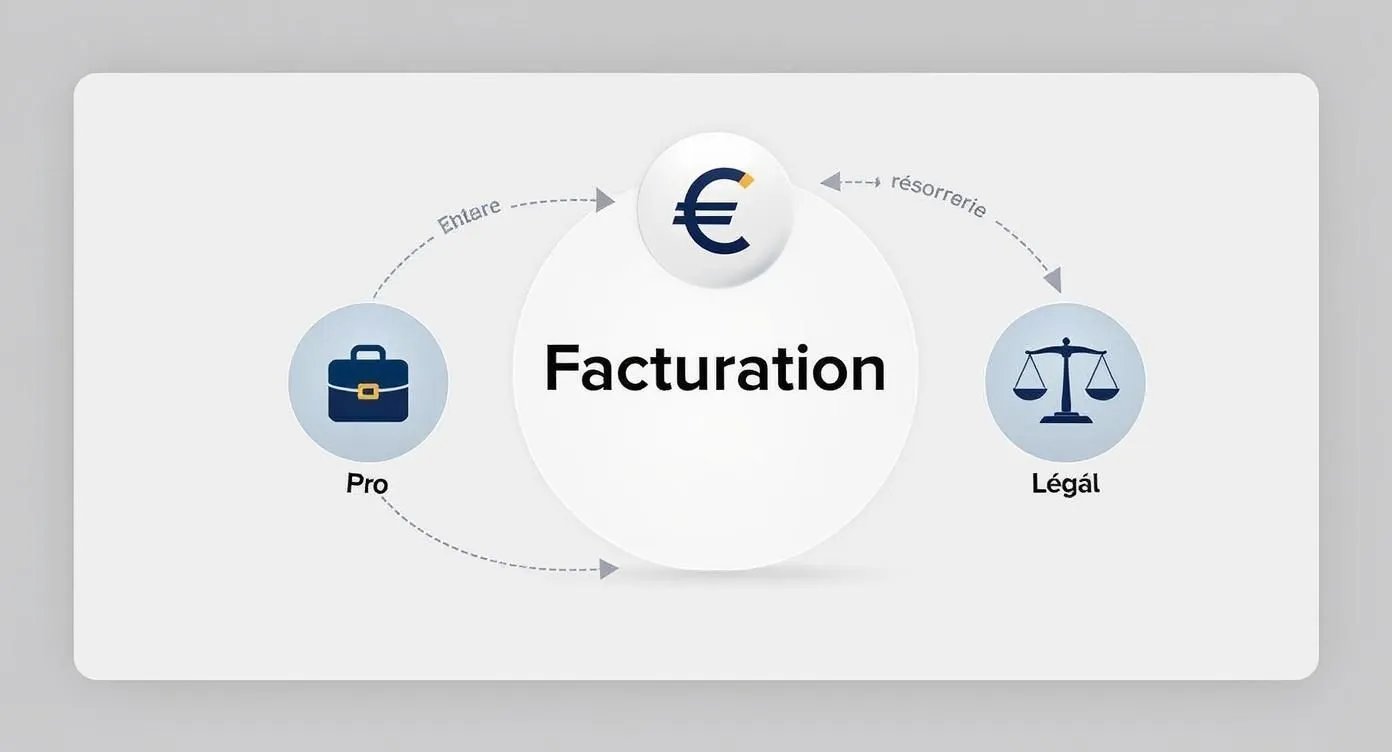
These three elements aren’t independent; they’re closely linked. Flawless invoicing turns a simple administrative constraint into a real lever for running your business.
The heart of the matter: the service and the amounts
This is where we get to the core of it: what are you selling? For each product or service, the details must be crystal clear.
- The exact description: Be precise, avoid vagueness. “Logo creation” is better than “Graphic design service”.
- The quantity: The number of items, hours or days sold.
- The unit price excluding tax (net): This is the calculation base, your raw rate.
- The total amount excluding tax: A simple calculation (quantity × unit price) that must be accurate.
Most sole traders start under the VAT exemption scheme (franchise en base de TVA). If that’s your case, a mention is absolutely mandatory to explain it.
VAT not applicable, art. 293 B of the French Tax Code (CGI)
This short sentence is non-negotiable. As long as you don’t charge VAT, it must appear on all your invoices. It informs your client that you’re not collecting this tax and explains why your prices are shown excluding tax.
Finally, the total amount due must jump out at a glance. And don’t forget the numbering! Every invoice must have a unique number that follows a logical, uninterrupted sequence (for example, 2024-001, 2024-002…). This is a strict legal requirement to ensure the traceability of your bookkeeping. Every sole trader invoice example you’ll find follows this golden rule.
Payment terms and other details that matter
Let’s finish with the terms of the “deal”. Clearly state the invoice issue date and the payment due date. If you invoice other professionals, the law requires you to mention the applicable late-payment penalty rate, as well as the flat-rate €40 recovery fee.
For certain activities, particularly in the trades, other mentions are required. A construction tradesperson, for example, must mention their professional insurance, such as the ten-year warranty (garantie décennale). These details aren’t trivial: they reinforce your credibility and protect you.
VAT for sole traders: how does it work?
Let’s tackle a topic that often causes a bit of anxiety: VAT. Rest assured, for most sole traders starting out, it’s actually very simple. You start under a special scheme, the VAT exemption (franchise en base de TVA), which makes life much easier for you.
In concrete terms, what does that mean? Simply that you don’t have to charge VAT to your clients. Your rates are “net” (excluding tax), so you have nothing to collect for the state. It’s a real boost to get started, as it simplifies your bookkeeping to the maximum. In exchange, of course, you can’t reclaim VAT on your own business expenses.
The exemption thresholds to watch closely
This favorable scheme isn’t unlimited. It’s conditional on revenue caps. It’s crucial to keep an eye on this, because if you exceed them, you move to another category and must start charging VAT.
Here are the thresholds to keep in mind:
- €36,800 in revenue for services and liberal professions.
- €91,900 in revenue for goods sales and accommodation activities.
There’s a small tolerance threshold that gives you a bit of leeway, but if you cross that too, the switch to VAT becomes immediate. To fully understand all the subtleties, I recommend reading our full guide on VAT for sole traders, which breaks down every scenario.
Moving to VAT isn’t a punishment, but a sign of growth. It’s a natural step in the development of your business that simply requires a bit of anticipation to be managed smoothly.
Moreover, a major change is looming for 2025. A reform under discussion could lower the exemption threshold for service providers to €25,000. If passed, this means many sole traders will have to charge VAT much earlier than before. To learn more about the consequences of this proposal, the site LegalPlace.fr has published an analysis on the impact of this reform on sole trader income.
My revenue exceeds the thresholds, what should I do?
If this happens to you, don’t panic — it means business is going well! The first thing to do, without delay, is to contact your local Business Tax Office (Service des Impôts des Entreprises, SIE) to obtain your intra-community VAT number. It will become mandatory on all your invoices.
Next, you’ll need to adapt your documents. The old mention “VAT not applicable, art. 293 B of the CGI” must disappear. In its place, you’ll need to include:
- Your intra-community VAT number.
- The VAT rate applicable to your services or products.
- The breakdown of amounts: total excluding tax, VAT amount and total including tax.
This adjustment transforms your sole trader invoice example and marks a new era for your business. Remember to prepare this transition carefully, notably by informing your clients that your rates will change to include VAT.
Our downloadable invoice templates: get started right away!
Theory is good. Practice is better! To help you take action without any hassle, we’ve prepared several invoice templates that cover the most common situations for a sole trader. Every sole trader invoice example is designed to be clear, professional and, above all, easy to customize.
Think of these templates as practical guides, not just documents to fill in. You’ll find small notes and instructions to walk you through step by step. The idea is to make you self-sufficient and confident with your invoicing.
A template for every need
Whether you’re a tradesperson, a consultant or an e-commerce seller, whether you’re requesting a deposit or not, there’s a template for you. We focused on three key scenarios to cover the essentials of your needs.
- Service invoice template: Perfect if you’re a consultant, developer, coach… It’s structured to clearly describe your assignments, whether based on time spent or concrete deliverables.
- Product sales template: Ideal for creators, artisans and e-commerce sellers. Its structure makes it easy to add multiple items with their references, quantities and unit prices.
- Template with deposit: Essential for securing large projects. This example directly includes the legal mentions needed to request part of the payment upfront.
All these templates are available in Word and Excel format. It’s up to you to choose the tool you’re most comfortable with!
Starting from an invoice template isn’t laziness, it’s efficiency. It’s a smart way to save time so you can focus on what really matters: your craft and your clients’ satisfaction.
The image below gives you a very clear idea of what a well-built sole trader invoice example looks like, with all the important information jumping out at a glance.
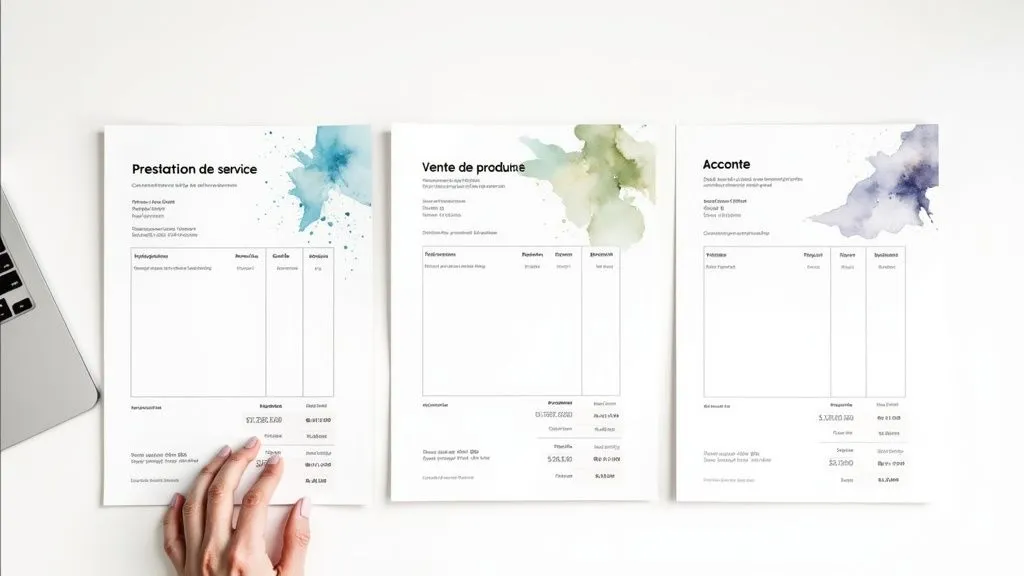
This visual shows exactly what you should aim for: clarity and good organization. Every piece of information is in its place, making it simple and pleasant for your client to read.
How to make the most of these templates?
Downloading a template is the first step. The secret is to truly make it your own. Here are a few tips to keep your invoicing always flawless.
- Customize the header once and for all. Add your logo, your name, your address, your SIREN number. Save this file as your “base template” so you never have to touch it again.
- Be precise in the description. Don’t settle for a vague label. The more you detail your service or product, the less risk there is of misunderstanding or dispute.
- Check the numbering every time. This is the classic mistake! Before sending a new invoice, take a look at the previous one to make sure the number follows the logic, with no gap or duplicate.
- Proofread before sending. A simple typo or calculation error can tarnish your professionalism. Take two minutes for a final check — it’s really worth it.
Even though they’re very handy to get started, spreadsheets like Excel have their limits and can quickly become a source of manual errors. If you want to go a bit further, our sole trader Excel invoice template offers a few more advanced features.
Naturally, as your business grows, switching to dedicated invoicing software like Bizyness becomes an obvious choice. It automates numbering, manages your client and product records, and guarantees you’re always compliant with the law. It’s the logical next step to save precious time and gain invaluable peace of mind.
Identifying and avoiding the most common invoicing mistakes
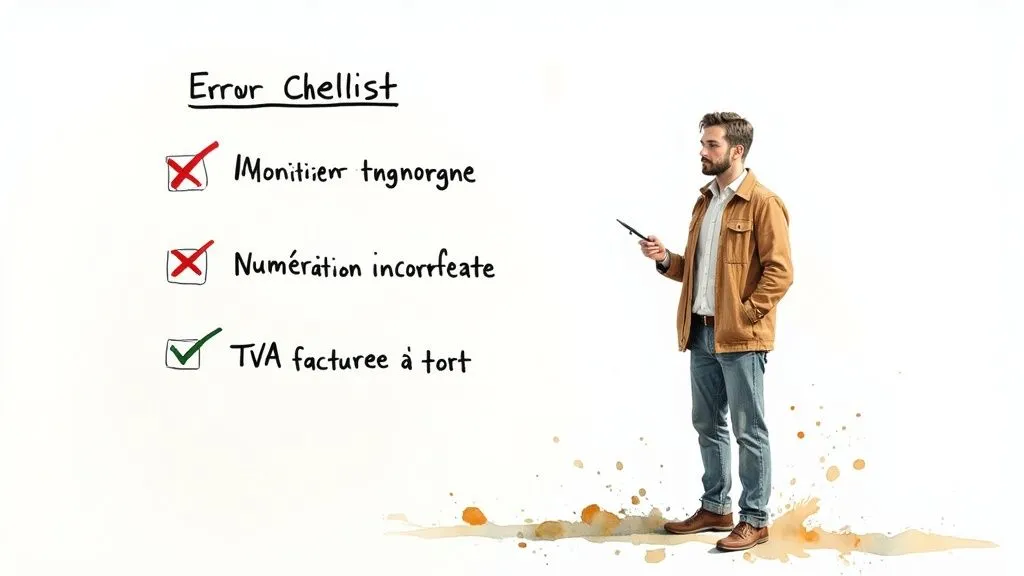
Even with the best sole trader invoice example in front of you, no one is immune to a small slip-up. And yet, these missteps can be costly, whether in fines or in credibility with your clients. Fortunately, once you know the pitfalls, it becomes much easier to avoid them.
A simple numbering mistake, a forgotten legal mention or an incorrect application of VAT can quickly turn what should be a simple formality into a real headache. And the tax authorities don’t take this lightly. A single missing mention can earn you a fine of €15 per invoice, capped at a quarter of the total amount. Vigilance is therefore essential.
Missing mandatory details
This is undoubtedly the most common mistake. Caught up in the heat of the moment, we forget a piece of information that seems minor but is actually essential. The usual suspects? The SIREN number, the client’s full address, or the famous “VAT not applicable, art. 293 B of the CGI” mention for those under the exemption scheme.
To make sure you never leave anything to chance, the simplest solution is to adopt a standard invoice template or, even better, use invoicing software. These tools include dedicated fields for all the legal information, acting as genuine safeguards. This way you’re guaranteed that every document is fully compliant, without even having to think about it.
Invoice numbering errors
The rule is simple and non-negotiable: your invoice numbering must be chronological, continuous and without any gap. It’s strictly forbidden to delete a validated invoice or leave a “gap” in the sequence. This rigor ensures the traceability and transparency of your bookkeeping.
Here are the main pitfalls to avoid:
- Duplicates: Assigning the same number to two different invoices.
- Gaps in the sequence: Jumping from invoice 2024-015 to 2024-017.
- Deleting an already-issued invoice: If you need to cancel an invoice, the only legal solution is to issue a credit note that explicitly references the original invoice.
To secure your numbering, adopt a simple system and stick to it. The YEAR-NUMBER format (for example: 2024-001, 2024-002) is an excellent choice. Automating this with a tool like Bizyness eliminates this risk entirely.
Poor VAT management
Finally, VAT management is a recurring source of errors, especially when exceeding the exemption thresholds. Continuing to issue invoices without VAT when you’ve become liable for it is a serious mistake in the eyes of the tax authorities.
Conversely, charging VAT while you’re still under the exemption scheme is also a mistake. It unnecessarily complicates your bookkeeping and your client’s. The key is therefore to closely monitor your revenue and anticipate the switch to VAT so you can adapt your invoices as soon as needed.
FAQ: practical invoicing cases
Even with the best invoice template in front of you, real-world situations always raise their share of questions. We’ve compiled here the most frequent questions to give you clear, direct and actionable answers, so you can invoice with total peace of mind.
Can I modify an invoice that’s already been sent?
The answer is a categorical no. Once an invoice has been issued and sent to your client, it becomes an official accounting record, set in stone. You can neither modify it nor delete it, even if you notice a typo right after sending it.
So how do you fix it? The one and only way to correct the situation is to issue a credit note. This is a new document, with its own number, which cancels the original invoice, in full or in part. Be sure to mention the reference of the invoice you’re correcting (for example, “Credit note referring to invoice no. 2024-042”). This is the only method that guarantees clean, legally compliant bookkeeping.
Do I really need to make an invoice for just a few euros?
Yes, it all depends on your client! If you’re working for another professional (a company, another self-employed person…), the invoice is mandatory, regardless of the amount. Even for a one-euro service, you must formalize the transaction.
For an individual client, the rules are a bit more flexible. The invoice becomes mandatory in two situations:
- The amount of the sale or service exceeds €25 including tax.
- The client explicitly requests it, even for a very small amount.
A friendly tip: get in the habit of invoicing systematically. It’s the best way to closely track your revenue, simplify your URSSAF declarations and protect yourself in case of a problem or dispute.
How do I number my invoices without making mistakes?
Numbering is essentially the pillar of your invoicing. The golden rule is simple: it must be chronological and continuous, without the slightest gap. Every new invoice must have a unique number that logically follows the previous one.
The simplest approach? A basic sequence of numbers: Invoice no. 1, Invoice no. 2, etc. But to make things easier to track over the years, many self-employed people adopt a system with a prefix, often the current year:
- 2024-001
- 2024-002
- … then start again at 2025-001 the following year.
Whatever format you choose, the key is to stick with it. The safest way to avoid mistakes is still to use invoicing software, which handles this numbering for you.
Isn’t a signed quote enough to serve as an invoice?
Absolutely not! These are two documents that serve completely different purposes. A signed quote is a commercial commitment. It proves that your client agrees with your proposal and your rates. It’s essentially the contract that binds you.
The invoice, on the other hand, is an accounting and legal document. It certifies that you’ve actually completed the work (or delivered the product) and triggers your client’s obligation to pay. Even with a properly signed quote, you must always issue a final invoice to get paid and stay compliant.
Managing your invoicing can seem intimidating, but with the right tools, this administrative chore becomes a simple formality. Bizyness, for example, lets you create compliant invoices in a few clicks, automate their numbering and track your payments effortlessly. Free up time to focus on what you do best.
Try Bizyness for free and discover truly simplified management.
