

 Français
 Sole Trader Invoicing: An Easy Guide to Getting It Right
Master sole trader invoicing with our expert advice. Get all the legal tips for simpler, more effective invoice management.
Mastering the fundamentals of micro-entrepreneur invoicing
Rigorous invoicing is essential to the success of any micro-entrepreneur business. Far more than a simple administrative formality, it reflects the professionalism and credibility of the sole trader. This process, simplified for micro-entrepreneurs, nonetheless requires careful attention to detail to avoid potentially costly mistakes.
Mandatory legal information: the foundation of a compliant invoice
To be legally and fiscally valid, every invoice must include certain mandatory details. Essential elements include: the word “Invoice,” a unique sequential number, the issue date, the full contact details of both seller and client (including the SIRET number and, if applicable, the intra-community VAT number). You must also detail the description of the services or products sold, along with their unit price and quantity, the total amount excluding tax, the VAT exemption notice (“VAT not applicable, art. 293 B of the French Tax Code”), and the payment terms. Omitting any of these details can result in penalties.
VAT exemption: a distinctive feature of the sole trader scheme
A major advantage of the sole trader (micro-entrepreneur) scheme is the basic VAT exemption. This means you do not charge VAT on your invoices and do not remit it to the state, which considerably simplifies your bookkeeping. The VAT exemption notice is therefore essential. It is nonetheless important to stay informed about the revenue thresholds beyond which the exemption no longer applies. Exceeding these thresholds brings new obligations, such as charging and declaring VAT. There has, in fact, been significant growth in the number of sole traders in France. In June 2024, some regions such as Brittany (+9.6%), Picardy (+9.5%) and Île-de-France (+8.7%) recorded substantial increases, illustrating the dynamism of this scheme. See more detailed statistics here.
Anticipating mistakes and building a professional image
Even minor invoicing errors can have significant consequences: late payments, commercial disputes, financial penalties, and a negative impact on your brand image. To prevent them, putting rigorous processes in place is essential: using invoicing software such as Excel, carefully checking each document before sending it, and archiving a copy of all your invoices. Sole trader invoice templates are available online. Our sole trader invoice templates in Excel A clear, precise, and compliant invoice strengthens your credibility with clients and contributes to the long-term success of your business.
Creating invoices that build trust and get you paid
Your invoices are far more than a simple legal obligation. They reflect your brand image and directly influence how clients perceive your professionalism. A well-designed invoice is easy to understand, encourages fast payments, and reinforces your credibility.
For sole traders, invoicing is a key step. A clear, precise document avoids misunderstandings and helps maintain a smooth client relationship.
The importance of a clear, concise invoice
Clarity and conciseness are essential for an effective invoice. High-performing sole traders structure their invoices to optimize readability. A well-organized document, with distinct sections for key information, allows your clients to quickly understand the details of the transaction.
For example, group your contact details and your client’s together at the top of the invoice. Then detail each service or product sold, specifying the quantity, unit price, and total price.
Numbering and wording: getting the details right
A clear, consistent sequential numbering system, such as 2024-001, 2024-002, is essential for effective administrative tracking and makes filing your invoices easier. The choice of wording also matters: professional, courteous language strengthens your brand image.
Don’t forget the mandatory notice regarding the VAT exemption: “VAT not applicable, art. 293 B of the French Tax Code”.
Here is a summary table of the mandatory details:
For optimal management of your sole trader business, invoicing software can prove very useful.
| Mandatory detail | Description | Example |
|---|---|---|
| Invoice number | Unique, sequential number | 2024-050 |
| Issue date | Date the invoice was created | 12/07/2024 |
| Seller identity | Name/company name, address, SIRET | DUPONT Jean, 1 rue de la Paix, 75000 Paris, 12345678900012 |
| Buyer identity | Name/company name, address | SARL Martin, 2 avenue des Champs-Élysées, 75000 Paris |
| Description of services | Detail of products/services sold | Digital marketing consulting |
| Quantity | Number of units sold | 10 hours |
| Unit price excl. VAT | Price per unit before tax | €50 |
| Total price excl. VAT | Total price before tax | €500 |
| VAT notice | Notice regarding the basic VAT exemption | VAT not applicable, art. 293 B of the French Tax Code |
| Payment terms | Accepted deadlines and payment methods | Payment within 30 days by bank transfer |
This table presents the mandatory legal details for sole trader invoices. It is important to comply with these requirements to ensure the validity of your invoices.
Tailoring your invoices to your industry
Every industry has its own specifics. Proven invoice templates exist for intellectual services, crafts, retail, and more. Our tips on sole trader invoicing can help you adapt these templates to your own business by including the information relevant to your clients.
Customization and compliance: finding the right balance
Customizing your invoices, for example by adding your logo, strengthens your professional identity. However, it is essential to comply with the regulatory framework and include all mandatory details. The shift toward electronic invoicing, which is gradually becoming mandatory, requires adapting your practices.
The impact of electronic invoicing
Electronic invoicing simplifies exchanges, reduces costs, and limits errors. Choose invoicing software compatible with electronic invoicing to prepare for this transition and stay compliant with regulations. By mastering these aspects, you’ll create professional invoices that build trust and encourage fast payments.
Navigating the ins and outs of VAT with confidence
VAT is often a source of confusion for sole traders. This status generally benefits from the basic VAT exemption. This means you don’t have to charge it to your clients. This administrative simplification considerably eases the management of your micro-entrepreneur business. It also allows you to offer more competitive prices. However, it’s important to understand the implications of this scheme. It’s also essential to anticipate potential changes in your business.
Understanding the basic VAT exemption and its impact
The basic VAT exemption is a significant competitive advantage. This is especially true when working with individual consumers. Your prices are displayed excluding tax, making them more attractive. On the other hand, for your business clients, this has no impact, since they reclaim the VAT. What matters is clearly stating on your invoices the notice “VAT not applicable, art. 293 B of the French Tax Code”.
To illustrate this point, the infographic below summarizes the mandatory and optional details on a sole trader invoice. It also recaps the legal payment deadline.
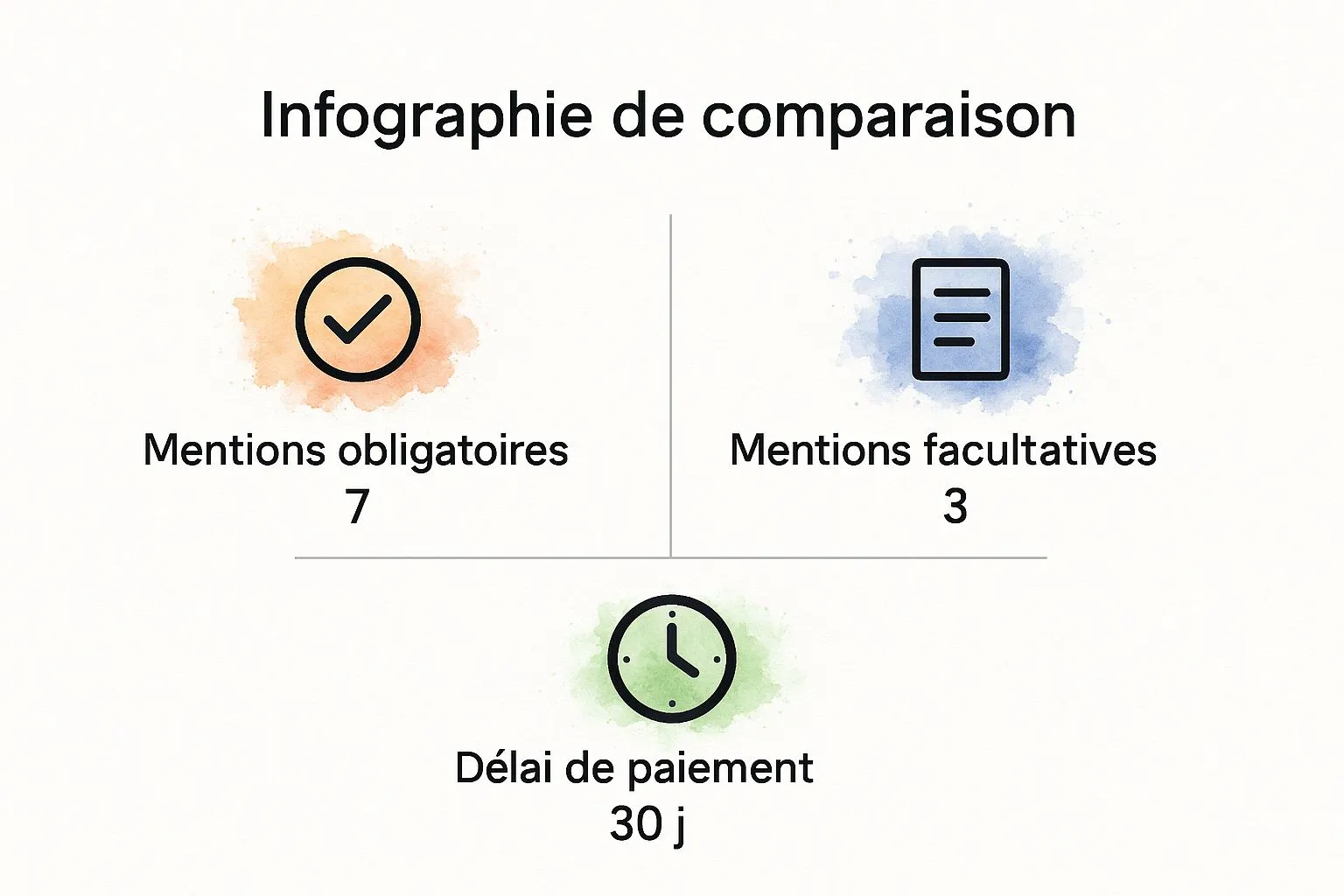
The infographic shows that a sole trader invoice, even with the VAT exemption, includes numerous mandatory details (7). This contrasts with the number of optional details (3). The legal payment deadline of 30 days is also noted.
Anticipating threshold overruns and the transition to a VAT scheme
The basic VAT exemption is subject to revenue thresholds. If you exceed them, you will need to charge and remit VAT. This transition requires adapting your invoicing practices. Transparent communication with your clients is also essential. The 2025 budget bill has, in fact, lowered the VAT exemption threshold. This affects many sole traders. To learn more about these changes and their consequences, see this article. Anticipating this transition is crucial. Adjusting your rates and clearly explaining the changes to your clients will protect your profitability. It will also help maintain good business relationships. To dive deeper into the topic, you can read this article: How to master VAT as a sole trader.
The table below presents the threshold changes for 2025:
Changes to VAT thresholds for sole traders
Comparative table showing the evolution of VAT exemption thresholds for the different sole trader business categories
| Business type | Previous thresholds | New thresholds | Impact |
|---|---|---|---|
| Services | €118,000 | €100,000 | Decrease |
| Sale of goods | €118,000 | €100,000 | Decrease |
| Liberal professions | €118,000 | €100,000 | Decrease |
This table highlights the reduction in thresholds across all business categories. This decrease will have a significant impact on many sole traders, who will now need to manage VAT.
Handling special cases: intra-community deliveries and intangible services
Certain situations, such as intra-community deliveries or intangible services, change the rules for applying VAT. For example, for intra-community deliveries, you must charge VAT if your client is not VAT-registered. For intangible services, the place of taxation depends on your client’s status. Understanding these specifics is fundamental. Adapting your invoices accordingly is essential to comply with the law. Staying informed of current regulations is therefore important. Using invoicing tools suited to handling these complex situations is also recommended.
Leveraging technology to transform your invoicing
As a sole trader, managing invoicing can quickly become an administrative headache. Fortunately, digital tools offer effective solutions to simplify this process and let you focus on your core business. Going digital means optimizing every step, from creation to collection.
Tailored solutions for every sole trader
A wide range of digital tools is available to you. From free mobile apps to more comprehensive invoicing software, the choice is vast. Some platforms, such as Bizyness, are specifically designed for sole traders. They offer dedicated features, such as automatic generation of compliant invoices and payment tracking. More traditional tools, such as spreadsheets, can also be used to create invoices, but require particular attention to compliance with mandatory details.
Saving time through automation
Automation is a major asset of digital solutions. Imagine: your software automatically generates your invoices as soon as a service is completed, calculates the amount, and sends it directly to your client. That’s precious time saved, letting you focus fully on growing your business. What’s more, automation reduces manual errors and ensures your documents are compliant. Payment tracking is also simplified through automated notifications and reminders.
Integration and adapting to growth
Integrating your invoicing tool with your digital ecosystem is an essential point. Syncing with your bank account and accounting software gives you a comprehensive view of your finances. In addition, some solutions grow with your business and offer more advanced features as your needs evolve. Managing quotes, credit notes, and recurring invoices can thus be integrated. Adapting to regulatory changes, particularly regarding VAT, is also crucial. For example, VAT thresholds were changed in 2025. For buy-resell and accommodation-supply activities, they moved from a range of €91,100–€101,000 to a range of €85,000–€93,500. For services and furnished rentals, the change is from €36,800–€39,100 to a range of €37,500–€41,250. These changes have a direct impact on the financial management of sole traders. More information on these updates is available here.
Choosing the ideal invoicing tool
Choosing the ideal solution depends on several factors: your business volume, your specific needs, and your budget. For a beginning sole trader with a low volume of invoices, a free solution may be enough. On the other hand, a business with a high volume of transactions and more complex needs, such as managing multiple currencies, will need more powerful software. Don’t hesitate to test different solutions and compare their features. Moving to digital invoicing is a worthwhile investment that streamlines your management, reduces errors, and lets you focus on growing your business.
Building an archiving system that protects your business
Archiving invoices is a legal obligation for sole traders. It is also a major asset for organizing your business. A well-designed archiving system lets you easily find all your documents, whether for a tax audit, a commercial dispute, or simply to analyze how your business has evolved. This system is essential to the long-term success of your business.
Organizing your archives for maximum efficiency
Several archiving methods are available to you: physical (binders, hanging folders) or digital (software, cloud). The key is to choose a method that suits you and to stick to it rigorously. For physical archiving, chronological filing by year, then by invoice number, is often effective.
For digital archiving, using clear file names and rigorously organized folders is essential. For example, create a folder for each year, then subfolders by month or by client. Whatever medium you choose, the goal is to be able to quickly access a specific invoice.
Document retention: a legal obligation to respect
The legal retention period for invoices is 10 years. This obligation applies to all invoices, both issued and received. Keeping your invoices for this period is essential in case of a tax audit or dispute. An effective archiving system simplifies this retention process and gives you peace of mind.
Payment tracking: an asset for your cash flow
A well-structured archiving system is a valuable tool for payment tracking. By centralizing your invoices and noting payment dates, you can quickly identify late payments.
This tracking lets you anticipate potential cash flow issues and respond accordingly.
Reminders and negotiations: preserving client relationships
In the event of a late payment, graduated reminders are needed. Start with a friendly reminder, then adopt a firmer tone if necessary. Clear communication with your clients is essential. Offer solutions, such as a payment plan, if the situation calls for it.
The goal is to recover the amounts owed while maintaining good business relationships. Firm but tactful negotiation techniques can help you reach an agreement with your clients. Constructive dialogue and a professional attitude are essential to preserving trust. Remember that your archiving system serves as evidence in the event of a complex dispute.
Archiving in the age of electronic invoicing
With mandatory electronic invoicing arriving in 2026, archiving is becoming even more important. Partner dematerialization platforms (PDPs) store your invoices electronically, but it is advisable to keep a backup copy. Invoicing software like Bizyness helps you manage your electronic invoices and simplifies their archiving.
In conclusion, an effective archiving system is an investment in your peace of mind and the long-term success of your sole trader business. It helps you meet your legal obligations, streamline your administrative management, control your cash flow, and build lasting relationships with your clients.
Mastering complex invoicing situations as a micro-entrepreneur
Invoicing as a micro-entrepreneur is often seen as simple. Yet certain more complex situations require particular attention and an adaptation of your practices. These cases, sometimes a source of concern for sole traders, deserve explanation to ensure compliant invoicing and avoid mistakes.
Handling international transactions: EU and non-EU
International transactions, whether within the European Union or with third countries, involve specific VAT rules. For intra-community transactions (within the EU), whether VAT applies depends on your client’s status.
If your client is a VAT-registered business, the reverse charge mechanism applies: your client declares the VAT themselves. If your client is an individual or a non-VAT-registered business, you must apply French VAT.
For transactions outside the EU, the rules are different. Exports are generally exempt from French VAT, but it is essential to check the tax rules of the destination country. These transactions require particular attention to the mandatory details on the invoice, notably your client’s intra-community VAT number, where applicable.
Mastering credit notes, deposits, and corrective invoices
Credit notes, deposits, and corrective invoices are specific documents that address particular situations. A credit note cancels all or part of an original invoice, for example in the event of an error or a product return.
A deposit represents a partial payment made before the service is fully completed or the product delivered. A corrective invoice, meanwhile, corrects an error on an original invoice without cancelling it. Mastering these documents is fundamental to the legal security of your transactions and to preventing disputes.
Adapting your invoicing to your industry
Every industry has its own particularities that influence invoicing. A sole trader in the construction sector will charge VAT even under the basic exemption if their client is a business. In personal services, certain services offer tax benefits to the client.
Handling transition periods: VAT thresholds and change of status
Exceeding the revenue thresholds for the basic VAT exemption brings new obligations. It is important to anticipate this transition in order to adjust your rates, your invoicing software, and to notify your clients.
A change in legal status (moving from micro-entrepreneur to SASU, for example) also requires adapting your invoicing, particularly regarding mandatory details.
Concrete examples by industry
- Services: A consultant working for a foreign company will apply French VAT if that company is not VAT-registered.
- Retail: An e-commerce seller trading internationally must manage customs taxes and regulations, in addition to VAT.
- Crafts: A craftsperson receiving a deposit for a custom creation issues a deposit invoice followed by a final invoice.
By mastering these situations, you ensure the compliance of your invoicing, optimize your management, and maintain client trust. Invoicing software like Bizyness supports you through these processes. It lets you create compliant invoices, manage credit notes and deposits, and track your international transactions with confidence.
