

 Français
 Mandatory mentions on a sole trader invoice: The complete guide
Everything you need to know about mandatory mentions on a sole trader invoice. Master the essential requirements for compliant invoicing and avoid costly mistakes.
As a sole trader, you might think an invoice is just a simple piece of paper to claim what you’re owed. That’s a mistake. In reality, it’s a fundamental legal document, a cornerstone of your business that must contain very specific information to be valid. Think of full identification of your business and your client (name, address, SIREN number), a unique invoice number, the date, a breakdown of what you sold… not forgetting the famous mention “VAT not applicable, art. 293 B of the French General Tax Code” if you benefit from the VAT exemption scheme.
Why a flawless invoice is your best ally
Think of your invoice as both your professional business card and your legal shield. Every document you send is a direct reflection of your seriousness and rigor. For a client, receiving a clear, complete invoice that follows the rules is a real sign of trust. It shows them you manage your business from A to Z, including the administrative side, which immediately strengthens your credibility.
Conversely, a sloppy, incomplete, or error-filled invoice can raise doubts. It opens the door to late payments, endless questions, and even disputes. Mastering the mandatory mentions on a sole trader invoice isn’t just an administrative chore; it’s a powerful lever for building healthy, lasting relationships with your clients.
What’s at stake beyond payment
The importance of flawless invoicing goes well beyond the client relationship. First and foremost, it’s a legal obligation that protects you. Imagine a tax audit: your invoices are tangible proof of your revenue and the legality of your operations. A small mistake, even an unintentional one, can have fairly heavy financial consequences.
Article 1737 of the French General Tax Code is very clear on this point: each missing or inaccurate mention can cost you a fine of €15, capped at 25% of the total invoice amount.
This penalty shows just how seriously the law takes the transparency of business transactions. Rigorous invoicing is therefore your best insurance against penalties.
Common mistakes and their consequences
To properly gauge the risks, let’s take a look at the most common pitfalls. Rushed invoicing can quickly turn into a costly problem. Here are a few classic mistakes to avoid at all costs and what they can lead to.
| Common mistake | Direct consequence | Risk to your business |
|---|---|---|
| Missing SIREN number | Fine of €15 per invoice | The legal validity of your invoice can be called into question. |
| Non-continuous numbering | Rejection of your accounts in the event of an audit | It becomes very difficult to track your income and prove your transactions. |
| Missing VAT mention | Risk of tax requalification | Loss of credibility and serious complications with the authorities. |
| Vague description of the service | Dispute with the client over the work done | Payment delays, or even outright refusal to pay the invoice. |
By understanding these stakes, you can turn what seems like a constraint into a genuine strategic asset. It’s the key to securing and growing your micro-business from day one.
The essential information on every invoice

Think of your invoice as the transaction’s ID card. Every small piece of information you include has a specific role and tells a clear story, both to your client and to the tax authorities. To build rock-solid invoicing, certain elements are simply non-negotiable. They are the foundations of your professional credibility.
These mentions, found everywhere, guarantee the traceability and transparency of the exchange. Without them, your invoice loses all its legal and accounting value, which could expose you to unnecessary risks. Thinking about these details isn’t a waste of time — it’s an investment in the peace of mind of your micro-business.
Clear identification of the parties
The very first thing to do is clearly identify both parties: you, the service provider or seller, and your client, the buyer. This is the “who’s who” of your invoice, the foundation of everything.
On the sole trader’s side (you):
- First and last name: Your civil identity, quite simply.
- Registered address: This is the official address of your micro-business, even if it’s your home.
- SIREN number: This unique 9-digit number is the true license plate of your business. It is absolutely essential.
On your client’s side:
- First and last name (or company name for a business): You need to know exactly who you’re dealing with.
- Billing address: Essential so your client can process the document on their end.
These pieces of information are the pillars of your invoice. A single omission, such as the SIREN number, and your document can be considered invalid.
The invoice’s structure
Once everyone is properly identified, you need to frame the transaction with time and logistics markers. Think of these elements as the GPS coordinates of a specific event.
Invoice numbering is a bit like a fingerprint: it’s unique and impossible to forge. It must strictly follow a chronological, continuous sequence, without any gaps or duplicates. For example, you could start with INV-2024-001, then INV-2024-002, and so on.
Here are the mentions that structure your document and must never be forgotten:
- The word “Invoice”: It must be spelled out in full to avoid any confusion with a quote.
- Invoice number: Unique and sequential, as just mentioned.
- Issue date: The day you create and send the document.
- Date of sale or service: The day the work was done or the product delivered.
Rigor is your best friend here. It doesn’t just show that you’re organized — it’s also a very strict legal requirement. To learn more, feel free to check out our guide to invoicing for sole traders.
The description and amount calculation
Now we get to the heart of the matter: what your client is paying you for. Clarity is key to avoiding misunderstandings and delayed payments. Every line must be precise.
- Description of the product or service: Be as detailed as possible. “Consulting service” is too vague. Prefer something like “Digital marketing consulting service - 5 hours”.
- Itemized breakdown: For each line, clearly indicate the quantity and the unit price excluding tax.
- Total amount due excluding tax: The sum of all your services.
The sole trader status is hugely popular, accounting for 64.5% of business creations in France. This popularity, largely driven by 39% of founders under 30, makes flawless administrative management all the more crucial for standing out. Mastering sole trader invoices and their mandatory mentions has therefore become an essential skill.
Mentions specific to sole trader status
Your sole trader status entitles you to a simplified regime, and this should show on your invoices. These documents aren’t just simple payment requests — they’re the administrative reflection of your particular status. Forgetting certain details means risking penalties and, worse, giving your clients an unprofessional image.
Two mentions are absolutely crucial and specific to your status: one relates to your VAT regime, the other to your legal identity. Knowing and applying them correctly is the key to ensuring every sole trader invoice includes its mandatory mentions, thereby strengthening your business’s credibility.
The famous VAT mention
The main difference between your invoicing and that of a standard company lies in Value Added Tax (VAT). As a sole trader, you fall by default under the VAT exemption scheme (franchise en base). In practice, this means you don’t charge VAT to your clients.
For everything to be transparent and legally compliant, this specific feature must be clearly stated on each of your invoices.
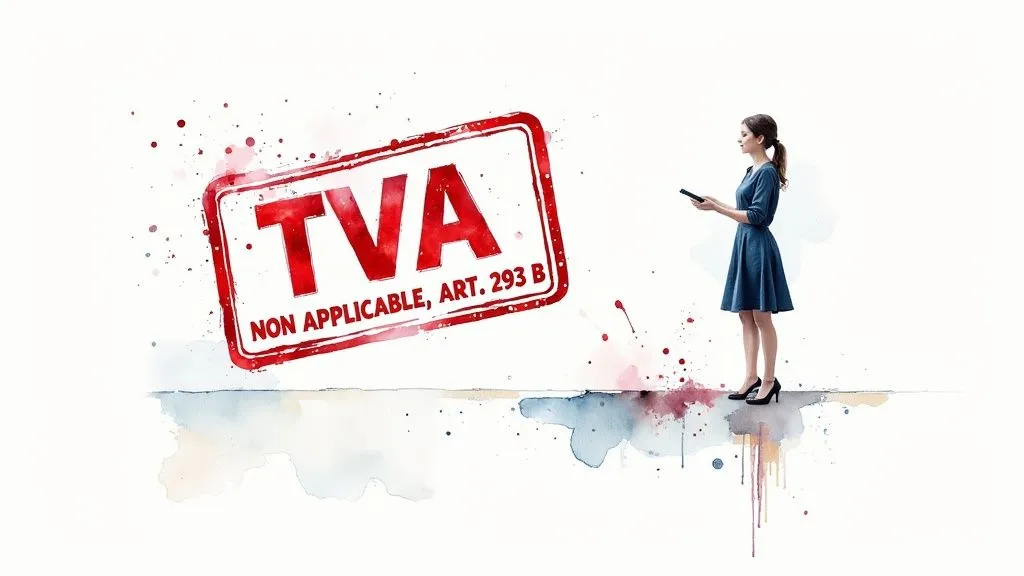
VAT not applicable, art. 293 B of the French General Tax Code
This simple sentence carries a lot of weight. It’s what justifies why your rates are shown excluding tax and why there’s no VAT line or total including tax on your invoices. Forgetting it is a classic mistake that can be costly: the tax authorities can fine you €15 per incomplete invoice.
Incidentally, administrative simplicity, invoicing included, remains one of the great strengths of the status. In March, there were still 58,960 new registrations under this scheme, a stable figure showing its lasting appeal to independent workers (-0.3% year-on-year).
Identifying your legal status
Since May 15, 2022, an important reform has been introduced to better protect the personal assets of sole traders. This change has brought about a new administrative requirement that applies to all your professional documents, invoices included.
You are now required to include the mention “Entrepreneur Individuel” or its abbreviation “EI” just before or after your first and last name.
- Example: John Smith (EI) or Entrepreneur Individuel John Smith
This isn’t a minor administrative detail. This mention officially informs your clients and partners that your business assets are separate from your personal assets. It’s a significant guarantee of legal transparency. To go further on this topic, feel free to read our complete guide to mandatory invoice mentions.
The infographic below is a good reminder of the importance of rigor, showing the penalties incurred if you forget certain key mentions.

As you can see, the financial consequences can quickly add up, ranging from a fixed fine per missing mention to much heavier penalties. For a complete overview of your obligations, it’s always useful to check the legal requirements applicable to sole traders.
Comparison of invoice mentions: sole trader vs. standard company
To clearly visualize the specifics of your status, nothing beats a comparison table. It highlights the fundamental differences between what you must indicate and what a standard company (such as an SARL or SAS) must state on its invoices.
| Mandatory mention | Sole trader (VAT exempt) | Standard company (subject to VAT) |
|---|---|---|
| VAT identification number | Not required | Mandatory (intra-community VAT number) |
| VAT-related mention | ”VAT not applicable, art. 293 B of the French General Tax Code” | Applicable VAT rate for each product/service |
| Amounts on the invoice | Total amount excluding tax only | Total excluding tax, VAT amount, total including tax |
| Business identification | First and last name + “EI” or “Entrepreneur Individuel” | Company name, legal form (SAS, SARL…), share capital amount |
This table clearly shows that a sole trader’s invoicing is lighter on the VAT front, but requires particular attention to the “EI” mention and the VAT exemption in order to be fully compliant.
Handling special situations and additional mentions
Life as a sole trader is rarely a smooth ride. Your invoices need to be able to adapt to situations that fall a bit outside the ordinary: requesting a deposit, working with a business client, or even handling a service for a foreign company. Each of these scenarios requires adding specific mentions to stay compliant.
Think of this section as a toolbox. For each situation, there’s a mention you shouldn’t forget. Ignoring it could lead to complications, such as a payment delay or a misunderstanding with your client. Mastering these details is an excellent way to secure your cash flow and strengthen your credibility.
Protecting your cash flow with business clients
When you invoice another business, the law is on your side to protect you against late payers. The framework is actually quite strict. It’s therefore essential to include information on your invoices that has a deterrent effect on a client who might delay paying you. This is a legal protection you shouldn’t take lightly.
Here’s what you absolutely must add to your B2B invoices:
- The payment due date: Clearly state in writing the date by which you expect payment. This can be “Payment on receipt” or, more typically, “Payment within 30 days”.
- Late payment penalties: Mention the rate that will apply if the deadline is missed. A simple wording is enough: “In the event of late payment, a penalty equal to three times the legal interest rate will be applied.”
- Fixed compensation for collection costs: This is a flat amount that compensates for the steps you’ll have to take if you’re not paid on time.
Fixed compensation for collection costs: €40. This mention, taken from article L. 441-10 of the French Commercial Code, is mandatory. It comes on top of late payment penalties and is automatically due from the very first day of delay, without even needing a reminder.
These elements are not simple options. They are mandatory mentions on your sole trader invoice as soon as your client is a business.
Managing deposits and partial payments
Requesting a deposit before starting a project is an excellent practice for securing your cash flow. In this case, you must issue a deposit invoice. This document follows the same rules as a standard invoice, but it must clearly state that it is only a partial payment.
Then, on the final invoice, once the work is complete, don’t forget to deduct the amount already received by adding a dedicated line.
A quick example for the final invoice:
- Total service excluding tax: €1,000
- Deposit paid on [date] (per invoice No. XXXX): - €300
- Net amount due: €700
This transparency is essential to avoid any confusion and ensure impeccable accounting tracking.
Specific mentions for craft trades
If you run a craft/trade business, other mentions must be added to inform and protect your clients. The most important one concerns your professional insurance, which is often mandatory in your field.
Whether it’s professional liability insurance or ten-year builder’s warranty insurance for construction trades, you must indicate it. Be sure to specify:
- The name of your insurer
- Their contact details
- The geographic coverage of your policy
This mention has the dual advantage of reassuring your clients and proving that you operate within a legal and secure framework.
The entrepreneurial momentum in France is very real, with a notable rise of +4.9% in micro-business creations recently. This growth calls for increased rigor on sole trader invoices and their mandatory mentions in order to stand out and sustain your business. To dig deeper into the topic, feel free to check out the latest data on business creation in France.
How to correct an invoice without losing your mind
Made a mistake on an invoice you’ve already sent? Above all, don’t panic. This happens far more often than you’d think, and fortunately, the law has a proper process for correcting it.
The first instinct — and the worst one — would be to delete the invoice or quietly edit it. That’s a very bad idea, because it’s simply illegal. Once issued, an invoice can no longer be touched. It’s part of your accounting timeline, which must remain intact.
The golden rule is therefore this: you never modify a validated invoice — you correct it with a new document. It’s the only way to guarantee transparency toward your client and the tax authorities, while preserving your professional credibility.
Credit note or corrected invoice: which one to choose?
To correct your mistake, two documents are possible. Each meets a specific need, so it’s essential to understand the difference in order to make the right choice.
-
The credit note: This is by far the most common solution. A credit note cancels, in whole or in part, an invoice you’ve already issued. Say you invoiced €500 instead of €400. You would create a €100 credit note to reduce what your client owes you. A credit note can also be used to fully cancel the original invoice if the service ultimately didn’t take place.
-
The corrected invoice: Less common, it’s used to replace the original invoice entirely. This is the right option when there are multiple errors (wrong client, wrong products, wrong VAT…) and it’s simpler to redo everything on a clean document. It must always reference the invoice it cancels and replaces.
In practice, the credit note is often simpler and more flexible. It creates a kind of “credit” for your client, which they can use on a future invoice or which will justify a refund from you.
Mandatory mentions for a proper correction
Whether you choose a credit note or a corrected invoice, this new document must include specific information to be legally valid. Without it, your correction won’t be recognized.
Here are the three key points to never forget:
- The document’s name: Clearly indicate in the header whether it’s a “Credit note” or a “Corrected invoice”. No room for ambiguity.
- A unique number: Like any invoice, this correcting document must have its own number, fitting logically into your usual numbering sequence.
- Reference to the original invoice: This is the crucial point. You must clearly state the number and date of the invoice you’re correcting. A phrasing like “References our invoice No. INV2024-052 dated 15/06/2024” or “Cancels and replaces invoice No. INV2024-052” works perfectly.
By following these steps, you demonstrate your professionalism and maintain a relationship of trust with your client. Incidentally, to make sure your base invoices are flawless, feel free to check out our complete guide to creating a sole trader invoice.
Ultimately, handling a mistake professionally is often seen as a sign of great reliability.
Your questions, our answers: the invoicing practical corner
To wrap up this overview, let’s move on to the most frequently asked questions. The goal here is to give you clear, direct answers to settle any remaining doubts. After this, you should feel perfectly comfortable creating every sole trader invoice with its mandatory mentions.
Can you invoice without a SIRET number?
The answer is no, without any hesitation. An invoice isn’t just a simple piece of paper — it’s an official document that attests to the legal existence of your business. The SIRET number is precisely the proof that you are properly registered.
Trying to invoice before receiving this crucial number is simply illegal. In the event of an audit, you’d be exposing yourself to real trouble. So be patient and wait to receive your official registration details before issuing a single invoice. It’s the foundation for starting off on solid ground.
Do I absolutely have to issue an invoice for an individual client?
That’s an excellent question. The basic rule is simple: for a business client, an invoice is always mandatory. That’s non-negotiable.
For an individual client, things are a bit more flexible, but it becomes mandatory in two cases:
- If your client requests it.
- For certain specific activities, such as personal services or distance selling.
That said, even when the law doesn’t require it, I strongly recommend getting into the habit of invoicing systematically. It’s the best way to keep an impeccable record of your income and give a professional image to your business management.
How long should you keep your invoices?
On this point, the law leaves no room for doubt. You actually have a dual obligation to meet. On one hand, the French Commercial Code (in article L123-22) requires you to keep all your accounting documents for 10 years. This of course includes your invoices.
On the other hand, the tax authorities can audit you over the last 6 years.
To rest easy, simply apply the stricter rule. Keep all your invoices, whether issued or received, for a minimum of 10 years. And that applies to both paper and digital formats!
What’s the best tool for creating invoices?
At first, it’s tempting to use a simple spreadsheet like Excel. It’s free and readily available. But be careful, it’s a breeding ground for potential errors: a gap in numbering, a missing legal mention… and the invoice is no longer compliant.
Investing in dedicated invoicing software is by far the safest and most professional solution. These tools are designed for exactly this: they automate the addition of mandatory mentions, handle numbering flawlessly, and simplify archiving for you. It’s a small cost, sure, but the time saved and peace of mind it brings are worth their weight in gold.
For hassle-free management and consistently flawless invoices, take a look at Bizyness. It’s a tool we designed for sole traders who’d rather spend their time on their core business than on paperwork. Simplify your invoicing today.
