

 Français
Sole Trader Invoice Template: The Complete Guide
Discover our ultimate guide to sole trader invoice templates: tips, free templates, and advice for successful professional invoicing.
The legal requirements you absolutely must master
Issuing an invoice as a sole trader (micro-entrepreneur), despite its apparent simplicity, is governed by precise rules. Mastering these legal obligations is essential to avoid potential penalties and ensure the longevity of your business. This is not a mere formality — it is the foundation of sound, transparent management.
Mandatory information: the heart of the invoice
French legislation is very strict about the information that must appear on every invoice. Omitting or altering a piece of information can have significant financial consequences. Here is the essential information:
-
Your identification: First name, last name, full address, SIRET number, and the words “Entrepreneur Individuel” or “EI”. Don’t forget your intra-community VAT number if you are liable for VAT.
-
Client identification: First name, last name and billing address. The delivery address must also appear if it differs from the billing address.
-
Invoice number: Assign a unique, chronological and uninterrupted number to each of your invoices. This is essential for rigorous tracking of your business.
-
Key dates: Clearly indicate the invoice issue date and the date the service was performed or the product sold.
-
Precise description: Describe the products or services sold in detail, stating quantities and unit prices.
-
Amounts: The total excluding tax (net), the applicable VAT rate, and the total including tax (gross) must be clearly stated.
-
Payment terms: Specify the due date and late-payment penalties. Mentioning the flat-rate compensation for collection costs is also mandatory.
VAT: a crucial point for your sole trader invoice template
The VAT regime that applies to your sole trader business has a direct impact on your invoicing. If you benefit from the VAT exemption scheme (franchise en base), the mention “VAT not applicable, art. 293 B of the French Tax Code” is mandatory. If, on the other hand, you are liable for VAT, you must clearly state the applicable rate for each product or service. An error here can lead to a tax reassessment.
The sole trader status continues to attract entrepreneurs, with more than 2.7 million active sole traders in France at the end of June 2023, an 8.6% increase year-on-year. This growth is confirmed across all sectors, including construction. Find out more about the growth of sole traders.
Why compliant invoicing matters
Invoicing that complies with the rules in force is fundamental for several reasons. It guarantees the legal validity of your transactions, simplifies managing your bookkeeping, and strengthens your credibility with clients and the tax authorities. By meeting these obligations, you protect yourself against disputes and penalties while building a serious, professional image. A well-drafted invoice is an undeniable asset for your business.
Creating a sole trader invoice template without the stress
Having covered the legal requirements, let’s turn to practice: creating your sole trader invoice template. Forget the complications — creating a clear, professional invoice is within your reach. Here are a few simple steps for hassle-free invoicing.
Structuring your invoice visually
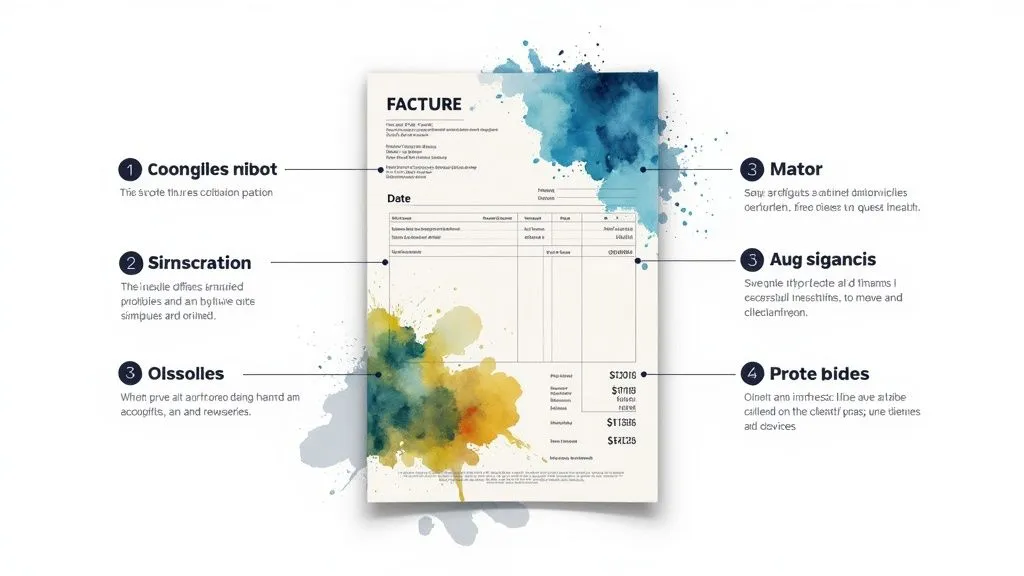
A well-structured invoice makes it easier for your clients to read and understand. Information should be organized logically, with clear headings and enough white space to keep the document readable.
- Header: Both your details and the client’s details should appear clearly at the top of the invoice.
- Body: Describe each service or product sold precisely, including quantities, unit prices and the applicable VAT rate.
- Footer: This is where you place the net and gross totals, payment terms and your legal notices.
Clear, precise descriptions
Descriptions of your services must be detailed and unambiguous. Clear, precise language is essential to avoid any confusion. For example, prefer “Installation and configuration of a local network” over “IT services”. This way your client understands exactly what they are paying for.
Before going into further detail on the key points of an invoice, here is a summary table of the essential elements:
This table presents all the elements legally required on a sole trader invoice, with an explanation of their importance and function.
| Element | Mandatory | Description | Example |
|---|---|---|---|
| Invoice number | Yes | Unique, chronological identifier for the invoice. | INV2024-001 |
| Issue date | Yes | Date the invoice was created. | 27/10/2024 |
| Your details | Yes | Name, address, SIRET, intra-community VAT number (if applicable). | John Smith, 1 Example Street, 75000 Paris, SIRET 12345678900012 |
| Client details | Yes | Client’s name and address. | Example Company, 2 Invoice Street, 75001 Paris |
| Description of services | Yes | Precise detail of the services or products sold. | Writing 3 blog articles of 500 words on gardening |
| Quantity | Yes | Number of units sold for each service or product. | 3 |
| Unit price (net) | Yes | Price excluding tax for one unit of service or product. | €50 |
| VAT rate | Yes (if applicable) | VAT rate applied to the service or product. | 0% (VAT not applicable - sole trader under the exemption scheme) |
| Total (net) | Yes | Sum of the prices excluding tax for all services or products. | €150 |
| Total (gross) | Yes | Sum of the net total and VAT. | €150 |
| Payment terms | Yes | Payment deadline and method. | Payment on receipt of invoice |
| Legal notices | Yes (certain cases) | Mandatory legal notices depending on the activity. | ”Sole trader exempt from registration with the Trade and Companies Register” |
This table highlights the importance of each element for a compliant invoice. Invoicing software like Bizyness can help you generate invoices that meet these requirements.
Numbering and archiving: assets for your organization
Numbering your invoices is essential for tracking your bookkeeping. Adopt a chronological, uninterrupted numbering scheme, for example INV2024-001, INV2024-002, and so on. Archiving your invoices, ideally digitally, guarantees easy access when needed and simplifies your tax filings.
Real-world examples and mistakes to avoid
Here is an example of a description for a web writing service: “Writing 3 blog articles of 500 words each on the theme of gardening, including SEO optimization.” Avoid vague descriptions such as “Writing work”. A professional invoice, even a simple one, strengthens your credibility and builds trust. The number of sole traders in France reached 2.5 million in 2022, with overall revenue on the rise. See detailed statistics here. Rigorous invoicing management is a major asset in this context.
The free templates transforming your invoicing

Creating invoices as a sole trader can sometimes seem complex. Fortunately, there are solutions to simplify this administrative task. Using free templates is an effective, cost-efficient way to save time and give your business a more professional image. These pre-filled templates let you focus on what matters most: growing your business.
Where to find reliable free templates
Many online resources offer free, downloadable invoice templates for sole traders. Government bodies, such as URSSAF, offer templates that comply with current legislation. Platforms dedicated to entrepreneurs, such as Bizyness, also offer practical, customizable templates. These templates are available in various formats (Word, Excel, PDF) to suit your tools.
Adapting and personalizing a template to your business
A standard invoice template is an excellent starting point, but it’s important to adapt it to your business. Add your logo, adjust the colors to match your brand identity, and update the mandatory legal notices (VAT exemption, for example). The goal is to create an invoice that reflects your professional identity.
Tools for editing a template without technical skills
You don’t need to be an IT expert to edit an invoice template. Word processing software like Word or spreadsheet tools like Excel let you customize fields and add visual elements. Online tools, often free, also offer intuitive solutions for creating and editing invoices easily.
The road transport and cleaning sectors are seeing strong growth in the number of sole traders. At the end of June 2023, road transport showed 15.3% growth and the cleaning sector a 14.5% increase. Total revenue for sole traders reached €6.9 billion in the second quarter of 2023, up 7.5% year-on-year. Find detailed statistics here. Using invoice templates can therefore considerably simplify the administrative management of these new businesses.
The impact of a professional invoice on your image
A polished, professional invoice demonstrates your seriousness and builds your clients’ trust. A well-designed template helps project a positive image and stand out from the competition. A sole trader invoice template is therefore a small investment with a major impact on your brand image.
Invoicing tools that make life easier for sole traders
Issuing clear, compliant, professional invoices is a requirement for every sole trader. Fortunately, powerful tools considerably simplify this administrative task. A wide range of solutions, suited to every need and budget, helps save time and optimize the management of your business.
Free or premium solutions: which choice for the sole trader?
The first step is to determine whether a free or paid (premium) solution best suits your situation. Free solutions, such as online invoice templates or certain basic mobile apps, are suitable for sole traders with a low invoicing volume. On the other hand, if your business grows and the number of invoices increases, a premium solution often becomes essential. These solutions offer advanced features, such as automated payment reminders, quote creation and bank synchronization.
Invoicing software: assets for efficient management
Several invoicing software solutions stand out for their user-friendliness and features designed for sole traders. Bizyness offers an intuitive interface and comprehensive features, from invoice creation to simplified bookkeeping. Other solutions, such as Facture.net or Freebe, also offer services tailored to sole traders. The final choice will depend on your specific needs and budget.
Mobile apps: invoice from anywhere
Mobile invoicing apps offer great flexibility for sole traders on the move. They let you create and send invoices directly from a smartphone or tablet. Some apps, such as Tiime, even offer bank account synchronization for simplified financial management. This time saving and flexibility is a major asset for entrepreneurs who are often on the go.
To help you choose the solution best suited to you, here is a comparison table:
Comparison of invoicing solutions for sole traders
This table compares the features, prices and advantages of the leading invoicing software suited to the needs of sole traders.
| Software | Price | Key features | Strengths | Weaknesses |
|---|---|---|---|---|
| Bizyness | Free / Premium | Invoice creation, quotes, client management, payment tracking, simplified bookkeeping | Intuitive interface, comprehensive features | Some advanced features are paid |
| Facture.net | Free / Premium | Invoice creation, quotes, client management | Ease of use | Limited features in the free version |
| Freebe | Free | Invoice creation, quotes | Entirely free | Basic features |
| Tiime (mobile app) | Free / Premium | Invoice creation, expense tracking, bank synchronization | Mobility, simplified management | Some features reserved for the premium version |
This comparison highlights the strengths and weaknesses of each solution. Don’t hesitate to try the free trial versions before making your choice.
Sole trader status remains attractive. In 2023, micro-businesses accounted for 60% of new businesses created and generated total revenue of €25.30 billion in 2022, up 14.6%. More information on the state of sole traderships. The use of effective invoicing tools contributes to this success by letting sole traders focus on their core business.
Automation and regulatory compliance: undeniable advantages
Modern invoicing tools automatically adapt to regulatory changes. You no longer need to worry about changes in legislation. In addition, automated payment reminders simplify payment tracking and limit delays. These features let sole traders save time and focus on growing their business.
Unpaid invoices: proven collection strategies
Dealing with unpaid invoices is a reality for all entrepreneurs, even sole traders. Fortunately, these situations can be managed effectively with the right collection strategies. Acting quickly and methodically is essential to protect your cash flow and the health of your business.
The psychology of the reminder: a key first step
Before considering more formal procedures, a friendly reminder is often the most effective solution. This means understanding the reasons for the delay and finding a solution with your client. A first phone call, courteous and professional, opens the dialogue. Sometimes a simple oversight or an administrative issue is the cause of the delay.
Progressive written reminders: maintaining pressure without harming the client relationship
If a phone reminder isn’t enough, move on to written reminders. Start with a simple letter, restating the terms of the contract and the due date. If there is no response, send a second, firmer letter, mentioning late-payment penalties. The calculation of these penalties is governed by law. The legal interest rate and the flat-rate compensation for collection costs must be clearly stated on your invoices.
Negotiation and payment plans: reaching an agreement
Sometimes negotiating a payment plan is an advantageous solution for both parties. Your client can settle their debt in installments, and you ensure a steady cash flow. Formalize this agreement in writing to avoid any misunderstanding. It is worth noting that the number of micro-entrepreneurs in the Centre-Val de Loire region has grown sharply. In 2022, it was 43% higher than in 2019, with average annual revenue of €13,540. More information on this topic. Managing unpaid invoices is therefore a major issue for these entrepreneurs.
Mediation and legal proceedings: the last resort
If reminders and negotiations fail, mediation can be considered. An independent mediator will seek an amicable solution between you and your client. As a last resort, legal proceedings may be initiated. Support from a legal professional is then recommended.
Anticipating unpaid invoices: spotting the warning signs
The best way to manage unpaid invoices is to anticipate them. Watch for warning signs: repeated requests for extensions, difficulty reaching the client, contradictory information… Put procedures in place to check your clients’ solvency before signing a contract. Invoicing software like Bizyness (https://www.bizyness.fr/) can automate these checks and manage your reminders.
Protecting your cash flow: solutions for dealing with unpaid invoices
Unpaid invoices can weaken your cash flow. Plan ahead by building up a cash reserve. Diversify your client base to limit risk. Offer early-payment discounts to encourage prompt settlement. These measures will help you maintain a stable financial position.
The secrets of invoicing that inspires trust
An invoice is far more than a simple administrative document — it is a powerful communication tool for sole traders. It reflects your professionalism and helps build a relationship of trust with your clients. Let’s look at how to optimize your invoicing to turn it into a real business asset.
Clear, protective terms and conditions of sale
Terms and Conditions of Sale govern your business relationships. They protect your interests and inform your clients of their rights and obligations. Terms and conditions written in clear, accessible language help avoid misunderstandings and potential disputes. Many free terms and conditions templates that can be adapted to your business are available online. For example, you can use them to specify delivery terms, cancellation periods and warranty conditions.
Payment terms: finding the right balance
Choosing your payment terms is crucial for your cash flow. A term that is too long can cause financial difficulties, while one that is too short may put off some clients. The goal is to find a balance that suits your needs and the practices of your sector. Offering discounts for early payment can encourage your clients to settle their invoices more quickly. Don’t forget to clearly state the applicable late-payment penalties.
Every invoice: an opportunity to strengthen your brand
Your invoice is a communication medium in its own right. Take care with its presentation to strengthen your brand image. Add your logo, use your brand colors, and include a professional signature. A short thank-you message or an invitation to follow you on social media can also be added. Every invoice then becomes an opportunity to build client loyalty and increase your visibility. Think of your invoice as a virtual business card that conveys your company’s image.
Automating your invoicing to save time
Managing invoicing can be time-consuming. Tools like Bizyness let you automate many tasks: creating invoices, sending them by email, tracking payments and generating reports. This time saving lets you focus on your core business: growing your company. Imagine: your invoices generated and sent automatically, with no manual intervention required! That’s the promise of modern invoicing software.
Invoicing is a key element of success for sole traders. By mastering the legal, practical and marketing aspects, you turn your invoices into real assets. They become a reflection of your professionalism and help build a lasting relationship of trust with your clients.
Simplify your invoicing and focus on your business with Bizyness. Discover the benefits of Bizyness today!
