

 Français
 Sole Trader Invoice Template Without VAT – Free & Compliant
Download our free sole trader invoice template without VAT, in Word or Excel. Easy, free and compliant, so you avoid invoicing mistakes.

As a sole trader (micro-entrepreneur), your invoicing is much more than a simple payment request. It’s the showcase of your professionalism. When you benefit from the VAT exemption scheme, certain rules are non-negotiable, starting with the famous mention “VAT not applicable, art. 293 B of the French Tax Code (CGI)”. It’s a non-negotiable line on your invoices, and the best way to never forget it is to adopt a solid template from the start.
Why flawless VAT-free invoicing is a pillar of your business
The sole trader status is booming, and it’s no accident. In 2023, more than 64% of new business creations in France were micro-businesses. This popularity is largely explained by lighter administrative management, particularly thanks to the VAT exemption scheme. To better understand this phenomenon, the data on entrepreneurship in France is quite revealing.
But be careful, simplicity doesn’t mean laxity. Your invoice remains an official document that carries your liability. It has to be flawless.
Your invoice, a sign of trust for your clients
Imagine receiving a clear, complete invoice, without the slightest error. It inspires confidence, doesn’t it? That’s exactly the effect you need to produce on your clients. Careful invoicing proves that you master your subject, beyond your core business.
A well-made document avoids unnecessary questions and back-and-forth that can delay payment. It’s a detail that, added up over time, builds your reputation and retains your clientele.
The mention “VAT not applicable, art. 293 B of the CGI” isn’t just administrative jargon. It signals to your client that the price is net of tax. This is crucial information, especially if it’s a business client, because it clarifies that there is no VAT to reclaim on their end.
Protect yourself from legal and financial risks
The tax authorities don’t take invoicing rules lightly. A simple omission, such as the absence of the VAT mention, can have serious consequences. In the event of an audit, an invoice deemed non-compliant can be reclassified, and financial penalties can quickly add up.
Complying with the rules for VAT-free invoicing is therefore not an option, but insurance for the longevity of your business. To learn everything on the subject, feel free to check out our complete guide on invoicing for sole traders. Starting from a reliable template saves you a lot of hassle and lets you focus on what really matters: your work.
Mandatory information: much more than a mere formality
Beyond the famous “VAT not applicable” mention, a compliant invoice is a real puzzle. Every piece matters, not only to stay within the rules set by the tax authorities, but also to keep everything clear with your client and to make sure your own bookkeeping doesn’t turn into a headache.
Think of your invoice as the identity card of the transaction. It must identify you and your client, and precisely describe what was sold. It’s the basis of a healthy business relationship.
This information isn’t there for show. A simple oversight can invalidate your invoice and cost you dearly: the fine is €15 per missing or inaccurate mention. To make sure you don’t leave anything to chance, take a look at our complete guide on mandatory information on an invoice.
Set up bulletproof numbering
This is a crucial point, often overlooked when starting out. The golden rule is simple: your invoice numbers must follow each other without interruption and respect chronological order. A “gap” in the sequence can alert the tax authorities during an audit, who might see it as an attempt to conceal revenue.
To make life easier for yourself, adopt a reliable system from the start. A structure like YEAR-MONTH-XXX or INV-YEAR-XXX works very well.
- 2024-001 for your very first invoice of the year.
- 2024-002 for the next one, and so on.
This format is not only clear and professional, it also helps you find your way around at a glance, even years later. It’s the guarantee of seamless continuity, as the law requires.
Consistent numbering isn’t just an administrative constraint, it’s your best ally for sound management. It dramatically simplifies bank reconciliation and payment tracking.
Tailor the information to your business
Every invoice must accurately reflect the service you provided. The description of what you sell is therefore a key element. Be precise!
For example, if you’re a jewelry designer, don’t settle for a vague “Creation”. Prefer a detailed description: “Sterling silver 925 bracelet with moonstone, ‘Clair de Lune’ model”. It’s more professional and leaves no room for doubt for your client.
Along the same lines, a consultant will avoid the generic “Consulting service”. They will instead specify: “Digital strategy consulting engagement – SEO audit and recommendations – 5 hours”. This clarity justifies your rate and builds your credibility. Using a sole trader invoice template without VAT does the work for you, you just have to adapt these descriptions to each assignment.
Your ready-to-use invoice template (and free!)
To save you time and spare you administrative headaches, I offer you a special sole trader invoice template without VAT, fully customizable. It’s available for immediate download in the formats you use every day: Word and Excel. Choose whichever suits you best.
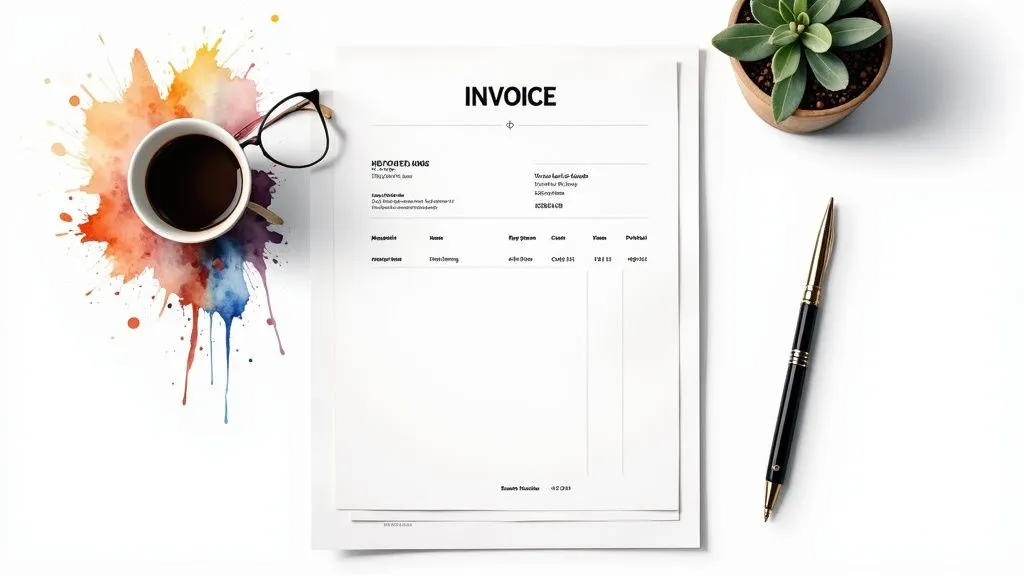
This visual gives you a concrete preview of a well put-together invoice. All the important fields are there, clearly visible, including the famous legal mention regarding VAT. It’s the perfect basis for issuing professional, compliant invoices in a few clicks.
So, Word or Excel? Each format has its strengths. Word is great for polishing the look. You can easily drop in your logo and adjust the colors to match your visual identity, a real plus for making an impression and strengthening your brand image.
Excel, on the other hand, is a great ally for automation. If you want totals to calculate themselves like magic and minimize the risk of error, it’s the format you need.
Make the template your own
Adapting this template is a real breeze. Once you’ve opened the file, just replace the generic information with your own: name, address, SIREN number, etc. It’s also the perfect time to add your personal touch, in particular your logo.
My expert tip: create a “master” version of your invoice with all your fixed information already filled in. Save it under an easy-to-find name, like “Invoice_Template_CompanyName”. Then, for each new assignment, you just need to open this master, fill it in with the client’s details, and save it under a new name. This simple little habit will save you precious time on a daily basis.
This first step is crucial for good organization. If you want to go further and master all the finer points, take a look at our guide featuring an invoicing example for micro-businesses with other best practices to adopt.
Filling in your invoice: the step-by-step practical guide
The first time you fill in a sole trader invoice template without VAT, you might feel a bit lost. But don’t worry, it’s a knack you’ll pick up quickly. Once you understand the mechanism, it becomes fast and logical, almost automatic. The idea is simple: create a clear, professional document that complies with the law so your client pays you without a hitch.
You always start with the basics: identification. Yours, and your client’s. At the top of the invoice, make sure your name, address and, above all, your SIREN number are perfectly legible. Then do the same with your client’s details. A small typo in their company name can be enough to hold up payment in their accounting department.
Be precise in describing your services
This is where the devil is in the details. A clear invoice is an invoice that gets paid quickly. Instead of a vague line like “Service provided”, get specific.
For example, if you’re a graphic designer, state: “Logo creation - 3 initial proposals and 2 rounds of revisions”. Much more informative, right? It justifies your rate and leaves no room for doubt.
For each service or product sold, detail the line with these elements:
- The precise description of what you did or sold.
- The quantity (number of hours, days, items…).
- The unit price excluding tax (net), which is your base rate.
- The line total excluding tax (simply Quantity x Unit Price).
By structuring your invoices this way, you make life easier for your client, who will immediately understand what they’re paying for.
The whole process is actually quite simple to visualize.
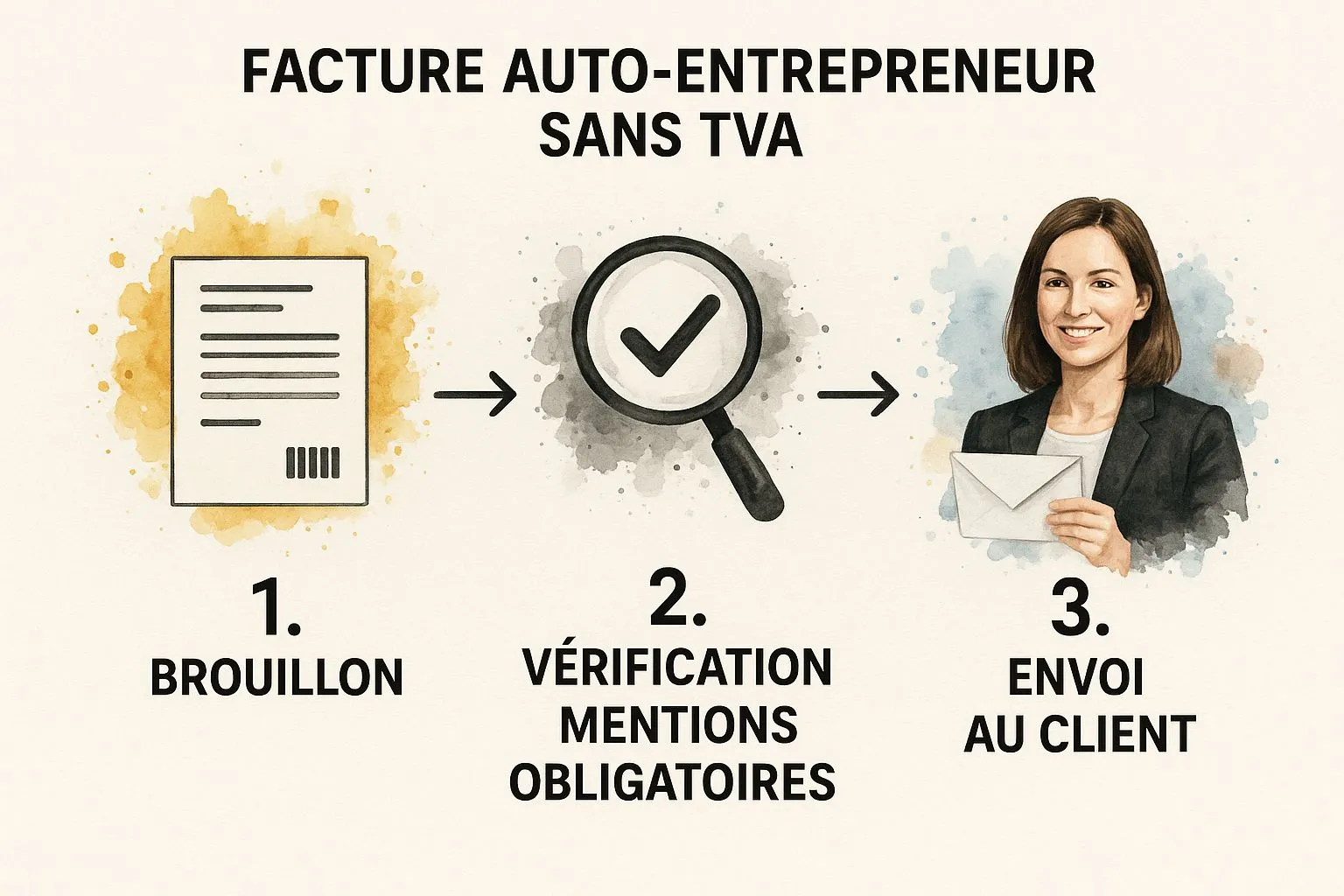
This diagram shows it well: rigor and checking the mandatory mentions are truly at the heart of the process. That’s what turns a simple document into an official invoice, ready to be sent.
Anticipate special cases like a pro
Your day-to-day life as an entrepreneur will include situations that are a bit out of the ordinary. A commercial discount for a good client? A deposit already paid? This information needs to be included transparently.
It generally appears as a deduction, just before calculating the final amount, the famous “Net amount due”.
The most important thing? Your magic phrase. Right above the total, the sentence “VAT not applicable, art. 293 B of the CGI” is absolutely mandatory. It’s what legally justifies the absence of VAT and proves that you’re compliant. Never forget it!
With the continuous rise in business creations, particularly in sectors like retail or car repair, mastering these basics is essential. This legal mention is a safeguard for you and a clarification for your client. To go further, you can check out the latest trends in business creation in France.
And finally, one last check: are the invoice issue date and payment due date both present? Perfect, you can send it.
Even with a perfect invoice template, a small mistake can quickly turn into an administrative nightmare. The VAT exemption scheme may be simple, but that simplicity doesn’t forgive sloppiness. A single slip-up, and the consequences can be far more unpleasant than you’d imagine.
Fortunately, once you know the pitfalls, it becomes much easier to avoid them. It’s your best guarantee for keeping sound management, avoiding fines and, just as important, keeping your clients’ trust.
Classic mistakes that can cost you dearly
Some blunders are so common you could almost make a top 3 out of them. Ignoring them can cost you far more than the €15 fine set for a simple missing mention.
Here are the pitfalls to watch out for very closely:
- Forgetting the famous legal mention. This is mistake number one. Not writing “VAT not applicable, art. 293 B of the CGI” makes your invoice non-compliant. Your client could dispute it and, in the event of an audit, the tax authorities will definitely flag it.
- Having “gappy” numbering. Jumping from invoice 2024-015 to 2024-017, as if nothing happened, is a very bad idea. To the tax authorities, an interrupted sequence can look like an attempt to hide income. The continuity of your numbers isn’t optional, it’s a requirement.
- Poorly anticipating threshold overruns. This is probably the most dangerous trap. As soon as your revenue crosses the exemption thresholds, you must charge VAT. And this applies from the very first day of the month in which the overrun occurs. If you forget, you’ll still have to pay the state the VAT you should have collected.
The simplicity of the VAT-free scheme largely explains its success and the consistently high volume of micro-business creations. For this advantage not to backfire on you, rigorous invoicing is key. If the topic interests you, you can check out the latest figures on new micro-businesses to see the trend.
How do you fix things if a faulty invoice has already been sent?
Nobody’s perfect. If you notice an error on an invoice your client has already received, take a breath. There’s a solution, but you need to act quickly and correctly.
The first reflex to avoid: never delete the faulty invoice and never quietly edit it. The only legal method is to create a new document to cancel and replace the old one. This is essential to guarantee transparent bookkeeping.
The procedure to follow depends on one detail: payment.
If your client hasn’t paid yet, the simplest thing is to issue a corrected invoice. It must have a new unique number and clearly mention the invoice it cancels (for example: “Cancels and replaces invoice No. 2024-015”).
On the other hand, if the invoice has already been settled, the procedure is different. You must first create a credit note to cancel the transaction in your books. Then you can issue a new, correct invoice.
VAT-free invoicing: answers to your most frequently asked questions
Starting out as a sole trader also means discovering the joys of invoicing. And naturally, it raises quite a few questions, especially when VAT doesn’t (yet) come into the equation. Let’s untangle the most common questions together so you can invoice with peace of mind.
First, the big question: do you absolutely need invoicing software? The answer is no, not right away. As long as you’re under the VAT exemption scheme, a good old sole trader invoice template without VAT in Word or Excel does the job perfectly. What matters is that it’s flawless on the legal mentions.
That said, keeping an eye on the future is always a good idea. Electronic invoicing will become the norm between 2026 and 2027. Equipping yourself now with a simple, compliant tool spares you a headache later and, let’s be honest, it immediately looks more professional.
How should you react to an unpaid invoice?
An unpaid invoice happens. Don’t panic. The first thing to do is a friendly reminder. A polite email or a quick phone call can unblock many situations, often caused by a simple oversight.
If silence persists, it’s time to step things up: a formal notice letter, sent by registered mail with acknowledgment of receipt. This is the mandatory prerequisite before considering more formal debt collection proceedings. Above all, keep a careful copy of all your exchanges, they’ll be your best evidence in the event of a dispute.
What if I exceed the VAT thresholds during the year? This is the scenario to anticipate! From the first day of the month in which you exceed the threshold, you become liable for VAT. In concrete terms, all invoices you issue from that date must show VAT, even if the quotes you’d previously sent didn’t mention it.
How do you invoice a client abroad?
Selling your services outside our borders requires a bit of vigilance. The rules of the game change depending on whether your client is in Europe or elsewhere in the world.
-
For a business client in the EU: This is the reverse-charge principle. You invoice excluding tax. Be sure to ask for their intra-community VAT number and include it on your invoice, with the mention “VAT exemption, article 262 ter I of the CGI”.
-
For a client outside the EU: In the case of a service, the invoice is issued without VAT, because the transaction is simply not subject to French VAT.
One last question that comes up often: deposits. Should they be invoiced? The answer is a resounding yes. A deposit invoice is a genuine invoice. It must follow the same formal rules, have its own number and include all the mandatory mentions.
Want managing your quotes, invoices and bookkeeping to become effortless? Discover Bizyness. It’s the tool we designed for sole traders who’d rather spend time on their core business than on paperwork. You can try it for free.