

 Français
The stress-free guide to sole trader invoicing
Learn how to master sole trader invoicing: issue and manage your invoices with ease thanks to this clear, practical guide.
As a sole trader, it’s tempting to see an invoice as nothing more than a request for payment. But it’s much more than that. It’s a legal document, proof of a transaction that protects your business. Impeccable invoice management is truly the cornerstone of a healthy micro-business. It’s what guarantees your compliance in the eyes of the tax authorities and, above all, what builds your credibility with clients.
Why flawless invoicing is vital for your business

Far from being an administrative chore, invoicing is the lifeblood of your business: it fuels your cash flow and reflects your professionalism. Think of every invoice you send as a business card. It builds your clients’ trust and proves your legitimacy. Rigorous management of this document will save you plenty of headaches.
In practice, clear, precise invoicing is your best ally against:
- Late payments: When terms are crystal clear and the due date is clearly visible, clients are naturally encouraged to pay you faster.
- Client disputes: A detailed description of the services or products sold leaves no room for doubt or contestation.
- URSSAF or tax audits: Compliant invoices, with an unbroken sequential numbering, prove transparent management. That’s your best defense.
More than an obligation, a growth lever
The sole trader (auto-entrepreneur) status is booming, that’s a fact. The sector is in full swing. To give you an idea, in August 2025 a record was broken with 102,961 businesses created in a single month, the vast majority being micro-businesses. You can check out the key figures on business creation to learn more. In this highly dynamic environment, standing out is essential. And it starts with flawless professionalism, right down to your invoices.
Never underestimate the impact of your invoices. A well-presented document, without the slightest error, immediately reassures your clients and partners. It positions you as a reliable expert, well beyond the job you just completed.
Of course, the sustainability of your business doesn’t rest on invoicing alone. A broader financial vision is just as crucial. If you have major life plans, such as buying property, it can be well worth exploring the services of a broker specialized in self-employed workers to help you achieve your ambitions.
As a sole trader, an invoice isn’t just a piece of paper to get paid. It’s a legal document, a genuine contract that must be impeccable. The slightest oversight can weaken your business and, let’s be honest, expose you to penalties. The point isn’t to tick boxes on a checklist, but to understand why each piece of information is there, so that rigor becomes second nature.
This discipline matters even more as the status attracts more and more people. Faced with this competition, tight, professional invoicing sets you apart and strengthens your credibility. The numbers speak for themselves: at the end of 2024, Urssaf already counted 2.914 million sole traders, up +5.6% in one year. For those who love stats, you can check the latest INSEE data.
Clear identification of the parties: who’s selling to whom?
Let’s start with the basics: who is the seller, who is the buyer? It may seem obvious, but this is where the first mistakes creep in.
On your business’s side:
- Your full name, followed by the mention “EI” or “Entrepreneur Individuel” (sole trader). This is mandatory and non-negotiable.
- The address of your registered office, i.e. the official address of your micro-business.
- Your SIREN number, your professional ID card.
On your client’s side:
- If it’s a professional, you must state their name (or company name), full address, and SIREN number.
- For an individual, their name and address are enough.
Don’t take this information lightly. In the event of an audit or dispute, it’s this information that proves who is involved in the transaction. A small typo can make your invoice contestable.
The heart of the matter: what you’re billing and for how much
This is where precision is king. A vague description like “consulting services” is an invitation to misunderstandings and endless discussions. Be transparent.
The best approach is to detail each product or service on a separate line, specifying:
- The quantity (number of items, hours, days worked).
- The unit price excluding tax (net of VAT).
- The total net amount for that line.
In the end, the total to be paid must be clearly displayed net of VAT. A well-detailed invoice is an invoice that’s easier for your client to understand and therefore, often, paid faster.
Numbering and dates: the guardians of time
The tax authorities keep a very close eye on your invoice numbering. The golden rule? It must be chronological and continuous. In other words, numbers must follow one another without any gaps (for example, INV-2025-001, INV-2025-002, etc.).
A friendly piece of advice: Never try to “fill in gaps” by reusing a number or deleting an invoice. If you make a mistake, the only legal method is to issue a credit note that cancels the previous invoice. Then you create a new invoice, with a new number.
The issue date is equally crucial. It’s what starts the clock on payment deadlines and serves as a reference for your tax filings. To get a firm grasp of all the legal subtleties governing your business, including the information that must appear on your documents, I recommend reading up on mandatory legal notices.
The famous VAT statement
As a sole trader, you’re very often under the VAT exemption scheme (franchise en base). This means you don’t charge VAT to your clients. However, you’re formally required to state this clearly, in black and white.
The magic sentence to include on every invoice is: “VAT not applicable, art. 293 B of the French Tax Code”. Its absence is one of the most common mistakes, and it can sting: the fine is €15 per missing mention, capped at a quarter of the invoice amount. It’s the kind of silly mistake that can quickly get expensive.
To help you get a clearer picture, here’s a table summarizing everything we’ve just covered. Think of it as your checklist before sending out any invoice.
Summary of mandatory information for a compliant invoice
This table recaps all the legal information to include on your invoices to avoid mistakes and stay compliant.
| Required element | Why it matters | Concrete example |
|---|---|---|
| Your information | Legal identification of your business. | Jean Dupont EI |
| 15 rue de la Paix, 75001 Paris | ||
| SIREN: 123 456 789 | ||
| Your client’s information | Clear identification of the debtor. Essential in case of a dispute. | Société XYZ |
| 10 avenue des Champs, 75008 Paris | ||
| SIREN: 987 654 321 | ||
| Invoice number | Tax obligation for traceability. Must be unique and sequential. | INV-2025-042 |
| Issue date | Starting point for payment deadlines and for your tax filings. | 15 October 2025 |
| Detail of services | Justifies the amount billed and avoids misunderstandings. | Logo design (3h) |
| Unit price net: €50 | ||
| Net amount: €150 | ||
| Amounts (net of VAT) | Clarity on cost, separating price from VAT (even if not applicable). | Total net: €150 |
| VAT statement | Legal requirement if you’re under the exemption scheme. | ”VAT not applicable, art. 293 B of the French Tax Code” |
| Payment date | Sets the deadline for your client. | Payment due date: 14 November 2025 |
With this summary, you have everything you need to write invoices that are not only compliant but also strengthen your professional image. It’s a mark of seriousness that reassures your clients and secures your business.
Understanding VAT as a sole trader: child’s play?
VAT management is often the topic that makes sole traders frown. We build it up into a huge deal, when in reality, once you’ve grasped the rules of the game, everything becomes clear. One of the biggest advantages of the micro-business scheme, especially at the start, is precisely the VAT exemption.
In concrete terms, what does that mean? Simply that you don’t charge VAT to your clients. If you sell a service for €100, your client pays you €100, full stop. It’s a real boost to staying competitive, since your prices are mechanically lower than those of a business that has to add 20% VAT.
Making the most of the VAT exemption scheme
This advantage is a real breath of fresh air, especially when you know how thin margins can be. In 2025, the average income of a sole trader ranges between €590 and €670 per month, and half report less than €340 monthly. When you add social security contributions, which still weigh in at between 22% and 25% of revenue, it’s easy to see why not having to charge VAT helps keep prices attractive. For those who want to dig deeper, an analysis of sole trader income on Hiscox.fr gives a good overview.
But be careful, this tax break isn’t unconditional. It’s tied to revenue thresholds that you need to watch closely.
Here are the figures to keep in mind to stay under the VAT exemption:
- Base threshold: €36,800 for services and liberal professions.
- Tolerance threshold: €39,100 for these same activities.
- Base threshold: €91,900 for the sale of goods.
- Tolerance threshold: €101,000 for sales.
As long as you stay below the base threshold, everything runs smoothly. If you go above it but stay under the tolerance threshold, you keep the exemption for the current year. However, you’ll become liable for VAT from January 1 of the following year. Be prepared!
The day everything shifts: switching to VAT
The switch happens automatically as soon as you cross the tolerance threshold. From the first day of the month in which you exceed it, you must start applying VAT to your invoices. It’s not optional, it’s mandatory.
Let’s take a concrete example: You’re a graphic designer and your revenue reaches €40,000 on October 15. It’s official, you’ve exceeded the €39,100 threshold. Result: all your invoices issued since October 1 must include VAT. Even the one you issue on October 15. You’ll need to add 20% to it.
This change of regime isn’t trivial and reshapes your management from top to bottom:
- Collecting VAT: You now have to add the applicable VAT rate (usually 20%) to the net amount of your sales or services.
- Filing VAT returns: You’ll need to file returns (monthly or quarterly) and remit to the State the money you collected on its behalf.
- Deducting VAT: Here’s the good news! You can now reclaim the VAT you pay on your own business expenses: your computer, software subscriptions, supplies…
The infographic below gives you a quick decision tree to check the key points of your invoice depending on your client.
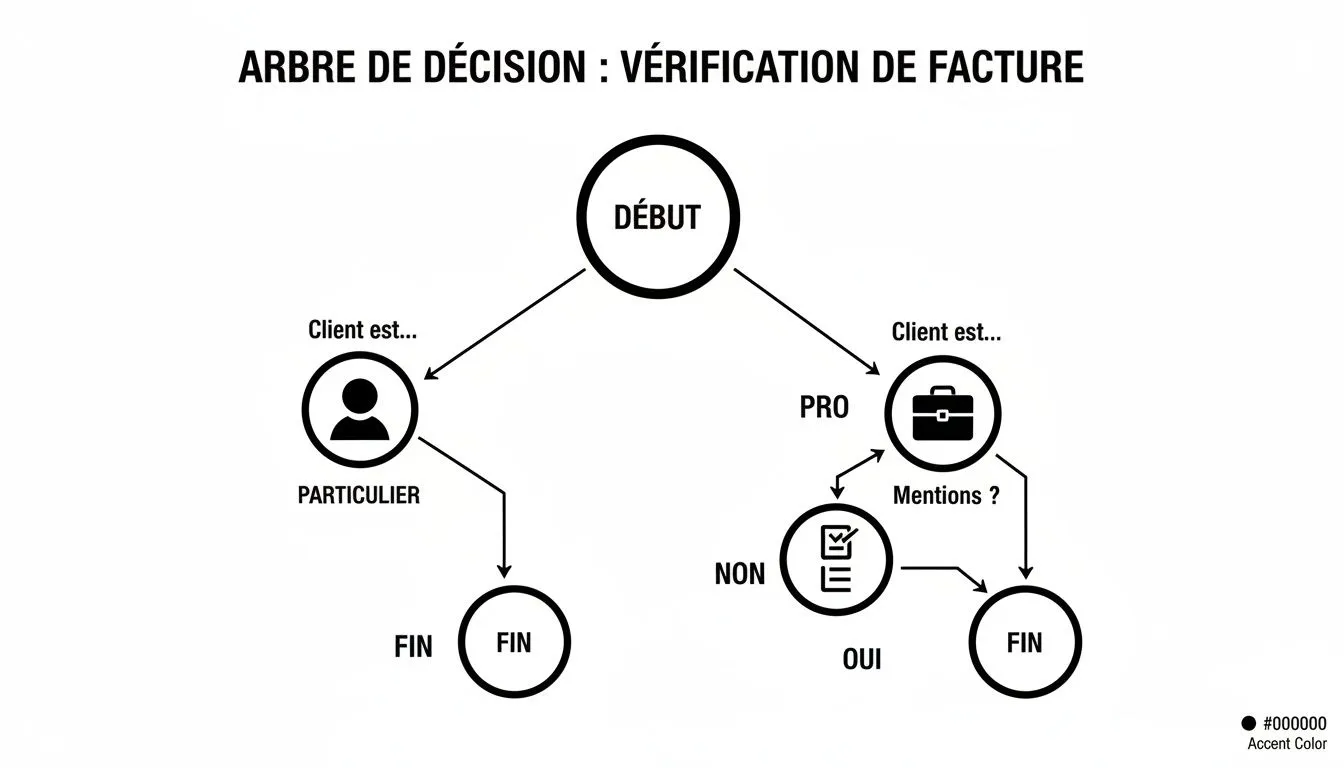
This diagram makes it clear: while invoicing an individual is fairly simple, working with a professional requires more rigor, particularly around VAT management.
Switching to VAT can feel a bit scary at first, but it’s also a sign that your business is growing and becoming more professional. The key is to anticipate this moment so you can adjust your rates smoothly and update your setup. To help you with that, we’ve put together a full guide explaining everything you need to know about VAT in a micro-business.
Invoice templates for every real-world situation
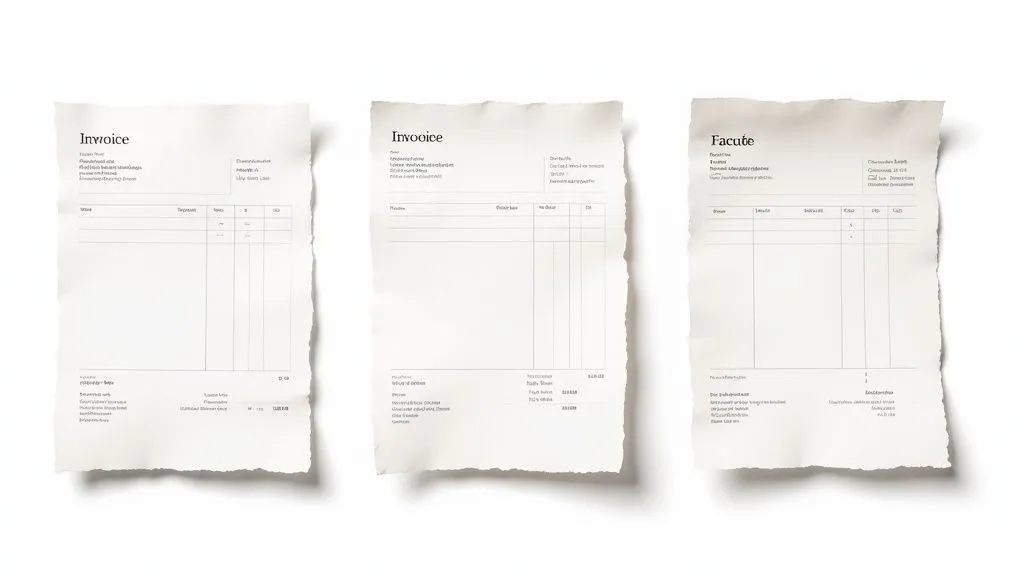
Theory is one thing. But to really get the hang of it, nothing beats concrete, real-world examples. Let’s forget generic downloadable templates. Instead, let’s break down the situations you’re bound to encounter. The goal? For you to understand the logic behind each type of invoice, so you can adapt it to your own business, whatever it may be.
Because let’s be clear: every job is different. Invoicing a large company for consulting doesn’t require the same level of detail as selling a handmade creation to an individual. Your number one priority should always be clarity. A clear document means fewer questions and faster payment.
The template for a B2B service
Let’s take an example. You’re a digital marketing consultant and you’ve just wrapped up a 10-hour project for a company. Here, the key is the description. That’s what makes all the difference.
Here are the points you can’t skip:
- Detail the tasks, really. Don’t just write “Consulting services.” Be specific: “SEO audit of the website (4h),” “Creation of the Google Ads campaign (6h).”
- Show a clear unit price. State your hourly rate net of VAT. Transparency always pays off.
- Check your client’s information. In B2B, the company name, address, and SIREN number are crucial. The smallest typo can hold up your invoice for weeks in the accounting department.
This level of detail is what justifies your work and cuts short any discussion. It’s a mark of professionalism that makes your client’s life easier, and therefore yours too.
The case of selling goods
Let’s change the scene. Imagine you sell handmade jewelry through your online shop. Your invoice will logically focus on the products, not on time spent.
For this type of transaction, make sure each line is properly filled in:
- The exact description of each product: “Silver necklace, ‘Luna’ model,” “‘Étoile’ earrings.”
- The quantity: If your customer ordered two identical necklaces, that needs to be stated clearly.
- The unit price net of VAT: The price of the item alone, before any discount.
- Shipping costs: Remember to add a clearly separate “Shipping fees” line if you charge for it.
A well-crafted invoice for product sales is proof of your professionalism and reassures the buyer. It’s also an essential document for tracking your inventory and keeping your accounts up to date.
The mixed invoice: services and goods
Some businesses are hybrid. Are you a photographer? There’s a good chance you bill for both the photo shoot (service) and the sale of printed photos (goods). No need to worry, it’s very simple to manage on a single document.
Just make sure to clearly separate the two categories on your invoice. Create one section for services and another for products, each with its own detailed lines. The grand total is simply the sum of the two subtotals. This structure lets your client instantly understand what they’re paying for.
For a clearer picture, feel free to take a look at these invoice examples for sole traders. You’ll find annotated templates to visualize these different scenarios.
Switch to automated invoicing to boost your efficiency
Creating invoices by hand in a spreadsheet works for a while. At first, it seems simple and free. But very quickly, as your business takes off, it becomes a real source of stress and a considerable waste of time. I’ve seen it happen time and again: what started as a stopgap solution turns into a real administrative burden.
Automation isn’t a luxury reserved for large companies. It’s a key step in securing your management and letting you focus on your growth.
Switching to a dedicated invoicing tool will literally change your day-to-day as an entrepreneur. The first benefit is time. No more copy-pasting lines, checking three times whether the invoice number is right, or spending hours on formatting. In just a few clicks, your sole trader invoice is ready, compliant, and sent.
And then there’s the mental load you shed. Software never gets sequential numbering wrong, it applies up-to-date legal mentions, and it calculates totals without error. That’s a peace of mind that’s priceless.
The features that really make the difference
Good invoicing software is much more than a simple PDF generator. It’s the real dashboard of your business. If you’re looking for a tool, make sure it offers at least these three essential features:
- Converting quotes into invoices: Your client has signed? One click, and the quote becomes an invoice. No double entry, no risk of error. Simple, fast, efficient.
- Real-time payment tracking: At a glance, you know exactly where you stand. Which invoices are pending? Which are overdue? This is essential for managing your cash flow, and some tools even send automatic reminders for you.
- Recurring invoice management: If you work with subscriptions or monthly services, this feature is a gem. The software generates and sends invoices on your behalf, every month, without you having to think about it.
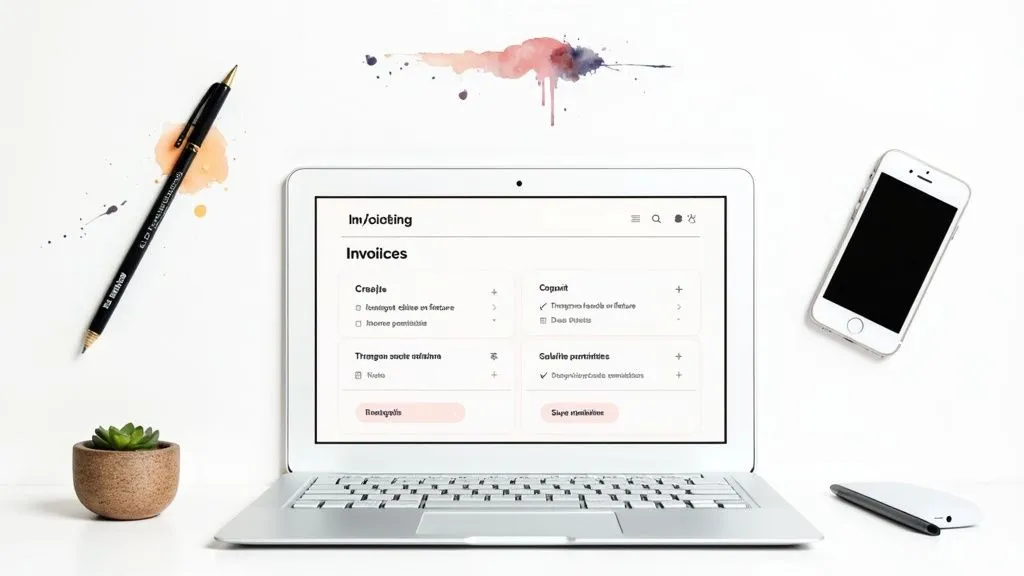
The image above perfectly illustrates how much a modern tool simplifies the process. Everything is centralized, clear, and designed for speed.
Steering your business instead of just enduring it
One of the most powerful benefits of a tool like Bizyness, one that’s often overlooked at first, is the visibility it gives you. You track your revenue in real time, which is already great, but above all, you can anticipate the moment you’ll approach the VAT thresholds.
The tool doesn’t just produce documents. It gives you the key figures to make the right decisions at the right time. That’s what makes the difference between running your business and steering it with a clear vision.
This proactive approach changes everything. Instead of scrambling through a VAT transition under pressure, you anticipate it and prepare for it calmly. You gain control and can focus on what really matters: your core business.
Adopting good invoicing software is often the first step toward freeing yourself from paperwork. To go further on this topic, I recommend reading our full guide on automating administrative tasks.
Anticipating changes and avoiding costly mistakes
Managing the admin side of a micro-business is a bit like navigation: you need to keep an eye on the horizon to anticipate changes of course and know which pitfalls to avoid. The rules of the game evolve, and what’s valid today won’t necessarily be valid tomorrow. To navigate calmly, you need to be proactive.
The biggest shift awaiting everyone is, of course, mandatory e-invoicing. The initial timeline has been pushed back, but make no mistake: this reform will eventually apply to everyone, including sole traders. The idea is to simplify VAT reporting and better fight fraud. In practice, this means you’ll soon need to go through a state-certified platform to send your invoices.
No need to panic, we’re not there yet. But now is the time to start thinking about it, particularly by choosing invoicing tools that are already ready for this transition. You’ll thank yourself later.
The small classic mistakes that can cause big problems
Beyond this major reform, there’s a whole range of everyday mistakes on a sole trader invoice that can cost you time, money, and get you into trouble. Here are the most common ones, to banish once and for all.
- Forgetting the famous “EI”: Since 2022, this is non-negotiable. The mention “EI” or “Entrepreneur Individuel” must appear right after your name on all your professional documents. A simple oversight can be penalized during an audit.
- Playing with numbering: You made a mistake on an invoice and deleted it? Bad idea. This creates a gap in your number sequence, which is strictly forbidden. The one and only way to fix it is to issue a credit note to cancel the previous invoice.
- Underestimating the retention period: This is a golden rule. You must archive all your invoices, both sent and received, for 10 years. Not 9, but 10. Good software with secure cloud storage is your best friend for this.
Article L.123-22 of the French Commercial Code is very clear: the tax authorities can ask you to produce any accounting document, including invoices, up to a decade after it was issued. Better not to take this obligation lightly.
These mistakes are common, but fortunately, they’re also easy to avoid. A bit of rigor, or better yet, a good management tool, and you’re all set. Paying attention to these details is how you build a business on solid foundations, sheltered from unpleasant surprises. Compliance isn’t just a constraint, it’s your best insurance for peace of mind.
Don’t let the slightest error slip into your invoices anymore. With Bizyness, automate your invoicing, ensure your legal compliance in just a few clicks, and calmly anticipate future obligations. Focus on your craft, we’ll take care of the rest. Discover how Bizyness can simplify your day-to-day starting today.
