

 Français
 Sole Trader with Multiple Activities: Practical Guide and Tips
Discover how to effectively manage multiple activities as a sole trader. Expert advice to optimize your income and succeed in your project.

Understanding the fundamentals of multi-activity status

The sole trader (micro-entrepreneur) status offers unique flexibility, allowing you to carry out several activities under the same scheme. This multi-activity approach represents a genuine opportunity to diversify your income, build a more well-rounded professional profile, and potentially accelerate your growth.
However, it is essential to understand the mechanisms and rules governing this status in order to make the most of it.
Why choose multi-activity as a sole trader?
Running multiple activities lets you test new ideas without taking on significant risk. Imagine a freelance graphic designer who wants to move into web marketing: the sole trader status lets them add this activity without creating a new legal structure.
Moreover, having several activities can act as a safety net. If one activity underperforms, the others can compensate. This provides valuable financial stability, particularly in uncertain times.
In France, interest in sole tradership, often associated with running multiple activities, is significant. A majority of new business creators are under 32 years old, reflecting the dynamism of young entrepreneurs. Discover more statistics on this topic.
Effectively managing your NAF codes
A crucial aspect of running multiple activities is managing your NAF codes (French Activity Classification Codes). Each activity you carry out must be declared with its corresponding NAF code.
This allows the administration to correctly classify your activity and apply the appropriate social contribution rates. It’s important to choose your NAF codes carefully from the outset.
A mistake here can lead to administrative complications down the line. How to master the process as a sole trader with multiple activities.
The rules on combining activities: what actually works
Combining activities as a sole trader is subject to specific rules. Even if you run several activities, you only have a single revenue cap.
This cap varies depending on the nature of your main activity, i.e. the one generating the most income. The cap for a commercial activity differs from that of a professional service activity, for example.
It is therefore essential to correctly identify your main activity and monitor your revenue to stay within the scheme’s limits.
Structuring your multi-activity approach
To succeed with multiple activities, rigorous organization is essential. It’s important to separate the management of each activity, both from an accounting and administrative standpoint.
Set up distinct tracking systems for invoices, expenses, and clients for each activity. This will give you a clearer view and simplify your declarations.
Good structuring will also help you optimize your time and manage your different assignments effectively.
Mastering administrative procedures efficiently
Becoming a sole trader with multiple activities can seem intimidating. Yet, with rigorous organization, managing the administrative side quickly becomes simpler. This guide walks you through turning this apparent complexity into a clear, well-managed process.
Choosing your NAF codes strategically
Choosing your NAF codes (French Activity Classification Codes) is a fundamental step when registering your multi-activity sole trader business. Each activity you carry out must be associated with a specific NAF code. This choice influences not only how your activity is categorized, but also the social contribution rates that will apply to you. It is therefore essential to find out precisely which NAF code corresponds to each of your activities. A mistake at this stage can lead to administrative complications down the line.
Declaring your activities: forms P0 and P2
The P0 form (for starting an activity) and the P2 form (for modifying or adding an activity) are the tools needed to declare your various activities. You’ll find them on the one-stop-shop (guichet unique) website. They must be filled out precisely and rigorously, clearly stating each activity and its associated NAF code. Once completed, these forms must be submitted to the one-stop shop, which will forward them to the relevant Centre de Formalités des Entreprises (CFE).
The optimal timing for your declarations
Meeting revenue declaration deadlines, whether monthly or quarterly depending on your choice, is essential to avoid penalties. It is strongly recommended to set up a system for tracking due dates. Management software like Bizyness can help you automate these declarations and optimize your time.
You might also be interested in: How to master your tax return as a sole trader.
Structuring your files for maximum efficiency
Methodical organization is the key to simplified administrative management. Create separate folders for each activity, grouping invoices, expense receipts, and other important documents. This practice will make your declarations easier and let you quickly find any information in case of an audit. A clear, precise system will save you valuable time.
Anticipating requirements and setting up a tracking system
By understanding the requirements of organizations such as URSSAF and the tax authorities, you can anticipate their requests and prepare the necessary documents in advance. Regular monitoring will let you ensure your compliance and quickly identify areas for improvement. For example, if you work in the cosmetics sector, knowing the different skin types well is essential. Here’s a useful article: Knowing your skin type. This example illustrates the importance of adapting your organization to your sector of activity.
Avoiding costly mistakes
Certain mistakes, such as an incorrect NAF code or exceeding the revenue cap, can have significant consequences. Find out about the applicable regulations and don’t hesitate to consult an accountant if necessary. A small initial error can quickly become a major problem.
By following this advice, you’ll be able to effectively manage the administration of your multi-activity sole trader business and focus on what matters most: growing your business. Mastering administrative procedures is an essential asset for the success of your project.
Exploring winning activity combinations

A sole trader who wants to run multiple activities must carefully select ones that complement each other and generate real added value. The goal is not to endlessly multiply activities, but to offer a coherent, attractive proposition to your clientele. This strategic choice is decisive for the success and longevity of your project.
Identifying market opportunities
An in-depth market analysis is essential to identify unmet needs and promising niches. Take the example of a sole trader specializing in website creation. They might notice growing demand for online training courses on the topic. This observation represents an opportunity to broaden their offering and meet a concrete need. Identifying these synergies is essential for profitable multi-activity.
The sole trader should position themselves as an expert capable of meeting several complementary needs.
Combining your skills
Ideally, your different activities should complement and enrich one another. A web copywriter fluent in several languages could offer translation services. This complementarity allows for a more complete service and helps expand your client base. Building bridges between your skills strengthens the coherence of your profile and makes prospecting easier.
A versatile profile is often seen as an asset by clients.
Developing a coherent offering
The clarity and coherence of your offering are essential for attracting and retaining clients. Imagine a sports coach who also offers sophrology sessions. Combining these two activities, though distinct, creates a synergy within an overall wellness approach. A well-thought-out, clearly presented offering will set you apart from the competition and justify your rates.
Presenting a clear, concise offering is the key to convincing your prospects.
Examples of successful combinations
- Consultant-trainer: A digital marketing consultant can give training courses to share their expertise and reach a wider audience.
- Creator-online seller: An artisan making jewelry can sell it directly on an online platform, controlling the entire value chain.
- Hybrid services: A photographer can offer photo retouching and visual content creation for social media, meeting different needs.
These examples illustrate the diversity of possible combinations.
The number of sole traders declaring positive revenue rose by 5.6% in the second quarter of 2024 compared to the previous year, according to INSEE. This trend confirms the growing interest in diversifying activities.
Adapting your offering to the market
The multi-active sole trader must stay attuned to market trends and adapt their offering accordingly. This may involve acquiring new skills, evolving their positioning, or creating new services. Flexibility and adaptability are major assets for success. By analyzing your clients’ demands and the changes in your sector, you can adjust your strategy and maximize your chances of success. A good understanding of your clients and their needs is essential for a relevant offering and sustainable growth. Tools like Bizyness can simplify your administrative management and let you focus on growing your business.
Optimizing your tax and accounting management
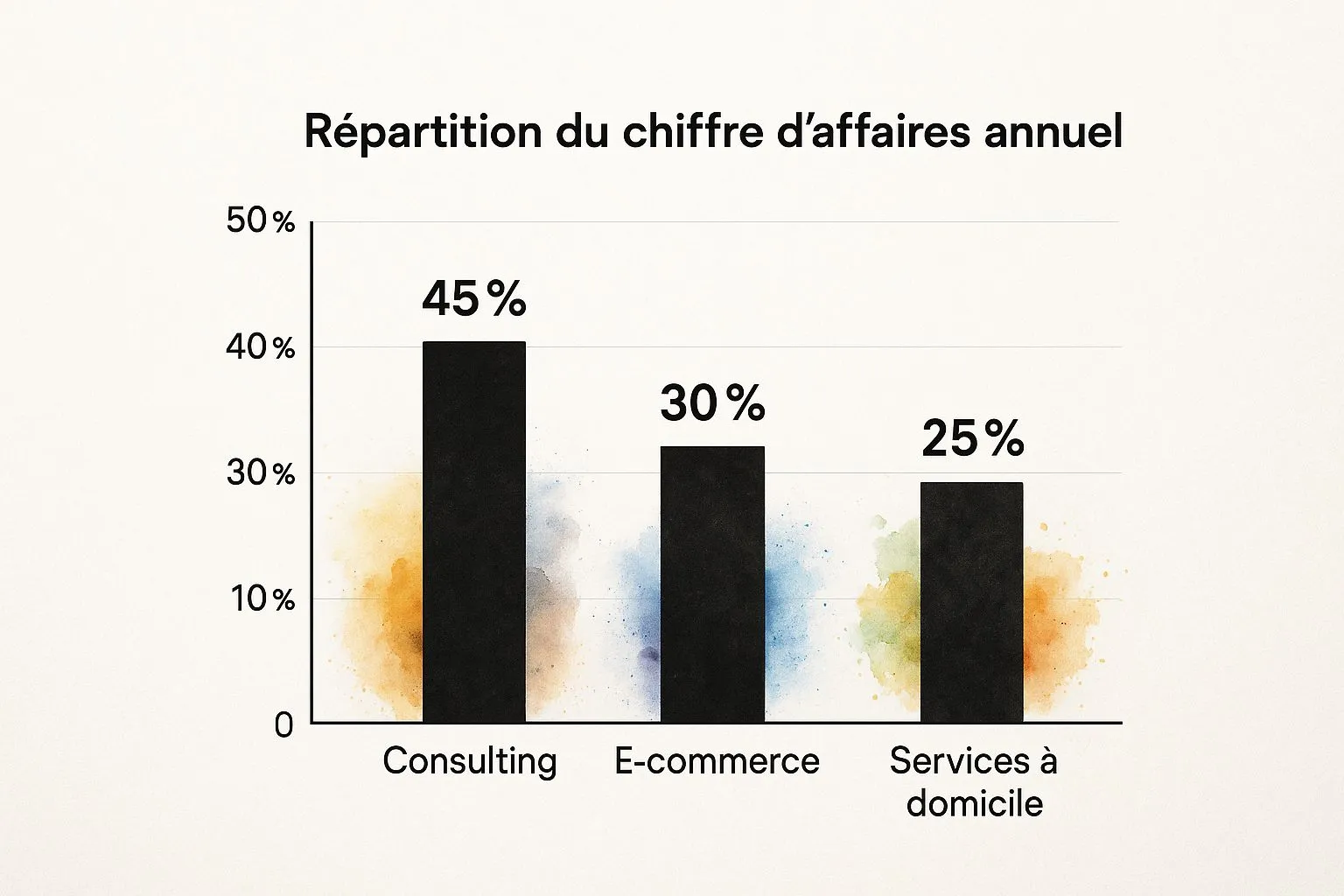
The chart above illustrates the breakdown of annual revenue across three activities: Consulting (45%), E-commerce (30%), and Home Services (25%). It highlights the importance of clear accounting separation for each activity, particularly for sole traders running multiple activities. This visualization underscores the need for rigorous management to optimize your tax situation.
As a sole trader with multiple activities, managing your finances effectively is essential. Beyond simply meeting legal obligations, optimized management can save you time and money. This chapter guides you toward high-performing tax and accounting management.
Separating the accounting for each activity
The first step toward sound financial management is to clearly separate the accounting for each of your activities. Each activity should have its own tracking of income, expenses, and costs, as if you were managing several separate entities.
This simplifies your declarations and lets you analyze the profitability of each activity. This separation is fundamental for a sole trader with multiple activities, since social contribution rates can vary.
Exploring tax optimization strategies
Tax optimization involves using legal mechanisms to minimize your taxes, not to evade them. For example, certain business expenses are deductible from your income. Knowing these details can reduce your taxable base.
For more advanced optimization, the advice of an accountant is recommended. They can advise you on the best strategies to adopt based on your situation. How to optimize your taxes as a sole trader might interest you.
To better illustrate the differences between activity categories, here is a comparison table:
Revenue caps and contribution rates by activity category
Comparison table of revenue thresholds and social contribution rates by type of activity
| Type of activity | 2025 revenue cap | Contribution rate | CFP rate |
|---|---|---|---|
| Sale of goods | €188,700 | 12.8% | 0.5% |
| Provision of services | €77,700 | 22% | 0.2% |
| Professional services | €77,700 | 22% | 0.2% |
This table presents example values and does not necessarily reflect current reality. Please refer to official sources for accurate information.
The importance of knowing the caps and rates for each activity is thus clearly highlighted. This allows you to anticipate and optimize your contributions.
Using effective tracking tools
Tools like Bizyness greatly simplify accounting management. They automate certain tasks, such as invoicing and payment tracking. They also provide an overview of your financial situation, making it easier to prepare your declarations.
These tools save you time and limit the risk of errors. Centralizing your data makes it easier to track your different activities.
Mastering contribution rates
Each activity is subject to specific social contribution rates. Knowing them is crucial for a sole trader running multiple activities. Misapplying these rates can lead to tax reassessments.
Rates for commercial activities differ from those for professional service activities. It is therefore important to correctly identify the nature of each of your activities and stay informed of legislative changes.
Anticipating tax audits
Good accounting management lets you anticipate tax audits and easily justify your declarations. Keep all necessary supporting documents — invoices, bank statements, etc. — to prove your activity is compliant.
Rigorous tracking and well-organized documents (sorted by activity and by year) will give you peace of mind.
By applying this advice, you’ll optimize your tax and accounting management. High-performing financial management will keep you compliant, maximize your profitability, and let you focus on growing your activities.
Capitalizing on the benefits while managing the challenges
A sole trader with multiple activities juggles various projects. This situation offers undeniable advantages, but also presents challenges to overcome. This section explores the benefits of diversification and the potential obstacles. How can you turn this complexity into a genuine competitive advantage?
The strategic benefits of diversification
Diversifying your activities helps minimize risks tied to a specific sector. If one of your activities experiences a downturn, the others can compensate and ensure financial stability. This is a significant security for your business.
Moreover, complementarity between your activities can optimize your income. For example, a freelance graphic designer could offer online training on the software they use. This increases their revenue and diversifies their income sources. It also lets them develop a unique professional profile and stand out from the competition.
Easier access to entrepreneurship through the sole trader status has, moreover, encouraged multi-activity for many people in France. Learn more about the history of this status.
The challenges of multi-activity and how to overcome them
Managing several activities requires rigorous organization. One of the major challenges is managing divided attention. It’s important to prioritize tasks and focus on the most profitable activities. Tools like Bizyness can help you with this organization.
Another challenge lies in creating a coherent business positioning. How do you project a unified professional image despite the diversity of your activities? The solution often lies in identifying a common thread linking your different skills. For example, a web copywriter could also offer translation services, capitalizing on their language skills.
Finally, the balance between quality and quantity is essential. Multiplying activities should not compromise the quality of your services. You need to find the right balance to satisfy your clients and maintain a solid reputation. Time management techniques suited to multi-activity are then indispensable.
Turning complexity into a competitive advantage
Despite these challenges, running multiple activities can become a real asset. It lets you offer a more complete range, reach a wider audience, and adapt quickly to market fluctuations.
By mastering their time and developing synergies between their different activities, the multi-active sole trader can forge a lasting competitive advantage. Bizyness can help you simplify your administrative management and focus on growing your business.
Strategies for successful multi-activity
- Define clear objectives for each activity: This helps you stay focused and measure your progress.
- Set up a realistic schedule: A schedule adapted to your different activities is essential for good organization.
- Communicate effectively about your different offerings: Clear, targeted communication is essential for attracting the right clients.
- Keep training continuously: Acquiring new skills lets you evolve and stay competitive.
- Rely on high-performing management tools: They simplify your daily life and save you time.
By applying these strategies, you’ll be able to make the most of your multi-activity and turn it into a genuine driver of success.
Developing a multi-activity growth strategy

A sole trader juggling several activities must absolutely put in place a suitable growth strategy. This requires rigorous planning, flawless organization, and a clear vision of their objectives. This guide presents the keys to growing your activities simultaneously and achieving your ambitions.
Prioritizing to maximize your profits
For optimal growth, prioritizing activities based on their profitability and potential is essential. Some activities can generate more revenue for less time invested. It therefore makes sense to focus on these first.
For example, if your website creation activity proves more lucrative than your community management activity, it makes sense to give it more attention. This doesn’t mean abandoning your other activities, but rather organizing the whole strategically.
Managing your multi-activity clientele
A Customer Relationship Management (CRM) system suited to multi-activity is a major asset. It lets you centralize all information relating to your clients, regardless of the service or product offered. A high-performing CRM makes it easier to track interactions, manage contracts, and build loyalty.
Take the example of a sole trader offering web copywriting and translation services: a CRM will let them effectively manage each client’s requests, regardless of the service requested.
Optimizing your productivity with tools
Using productivity tools is essential for effectively managing several activities. Project management software, scheduling apps, and collaborative communication tools are all solutions that can save you valuable time.
Using a shared calendar to plan appointments and deadlines for each activity, for example, can help you avoid many oversights. Bizyness can help you centralize your administrative management and optimize your time.
Consistency of your personal brand
Despite the diversity of your activities, projecting a coherent brand image is essential. Your clients need to understand who you are and what you offer, even if you practice several trades. This coherence strengthens your credibility and makes your brand easier to recognize.
If you are both a sports coach and a nutritionist, for example, you could communicate around a holistic approach to wellness.
Integrating your business strategy
An integrated business strategy is essential for effectively promoting all of your activities. This involves creating synergies between your different offerings and presenting them coherently to your target audience.
A photographer who also offers photo retouching services could, for example, offer packages including both services.
A cross-cutting professional network
Your professional network should support all of your activities. Don’t hesitate to communicate about all your skills and to ask for recommendations for each of them. A strong network can bring you opportunities across all your areas of expertise.
A digital marketing consultant could also offer online training courses, for example, and promote both activities to their network.
Using a prioritization matrix
A prioritization matrix lets you evaluate and rank your activities according to key criteria such as profitability, time invested, and growth potential.
To help you with this process, here is a concrete example:
Activity prioritization matrix
A decision-support tool for evaluating and prioritizing your different activities according to their potential
| Activity | Profitability | Time invested | Growth potential | Total score |
|---|---|---|---|---|
| Web copywriting | High | Medium | Strong | 9 |
| Translation | Medium | Low | Medium | 6 |
| Community management | Low | High | Low | 3 |
This table illustrates how a matrix can help you identify the most promising activities.
By applying this advice and using tools like Bizyness to simplify your management, you’ll be able to develop a solid, sustainable growth strategy for all of your activities.
Essential tips for lasting success
As a sole trader managing multiple activities, your long-term success depends on a well-thought-out strategy and a constant capacity for adaptation. This chapter offers practical advice and points of vigilance to guide you toward success.
Setting clear, measurable objectives
The first step toward lasting success is defining SMART objectives. These objectives should be Specific, Measurable, Achievable, Realistic, and Time-bound. For example, instead of wanting to “increase revenue,” set yourself a goal like “increase web copywriting revenue by 15% over the next quarter.” Precise objectives let you track your progress and maintain your motivation.
Organizing your time effectively
Time management is essential when running several activities. Use a diary or a scheduling app to organize your days and weeks. Prioritize the most important and profitable tasks for each activity. Assign specific time slots to each activity and stick to them as much as possible. For example, dedicate your mornings to web copywriting and your afternoons to graphic design.
Mastering your communication
Clear, consistent communication is essential for promoting your different activities. Define a clear message for each one and adapt your communication to your target audience. Use social media, your website, and other channels to get noticed. For example, if you offer sports coaching and nutrition services, create distinct content for each activity on social media.
Keep training continuously
The entrepreneurial world is constantly evolving. Investing in continuous training is essential to stay competitive and acquire new skills. For example, if you are a graphic designer, take courses on new software or new design trends. Continuous learning lets you improve your services and offer a more complete range.
Monitoring your finances closely
Rigorous financial tracking is essential for the sustainability of your activities. Use accounting software to manage your income, expenses, and costs for each activity. Regularly analyze your results to identify the strengths and weaknesses of each activity. For example, if you find that an activity is less profitable than expected, adjust your strategy or consider a repositioning.
Building a solid network
A solid professional network can open doors for you and bring valuable collaborations. Attend events, join online groups, and network with other entrepreneurs. Don’t hesitate to present your different activities and ask for recommendations. A diverse network can help you find new clients and grow your business.
Adapting to change
The market and client needs are constantly evolving. Be flexible and ready to adapt your offerings and strategies based on market trends. Don’t hesitate to experiment with new approaches and adjust your offering based on client feedback. Adaptability is an essential quality for a multi-activity sole trader.
Celebrating your successes
Finally, don’t forget to celebrate your successes, even the smallest ones. Recognizing your progress motivates you and encourages you to persevere. For example, if you reach a revenue goal, treat yourself to a reward. Celebrating your successes is important for maintaining a positive attitude and long-term motivation.
Examples of warning signs and solutions
- A drop in revenue from one activity: Analyze the causes of this decline (competition, market changes, etc.) and adapt your strategy (new offering, new positioning, etc.).
- Not enough time to manage all your activities: Prioritize tasks, delegate where possible, and optimize your organization with tools like Bizyness.
- Difficulty balancing work and personal life: Set clear boundaries between your work and your personal life, and schedule rest periods.
By applying this advice, you’ll build a solid foundation for lasting success as a sole trader with multiple activities. Bizyness, the all-in-one management tool, supports you on this journey by simplifying your accounting, invoicing, and administrative management. Discover Bizyness today and focus on what matters most: growing your activities.
