

 Français
Sole Trader Pricing: A Guide to Optimizing Your Income
Discover everything about sole trader pricing. Calculate your rates, manage your contributions, and maximize your income with our essential guide.

Setting your rates as a sole trader isn’t just about picking a number at random. It’s much more than that. You need to see the whole picture as an ecosystem: every euro you invoice and collect triggers a series of calculations for your social contributions and taxes. That’s what ultimately determines what you actually get to keep.
Understanding how sole trader pricing works
Getting into micro-entrepreneur pricing is a bit like learning the rules of a new game. To build a good strategy and win, you first need to understand how each piece moves and interacts with the others. Forget the idea that it’s just about writing an amount on an invoice.

Everything starts with your revenue. It’s the gross amount your clients pay you, but be careful, it’s not your salary yet. Picture a cake fresh out of the oven. Before you can eat your slice, you’ll need to hand out a few others. Each of those slices corresponds to a mandatory deduction.
The elements that make up your rate
The structure of deductions is fairly simple to understand, but it’s crucial to master it well. Your revenue is the basis for calculating several contributions that will shape your final net income.
Here’s what you absolutely need to keep in mind:
- Social contributions: This is clearly the biggest chunk. They’re essential because they fund your entire social protection (health, retirement, family benefits). The percentage applied depends directly on the nature of your activity.
- Income tax: Whether you choose the standard regime or the flat-rate withholding option, part of your income is deducted for tax.
- The Vocational Training Contribution (CFP): This is a very small contribution, but it’s mandatory. In return, it gives you access to training rights throughout your career.
- Your operating costs: An essential point! Even though you can’t deduct them from your revenue, your business expenses (software, equipment, insurance, etc.) must be anticipated and factored into your rates. It’s the only way to guarantee your business is profitable.
Understanding this mechanism well is the first step to setting prices that are both fair to your clients and viable for you. Every euro collected is not a euro earned; it’s a euro that will be split between the state, your various costs, and finally, what lands in your bank account.
With this overview, you now have the keys to tackle the more technical aspects we’re about to detail. Mastering this breakdown is simply essential to ensuring the financial health of your micro-business.
Social contributions decoded for you
When you’re starting out, the word “contributions” can be a bit scary. In reality, it’s much simpler than it seems, and above all, it’s what protects you. These are the deductions from your revenue that fund your social security: health insurance, retirement rights, training… In short, your whole safety net as an independent worker.
Think of them as a kind of all-in-one professional insurance. Every euro you contribute is a brick you’re laying for your protection today and for your future. The good news? The system is fully proportional. If you don’t collect anything, you don’t pay anything. It’s as simple as that.
The amount of this sole trader pricing for social charges varies depending on what you do. There are three broad categories of activity, each with its own rate.
Contribution rates by activity
The principle is clear: each type of activity corresponds to a fixed percentage of contributions. Your activity will be classified as either BIC (Industrial and Commercial Profits) or BNC (Non-Commercial Profits), and it’s this category that determines the rate applied to your revenue.
Correctly identifying your category is therefore the first crucial step to getting a clear picture of your charges.
-
Sale of goods (BIC): Selling products, online or in a shop? This is the lowest rate: 12.3% of your revenue.
-
Commercial or craft service provision (BIC): Here we’re talking about tradespeople (plumbers, hairdressers), delivery drivers, or web developers. The rate climbs a bit to 21.2%.
-
Liberal professions (BNC): This category covers consultants, trainers, graphic designers, and all intellectual professions. The rate is 21.2% for most (those affiliated with the general regime) and 21.1% for a few specific professions still under CIPAV. To learn more about upcoming changes, particularly in 2025, articles such as this one from Blog du Dirigeant cover the topic in detail.
The huge advantage is that these percentages cover everything. No complex calculations, no bad surprises.
The calculation is direct and straightforward: you take your revenue collected over the period (month or quarter) and apply your rate. Zero revenue = zero contribution. That’s the golden rule.
Take a look at this infographic. It shows very concretely how this works for a sales activity.
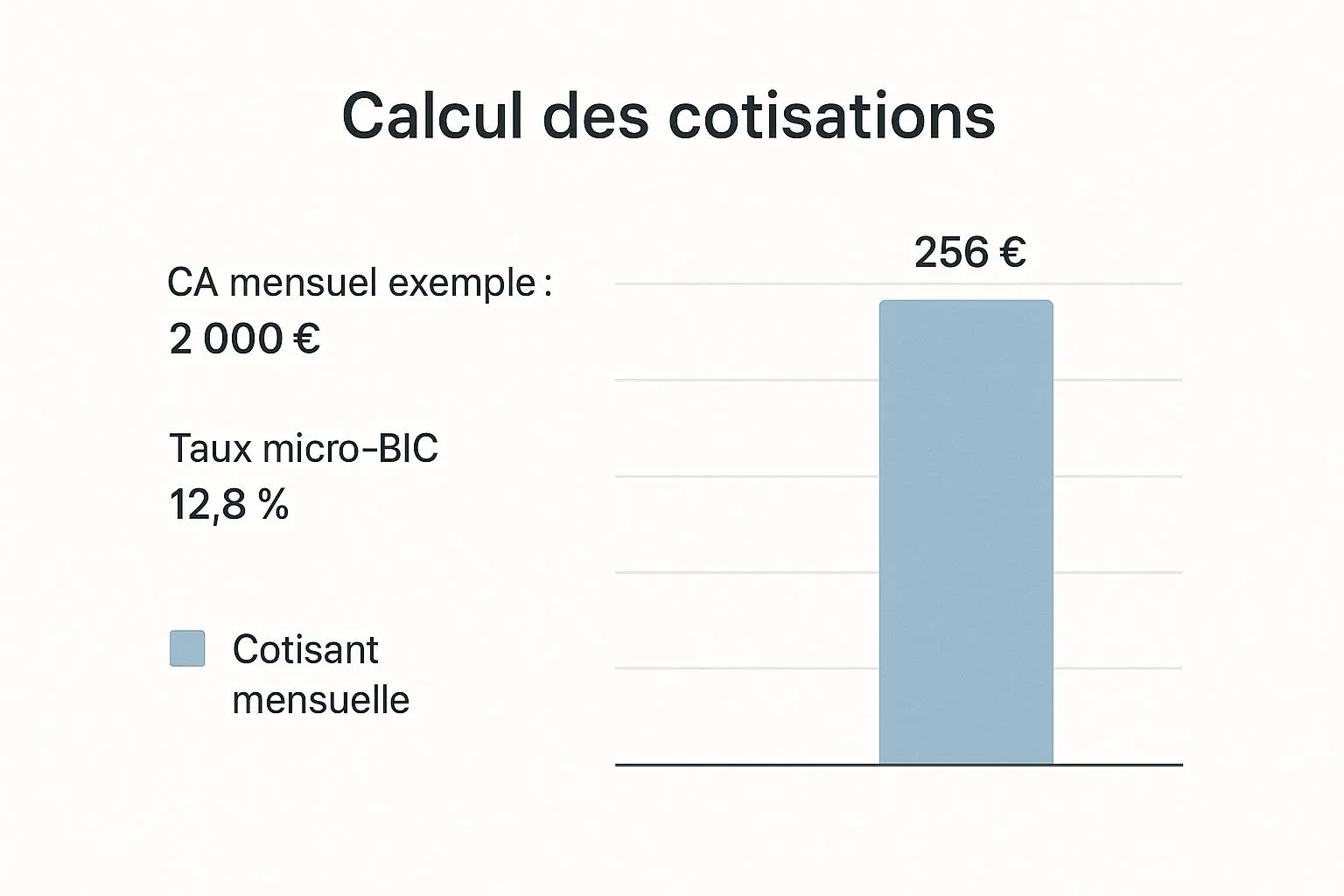
Pretty clear, right? For €2,000 worth of products sold, our sole trader pays €246 in contributions (not €256 as sometimes stated by mistake, since the rate is 12.3%). They’re left with €1,754 in their pocket, before even thinking about income tax.
Table of social contribution rates by activity
To make everything perfectly clear, here’s a small table summarizing the rates. Keep it handy, it will always come in useful.
| Nature of activity | Category (BIC/BNC) | Social contribution rate |
|---|---|---|
| Sale of goods, catering, accommodation | BIC | 12.3% |
| Commercial and craft service provision | BIC | 21.2% |
| Liberal professions (general regime) | BNC | 21.2% |
| Liberal professions (CIPAV) | BNC | 21.1% |
This simplicity is truly one of the status’s biggest advantages. It lets you calculate your net income at a glance and set fair rates so your business is profitable from day one.
Navigating revenue thresholds and VAT management
The sole trader status is very appealing for its simplicity, that’s a fact. But for the adventure to stay simple, it’s crucial to know the rules of the game well, particularly the revenue thresholds.
Specifically, you need to juggle two distinct thresholds: the base threshold and the increased threshold (sometimes called the tolerance threshold). Keeping these figures in mind is key to setting your rates and avoiding any administrative surprises.
Let’s take a closer look.
- The base threshold: This is the main limit. If you stay below it, you benefit from the VAT exemption scheme. Simple and effective.
- The increased threshold: This gives you a bit of leeway. You can exceed the base threshold for one year without immediately switching to VAT, but be careful, the tax authorities will be watching you.
- The switch to VAT: Unavoidable if you exceed the increased threshold. From that point on, new obligations apply to you.
Understanding the difference between the base threshold and the increased threshold
The base threshold is the official cap that lets you avoid charging VAT to your clients. It’s what often makes your rates more competitive at the start.
The increased threshold acts as a kind of safety net. It allows you to exceed the first threshold for one year, without having to apply VAT immediately. It’s a reprieve, but one that needs to be managed carefully.
Thanks to this VAT exemption scheme, the thresholds are currently:
- €85,800 (base threshold) and €94,300 (increased threshold) for the sale of goods.
- €34,400 (base threshold) and €36,800 (increased threshold) for service provision.
If you want to dig deeper into the topic, you’ll find additional information in this guide on sole trader income.
Anticipating the switch to VAT
When your revenue starts flirting with the increased threshold, it’s time to switch into vigilance mode. Anticipation is your best weapon.
This means closely tracking your incoming payments, month by month, so you’re not caught off guard by the switchover.
“Forecasting your revenue closely is your best ally for switching to VAT without stress.”
Here’s a small roadmap to help you prepare:
- Run simulations. Use online tools or a simple spreadsheet to project your revenue over the coming months.
- Communicate with your clients. Let them know in advance that your rates will soon include VAT. Transparency is always appreciated.
- Adapt your invoicing. Tools like Bizyness can be set up to automatically handle this change and generate compliant invoices.
Bizyness, for instance, can alert you as you approach the thresholds and handle issuing your new invoices with VAT included.
Why is this monitoring so important?
Keeping a close eye on your thresholds isn’t just an administrative constraint, it’s a genuine act of business management. It lets you stay compliant and avoid penalties that can really hurt.
But that’s not all. It’s also a way to:
- Avoid a surprise tax reassessment.
- Protect your margins by preparing for the switch to VAT.
- Manage your cash flow more calmly and plan your investments.
A few practical cases to make it clearer
Let’s imagine a freelance graphic designer. Their revenue for year N-1 was €35,000. So they’re VAT-exempt. In year N, their business takes off and they reach €38,000 in October.
- Month 1 (October): Their revenue reaches €38,000. They’ve exceeded the increased threshold of €36,800. A tool like Bizyness sends them an alert.
- Month 2 (November): From the first day of this month, they must charge VAT. Their prices need to be revised to include the 20%.
- Month 3 (December): They file their first VAT return and can start deducting the VAT paid on their own business purchases (software, equipment, etc.).
For an e-commerce seller, the mechanism is the same, but with higher thresholds. If they make €95,000 in sales over the year, they switch to the standard VAT regime from the first day of the month they exceed the threshold.
The main challenge is managing cash flow well to set aside the VAT collected, since it will need to be paid back to the state.
By anticipating these scenarios, the switch to VAT is no longer an obstacle, but a natural step in the growth of your business. With good planning, what looks like a tax constraint becomes a well-managed growth lever.
Choosing your tax regime to optimize your taxes
Taxation of your micro-business isn’t set in stone. It’s above all a strategic choice that can seriously affect what’s left at the end of the month. As a sole trader, you have two main routes for paying your taxes: the standard regime (called micro-fiscal), which applies by default, and a very specific option: the flat-rate withholding of income tax (versement libératoire).
Imagine you have a choice between a set menu and à la carte. The set menu (the standard regime) is simple, direct, and applies to everyone. The à la carte option (flat-rate withholding) can be much more advantageous, but on one condition only: that it’s perfectly suited to your personal situation.
The standard micro-fiscal regime: the default solution
This is the basic system, the one that applies if you don’t do anything special. It works fairly simply: the tax authorities start from your annual revenue and apply a flat-rate allowance to estimate your business expenses.
This allowance varies depending on your activity:
- 71% for the purchase and resale of goods.
- 50% for commercial service provision (BIC).
- 34% for liberal professions (BNC).
What’s left after this allowance is your taxable income. It’s added to the other income of your tax household (salaries, etc.), and the total is subject to the progressive tax scale. The advantage? If your household ends up not being taxable, you simply pay no tax at all on your business income.
Flat-rate withholding: an option worth examining closely
Flat-rate withholding completely changes the game. No more waiting for the annual tax return and the potentially hefty tax bill that can come with it. With this option, you pay your tax as you go, at the same time as your social contributions, each month or quarter.
A small percentage is deducted directly from the revenue you collect. This rate is added on top of your usual social contributions:
- +1% for the sale of goods.
- +1.7% for service provision (BIC).
- +2.2% for liberal professions (BNC).
The major advantage of flat-rate withholding is its simplicity and predictability. You pay a little bit each time, and it’s settled. No bad surprises at year-end, your tax is paid as you go, as you collect revenue.
Be careful, this option isn’t available to everyone. To be eligible, your reference tax income from year N-2 must not exceed a certain threshold. For example, for a single person choosing the option in 2024, that income must not have exceeded €27,478 in 2022.
So, when should you opt for flat-rate withholding?
The answer depends entirely on your overall tax situation, not just your revenue. Flat-rate withholding becomes really worthwhile if the standard progressive scale puts you in a high tax bracket, such as 30% or more. In that case, paying a small fixed percentage of your revenue is much more cost-effective.
Conversely, if you’re not taxable or you’re in the lowest bracket at 11%, the standard regime is often the smarter choice. Why? Because with flat-rate withholding, you systematically pay tax, even when you might have owed nothing under the default system. It’s a bit like paying for a service you don’t need.
To dig deeper into the topic, our guide on tax optimization for sole traders will give you more advanced strategies.
The best reflex to adopt? Run the numbers. Take your projected revenue, your family situation, and calculate what you’d pay under both options. It’s the only way to know for certain which option will best protect your cash flow.
Now let’s move from theory to practice. It’s good to know the rates on paper, but what really matters is knowing what’s left in your pocket at the end of the month. Understanding how to go from your invoiced revenue to your actual income is key to setting rates that let you make a living from your business.
It’s not rocket science, promise. The calculation simply involves subtracting, one after another, the various charges from what you’ve invoiced. Think of your revenue as a cake fresh out of the oven: each deduction is a slice you have to hand out before you can eat your own.
From your revenue to your disposable income
The starting point is always the total amount you collect from your clients. That’s your gross revenue. From there, we start subtracting.
Here are the steps to follow to see things clearly:
- Gross revenue: This is the total amount you’ve invoiced and collected.
- Subtract social contributions: Apply the percentage that matches your sector (for example, 21.2% if you’re providing liberal services).
- Subtract tax (if you’re on flat-rate withholding): If you chose this option, deduct the corresponding rate (such as 2.2% for liberal professions).
- Don’t forget the small taxes: Remember the Vocational Training Contribution (CFP, from 0.1% to 0.3%) and, for tradespeople and shopkeepers, the chamber of commerce/trade tax.
What’s left after all that is your net income before paying your own operating costs. To find your “real” income, the one you can actually use for personal expenses, you still need to deduct your business expenses: software subscriptions, professional insurance, small equipment, etc. If you need a hand with this part, our guide to setting your hourly rate as a sole trader will give you some very concrete examples.
Simulation for a freelance consultant
Let’s take a concrete example to make things clearer. Imagine a marketing consultant (liberal BNC activity) who invoiced €3,000 this month. They chose the flat-rate tax withholding option.
- Revenue: €3,000
- Social contributions (21.2%): - €636
- Flat-rate tax withholding (2.2%): - €66
- CFP (0.2%): - €6
Net income before expenses: €3,000 - €636 - €66 - €6 = €2,292. That’s the amount that actually lands in their bank account.
Now, if this consultant has around €200 in business expenses per month (software, professional liability insurance…), their final disposable income is €2,092.
This exercise is truly fundamental. It helps you visualize the structure of your costs and adjust your rates to make sure you reach your goals. Also remember to keep an eye on revenue thresholds in your forecasts. As a reminder, for the 2023-2025 period, the thresholds were revised upward, rising to €188,700 for purchase-resale and €77,700 for service provision. You can find all the details on these thresholds on Bpifrance Création’s website.
Monthly net income simulation for €3,000 revenue
To further illustrate the impact of rates and tax options, let’s compare what’s left for a consultant and a tradesperson with the same revenue of €3,000 per month. You’ll see that the type of activity and tax regime change everything!
| Expense/income item | Liberal consultant (BNC) | Tradesperson (BIC Services) |
|---|---|---|
| Monthly revenue | €3,000 | €3,000 |
| Social contributions | €636 (21.2%) | €660 (22%) |
| Flat-rate withholding | €66 (2.2%) | €51 (1.7%) |
| Training contribution (CFP) | €6 (0.2%) | €9 (0.3%) |
| Total charges and taxes | €708 | €720 |
| Net income before expenses | €2,292 | €2,280 |
| Estimated business expenses | €200 | €400 |
| Final disposable income | €2,092 | €1,880 |
As you can see, even with identical revenue, final income can vary significantly. Business expenses (often higher for a tradesperson who may need equipment and travel) play a crucial role in calculating actually disposable income.
Your frequently asked questions about sole trader pricing
Starting out as a sole trader brings its share of questions, especially when it comes to rates and charges. That’s completely normal. To help you see things more clearly, we’ve gathered the most common questions here and answer them simply and directly.
What happens if my revenue is zero euros?
This is one of the biggest advantages of the micro-business regime, and an essential point that makes it so reassuring to get started. The golden rule is simple: zero revenue = zero contribution.
Specifically, if for a month or a quarter you don’t invoice anything, you have absolutely no social charges to pay. Of course, you still need to file your revenue declaration with URSSAF, but you’ll just need to enter “€0”. It’s a genuine safety net, letting you test an idea without taking on financial risk.
Can I deduct my business expenses?
The answer is no, and it’s a crucial point to understand well. Unlike a standard company, as a micro-business you can’t deduct your actual expenses (equipment purchases, software, travel costs, etc.) from your declared revenue.
To make up for this, the tax authorities apply a flat-rate allowance to your revenue before calculating your tax (if you haven’t opted for flat-rate withholding). This allowance is:
- 71% for the sale of goods.
- 50% for commercial and craft service provision (BIC).
- 34% for liberal professions (BNC).
Your job, as an entrepreneur, is therefore to factor all your expenses (raw materials, subscriptions, insurance…) directly into your rate calculations. It’s the only way to make sure you cover your costs and turn a profit.
How does the ACRE benefit work?
ACRE (business creation or takeover assistance) is a genuine boost to ease your charges at the start. If you’re eligible, this benefit gives you a partial exemption from your social contributions during your first year.
In practice, your contribution rates are reduced by 50%. For example, a liberal-activity consultant, who normally contributes at 21.2%, will see their rate drop to just 10.6% during the ACRE period. This benefit ends at the end of the 3rd calendar quarter following the start of your business. It’s a significant boost of breathing room for your cash flow when starting out.
How do I declare my taxes with my sole trader income?
The income tax return is filed each year, in spring, at the same time as the rest of your household’s income. You’ll need to fill out a supplementary return, form 2042-C PRO.
You’ll enter your gross annual revenue there, meaning without applying the allowance yourself. The tax authorities will handle that automatically to determine your taxable income. For a detailed step-by-step, take a look at our full guide on filing taxes as a sole trader.
Each answer to these questions brings you a bit closer to managing your business with peace of mind. Mastering these rules well is the key to running your micro-business with confidence and efficiency.
