

 Français
Sole Trader Rates in France: A Complete, Up-to-Date Guide
Discover everything about French sole trader (micro-entrepreneur) rates, including contributions, taxation and hidden costs. Optimize your status with our essential guide!
Understanding sole trader (micro-entrepreneur) rates is above all a matter of simplicity. The basic idea is that your charges are a fixed percentage of what you actually collect. The golden rule is simple and reassuring: no revenue, no contributions to pay. That’s what makes this status so accessible.
Decoding micro-entreprise rates and thresholds
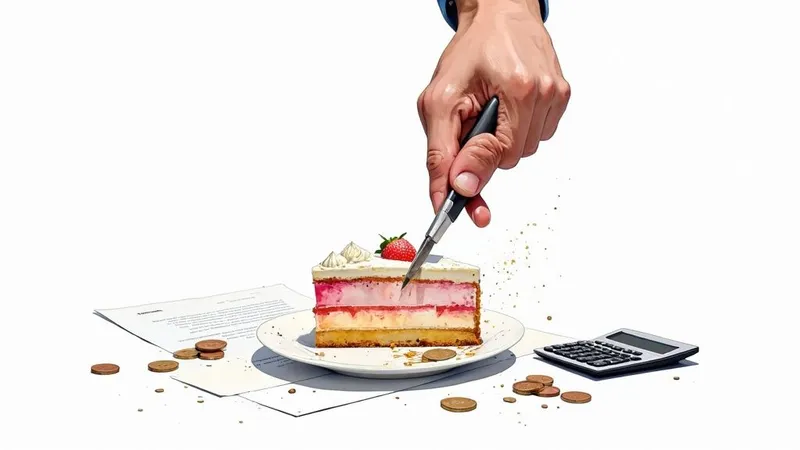
The word “rate” can sound a bit scary, but in the world of the micro-entreprise, it rhymes with clarity. Think of your revenue as a cake. For every slice you sell (every euro you collect), URSSAF takes a small, always identical portion. This system is great because your charges perfectly match the reality of your activity.
That’s a huge difference from other legal statuses where fixed charges fall due every month, whether or not you have clients. As a micro-entrepreneur, if a month is quieter, your charges drop proportionally. This flexibility is a real breath of fresh air, especially when starting out, because it significantly limits financial risk.
Social contribution rates: a different percentage for every trade
Your main charge is that famous social contribution rate. Watch out, it isn’t unique! It varies depending on the exact nature of your activity. It’s therefore crucial to know which category you fall into so you can apply the right percentage and avoid unpleasant surprises.
Here are the three main families of activities:
- Sale of goods (BIC): simple — you buy to resell. This also includes catering or accommodation services such as gîtes.
- Commercial and craft services (BIC): this covers all manual trades (plumber, mobile hairdresser…) and certain commercial activities such as real estate agents.
- Professional/liberal activities (BNC): this category groups more intellectual or technical services. It includes consultants, web developers, but also regulated professions such as psychologists who choose this status.
The percentage you pay funds your entire social protection: health and maternity insurance, basic and supplementary pension, family allowances, etc.

Understanding these rates well is the key to managing your cash flow. They tell you exactly what share of every euro invoiced stays in your pocket.
To make things easy, here’s a table summarizing the essentials.
Key contribution rates and revenue thresholds
This table summarizes the current social contribution percentages and the annual revenue thresholds to watch for your micro-entreprise.
| Activity category | Social contribution rate | Pre-tax revenue threshold |
|---|---|---|
| Sale of goods (BIC) | 12.3% | €188,700 |
| Services (BIC) | 21.2% | €77,700 |
| Liberal activities (BNC) | 21.1% | €77,700 |
Keep these figures in mind: they are the foundation of managing your micro-entreprise and let you forecast your charges at a glance.
Demystifying the calculation of your social contributions
The real strength of the micro-entrepreneur status is the simplicity of calculating your charges. But what exactly does this percentage deducted from your revenue correspond to? Far from being an abstract tax, it directly funds your own social protection.
Every euro you pay in actually feeds a common pool that secures you on several fronts. Think of it as an all-in-one package that covers:
- Your health and maternity insurance.
- Your daily allowances in case of sick leave.
- Your pension rights (basic and supplementary schemes).
- Family allowances and other contributions such as the CSG and CRDS.
Proportionality, the secret to healthy cash flow
One of the biggest advantages of the system is that it’s proportional. Your charges always correspond to a fixed percentage of what you collect. This is a major difference from the “classic” self-employed status, where contributions are often calculated on a flat-rate basis or on the previous year’s income, which can create cold sweats and major cash flow mismatches.
With this mechanism, there’s no stress during quieter months. If your revenue is €0, your social contributions amount to €0. It’s as simple as that. This flexibility is a real breath of fresh air, especially when starting out, because it lets you launch without being immediately crushed by fixed costs.
This simplified approach also offers a notable financial advantage. For example, craftspeople under the micro-entreprise scheme benefit from a much more attractive overall social contribution rate than those under the classic scheme. The gap can represent several percentage points, a difference that is directly felt in net income at the end of the month. If you’re interested in the topic, you’ll find more details in this French Senate report.
The principle to remember is simple: your contributions work for you. They aren’t just a tax, but an investment in your own safety net, calculated fairly and predictably.
Grasping this logic is the first step toward running your business with peace of mind.
Easily anticipating your net income
Mastering this calculation gives you a superpower: knowing almost instantly your disposable income after social contributions.
Let’s take a concrete example. You’re a consultant (liberal activity) with a rate of 21.1%. You’ve just invoiced a mission for €1,000 excluding VAT. At a glance, you know that €211 will go toward social contributions.
You’ll be left with €789 in your pocket, before even thinking about income tax. This immediate visibility is a valuable tool for setting your rates, assessing a project’s profitability, and managing your personal budget. It’s the key to avoiding unpleasant surprises and building a business that lasts.
Choosing the right tax option to optimize your charges

When we talk about sole trader rates, we often think of social contributions. That’s true, they represent a significant share of the charges. But that’s only part of the equation. The other component, just as crucial for knowing what you truly keep, is income tax.
For this, two paths are open to you, each with its own calculation logic.
The first is the default scheme, known as the micro-fiscal regime. It’s fairly simple: the tax authorities apply a flat-rate deduction to your revenue to estimate your professional expenses. The remaining amount is then added to your household’s other income, and the whole is subject to the standard tax scale.
The other path is an option you choose deliberately: the final withholding tax payment (versement fiscal libératoire, or VFL). Its name may sound a bit off-putting, but its principle is actually very clear. It’s a sort of all-in-one withholding that lets you pay your income tax at the same time as your social contributions.
The classic regime vs. the final withholding option: head to head
With the VFL, a small percentage is added directly to your usual contribution rate. In practice, you pay your tax as you go, with each revenue declaration. Once this payment is made, the state considers you settled for income tax on your sole trader earnings. Done.
Here are the VFL rates added on top of your social contributions:
- 1% for the sale of goods.
- 1.7% for commercial and craft services (BIC).
- 2.2% for liberal activities (BNC).
Beware, this option isn’t open to everyone. Your reference taxable income from year N-2 must not exceed a certain threshold. And even if you’re eligible, it isn’t always the best choice. Imagine you’re not taxable at all: with the VFL, you’d pay tax you wouldn’t normally owe!
The choice between the micro-fiscal regime and the VFL is purely strategic. It depends on your family situation, your revenue, and your household’s other income. A decision made lightly can easily cost you several hundred euros a year.
So, which option is more profitable for you?
How do you decide? Running a simulation remains the best method. But to get a first idea, simply compare your marginal tax bracket rate (TMI) with the applicable VFL rate.
If your marginal tax rate is 11% or 30%, for example, chances are the VFL will come out ahead. Paying 1.7% or 2.2% instead of 11% or more — the math is quick.
Conversely, if you’re not taxable (0% marginal rate), the classic regime is without a doubt the better solution. Why pay tax, even a small amount, if you don’t owe any?
To be sure you’re making the right decision, it’s essential to fully grasp all the implications of this option. Don’t hesitate to check our complete guide to find out whether the final withholding tax option for sole traders is really right for you. Your choice will have a direct impact on your business’s profitability.
Putting the numbers into perspective with concrete examples
After the theory, let’s move to practice! Percentages are all well and good, but nothing beats concrete cases to really visualize the impact of charges on what’s left at the end of the month. Let’s break down three sole trader profiles together to see, in hard cash, how it plays out.
These simulations will turn somewhat abstract figures into a tangible financial reality. The idea is to help you better anticipate your cash flow and, of course, set fair rates.
Practical case 1: a freelance web developer
Let’s start with Antoine. He’s a web developer, a liberal activity (BNC category). His social contribution rate is set at 21.1%. This month, he’s worked hard and just collected €3,000 in revenue.
The calculation of his contributions is very simple: €3,000 x 21.1% = €633
What’s left before tax is therefore €3,000 - €633, or €2,367.
Now imagine Antoine chose the final withholding tax option (VFL). The tax rate of 2.2% must then be added. His total deduction climbs to 23.3% (21.1% + 2.2%). The total amount taken from his revenue will be €3,000 x 23.3% = €699. He’ll be left with €2,301 net in his pocket.
Practical case 2: a self-employed mason
Now let’s look at Claire, a craftswoman working in masonry. Her activity is a craft service (BIC), giving her a contribution rate of 21.2%. After wrapping up a big job, she collects an invoice for €4,000.
The calculation of her social charges is as follows: €4,000 x 21.2% = €848
Her disposable income, before thinking about taxes, comes to €4,000 - €848 = €3,152.
If Claire also opted for the VFL (with a rate of 1.7% for her activity), her overall deduction rises to 22.9%. Her total charges are then €4,000 x 22.9% = €916. In the end, she’ll keep €3,084 net.
These little calculations are the basis of your financial management. By mastering them, you know precisely what you earn on each job. This is essential for judging the profitability of your work and building quotes that hold up.
To help you visualize the key information, this infographic summarizes the main revenue thresholds and contribution rates.
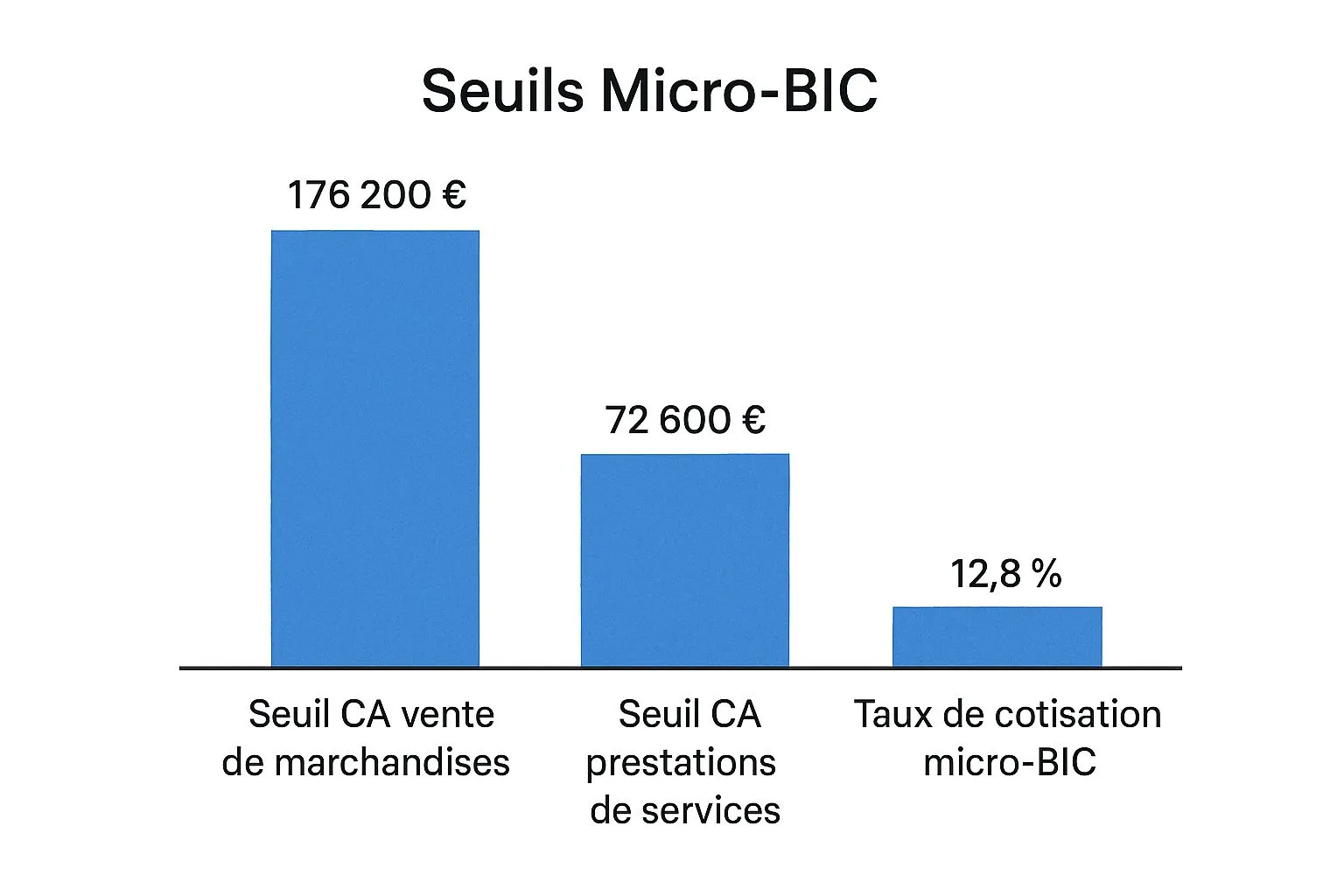
What matters is the significant difference between the thresholds for the sale of goods and those for services. This is a crucial point to keep an eye on for the future of your micro-entreprise.
Practical case 3: a marketplace seller
Finally, let’s look at Léo. He makes handcrafted items that he sells online. This is therefore a sale-of-goods activity (BIC), with a much lower contribution rate: 12.3%. This month, his sales brought in €1,500.
The calculation of his contributions is quick: €1,500 x 12.3% = €184.50
His income before tax is €1,315.50.
With the VFL (with a rate of 1% for sales), his total deduction is 13.3%. The overall amount of his charges will be €1,500 x 13.3% = €199.50, leaving him with a final net income of €1,300.50.
To highlight these differences, let’s imagine our three sole traders all generate revenue of €2,000 this month and have all opted for the VFL.
Simulation of monthly deductions for €2,000 in revenue
| Activity profile | Social rate | Tax rate (VFL) | Total monthly deductions |
|---|---|---|---|
| Web developer (liberal) | 21.1% | 2.2% | €466 (23.3%) |
| Self-employed mason (craft) | 21.2% | 1.7% | €458 (22.9%) |
| Online seller (commercial) | 12.3% | 1.0% | €266 (13.3%) |
This table clearly shows that, for the same revenue, the amount of charges varies enormously depending on the nature of the activity.
As you can see, estimating your income is ultimately fairly simple. Once your revenue is collected and your charges calculated, don’t forget to provide a proper invoice to your client. If you need a hand, feel free to check our sample invoices for sole traders which will guide you step by step.
What other fees and taxes should you plan for?
When thinking about a sole trader’s charges, we often focus on social contributions and income tax. That makes sense, they are the most significant. But to have a complete picture and avoid unpleasant surprises, you also need to look at a few other fees and taxes that add to the total.
These are essential elements to know in order to properly manage your business. Even if they’re less frequent or smaller, they’re part of running a micro-entreprise and deserve your full attention.
First on the list is the Cotisation Foncière des Entreprises (CFE), a local business property tax. It’s a local tax that almost all businesses, including micro-entreprises, must pay. Whether you have a dedicated office or work from a corner of your living room, you’re subject to it.
Its amount can vary wildly from one municipality to another. Why? Because it’s calculated based on the rental value of the property you use for your professional activity. The good news is that you benefit from a full CFE exemption for your first calendar year of activity. To take advantage of this, it’s crucial to properly fill out the initial declaration (the famous form 1447-C-SD) that you’ll receive by mail.
The vocational training contribution (CFP)
Next comes a small mandatory charge, deducted at the same time as your social contributions: the Contribution à la Formation Professionnelle (CFP), or vocational training contribution. It’s a modest contribution, but a valuable one, since it gives you access to continuing education rights. An excellent way to build your skills throughout your entrepreneurial journey.
The rate for this contribution is very low, but it depends on the nature of your activity:
- 0.10% for merchants and non-regulated liberal professions.
- 0.30% for craftspeople, a bit higher.
- 0.20% for regulated liberal professions.
Even if the amount may seem negligible, it funds an essential right to stay relevant in your market. Don’t forget to also factor in other operating costs, such as professional insurance or bank fees. By the way, if you use your car for work, our complete guide on calculating mileage expenses for sole traders will be very useful for estimating these costs accurately.
Having a 360-degree view of all your costs, even the smallest, is what sets professional management apart from amateur management. It’s the key to setting fair prices and guaranteeing your profitability.
The special case of VAT
Let’s finish with a major topic: VAT. As a sole trader, you start by default under a very advantageous scheme called “VAT exemption” (franchise en base de TVA). In practice, this means you don’t charge VAT to your clients, and therefore you don’t reclaim it on your purchases either. This is a huge administrative simplification that significantly lightens your day-to-day management.
But be careful, this scheme isn’t unlimited. If your revenue crosses certain thresholds, you switch to the standard VAT regime. These thresholds are €91,900 for the sale of goods and €36,800 for services.
From that point on, you’ll need to add VAT to your invoices, declare it periodically, and remit it to the state. This is a pivotal step in the growth of a micro-entreprise. While it brings new accounting obligations, it also lets you reclaim VAT on your own business expenses, which can prove beneficial. The key word is anticipation: keep an eye on your revenue to adjust your rates and organization without being caught off guard.
Understanding the evolution of the status to run your business better

To fully understand how sole trader rates work today, it helps to look back a bit. When the status was created in 2009, the idea was simple: allow anyone to launch a small side activity, without paperwork and without headaches.
The original philosophy was clear: you collect, you pay charges. You collect nothing, you pay nothing. A real little revolution for its time, which allowed many people to test an idea without risk. The only downside was that income thresholds were fairly low, which inevitably limited the scope of projects.
A major turning point for entrepreneurs
Everything changed in 2018, when revenue thresholds were doubled. This change completely reshuffled the deck. Overnight, the micro-entreprise was no longer just a way to make ends meet; it became a genuine springboard for launching and growing a main business activity.
This new flexibility opened the door to much more ambitious projects, making the status the number one choice for thousands of business founders.
Thanks to this evolution, the micro-entreprise went from a side-income status to the main driver of individual business creation in France.
This transformation explains why this model is such a success. The year 2021 shattered all records, with the creation of 641,500 new micro-entreprises. To put that in perspective, that represents more than 64% of all sole proprietorships launched that year. If these figures interest you, you can check the detailed business creation statistics.
Keeping in mind that this status was designed for simplicity and then adapted for growth will help you understand its inner workings much better. This will help you navigate its rules more confidently and optimize your charges to help your project take off.
Your questions about sole trader charges, answered
Starting out as a sole trader is great, but you quickly find yourself with a thousand questions about charges and taxes. That’s normal! Let’s untangle the most common points together so you can run your business with peace of mind.
The first question on everyone’s lips: “What if I earn nothing, do I still pay something?” The answer is a resounding no. That’s the whole beauty of the status: if you don’t collect any revenue, you pay absolutely no contributions. Zero euros.
Specifically, how are my charges calculated?
It’s very simple: your charges always correspond to a fixed percentage of what you actually collected. Not what you invoiced, but the money that actually arrived in your account. This rate simply varies depending on your type of activity.
- Let’s take an example: imagine your rate is 21.1%. If you collect €100 from a client, you’ll set aside €21.10 for URSSAF.
This system is designed to be fair and to follow the pace of your activity. In good months, you contribute more. In quieter months, your charges automatically decrease, without you having to do anything.
Can I deduct my expenses (computer, fuel, etc.)?
No, and this is an essential point to understand about the micro-entreprise. Unlike a standard company, you cannot deduct your actual expenses to reduce your charges.
To compensate, the tax authorities assume you have expenses and apply a flat-rate deduction directly to your revenue. This is what makes management so simple and justifies the relatively low contribution rates.
This deduction depends on what you do:
- 71% if you sell goods.
- 50% if you’re a craftsperson or offer commercial services (BIC).
- 34% for liberal activities (BNC).
It’s your revenue, once this deduction is applied, that serves as the basis for calculating your income tax (unless you’ve chosen the final withholding option, of course).
What happens if my revenue takes off and I exceed the thresholds?
If your revenue exceeds the allowed thresholds for two consecutive years, you lose the benefit of the micro-entreprise scheme. Don’t panic, your business doesn’t stop, but it automatically switches to the “classic” sole proprietorship regime.
The main difference is that accounting becomes more complex and your obligations change. That’s why it’s really important to keep an eye on your revenue throughout the year.
Juggling these calculations and declarations can quickly become a source of stress. What if you focused instead on what you love doing — your craft? With a tool like Bizyness, you can automate your invoicing and declarations in just a few clicks. Discover how Bizyness can simplify your daily life.
